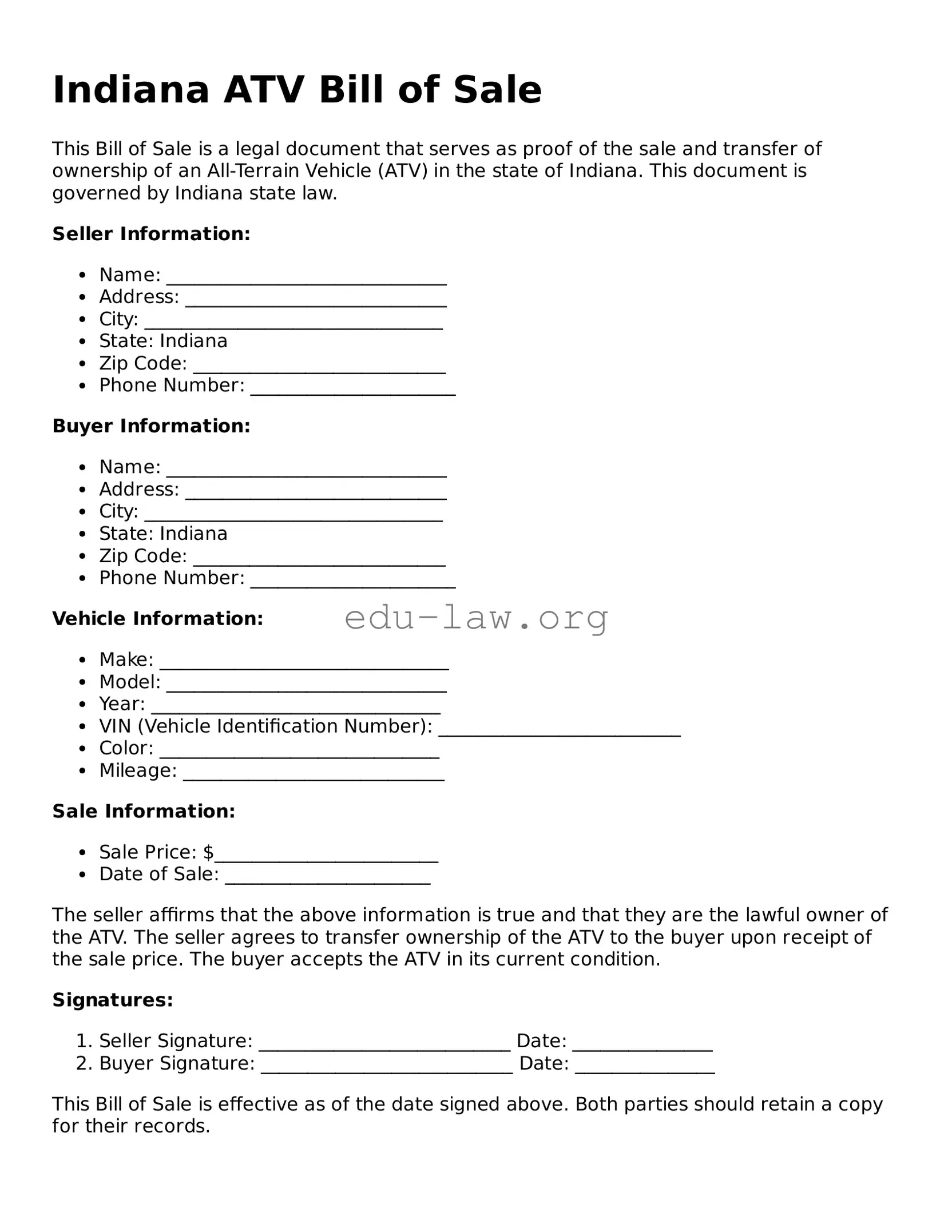
When buying or selling an all-terrain vehicle (ATV) in Indiana, having a properly completed Bill of Sale is essential for both parties involved in the transaction. This document serves as proof of ownership transfer, detailing important information such as the names and addresses of the buyer and seller, the vehicle identification number (VIN), and the make and model of the ATV. Additionally, it often includes the sale price and the date of the transaction, ensuring clarity and transparency. By using an ATV Bill of Sale form, both the buyer and seller can protect their interests, as it provides a legal record that can be referenced in case of future disputes. Furthermore, this form may be required when registering the ATV with the Indiana Bureau of Motor Vehicles, making it a critical component of the purchasing process. Understanding the nuances of this document can help facilitate a smooth transaction, ensuring that both parties are informed and compliant with state regulations.
Indiana ATV Bill of Sale
This Bill of Sale is a legal document that serves as proof of the sale and transfer of ownership of an All-Terrain Vehicle (ATV) in the state of Indiana. This document is governed by Indiana state law.
Seller Information:
Buyer Information:
Vehicle Information:
Sale Information:
The seller affirms that the above information is true and that they are the lawful owner of the ATV. The seller agrees to transfer ownership of the ATV to the buyer upon receipt of the sale price. The buyer accepts the ATV in its current condition.
Signatures:
This Bill of Sale is effective as of the date signed above. Both parties should retain a copy for their records.
| Fact Name | Description |
|---|---|
| Purpose | The Indiana ATV Bill of Sale form is used to document the sale and transfer of ownership of an all-terrain vehicle (ATV) in Indiana. |
| Governing Law | This form is governed by Indiana Code Title 9, Article 27, which pertains to off-road vehicles. |
| Required Information | Buyers and sellers must provide their names, addresses, and signatures, along with details about the ATV, including make, model, year, and VIN. |
| Notarization | While notarization is not mandatory, it is recommended to enhance the document's authenticity and protect against disputes. |
| Tax Implications | Sales tax may be applicable on the transaction, and both parties should be aware of their tax obligations upon sale. |
| Record Keeping | Both the buyer and seller should keep a copy of the completed Bill of Sale for their records, as it serves as proof of the transaction. |
After you have gathered the necessary information, you can begin filling out the Indiana ATV Bill of Sale form. This document is important for transferring ownership and should be completed carefully to ensure all details are accurate.
Once you have completed the form, keep a copy for your records. The buyer will need this document to register the ATV in their name. Make sure all information is clear and legible to avoid any issues during the registration process.
What is an Indiana ATV Bill of Sale form?
An Indiana ATV Bill of Sale form is a legal document used to record the sale and transfer of ownership of an all-terrain vehicle (ATV) in the state of Indiana. This form provides essential information about the transaction, including the buyer's and seller's details, the ATV's description, and the sale price. It serves as proof of ownership and can be useful for registration purposes.
Why is a Bill of Sale important for an ATV transaction?
A Bill of Sale is important because it establishes a clear record of the transaction between the buyer and seller. It protects both parties by documenting the sale details, which can help resolve disputes if they arise in the future. Additionally, having a Bill of Sale is often required when registering the ATV with the Indiana Bureau of Motor Vehicles (BMV).
What information is required on the Indiana ATV Bill of Sale form?
The form typically requires the following information: the seller's name and address, the buyer's name and address, a detailed description of the ATV (including make, model, year, and Vehicle Identification Number), the sale price, and the date of the transaction. Both parties should sign the document to validate the sale.
Do I need to have the Bill of Sale notarized?
In Indiana, notarization of the Bill of Sale is not a legal requirement. However, having the document notarized can provide an additional layer of security and authenticity, which may be beneficial if there are any disputes in the future. It is often recommended to consult with local regulations or seek legal advice if unsure.
Can I use a generic Bill of Sale form for my ATV transaction?
While a generic Bill of Sale form may be used, it is advisable to use a specific Indiana ATV Bill of Sale form. This ensures that all necessary information is included and complies with state regulations. Using a state-specific form helps avoid potential issues during the registration process.
What should I do after completing the Bill of Sale?
After completing the Bill of Sale, both the buyer and seller should keep a copy for their records. The seller should provide the buyer with the original document, as it may be required for registration at the Indiana BMV. The buyer should also ensure that the ATV is registered in their name to avoid any legal complications.
Where can I obtain an Indiana ATV Bill of Sale form?
An Indiana ATV Bill of Sale form can be obtained from various sources, including online legal form providers, local DMV offices, or through legal stationery stores. It is important to ensure that the form you use is current and complies with Indiana state laws.
Incomplete Information: Many individuals fail to fill out all required fields. Missing details such as the seller's name, buyer's name, or vehicle identification number (VIN) can lead to complications.
Incorrect VIN: The VIN must be accurate and match the vehicle. A simple typo can cause issues during registration or transfer of ownership.
Failure to Sign: Both the seller and buyer must sign the form. Without signatures, the document is not valid and cannot be used to prove the sale.
Omitting Date of Sale: The date when the transaction occurs is crucial. Leaving this blank can create confusion regarding the transfer of ownership.
Not Providing Payment Details: It is important to include the sale price or payment terms. This information helps clarify the nature of the transaction.
Ignoring State Requirements: Each state may have specific requirements for ATV sales. Ignoring these can lead to legal issues or difficulties in registration.
When purchasing or selling an ATV in Indiana, several forms and documents can complement the ATV Bill of Sale. These documents help ensure a smooth transaction and provide necessary information for both parties involved. Below is a list of commonly used forms that you may need.
Having these documents ready can simplify the buying and selling process. Each form plays a role in ensuring that both parties are protected and that the transaction is legally sound. Always check for the latest requirements and forms specific to your situation.
The Indiana Boat Bill of Sale serves a similar purpose as the ATV Bill of Sale. Both documents are used to transfer ownership of a recreational vehicle, ensuring that the seller formally relinquishes their rights while the buyer receives proof of ownership. Each bill of sale includes essential details such as the buyer's and seller's names, the vehicle's description, and the sale price. This document is crucial for registering the boat with state authorities, just as the ATV bill is necessary for ATV registration.
The Indiana Motorcycle Bill of Sale also parallels the ATV Bill of Sale in its function. It documents the sale and transfer of ownership of a motorcycle, providing a legal record of the transaction. Like the ATV bill, it requires specific information about the motorcycle and the parties involved. This document helps protect both the buyer and seller by detailing the terms of the sale, including any warranties or conditions attached to the motorcycle.
The Indiana Car Bill of Sale is another document that shares similarities with the ATV Bill of Sale. Both forms serve to finalize the sale of a motor vehicle, whether it be an ATV or a car. They include similar components, such as vehicle identification numbers, odometer readings, and the parties' signatures. This document is essential for the buyer to register the car with the state, just as the ATV bill is necessary for ATV registration.
The Indiana Trailer Bill of Sale functions similarly to the ATV Bill of Sale. It provides a legal record of the sale and transfer of ownership for a trailer, outlining the terms of the sale. Both documents require detailed information about the vehicle being sold and the parties involved. This helps ensure that the buyer can register the trailer and that the seller is protected from future claims regarding the vehicle.
The Indiana Snowmobile Bill of Sale is comparable to the ATV Bill of Sale in that it facilitates the transfer of ownership of a snowmobile. Both documents require similar information, including the buyer's and seller's details, a description of the vehicle, and the sale price. This document is vital for the buyer to register the snowmobile and for the seller to establish proof of the transaction.
The Indiana Personal Watercraft Bill of Sale mirrors the ATV Bill of Sale in its purpose of documenting the sale of a personal watercraft. It includes essential information about the buyer, seller, and the watercraft itself. Both documents serve to protect the interests of both parties and are necessary for registration with the state, ensuring that ownership is clearly established.
The Indiana Golf Cart Bill of Sale is another document that resembles the ATV Bill of Sale. It serves to formalize the sale of a golf cart, providing a record of the transaction. Both documents require similar details, such as the vehicle's description and the parties' information. This documentation is crucial for the buyer to register the golf cart and for the seller to have proof of the sale.
Lastly, the Indiana Off-Road Vehicle Bill of Sale shares similarities with the ATV Bill of Sale. This document is used for the transfer of ownership of off-road vehicles, which can include ATVs. It includes the same essential components, such as buyer and seller information, vehicle details, and the sale price. Like the ATV bill, this document is important for registration and helps protect both parties involved in the transaction.
When filling out the Indiana ATV Bill of Sale form, it's important to ensure that all information is accurate and complete. Here are some helpful tips on what to do and what to avoid:
By following these guidelines, you can help ensure a smooth transaction for both parties involved.
When it comes to the Indiana ATV Bill of Sale form, several misconceptions can lead to confusion for both buyers and sellers. Understanding the truth behind these myths can help ensure a smooth transaction. Here are nine common misconceptions:
The Bill of Sale is not necessary for ATV transactions. Many believe that a Bill of Sale is optional, but it serves as a crucial record of the transaction, providing proof of ownership and details of the sale.
Any generic Bill of Sale will suffice. While a generic form may seem convenient, it’s important to use the specific Indiana ATV Bill of Sale to ensure compliance with state laws and requirements.
Only the seller needs to sign the Bill of Sale. Both the buyer and seller should sign the document. This mutual agreement solidifies the transaction and protects both parties.
The Bill of Sale does not need to be notarized. Although notarization is not always required, having the document notarized can add an extra layer of authenticity and security to the transaction.
Once the Bill of Sale is signed, the transaction is complete. Completing the sale also involves transferring the title and registering the ATV with the Indiana Bureau of Motor Vehicles (BMV).
The Bill of Sale is only for new ATVs. This form is applicable for both new and used ATVs. It provides a record of the sale regardless of the vehicle's age.
There are no specific requirements for what must be included in the Bill of Sale. The form should include essential details such as the names of both parties, a description of the ATV, the sale price, and the date of the transaction.
Buyers do not need a copy of the Bill of Sale. Buyers should always keep a copy for their records. This document may be needed for future registration or proof of ownership.
Only individuals can buy or sell ATVs. Businesses can also engage in the sale of ATVs, and they too must complete the Bill of Sale to ensure proper documentation.
By clearing up these misconceptions, both buyers and sellers can approach their ATV transactions with greater confidence and clarity.
When dealing with the Indiana ATV Bill of Sale form, understanding its components and requirements is essential. Here are key takeaways to consider:
By following these key points, both buyers and sellers can navigate the process of completing the Indiana ATV Bill of Sale form effectively.