The Indiana Articles of Incorporation form serves as a crucial document for individuals or groups looking to establish a corporation in the state. This form outlines essential details about the new business entity, such as its name, duration, and purpose. Additionally, it requires information about the registered agent, who acts as the official point of contact for legal matters. The form also asks for the names and addresses of the initial directors, providing transparency regarding the governance of the corporation. Furthermore, it includes provisions for the distribution of shares, which is vital for understanding ownership structure. Completing this form accurately is important, as it not only initiates the legal recognition of the corporation but also ensures compliance with state regulations. By addressing these key components, the Articles of Incorporation form lays the foundation for a corporation's operations and legal standing in Indiana.
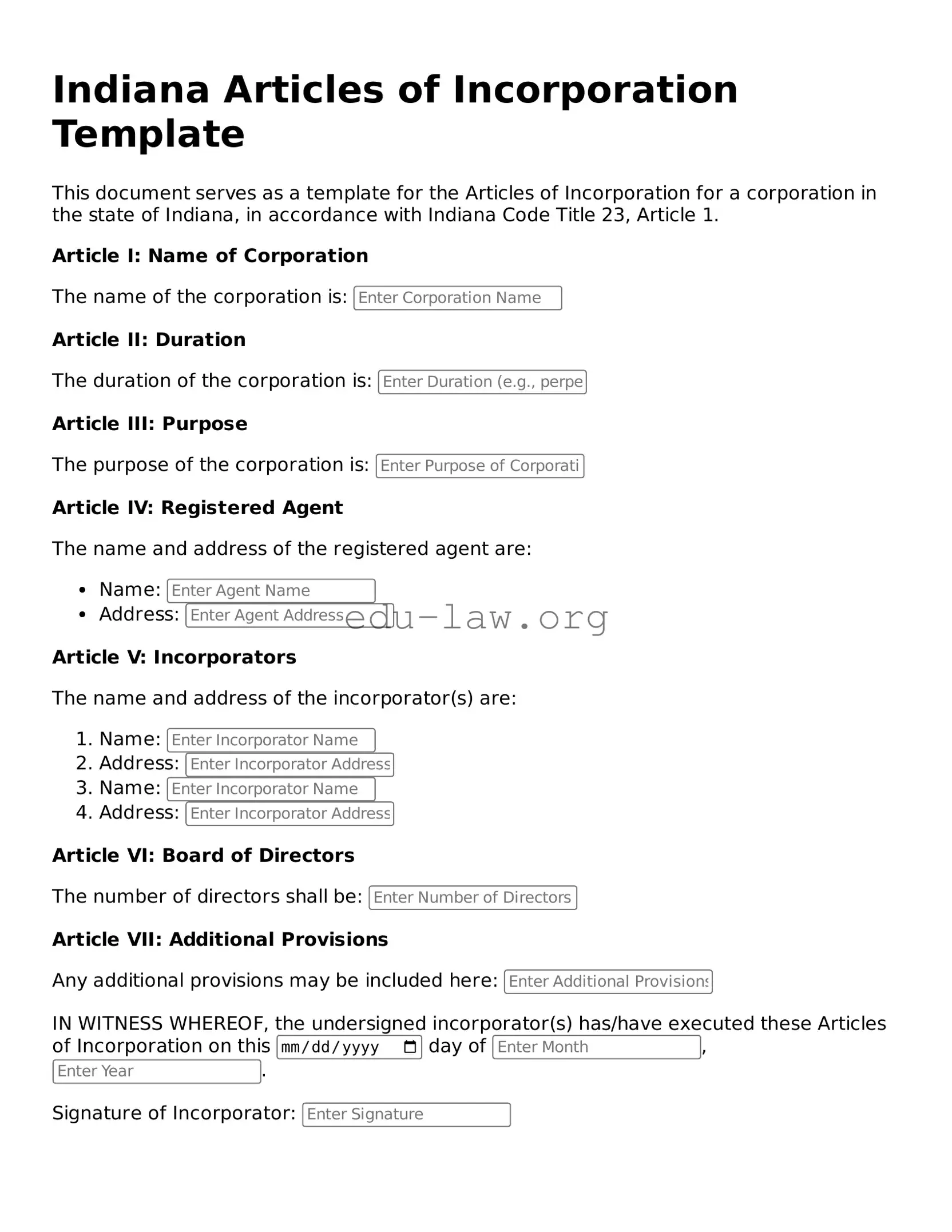
Indiana Articles of Incorporation Template
This document serves as a template for the Articles of Incorporation for a corporation in the state of Indiana, in accordance with Indiana Code Title 23, Article 1.
Article I: Name of Corporation
The name of the corporation is:
Article II: Duration
The duration of the corporation is:
Article III: Purpose
The purpose of the corporation is:
Article IV: Registered Agent
The name and address of the registered agent are:
Article V: Incorporators
The name and address of the incorporator(s) are:
Article VI: Board of Directors
The number of directors shall be:
Article VII: Additional Provisions
Any additional provisions may be included here:
IN WITNESS WHEREOF, the undersigned incorporator(s) has/have executed these Articles of Incorporation on this day of , .
Signature of Incorporator:
| Fact Name | Details |
|---|---|
| Governing Law | The Indiana Articles of Incorporation are governed by the Indiana Business Corporation Law, specifically Indiana Code Title 23, Article 1. |
| Purpose of Form | This form is used to officially create a corporation in the state of Indiana. |
| Filing Requirement | Filing the Articles of Incorporation with the Indiana Secretary of State is mandatory to establish a corporation. |
| Information Needed | The form requires information such as the corporation's name, registered agent, and business address. |
| Filing Fee | A filing fee is required when submitting the Articles of Incorporation. As of October 2023, the fee is $90 for standard processing. |
| Processing Time | The processing time for the Articles of Incorporation can vary, but typically takes around 5 to 10 business days. |
After you have gathered the necessary information, you are ready to fill out the Indiana Articles of Incorporation form. Completing this form is a crucial step in establishing your business entity in the state. Ensure that you have all relevant details at hand to make the process smooth and efficient.
Once your Articles of Incorporation have been filed and accepted, you will receive confirmation from the state. This confirmation is an important document, as it officially establishes your corporation and allows you to move forward with your business operations.
What are the Articles of Incorporation in Indiana?
The Articles of Incorporation is a legal document that establishes a corporation in Indiana. It outlines essential information about the corporation, such as its name, purpose, registered agent, and the number of shares it is authorized to issue. This document must be filed with the Indiana Secretary of State to formally create the corporation and grant it legal status.
What information do I need to include in the Articles of Incorporation?
When completing the Articles of Incorporation form, you will need to provide several key pieces of information. This includes the corporation's name, which must be unique and distinguishable from other registered entities in Indiana. You will also need to specify the corporation's purpose, the address of its principal office, the name and address of the registered agent, and details about the corporation's stock structure, such as the number of shares and their par value, if applicable.
How do I file the Articles of Incorporation in Indiana?
Filing the Articles of Incorporation in Indiana can be done online or by mail. For online submissions, you can visit the Indiana Secretary of State’s website, where you can complete the form and pay the required filing fee electronically. If you prefer to file by mail, you can download the form, fill it out, and send it along with the payment to the appropriate address listed on the form. Be sure to keep a copy for your records.
What is the filing fee for the Articles of Incorporation in Indiana?
The filing fee for the Articles of Incorporation in Indiana varies depending on the type of corporation you are forming. As of the latest information, the fee is generally around $90 for a domestic corporation. Additional fees may apply if you choose expedited processing or if you are filing for a specific type of corporation, such as a nonprofit. Always check the Indiana Secretary of State’s website for the most current fee schedule.
What happens after I file the Articles of Incorporation?
Once the Articles of Incorporation are filed and approved, the corporation is officially created. You will receive a confirmation from the Secretary of State, which serves as proof of your corporation’s existence. After incorporation, it is important to comply with ongoing requirements, such as holding annual meetings, maintaining proper records, and filing annual reports to keep your corporation in good standing.
Failing to choose a unique name for the corporation. The name must not be similar to any existing businesses registered in Indiana.
Omitting the purpose of the corporation. It’s essential to clearly state the business activities the corporation will engage in.
Not including the registered agent’s information. This person or entity is responsible for receiving legal documents on behalf of the corporation.
Incorrectly filling out the number of authorized shares. Ensure that the number accurately reflects the corporation's structure.
Failing to provide the correct address for the principal office. This address must be a physical location, not a P.O. Box.
Neglecting to include the names and addresses of the incorporators. All individuals involved in the formation must be listed.
Not signing the form. The Articles of Incorporation must be signed by at least one incorporator to be valid.
Using the wrong form version. Always ensure you are using the most current version of the Articles of Incorporation form.
Failing to pay the required filing fee. Ensure that the payment is included with the submission to avoid delays.
Not reviewing the completed form before submission. Double-checking for errors can save time and prevent rejections.
When forming a corporation in Indiana, several documents accompany the Articles of Incorporation to ensure compliance with state requirements. Each of these documents plays a crucial role in establishing and maintaining the corporation's legal status. Below is a list of commonly used forms and documents.
Understanding these documents can help streamline the incorporation process and ensure compliance with Indiana's legal requirements. Properly preparing and submitting these forms will contribute to the successful establishment of a corporation.
The Certificate of Formation is a document used in many states, similar to the Articles of Incorporation. It serves to establish a corporation's existence and outlines basic information about the company, such as its name, address, and purpose. Like the Articles of Incorporation, the Certificate of Formation must be filed with the state government, typically the Secretary of State. Both documents require information about the corporation's registered agent and can include provisions regarding the management structure.
The Bylaws of a corporation are another related document. While the Articles of Incorporation establish the corporation's legal existence, the Bylaws outline the internal rules and procedures for governance. Bylaws cover topics such as the roles and responsibilities of directors and officers, meeting protocols, and voting procedures. Unlike the Articles, Bylaws are not filed with the state but are maintained internally by the corporation.
The Operating Agreement serves a similar purpose for limited liability companies (LLCs). This document outlines the management structure and operating procedures of the LLC. It details member roles, profit distribution, and decision-making processes. Like the Articles of Incorporation, the Operating Agreement is essential for establishing the legal framework of the entity but is specific to LLCs rather than corporations.
The Partnership Agreement is comparable for partnerships. This document outlines the terms of the partnership, including each partner's contributions, responsibilities, and profit-sharing arrangements. While the Articles of Incorporation focus on corporations, the Partnership Agreement addresses the unique needs of partnerships, providing a clear understanding of how the partnership will operate.
The Certificate of Good Standing is another document that shares similarities with the Articles of Incorporation. This certificate verifies that a corporation is legally registered and compliant with state requirements. It is often required for various business activities, such as applying for loans or entering contracts. Both documents serve to confirm the legitimacy of a business entity in the eyes of the law.
The Statement of Information, required in some states, is similar in that it provides updated information about a corporation. This document typically includes details about the corporation’s officers, directors, and registered agent. While the Articles of Incorporation provide initial information, the Statement of Information ensures that the state has current data about the corporation’s operations and management.
The Annual Report is another important document that corporations must file periodically. This report updates the state on the corporation’s financial status and any changes in management or structure. Similar to the Articles of Incorporation, the Annual Report is a legal requirement, but it focuses on ongoing compliance rather than the initial establishment of the corporation.
The Business License is a document that, while not identical, serves a similar purpose in legitimizing a business. This license is required by local or state authorities to operate legally within a specific jurisdiction. Like the Articles of Incorporation, obtaining a Business License is a necessary step in establishing a business, ensuring that it meets local regulations.
The Trademark Registration is another document that may relate to the Articles of Incorporation in terms of protecting a corporation’s brand. While the Articles establish the legal entity, Trademark Registration protects the corporation's intellectual property. Both documents contribute to the overall legal standing and recognition of a business in the marketplace.
Lastly, the Shareholder Agreement is comparable as it governs the relationship between the shareholders of a corporation. This document outlines the rights and obligations of shareholders, including voting rights and the process for transferring shares. While the Articles of Incorporation establish the corporation, the Shareholder Agreement provides clarity on the management of shareholder relations and corporate governance.
When filling out the Indiana Articles of Incorporation form, there are important guidelines to follow. Below are four do's and don'ts to consider.
Understanding the Indiana Articles of Incorporation form is crucial for anyone looking to start a business in the state. However, there are several misconceptions surrounding this important document. Here are six common misunderstandings:
By clarifying these misconceptions, individuals can better navigate the process of incorporating their business in Indiana.
Filling out and using the Indiana Articles of Incorporation form is a crucial step in establishing a business entity in the state. Here are some key takeaways to consider:
Taking these steps can help ensure a smoother process in establishing a corporation in Indiana.