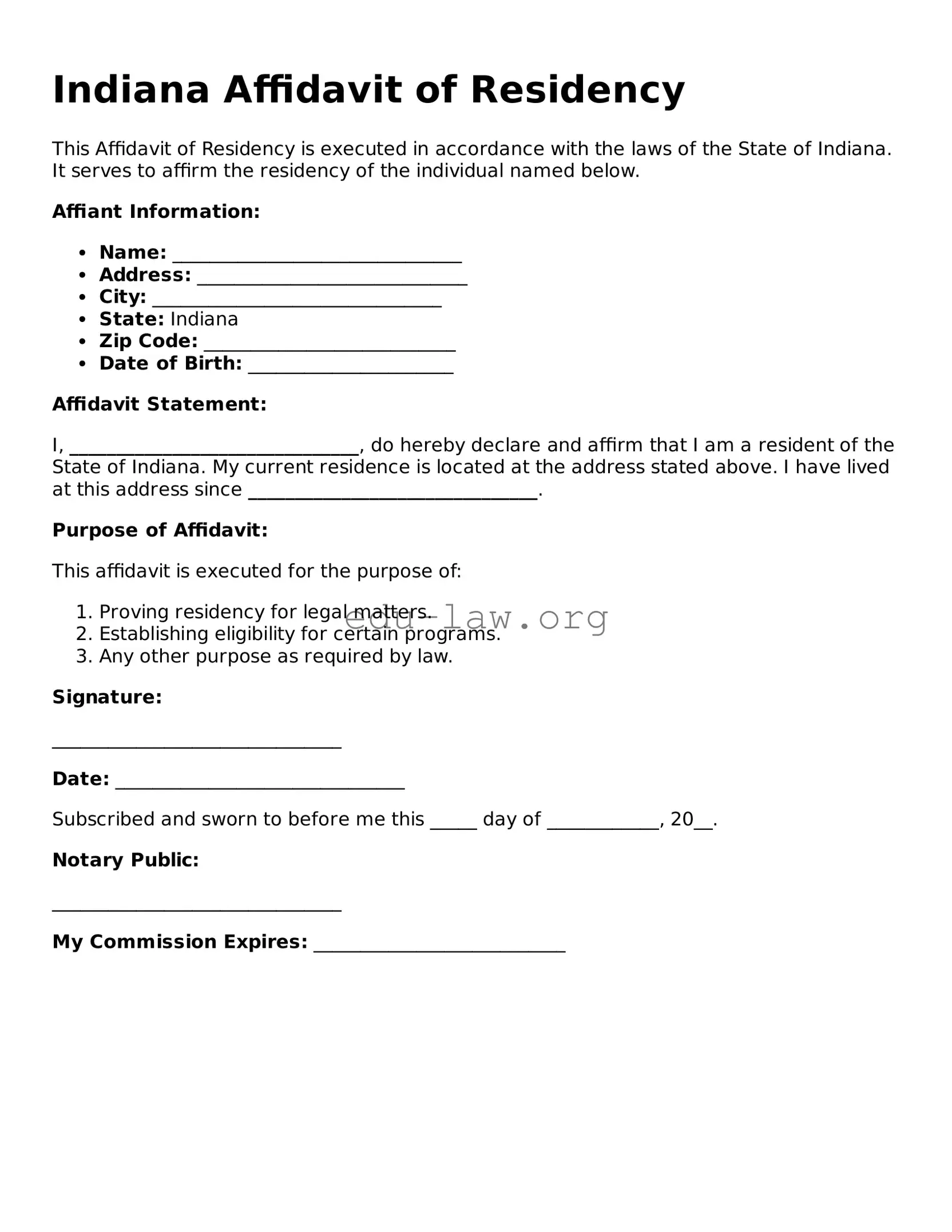
The Indiana Affidavit of Residency form serves as a vital document for individuals who need to verify their residence in the state of Indiana. This form is often used in various legal and administrative situations, such as enrolling children in school, applying for certain government benefits, or establishing residency for voting purposes. It typically requires the affiant, or the person making the statement, to provide personal details, including their name, address, and the duration of their residency. Additionally, the form may ask for supporting information, such as the names of household members or documentation that corroborates the claim of residency. Completing this affidavit accurately is essential, as it helps to ensure that the information provided is truthful and can be relied upon by institutions or authorities. Understanding the requirements and implications of the Indiana Affidavit of Residency form can make the process smoother for those who need it.
Indiana Affidavit of Residency
This Affidavit of Residency is executed in accordance with the laws of the State of Indiana. It serves to affirm the residency of the individual named below.
Affiant Information:
Affidavit Statement:
I, _______________________________, do hereby declare and affirm that I am a resident of the State of Indiana. My current residence is located at the address stated above. I have lived at this address since _______________________________.
Purpose of Affidavit:
This affidavit is executed for the purpose of:
Signature:
_______________________________
Date: _______________________________
Subscribed and sworn to before me this _____ day of ____________, 20__.
Notary Public:
_______________________________
My Commission Expires: ___________________________
| Fact Name | Details |
|---|---|
| Purpose | The Indiana Affidavit of Residency form is used to verify a person's residency status in the state of Indiana. |
| Governing Law | This form is governed by Indiana Code § 33-42-2-1. |
| Who Uses It | Individuals may need this form for legal proceedings, school enrollment, or other official purposes. |
| Notarization Requirement | The affidavit must be signed in front of a notary public to be considered valid. |
| Information Required | It typically requires the affiant's name, address, and a statement affirming their residency. |
| Submission | Once completed, the form should be submitted to the relevant authority or institution requiring it. |
| Validity | The affidavit remains valid as long as the residency information provided is accurate and up-to-date. |
| Penalties for False Information | Providing false information on the affidavit can lead to legal consequences, including potential charges of perjury. |
After gathering the necessary information, you are ready to complete the Indiana Affidavit of Residency form. This form is essential for verifying your residency status. Follow the steps below to fill it out correctly.
What is the Indiana Affidavit of Residency form?
The Indiana Affidavit of Residency form is a legal document used to verify a person's residence in the state of Indiana. It is often required for various purposes, such as enrolling a child in school or applying for certain government benefits. This form helps to establish proof of residency through a sworn statement.
Who needs to complete the Affidavit of Residency?
Individuals who need to confirm their residency in Indiana may be required to complete this form. Common scenarios include parents enrolling their children in public schools or individuals applying for state assistance programs. It is essential for anyone needing to provide proof of residence for legal or administrative reasons.
What information is required on the form?
The form typically requires the individual’s name, address, and the duration of residence at that address. Additionally, it may ask for identification details, such as a driver's license number or Social Security number. The individual must also provide a signature to affirm the truthfulness of the information provided.
How do I submit the Affidavit of Residency?
After completing the form, you will need to submit it to the relevant authority or organization that requested it. This could be a school district, government agency, or other entities. Be sure to check if they require a physical copy or if electronic submission is acceptable.
Is there a fee associated with the Affidavit of Residency?
Generally, there is no fee for completing the Affidavit of Residency form itself. However, certain organizations may charge fees for processing or related services. It is advisable to confirm with the specific entity requesting the form to understand any potential costs involved.
What should I do if my residency changes?
If your residency changes after submitting the affidavit, it is crucial to update the relevant parties. You may need to complete a new Affidavit of Residency form reflecting your new address. Keeping your information current helps to avoid any complications with enrollment or benefits.
Can someone help me fill out the form?
Yes, if you have questions or need assistance, you can seek help from a trusted friend, family member, or legal professional. They can guide you through the process and ensure that all required information is accurately provided. It’s important that the form is filled out correctly to avoid any issues.
Failing to provide accurate personal information. It is essential to include your full name, address, and date of birth. Omitting or misspelling these details can lead to delays or rejections.
Not signing the affidavit. A signature is required to validate the document. Without it, the affidavit may be considered incomplete.
Using incorrect or outdated information regarding residency. Ensure that the address listed is your current residence. Providing an old address can cause confusion and may affect your eligibility.
Neglecting to have the affidavit notarized. Many forms require notarization to confirm the authenticity of the signature. Failing to do so can render the affidavit invalid.
The Indiana Affidavit of Residency form is often accompanied by several other documents that help establish residency or support the information provided. Below is a list of common forms and documents that may be used alongside the affidavit.
Gathering these documents can streamline the process of verifying residency. Each piece of evidence contributes to a clearer picture of an individual's living situation and can help avoid potential issues down the line.
The Indiana Affidavit of Residency form shares similarities with the Affidavit of Support, commonly used in immigration processes. Both documents serve to affirm the truth of certain statements made by the signer. In the case of the Affidavit of Support, a sponsor must demonstrate their ability to financially support an immigrant. Similarly, the Indiana Affidavit of Residency requires the individual to confirm their residence, often for purposes such as school enrollment or legal identification. Both documents rely on the credibility of the signer's assertions and may require additional documentation to substantiate claims.
Another document that parallels the Indiana Affidavit of Residency is the Voter Registration Affidavit. This form is used to verify an individual's eligibility to vote based on their residency. Like the Indiana Affidavit, the Voter Registration Affidavit requires the individual to declare their residence and may necessitate proof of identity and address. Both documents play a crucial role in ensuring that individuals are accurately represented in civic processes, emphasizing the importance of residency in determining eligibility for certain rights and responsibilities.
The Declaration of Domicile is also akin to the Indiana Affidavit of Residency. This document is often used in legal contexts to establish an individual’s permanent residence in a particular state. While the Indiana Affidavit may focus on temporary residency for specific purposes, the Declaration of Domicile is more permanent in nature. Both documents require the signer to provide personal information and affirm their residency status, thereby serving as a formal declaration of where they consider their home to be.
In the realm of education, the Proof of Residency form is another document similar to the Indiana Affidavit of Residency. Schools often require this form to confirm that a student resides within a specific district. Much like the Indiana Affidavit, this document necessitates proof of residence, such as utility bills or lease agreements. Both forms serve the purpose of ensuring that students are enrolled in the appropriate educational institutions based on their actual living situations.
The Affidavit of Identity is also comparable to the Indiana Affidavit of Residency. This document is often used in various legal proceedings to verify a person’s identity. While the Indiana Affidavit focuses on where an individual lives, the Affidavit of Identity emphasizes who they are. Both documents are sworn statements, underscoring the importance of personal verification in legal contexts. They may require similar supporting documentation to validate the claims made by the signer.
The Certificate of Residence is another document that bears resemblance to the Indiana Affidavit of Residency. This certificate is often required for tax purposes, confirming an individual's residency in a particular jurisdiction. Like the Indiana Affidavit, it serves to establish residency for legal and administrative reasons. Both documents require the individual to provide evidence of their living situation and can be pivotal in determining obligations such as taxation or eligibility for local services.
Additionally, the Rental Agreement can be seen as a document that shares characteristics with the Indiana Affidavit of Residency. While it serves a different function, it often contains information that verifies a person's residency. A rental agreement outlines the terms of a lease and includes the tenant's name and address. Both documents affirm a person’s living situation, although the rental agreement is a contractual obligation, while the Indiana Affidavit is a sworn statement.
Lastly, the Residency Verification Form used in various government agencies is similar to the Indiana Affidavit of Residency. This form is often required when individuals apply for benefits or services that are dependent on residency status. Much like the Indiana Affidavit, it requires individuals to provide proof of where they live. Both documents aim to ensure that individuals receive the appropriate services based on their legitimate residency claims, highlighting the significance of residency verification in public policy.
When completing the Indiana Affidavit of Residency form, it is important to follow specific guidelines to ensure accuracy and compliance. Here’s a list of things you should and shouldn't do:
The Indiana Affidavit of Residency form is often misunderstood. Below are seven common misconceptions about this form, along with clarifications to help clear up any confusion.
While students frequently use the affidavit to establish residency for educational purposes, it is not limited to them. Any individual needing to prove their residency in Indiana can utilize this form.
Although notarization is a common practice for affidavits, the Indiana Affidavit of Residency does not require notarization to be valid. However, it is advisable to check specific requirements based on the intended use.
This form is not restricted to legal contexts. It can be used for various purposes, including applying for benefits, obtaining a driver's license, or registering to vote.
Submitting inaccurate information can lead to legal consequences. Honesty is crucial when completing the affidavit to avoid potential penalties.
Some individuals may need to submit the affidavit multiple times, especially if their residency status changes or if different agencies require updated documentation.
Renters and individuals living with family or friends can also complete the affidavit. Proof of residency can be established through various means, not solely through property ownership.
The process of completing the Indiana Affidavit of Residency is straightforward. Most individuals can fill it out without legal assistance, as long as they provide accurate information.
Understanding these misconceptions can help individuals navigate the residency verification process more effectively. It is important to approach the form with accurate information and a clear understanding of its purpose.
The Indiana Affidavit of Residency form is a legal document used to verify a person's residence in Indiana.
It is often required for various purposes, such as enrolling a child in school or obtaining a driver's license.
To complete the form, you must provide accurate information about your current address and the duration of your residency.
Both the affiant (the person completing the affidavit) and a witness must sign the document to validate it.
It is important to ensure that all information is truthful, as providing false information can lead to legal consequences.
Once completed, the affidavit may need to be notarized, depending on the requirements of the institution requesting it.
Keep a copy of the signed affidavit for your records, as you may need it for future reference.
Filing the affidavit with the appropriate agency or institution is crucial for it to serve its intended purpose.