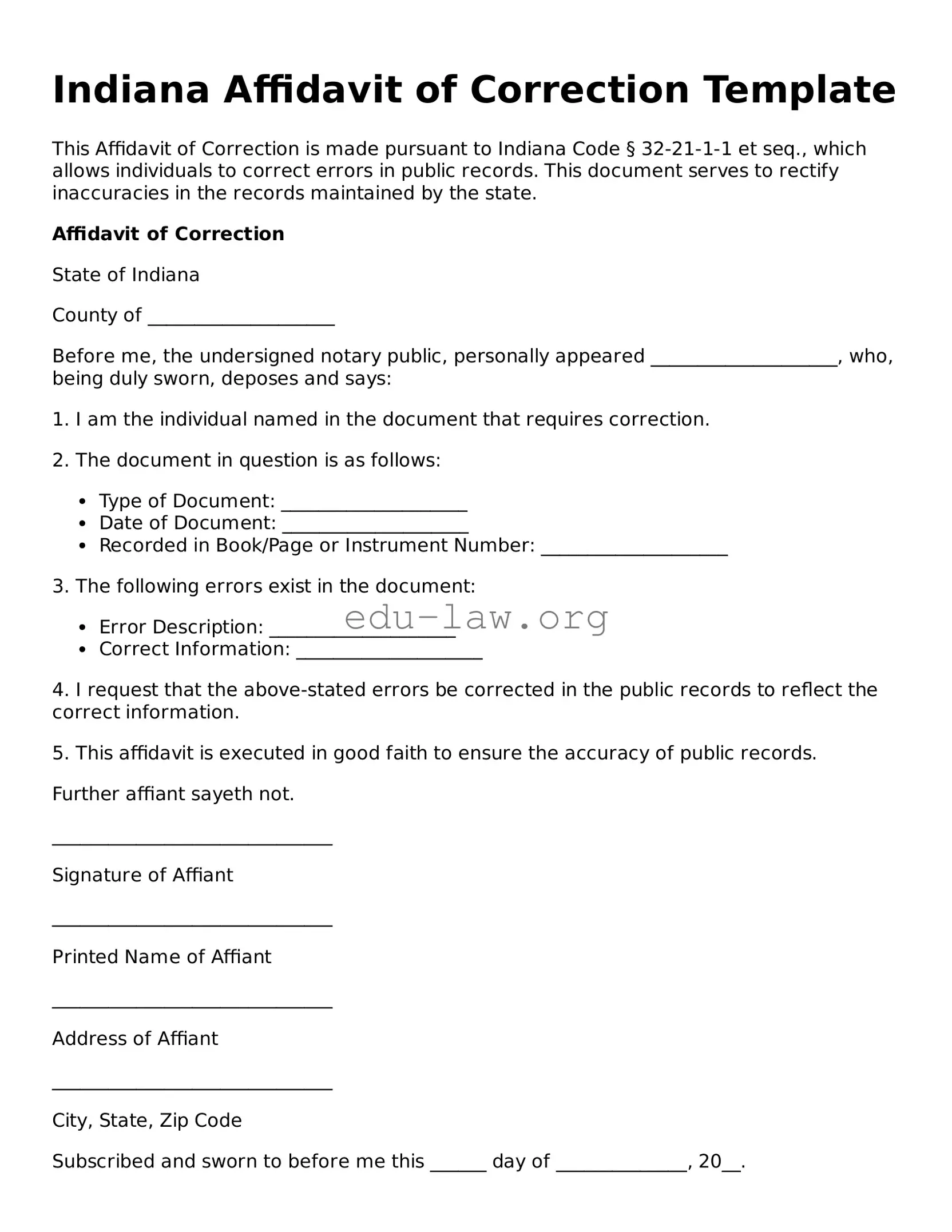
The Indiana Affidavit of Correction form serves as a valuable tool for individuals seeking to amend errors in public records. Whether it's a mistake in a name, date, or other critical details, this form provides a straightforward process to ensure that official documents accurately reflect the intended information. By completing this affidavit, you can clarify discrepancies that may arise in various records, such as property deeds, marriage licenses, or court documents. The form requires specific information, including the original document's details and a clear description of the correction needed. Once submitted, the affidavit can help prevent potential legal issues that might stem from inaccuracies. Understanding how to properly fill out and file this form is essential for anyone looking to maintain the integrity of their public records in Indiana.
Indiana Affidavit of Correction Template
This Affidavit of Correction is made pursuant to Indiana Code § 32-21-1-1 et seq., which allows individuals to correct errors in public records. This document serves to rectify inaccuracies in the records maintained by the state.
Affidavit of Correction
State of Indiana
County of ____________________
Before me, the undersigned notary public, personally appeared ____________________, who, being duly sworn, deposes and says:
1. I am the individual named in the document that requires correction.
2. The document in question is as follows:
3. The following errors exist in the document:
4. I request that the above-stated errors be corrected in the public records to reflect the correct information.
5. This affidavit is executed in good faith to ensure the accuracy of public records.
Further affiant sayeth not.
______________________________
Signature of Affiant
______________________________
Printed Name of Affiant
______________________________
Address of Affiant
______________________________
City, State, Zip Code
Subscribed and sworn to before me this ______ day of ______________, 20__.
______________________________
Notary Public
My Commission Expires: ________________
County of Residence: ____________________
| Fact Name | Details |
|---|---|
| Purpose | The Indiana Affidavit of Correction is used to correct clerical errors in public records. |
| Governing Law | This form is governed by Indiana Code § 36-2-9-12. |
| Eligibility | Any individual or entity that identifies an error in a recorded document may file this affidavit. |
| Common Errors | Errors often corrected include misspellings, incorrect dates, and inaccurate legal descriptions. |
| Filing Process | The affidavit must be filed with the county recorder where the original document was recorded. |
| Signature Requirement | The affidavit must be signed by the person who filed the original document or their authorized representative. |
| Cost | Filing fees may vary by county, so it is advisable to check with the local recorder’s office. |
| Record Keeping | Once filed, the affidavit becomes part of the public record and is accessible to anyone. |
After completing the Indiana Affidavit of Correction form, the next step involves submitting it to the appropriate office. This could be the county recorder or another designated agency, depending on the nature of the correction. Ensure all information is accurate and complete to avoid delays in processing.
What is the Indiana Affidavit of Correction form?
The Indiana Affidavit of Correction form is a legal document used to correct errors in public records. This form is typically utilized when there are inaccuracies in documents such as deeds, mortgages, or other official filings. The purpose of the affidavit is to clarify the correct information and ensure that public records accurately reflect the intended details.
Who can file an Affidavit of Correction in Indiana?
Any individual or entity that is affected by an error in a public record can file an Affidavit of Correction. This includes property owners, lenders, or anyone who has a vested interest in the document being corrected. It is important that the person filing the affidavit has the authority to do so and that they provide accurate information regarding the correction needed.
What information is required to complete the form?
To complete the Indiana Affidavit of Correction form, you will need to provide several key pieces of information. This includes the original document's details, such as the title, date of recording, and any specific errors that need correction. Additionally, the form requires the correct information that should replace the erroneous details. Signatures of the parties involved and notarization are also typically required to validate the affidavit.
Where should the Affidavit of Correction be filed?
The completed Affidavit of Correction must be filed with the same office where the original document was recorded. This is usually the county recorder's office in the county where the property is located. It is crucial to ensure that the affidavit is filed in the correct jurisdiction to effectively update the public records.
Is there a fee associated with filing the Affidavit of Correction?
Yes, there is usually a fee associated with filing the Indiana Affidavit of Correction. The amount may vary by county, so it is advisable to check with the local recorder's office for specific fee details. Payment methods and any additional requirements for filing should also be confirmed with the office.
What happens after the Affidavit of Correction is filed?
Once the Affidavit of Correction is filed and accepted by the county recorder's office, the corrections will be made to the public record. The updated information will be available for public viewing. It is recommended to obtain a copy of the corrected document for personal records. If there are any issues or further questions, contacting the recorder's office for clarification is advisable.
Failing to provide accurate information. Always double-check names, addresses, and dates. Errors can lead to delays or rejections.
Not signing the form. Ensure that all required signatures are included. A missing signature can invalidate the document.
Using incorrect dates. Make sure the date of the correction matches the date of the original document.
Neglecting to include supporting documents. If applicable, attach any necessary paperwork that validates the correction.
Overlooking the notary requirement. Most affidavits must be notarized. Ensure you have a notary public witness your signature.
Submitting the form to the wrong office. Verify the correct filing location to avoid unnecessary complications.
Using outdated forms. Always download the latest version of the Affidavit of Correction from the official website.
Ignoring deadlines. Be aware of any time limits for submitting corrections to ensure compliance.
Providing insufficient details about the error. Clearly explain what the mistake was and how it should be corrected.
Failing to keep copies. Always make copies of the completed form and any attachments for your records.
The Indiana Affidavit of Correction is a useful document for making amendments to previously filed documents. However, several other forms and documents often accompany it to ensure a smooth correction process. Below is a list of these related documents, each serving a specific purpose in the legal landscape.
These documents work together with the Indiana Affidavit of Correction to create a comprehensive approach to legal corrections. Understanding each form's role can help ensure that the correction process is efficient and legally sound.
The Indiana Affidavit of Correction is similar to the Affidavit of Identity. This document is used when an individual needs to confirm their identity for legal purposes. Both forms require a sworn statement and are often used to rectify errors in public records. The Affidavit of Identity helps establish a person’s true identity, while the Affidavit of Correction focuses on correcting specific inaccuracies in documents.
Another document comparable to the Indiana Affidavit of Correction is the Affidavit of Support. This form is typically used in immigration cases to show financial responsibility for a visa applicant. Both affidavits involve a sworn declaration and aim to provide clarity and accuracy in legal matters. However, the Affidavit of Support emphasizes financial obligations, whereas the Affidavit of Correction addresses errors in existing records.
The Indiana Affidavit of Correction also shares similarities with the Affidavit of Heirship. This document is often used in probate cases to establish the heirs of a deceased individual. Both forms require sworn statements and are used to clarify legal situations. The Affidavit of Heirship identifies rightful heirs, while the Affidavit of Correction addresses mistakes in legal documents.
The Affidavit of Change of Name is another document akin to the Indiana Affidavit of Correction. This affidavit is filed when an individual legally changes their name and seeks to update public records. Both documents require a formal declaration and serve to correct or update information. The Affidavit of Change of Name focuses on name alterations, while the Affidavit of Correction targets inaccuracies in various records.
The Indiana Affidavit of Correction can also be compared to the Affidavit of Service. This form is used to confirm that legal documents have been properly served to a party. Both affidavits involve sworn statements and provide necessary documentation for legal processes. The Affidavit of Service ensures that due process is followed, while the Affidavit of Correction aims to amend errors in existing records.
Another similar document is the Affidavit of Discrepancy. This affidavit is used when there are inconsistencies in records, such as discrepancies in financial statements. Both forms are sworn statements that seek to clarify and correct information. The Affidavit of Discrepancy addresses inconsistencies, while the Affidavit of Correction specifically targets errors in legal documents.
Lastly, the Indiana Affidavit of Correction is similar to the Affidavit of Truth. This document is often used to assert the truthfulness of statements made in legal proceedings. Both affidavits require a sworn declaration and aim to establish accuracy in legal matters. The Affidavit of Truth focuses on affirming the veracity of claims, while the Affidavit of Correction addresses specific errors in documentation.
When filling out the Indiana Affidavit of Correction form, it's important to follow specific guidelines to ensure your submission is accurate and effective. Here’s a list of things you should and shouldn’t do:
By following these guidelines, you can help ensure your Affidavit of Correction is processed smoothly and efficiently.
The Indiana Affidavit of Correction is a useful legal tool, but many people hold misconceptions about its purpose and use. Here are seven common misconceptions:
Many believe that the Affidavit of Correction can address any error in legal documents. However, it is specifically designed for correcting clerical mistakes, such as typographical errors or misstatements, rather than substantive changes.
Some individuals think that filing an Affidavit of Correction necessitates a court appearance. In fact, this form can usually be filed without the need for a hearing, making it a more straightforward process for correcting minor errors.
There is a misconception that submitting an Affidavit of Correction nullifies the original document. In reality, the affidavit serves to clarify and amend the original, maintaining its validity while correcting specific inaccuracies.
Some people think that only licensed attorneys can file an Affidavit of Correction. However, individuals can file this form on their own, provided they understand the requirements and process involved.
Many mistakenly believe that the affidavit allows for changes to the content or meaning of the original document. The Affidavit of Correction is limited to correcting factual errors and does not permit alterations to the substantive content.
Some may think that an Affidavit of Correction is merely a formality with no real legal implications. In fact, once filed, it has the same legal effect as the original document, with the corrections acknowledged and enforceable.
Finally, there is a belief that there are no time limitations on when an Affidavit of Correction can be filed. While there is generally no strict deadline, it is advisable to file corrections as soon as errors are discovered to avoid complications.
Understanding these misconceptions can help individuals navigate the process of using the Indiana Affidavit of Correction more effectively.
When filling out and using the Indiana Affidavit of Correction form, it is important to keep a few key points in mind. This form serves to correct errors in public records, and understanding its use can simplify the process significantly.