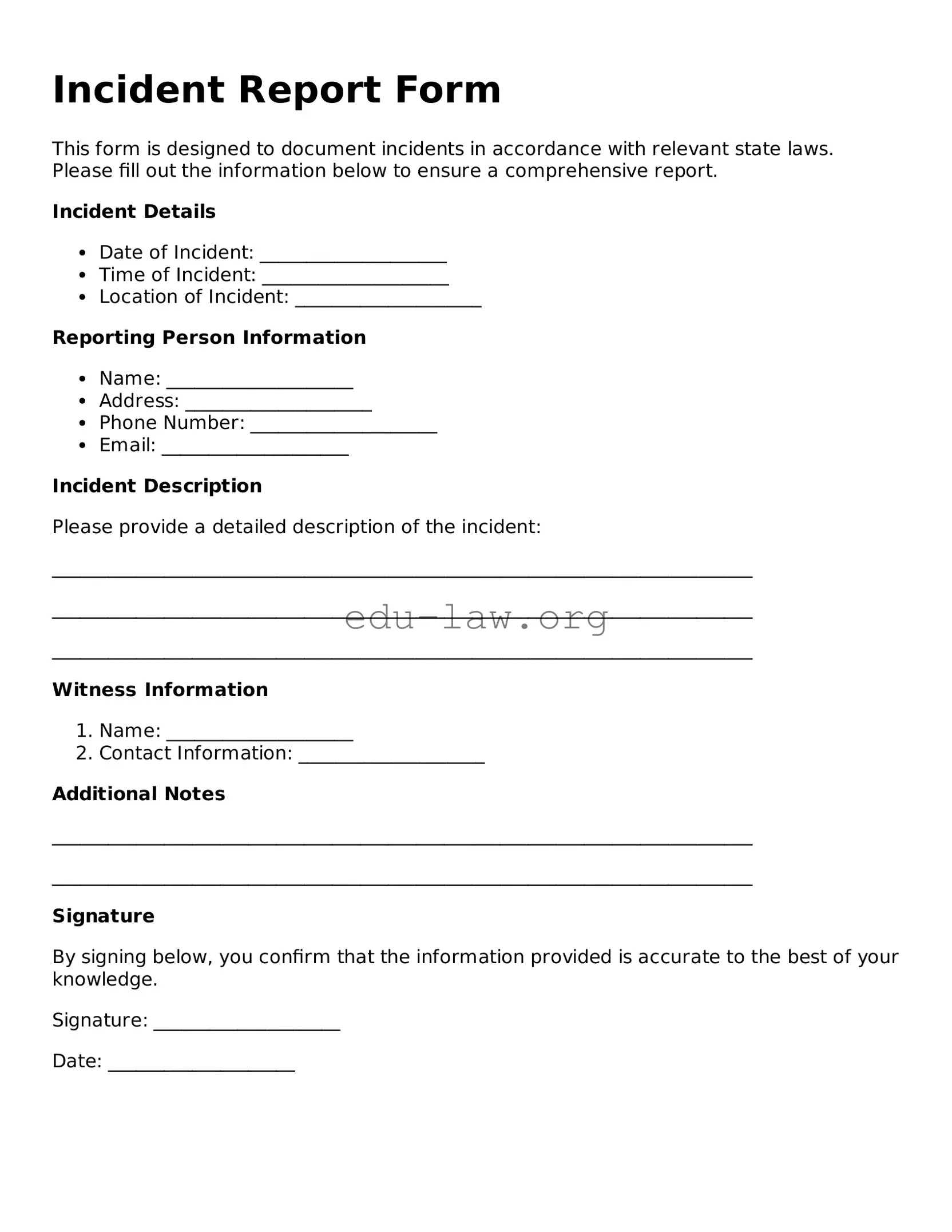
The Incident Report Form serves as a crucial tool for documenting events that require attention, whether they involve accidents, injuries, or other significant occurrences. Designed to capture essential details, this form typically includes sections for the date, time, and location of the incident, as well as the names of individuals involved and any witnesses present. Additionally, it prompts the reporter to describe the incident in detail, outlining the sequence of events leading up to the occurrence and any immediate actions taken in response. By providing a structured format for reporting, the form not only aids in the accurate collection of information but also supports organizations in identifying patterns, implementing safety measures, and ensuring compliance with legal requirements. Understanding how to effectively complete and utilize this form is vital for anyone involved in incident management, as it can significantly impact the resolution process and future preventative strategies.
Incident Report Form
This form is designed to document incidents in accordance with relevant state laws. Please fill out the information below to ensure a comprehensive report.
Incident Details
Reporting Person Information
Incident Description
Please provide a detailed description of the incident:
___________________________________________________________________________
___________________________________________________________________________
___________________________________________________________________________
Witness Information
Additional Notes
___________________________________________________________________________
___________________________________________________________________________
Signature
By signing below, you confirm that the information provided is accurate to the best of your knowledge.
Signature: ____________________
Date: ____________________
| Fact Name | Description |
|---|---|
| Purpose | The Incident Report Form is used to document details of an incident for record-keeping and legal purposes. |
| Who Uses It | This form is typically used by businesses, schools, and organizations to report accidents or incidents involving employees or visitors. |
| Information Required | Key information includes the date, time, location, individuals involved, and a detailed description of the incident. |
| State-Specific Forms | Many states have their own versions of the Incident Report Form, tailored to meet local regulations. |
| Governing Laws | In California, for example, the form is governed by the California Code of Regulations, Title 8, Section 342. |
| Confidentiality | Information on the form may be confidential and should be handled with care to protect personal data. |
| Submission Process | Completed forms are often submitted to a designated safety officer or human resources department for review. |
| Retention Period | Organizations are generally required to retain incident reports for a specified period, often several years. |
| Legal Implications | Accurate and timely completion of the form can be crucial in legal situations, as it may serve as evidence in disputes. |
Completing the Incident Report Form is an important step in documenting any incidents that may occur. Once the form is filled out, it will be submitted to the appropriate authorities for review and action.
What is an Incident Report Form?
An Incident Report Form is a document used to formally record details about an incident that has occurred. This can include accidents, injuries, or any unusual events that require documentation. The form captures essential information such as the date, time, location, individuals involved, and a description of what happened. Completing this form helps ensure that incidents are tracked and addressed appropriately.
Who should fill out the Incident Report Form?
The Incident Report Form should be filled out by anyone who witnesses or is involved in an incident. This can include employees, supervisors, or even visitors, depending on the situation. It is important for the person completing the form to provide accurate and detailed information to ensure a clear understanding of the incident.
When should the Incident Report Form be submitted?
What happens after the Incident Report Form is submitted?
Once the form is submitted, it is typically reviewed by a designated authority, such as a supervisor or safety officer. They will assess the information provided and determine if further investigation is needed. Depending on the findings, follow-up actions may include implementing safety measures, conducting training, or addressing any necessary disciplinary actions. The goal is to prevent future incidents and ensure a safe environment.
Failing to provide complete contact information. It is essential to include full names, addresses, and phone numbers for all parties involved.
Not detailing the incident accurately. A clear and concise description of what occurred helps in understanding the situation.
Omitting the date and time of the incident. This information is crucial for establishing a timeline.
Neglecting to identify witnesses. Including contact information for any witnesses can support the report.
Using vague language. Specific terms and descriptions enhance clarity and reduce ambiguity.
Forgetting to sign and date the report. A signature confirms the authenticity of the document.
Not reviewing the form for errors. Proofreading can catch mistakes that may lead to misunderstandings.
Submitting the report late. Timeliness is important for accurate record-keeping and response.
Ignoring the reporting guidelines. Each organization may have specific requirements for filling out the form.
When an incident occurs, it’s crucial to document the event thoroughly. The Incident Report Form is a key document in this process, but several other forms and documents often accompany it to ensure a comprehensive understanding of the situation. Below are some commonly used documents that complement the Incident Report Form.
Each of these documents plays a vital role in the incident reporting process. Together, they create a robust framework for understanding, addressing, and preventing future incidents, fostering a safer environment for everyone involved.
The Accident Report Form is quite similar to the Incident Report Form, as both documents serve the purpose of documenting unexpected events that result in injury or damage. An Accident Report typically focuses on incidents that occur in specific settings, such as workplaces or public areas, detailing the circumstances surrounding the accident, the individuals involved, and any immediate actions taken. This form helps organizations track safety issues and implement necessary changes to prevent future occurrences.
The Near Miss Report is another document that shares similarities with the Incident Report Form. While an incident report addresses actual events that caused harm, a near miss report captures situations where an incident almost occurred but did not result in injury or damage. This proactive approach allows organizations to identify potential hazards and take corrective actions before a serious incident happens, ultimately enhancing workplace safety.
The Claim Form is another document that aligns closely with the Incident Report Form. When an individual suffers an injury due to an incident, they may file a claim for compensation. The claim form typically requires details about the incident, including how it occurred, the extent of injuries, and any witnesses present. This information is essential for processing claims and ensuring that affected individuals receive the support they need.
The Witness Statement Form is also similar to the Incident Report Form, as it collects firsthand accounts from individuals who observed the incident. Witness statements provide valuable context and additional perspectives that can clarify what transpired during the event. These statements can be crucial in understanding the circumstances surrounding an incident and may play a significant role in investigations or legal proceedings.
The Investigation Report shares characteristics with the Incident Report Form in that it provides a detailed analysis of an incident after it has occurred. This document typically includes findings from an investigation, outlining the causes of the incident, contributing factors, and recommendations for preventing similar occurrences in the future. An investigation report aims to improve safety practices and ensure accountability within an organization.
Finally, the Emergency Response Report is similar to the Incident Report Form in that it documents actions taken during an emergency situation. This report outlines the response to an incident, including the steps taken to address the situation, the individuals involved, and any outcomes. By analyzing emergency responses, organizations can refine their procedures and enhance preparedness for future emergencies.
When filling out an Incident Report Form, it is important to follow certain guidelines to ensure clarity and accuracy. Here is a list of things you should and shouldn't do:
By adhering to these guidelines, you can help ensure that the report is effective and useful for any necessary follow-up actions.
When it comes to the Incident Report Form, several misconceptions can cloud understanding and lead to improper use. Here are five common misunderstandings:
Many believe that incident reports are only necessary for major accidents or injuries. However, even minor incidents should be documented. This helps identify patterns and prevent future occurrences.
Some individuals think that completing an incident report is not mandatory. In reality, it is often a requirement for compliance and can protect both the organization and the individuals involved.
This misconception suggests that only supervisors or management have the authority to submit an incident report. In fact, anyone who witnesses or is involved in an incident should be encouraged to report it.
Many assume that these reports are solely for internal record-keeping. However, they can also be essential for external investigations, insurance claims, and compliance with regulatory requirements.
Some people think that after an incident report is filed, it is forgotten. In truth, these reports are often reviewed and analyzed to improve safety protocols and prevent future incidents.
Filling out and using an Incident Report Form is essential for documenting any incidents that occur in the workplace. Here are some key takeaways to consider:
By following these guidelines, you can ensure that your Incident Report Form serves its intended purpose effectively.