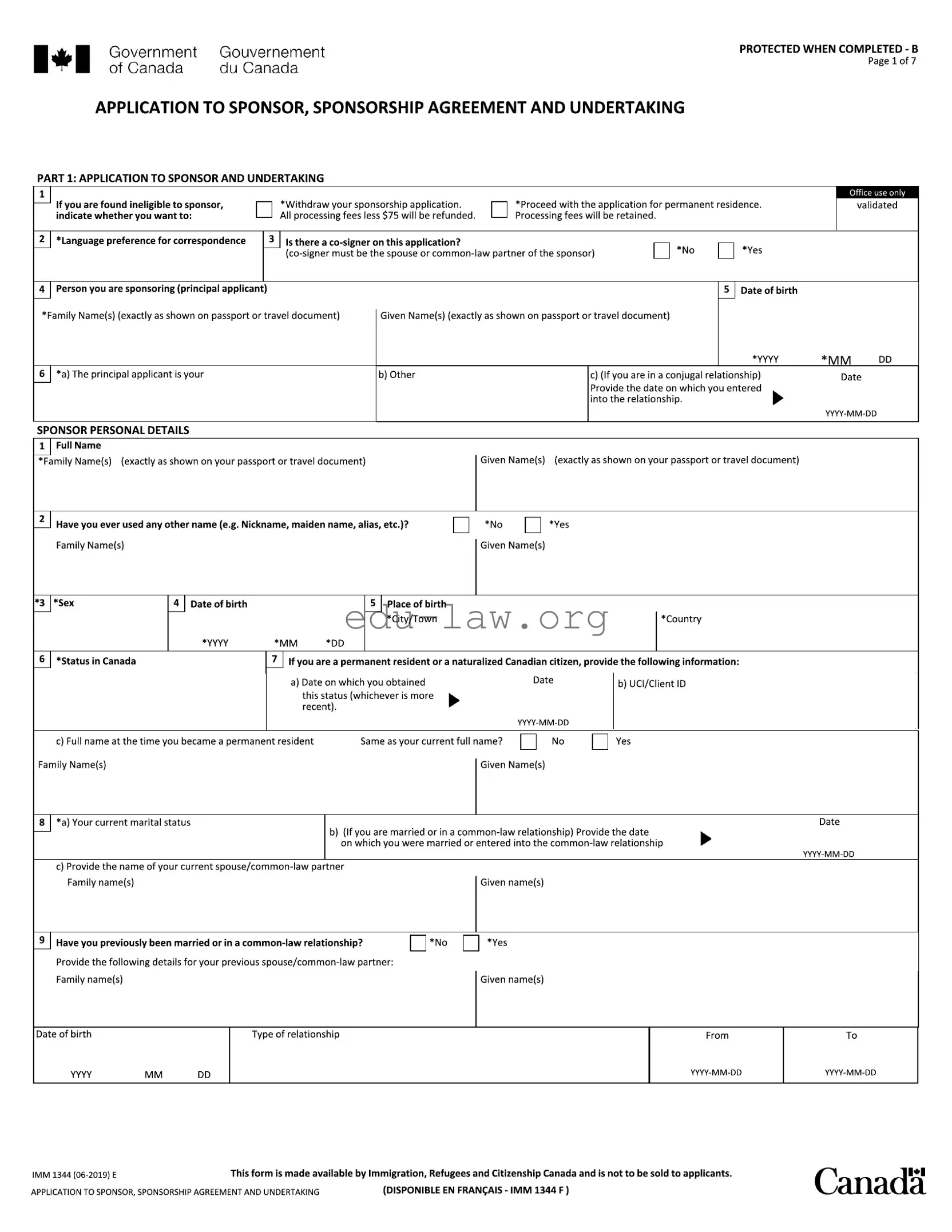
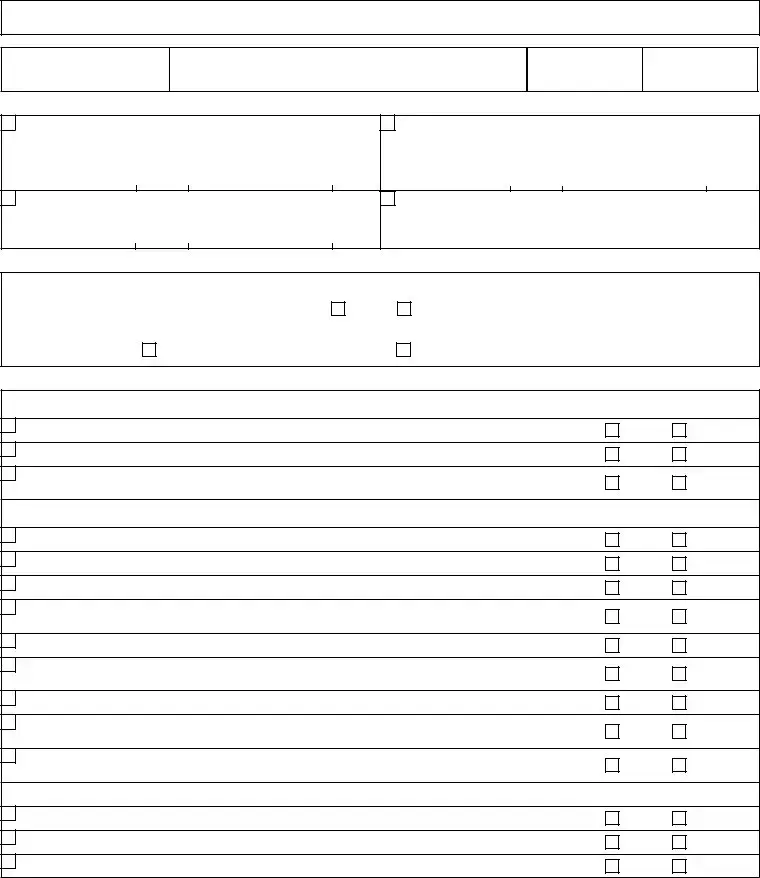
The IMM 1344 Application form plays a crucial role in the sponsorship process for individuals seeking to bring family members to Canada. This form is designed for Canadian citizens and permanent residents who wish to sponsor their spouses, common-law partners, or conjugal partners for permanent residency. It consists of several key sections, including personal details of the sponsor, the person being sponsored, and important declarations regarding eligibility. Sponsors must provide their full names, contact information, and residency status, while also disclosing any previous relationships that may affect their eligibility. Additionally, the form prompts sponsors to indicate whether they have a co-signer, which is typically a spouse or common-law partner. Throughout the application, individuals must answer various questions to assess their eligibility, including their age, citizenship status, and financial stability. The form also includes options for language preference and the choice to withdraw the application if necessary. Understanding these aspects is essential for anyone navigating the sponsorship process, as completing the form accurately can significantly impact the outcome of the application.


| Fact Name | Details |
|---|---|
| Purpose | The IMM 1344 form is used to apply for sponsorship of a family member for permanent residence in Canada. |
| Eligibility Requirements | To sponsor, the applicant must be a Canadian citizen or permanent resident, at least 18 years old, and reside in Canada. |
| Co-signer Requirement | If applicable, a co-signer must be the spouse or common-law partner of the sponsor. |
| Processing Fees | Processing fees are retained if the application proceeds. However, if the application is withdrawn, all fees except $75 will be refunded. |
| Residency Declaration | Sponsors living exclusively outside Canada must indicate their intent to return to Canada after the sponsored individual becomes a permanent resident. |
| Previous Sponsorship | Individuals who were sponsored as spouses or partners within the last five years are ineligible to sponsor a new application. |
| Governing Laws | The application is governed by the Immigration and Refugee Protection Act (IRPA) and the Immigration and Refugee Protection Regulations (IRPR). |
Filling out the IMM 1344 Application form is an important step in the sponsorship process. Once you complete the form, you will need to submit it along with any required fees and supporting documents to the appropriate immigration office. Make sure to double-check your information for accuracy, as errors can lead to delays.
What is the IMM 1344 Application form used for?
The IMM 1344 Application form is primarily used to apply for sponsorship of a family member or partner for permanent residence in Canada. This form allows individuals to declare their intent to support their loved ones financially and to provide necessary personal and relationship details. Completing this form is a crucial step in the immigration process for family reunification.
Who can be sponsored using the IMM 1344 form?
The form is designed for sponsoring a spouse, common-law partner, or conjugal partner, as well as dependent children. It is important to ensure that the individual being sponsored falls under the family class as defined by Canadian immigration laws. If you are unsure about eligibility, reviewing the guidelines provided by Immigration, Refugees and Citizenship Canada (IRCC) is recommended.
What information do I need to provide on the form?
Applicants must provide personal details such as full names, dates of birth, and places of birth for both the sponsor and the person being sponsored. Additionally, information about marital status, previous relationships, and residency status in Canada is required. The form also asks for contact information and any other names that may have been used by the sponsor.
What happens if I am found ineligible to sponsor?
If you are found ineligible to sponsor, you have two options. You can choose to withdraw your sponsorship application, in which case most processing fees will be refunded, minus a small administrative fee. Alternatively, you may decide to proceed with the application for permanent residence, but in this case, the processing fees will not be refunded.
Is there a co-signer required for the application?
A co-signer is not mandatory for every application. However, if you are married or in a common-law relationship, your spouse or partner can act as a co-signer. This individual must be included in the application and must meet specific eligibility requirements as well.
Can I authorize someone else to receive correspondence regarding my application?
Yes, you can authorize a representative to receive information related to your application. To do this, you must indicate their email and mailing addresses on the IMM 5476 form. This allows them to act on your behalf and receive updates about your application status.
What if my marital status changes after submitting the form?
It is essential to keep IRCC informed about any changes in your marital status after submitting the application. If your situation changes, such as getting married or divorced, you should notify them promptly. This ensures that your application remains accurate and that any necessary adjustments can be made.
How long does it take to process the IMM 1344 application?
Processing times for the IMM 1344 application can vary significantly based on several factors, including the complexity of the case and the current workload of IRCC. Typically, applicants can expect a processing time of several months. It’s wise to check the IRCC website for the most current processing times and updates.
What should I do if I have questions about completing the form?
If you have questions about filling out the IMM 1344 form, it is advisable to consult the official guide provided by IRCC. Additionally, you may consider reaching out to an immigration consultant or lawyer for personalized assistance. They can help clarify any uncertainties and ensure your application is completed correctly.
Incomplete Information: Failing to provide all required details can lead to delays or rejections. Ensure that every section is filled out completely and accurately.
Incorrect Names: Names must match exactly as they appear on passports or travel documents. Any discrepancies can cause complications.
Missing Signatures: Forgetting to sign the application can result in automatic rejection. Always check that all required signatures are present.
Wrong Dates: Providing incorrect dates, especially for birth or relationship status, can create issues. Double-check these details for accuracy.
Ignoring Eligibility Questions: Not answering the eligibility questions or providing misleading information can lead to disqualification. Be honest and thorough in your responses.
Inconsistent Marital Status: If there have been previous relationships, failing to disclose them or providing inconsistent information can raise red flags.
Incorrect Contact Information: Providing wrong or outdated contact details can hinder communication with immigration authorities. Ensure that all contact information is current.
Not Following Instructions: Each section may have specific instructions. Not adhering to these can lead to confusion and errors. Always read the guidelines carefully.
The Imm 1344 Application form is a crucial document for those looking to sponsor a family member for immigration to Canada. Along with this form, several other documents are typically required to ensure a complete and accurate application. Below is a list of these documents, each with a brief description.
Providing these documents alongside the Imm 1344 Application form helps to streamline the sponsorship process and increases the chances of a successful application. Ensure that all forms are filled out accurately and that all required documents are included to avoid delays.
The Form I-130, Petition for Alien Relative, is a crucial document in the U.S. immigration process that shares similarities with the Imm 1344 Application form. Like the Imm 1344, the I-130 is used to establish a qualifying relationship between a U.S. citizen or lawful permanent resident and their foreign relative. Both forms require detailed personal information about the sponsor and the beneficiary, including names, dates of birth, and proof of the relationship. The I-130 also includes a declaration of the sponsor's eligibility to support the relative financially, paralleling the financial undertaking found in the Imm 1344.
The Affidavit of Support (Form I-864) is another document that aligns with the Imm 1344 Application form. This affidavit is a legally binding contract that requires the sponsor to demonstrate their ability to financially support the immigrant. Similarly, the Imm 1344 includes an undertaking where the sponsor agrees to provide financial support to the sponsored individual. Both documents aim to ensure that the sponsored person will not become a public charge, reflecting the importance of financial stability in the immigration process.
The Form I-485, Application to Register Permanent Residence or Adjust Status, is comparable to the Imm 1344 in that it is part of the process for obtaining permanent residency. While the Imm 1344 focuses on sponsorship, the I-485 is submitted by the immigrant seeking to adjust their status in the U.S. Both forms require personal information and details about the applicant's current status, as well as supporting documentation to validate the claims made within the application.
The DS-260, Immigrant Visa Electronic Application, is another document that shares commonalities with the Imm 1344. The DS-260 is used by individuals applying for an immigrant visa from outside the U.S. Like the Imm 1344, it requires comprehensive personal details and information about the relationship between the applicant and the sponsor. Both forms serve as essential components in the immigration process, ensuring that all necessary information is collected to facilitate a smooth application experience.
The G-325A, Biographic Information, is a form that also bears similarities to the Imm 1344. This document collects biographical data about the applicant, including names, dates of birth, and addresses. In the Imm 1344, similar information is required from both the sponsor and the person being sponsored. Both forms aim to create a complete profile of the individuals involved, ensuring that immigration authorities have the necessary background information to assess eligibility.
The Form I-864W, Request for Exemption for Intending Immigrant's Affidavit of Support, is relevant in the context of sponsorship and financial support. It is used when the intending immigrant is a self-sufficient individual, similar to how the Imm 1344 requires sponsors to demonstrate their ability to support the immigrant. Both forms reflect the necessity of financial considerations in the sponsorship process, ensuring that the immigrant will not rely on government assistance.
The Form I-601, Application for Waiver of Grounds of Inadmissibility, is another document that connects to the Imm 1344. This form is used when an applicant is deemed inadmissible to the U.S. and seeks a waiver based on their relationship with a U.S. citizen or permanent resident. Like the Imm 1344, it emphasizes the importance of familial relationships in the immigration process, as sponsors often play a key role in helping to navigate issues of inadmissibility.
The Form I-765, Application for Employment Authorization, is relevant for individuals seeking to work while their immigration application is pending. Similar to the Imm 1344, which is a step in the sponsorship process, the I-765 is often filed alongside other immigration forms to ensure that the applicant can support themselves during the waiting period. Both forms reflect the interconnected nature of immigration applications and the importance of maintaining financial independence.
Lastly, the Form N-400, Application for Naturalization, shares common ground with the Imm 1344 in that both are integral to the immigration journey. While the Imm 1344 focuses on sponsoring a relative for permanent residency, the N-400 is the final step for eligible permanent residents seeking citizenship. Both forms require personal information and documentation that verifies the applicant's eligibility, highlighting the continuous relationship between different stages of the immigration process.
When filling out the IMM 1344 Application form, it's important to follow certain guidelines to ensure your application is processed smoothly. Here are some key do's and don'ts:
Understanding the Imm 1344 Application form is crucial for those looking to sponsor a family member for permanent residence in Canada. However, several misconceptions can lead to confusion. Below are six common misconceptions about the Imm 1344 Application form, along with clarifications for each.
It is essential to include all necessary documents when submitting the application. Incomplete submissions may lead to delays or rejections.
Permanent residents can also sponsor family members. However, specific eligibility criteria must be met.
If you are found ineligible to sponsor, you can withdraw your application and receive a refund of all processing fees except for a small amount.
The co-signer must be the spouse or common-law partner of the sponsor, not just any family member.
Previous relationships must be disclosed in the application. This information is crucial for assessing eligibility.
While some parts of the process may be completed online, physical documents are typically required to support the application.
Being aware of these misconceptions can help streamline the application process and increase the chances of a successful sponsorship. It is advisable to thoroughly review the application guidelines and ensure all information is accurate and complete.
Filling out the IMM 1344 Application form is a critical step for individuals looking to sponsor a family member for permanent residence in Canada. Here are some key takeaways to keep in mind:
Completing the IMM 1344 form accurately and thoroughly is essential for a successful sponsorship application. Careful attention to detail can significantly affect the outcome of the process.