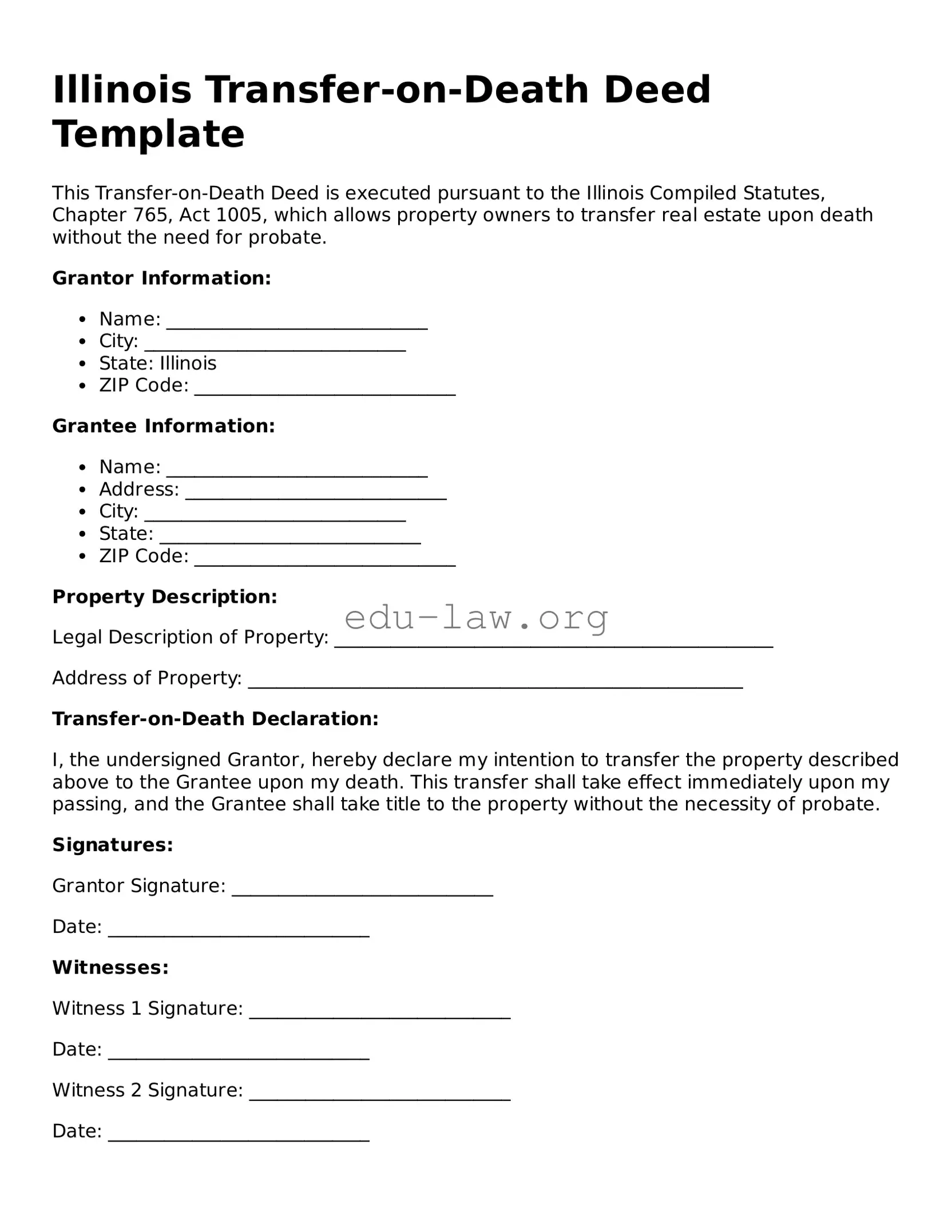
The Illinois Transfer-on-Death Deed (TOD) form offers a straightforward way for property owners to transfer their real estate to designated beneficiaries upon their death, avoiding the often lengthy and costly probate process. This deed allows individuals to retain full ownership and control of their property during their lifetime, while ensuring that their wishes are honored after they pass away. Beneficiaries can be specified in the deed, providing clarity and preventing disputes among heirs. Importantly, the form must be properly executed and recorded to be valid, emphasizing the need for attention to detail in its completion. Understanding the implications of this form is crucial for anyone considering estate planning in Illinois, as it can simplify the transfer of assets and provide peace of mind for both property owners and their loved ones.
Illinois Transfer-on-Death Deed Template
This Transfer-on-Death Deed is executed pursuant to the Illinois Compiled Statutes, Chapter 765, Act 1005, which allows property owners to transfer real estate upon death without the need for probate.
Grantor Information:
Grantee Information:
Property Description:
Legal Description of Property: _______________________________________________
Address of Property: _____________________________________________________
Transfer-on-Death Declaration:
I, the undersigned Grantor, hereby declare my intention to transfer the property described above to the Grantee upon my death. This transfer shall take effect immediately upon my passing, and the Grantee shall take title to the property without the necessity of probate.
Signatures:
Grantor Signature: ____________________________
Date: ____________________________
Witnesses:
Witness 1 Signature: ____________________________
Date: ____________________________
Witness 2 Signature: ____________________________
Date: ____________________________
This deed must be recorded with the appropriate county recorder's office in Illinois to be effective. Ensure that all signatures are notarized to meet state requirements.
| Fact Name | Description |
|---|---|
| Purpose | The Illinois Transfer-on-Death Deed allows property owners to transfer real estate to beneficiaries upon their death without going through probate. |
| Governing Law | This deed is governed by the Illinois Compiled Statutes, specifically 765 ILCS 1005. |
| Revocability | The Transfer-on-Death Deed can be revoked or modified at any time during the property owner's lifetime, ensuring flexibility in estate planning. |
| Execution Requirements | To be valid, the deed must be signed by the property owner and witnessed by two individuals or notarized. |
| Filing | The deed must be recorded with the county recorder’s office where the property is located to be effective. |
Once the Illinois Transfer-on-Death Deed form is completed, it must be signed and notarized before being recorded with the appropriate county office. This deed allows for the transfer of real property upon the owner's death without going through probate.
What is a Transfer-on-Death Deed in Illinois?
A Transfer-on-Death Deed (TOD Deed) is a legal document that allows a property owner to transfer their real estate to a designated beneficiary upon their death. This deed allows the owner to retain full control of the property during their lifetime, and the transfer occurs automatically without the need for probate, simplifying the process for heirs.
Who can use a Transfer-on-Death Deed?
Any individual who owns real estate in Illinois can use a Transfer-on-Death Deed. This includes homeowners, co-owners, and individuals holding property in a trust. However, the deed must be properly executed and recorded to be valid.
How do I create a Transfer-on-Death Deed?
To create a Transfer-on-Death Deed, you must fill out the appropriate form, which includes details about the property and the designated beneficiary. After completing the form, it must be signed in front of a notary public. Finally, the deed should be recorded with the county recorder's office where the property is located.
Are there any restrictions on who can be a beneficiary?
Yes, the beneficiary must be a natural person, which means they must be an individual rather than an organization or entity. You can designate multiple beneficiaries, but if one of them predeceases you, their share may pass to their heirs unless otherwise specified in the deed.
Can I change or revoke a Transfer-on-Death Deed?
Yes, you can change or revoke a Transfer-on-Death Deed at any time during your lifetime. To do this, you must create a new deed that either modifies or revokes the previous one. It is essential to record the new deed with the county recorder's office to ensure that your intentions are clear and legally recognized.
What happens if I sell the property after creating a Transfer-on-Death Deed?
If you sell the property after creating a Transfer-on-Death Deed, the deed becomes void. The sale of the property transfers ownership to the buyer, and the beneficiary named in the deed will not receive any interest in the property. It is important to understand that the deed only takes effect upon your death, and selling the property cancels its effect.
Is a Transfer-on-Death Deed subject to taxes?
Generally, a Transfer-on-Death Deed does not trigger immediate tax consequences. However, the property may be subject to estate taxes upon your death, depending on the total value of your estate. Additionally, the beneficiary may be responsible for property taxes once the property is transferred to them.
What if I do not have a Transfer-on-Death Deed?
If you do not have a Transfer-on-Death Deed and pass away, your property will go through the probate process. This can be time-consuming and may involve court fees, attorney fees, and other costs. Having a TOD Deed can help avoid these complications and ensure that your property is transferred according to your wishes.
Where can I find the Transfer-on-Death Deed form?
The Transfer-on-Death Deed form can typically be found on the Illinois Secretary of State's website or through the county recorder's office. It is advisable to ensure that you are using the most current version of the form and to follow any specific instructions provided by your local jurisdiction.
Not including the correct legal description of the property. It is crucial to provide a detailed description to avoid any confusion about the property being transferred.
Failing to sign the deed in front of a notary public. A signature without notarization can render the deed invalid.
Leaving out the names of the beneficiaries. All intended recipients must be clearly listed to ensure the transfer occurs as intended.
Using incorrect or outdated forms. Always ensure you are using the latest version of the Transfer-on-Death Deed form to avoid legal issues.
Not considering the implications of the transfer. Individuals should understand how this deed affects their estate and potential taxes.
Overlooking the requirement for witnesses. Some situations may require witnesses to sign the deed, depending on local regulations.
Failing to record the deed with the appropriate county office. Without proper recording, the transfer may not be recognized legally.
The Illinois Transfer-on-Death Deed is a valuable tool for individuals wishing to transfer property upon their passing without the need for probate. In addition to this deed, several other forms and documents may be necessary to ensure a smooth transfer of assets and to address related matters. Below is a list of commonly used documents that accompany the Transfer-on-Death Deed.
Understanding these documents and their purposes can greatly assist individuals in navigating the complexities of estate planning and property transfer. Each plays a crucial role in ensuring that one's wishes are honored and that loved ones are supported during a challenging time.
The Illinois Transfer-on-Death Deed (TOD) form shares similarities with a Will, which is a legal document that outlines how a person's assets should be distributed after their death. Both the TOD and a Will allow individuals to express their wishes regarding the transfer of property. However, while a Will takes effect only upon the individual's death and may require probate, the TOD deed allows for the immediate transfer of property outside of probate, simplifying the process for heirs. This can provide peace of mind, knowing that the property will automatically go to the designated beneficiary without the need for court intervention.
When filling out the Illinois Transfer-on-Death Deed form, it is crucial to adhere to certain guidelines to ensure the document is valid and effective. Below are six important dos and don'ts to consider:
Many people have misconceptions about the Illinois Transfer-on-Death Deed (TODD). Understanding the facts can help individuals make informed decisions regarding their estate planning. Here are six common misconceptions:
Understanding these misconceptions can lead to better estate planning decisions. It's important to seek professional advice to navigate the complexities of property transfer and ensure your wishes are honored.
When considering the Illinois Transfer-on-Death Deed form, it is important to understand its purpose and implications. Here are some key takeaways:
By following these guidelines, individuals can navigate the process of creating and utilizing a Transfer-on-Death Deed in Illinois more effectively.