In Illinois, navigating the complexities of estate management can be daunting, especially when dealing with the loss of a loved one. For those with modest estates, the Illinois Small Estate Affidavit offers a streamlined path to transferring assets without the need for formal probate proceedings. This form allows individuals to claim the deceased's personal property, provided that the total value of the estate falls below a specific threshold set by state law. Typically, the Small Estate Affidavit is utilized by heirs or beneficiaries who seek to access assets such as bank accounts, vehicles, or personal belongings without enduring the lengthy probate process. To successfully use this affidavit, certain conditions must be met, including the requirement that the decedent has been deceased for at least 30 days and that no pending probate case exists. Completing the form accurately is crucial, as it serves as a legal declaration to affirm the rightful claim to the estate. Understanding the nuances of this affidavit can significantly ease the burden during a challenging time, ensuring that individuals can honor their loved ones while efficiently managing the transfer of assets.
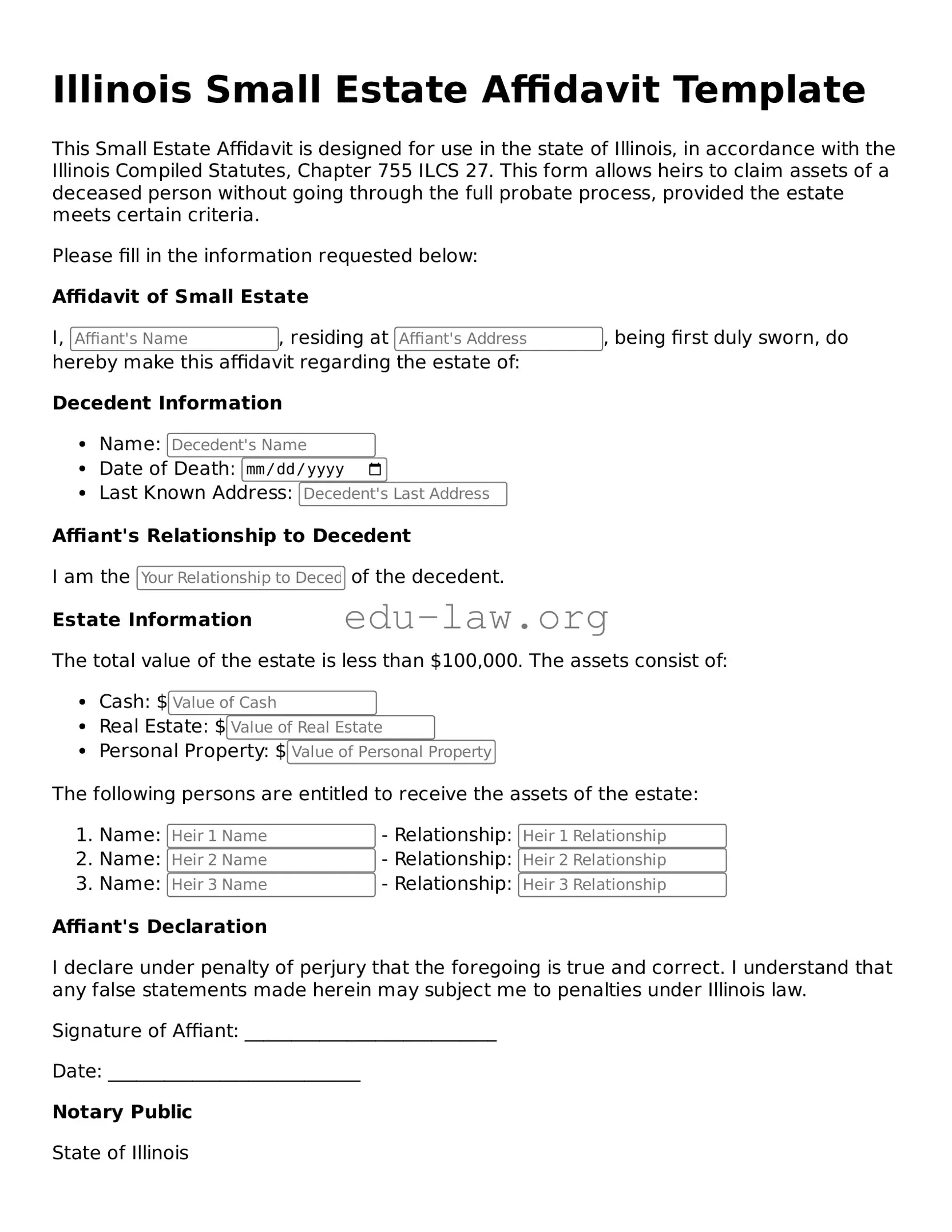
Illinois Small Estate Affidavit Template
This Small Estate Affidavit is designed for use in the state of Illinois, in accordance with the Illinois Compiled Statutes, Chapter 755 ILCS 27. This form allows heirs to claim assets of a deceased person without going through the full probate process, provided the estate meets certain criteria.
Please fill in the information requested below:
Affidavit of Small Estate
I, , residing at , being first duly sworn, do hereby make this affidavit regarding the estate of:
Decedent Information
Affiant's Relationship to Decedent
I am the of the decedent.
Estate Information
The total value of the estate is less than $100,000. The assets consist of:
The following persons are entitled to receive the assets of the estate:
Affiant's Declaration
I declare under penalty of perjury that the foregoing is true and correct. I understand that any false statements made herein may subject me to penalties under Illinois law.
Signature of Affiant: ___________________________
Date: ___________________________
Notary Public
State of Illinois
County of ___________________________
Subscribed and sworn before me this ____ day of __________, 20__.
Signature of Notary: ___________________________
My Commission Expires: ___________________________
| Fact Name | Description |
|---|---|
| Purpose | The Illinois Small Estate Affidavit allows individuals to settle the estate of a deceased person without going through formal probate, provided certain conditions are met. |
| Eligibility | This form can be used if the total value of the estate is $100,000 or less, excluding certain assets like real estate. |
| Governing Law | The use of the Small Estate Affidavit in Illinois is governed by 755 ILCS 27/1. |
| Filing Process | The affidavit must be signed by the heirs and filed with the appropriate court, along with any required documentation. |
| Assets Covered | It can be used for various assets, including bank accounts, personal property, and certain vehicles, but not for real estate. |
| Timeframe | Once the affidavit is filed, it typically allows for quicker access to the deceased's assets compared to traditional probate processes. |
Filling out the Illinois Small Estate Affidavit form is an important step in managing the affairs of a deceased person’s estate. Once you have completed the form, you will be ready to submit it to the appropriate court along with any required documentation.
Once the affidavit is submitted, the court will review it. If everything is in order, you will receive confirmation, allowing you to proceed with settling the estate.
What is the Illinois Small Estate Affidavit?
The Illinois Small Estate Affidavit is a legal document that allows heirs to claim assets from a deceased person's estate without going through a lengthy probate process. This form is particularly useful for estates that do not exceed a certain value, making it a simpler and more efficient option for settling small estates.
Who is eligible to use the Small Estate Affidavit?
Generally, any individual who is an heir or beneficiary of the deceased can use the Small Estate Affidavit. However, the total value of the estate must be under a specified threshold, which is currently set at $100,000 in Illinois. This includes all assets that do not require probate, such as bank accounts, personal property, and real estate.
What assets can be claimed using the Small Estate Affidavit?
Assets that can be claimed typically include bank accounts, vehicles, personal belongings, and other items that fall under the estate's total value limit. However, certain assets, like those held in a trust or jointly owned property, may not qualify for this process.
How do I complete the Small Estate Affidavit?
To complete the Small Estate Affidavit, you will need to provide specific information about the deceased, including their name, date of death, and details about the assets being claimed. The form must be signed in front of a notary public. It’s essential to ensure that all information is accurate to avoid any delays or complications.
Where do I file the Small Estate Affidavit?
The completed Small Estate Affidavit is typically filed with the local circuit court in the county where the deceased resided at the time of their death. Some financial institutions may also require a copy of the affidavit to release the assets.
Is there a fee associated with filing the Small Estate Affidavit?
Yes, there may be a filing fee when you submit the Small Estate Affidavit to the court. The fee can vary by county, so it’s advisable to check with your local court for the exact amount. Additionally, there may be fees for notarization and any copies you need to obtain.
Can the Small Estate Affidavit be contested?
While the Small Estate Affidavit simplifies the process, it can be contested by other potential heirs or beneficiaries. If someone believes they have a rightful claim to the estate, they may challenge the affidavit in court. This could lead to a more complicated legal situation.
How long does it take to process the Small Estate Affidavit?
The processing time for a Small Estate Affidavit can vary depending on the county and the specific circumstances of the case. Generally, once filed, the affidavit is processed relatively quickly, allowing heirs to access the assets within a few weeks if there are no disputes.
What should I do if I have more questions about the Small Estate Affidavit?
If you have further questions or need assistance with the Small Estate Affidavit, consider consulting with a legal professional who specializes in estate planning or probate law. They can provide personalized guidance and help you navigate the process smoothly.
Not checking the eligibility requirements. Before filling out the form, ensure that the estate qualifies as a small estate under Illinois law.
Failing to provide accurate information. Double-check names, dates, and other details to avoid any discrepancies that could lead to delays.
Omitting necessary signatures. All required parties must sign the affidavit. Missing signatures can invalidate the document.
Not including all assets. Make sure to list all the assets of the deceased, including bank accounts, real estate, and personal property.
Ignoring the debts of the estate. It’s important to mention any outstanding debts, as this affects the distribution of assets.
Using outdated forms. Always use the most current version of the Small Estate Affidavit form to ensure compliance with Illinois law.
Neglecting to notarize the affidavit. A notary public must witness the signatures for the affidavit to be legally valid.
Not providing proper identification. Include valid identification for all signers to avoid complications with the affidavit's acceptance.
Failing to file the affidavit correctly. Understand where and how to file the affidavit to ensure it is processed in a timely manner.
The Illinois Small Estate Affidavit is a valuable tool for individuals managing the estate of a deceased person. It simplifies the process of transferring assets when the estate's total value falls below a certain threshold. Alongside this affidavit, several other documents may be required to ensure a smooth transition of assets. Below is a list of commonly used forms and documents that complement the Illinois Small Estate Affidavit.
Using these documents in conjunction with the Illinois Small Estate Affidavit can streamline the process of settling an estate. It is important to gather all necessary paperwork to avoid delays and ensure that the wishes of the deceased are honored effectively.
The Illinois Small Estate Affidavit form shares similarities with the Affidavit of Heirship. This document is used to establish the heirs of a deceased person when there is no will. Like the Small Estate Affidavit, it allows heirs to claim property without going through the lengthy probate process. Both forms require the affiant to provide information about the deceased, the heirs, and the property involved, ensuring a smooth transfer of assets to rightful beneficiaries. The Affidavit of Heirship, however, typically focuses more on identifying heirs rather than detailing the estate's value.
Another document akin to the Illinois Small Estate Affidavit is the Will. While a Small Estate Affidavit is often utilized when a person dies without a will, a Will outlines the deceased's wishes regarding asset distribution. Both documents aim to facilitate the transfer of property and minimize disputes among heirs. However, a Will must go through probate, whereas a Small Estate Affidavit can expedite the process, allowing heirs to access assets more quickly, provided the estate falls under the specified value limits.
The Transfer on Death (TOD) Deed is also similar to the Illinois Small Estate Affidavit in that it allows for the direct transfer of property upon death without going through probate. A TOD deed enables property owners to designate beneficiaries who will automatically receive the property after the owner's death. Like the Small Estate Affidavit, this document simplifies the transfer process and can help avoid the complexities associated with probate. However, the TOD deed is specifically designed for real estate, while the Small Estate Affidavit can cover a broader range of assets.
Finally, the Petition for Summary Administration is comparable to the Illinois Small Estate Affidavit. This petition is filed in probate court when the estate is small enough to qualify for a simplified process. Both documents aim to expedite the transfer of assets and reduce the burden of traditional probate proceedings. However, the Petition for Summary Administration requires court involvement, whereas the Small Estate Affidavit allows heirs to manage the process independently, provided they meet the necessary criteria.
When filling out the Illinois Small Estate Affidavit form, it is crucial to follow specific guidelines to ensure the process goes smoothly. Here’s a list of things you should and shouldn't do:
By following these guidelines, you can help ensure a smoother experience when dealing with the Small Estate Affidavit in Illinois.
The Illinois Small Estate Affidavit is a useful tool for settling small estates without going through the lengthy probate process. However, several misconceptions surround this form. Below are eight common misunderstandings.
Understanding these misconceptions can help individuals navigate the estate settlement process more effectively and utilize the Small Estate Affidavit appropriately.
When dealing with the Illinois Small Estate Affidavit form, understanding its purpose and requirements is crucial. Here are some key takeaways to keep in mind: