The Illinois Self-Proving Affidavit form plays a crucial role in the estate planning process, particularly for those creating a will. This form serves as a tool to simplify the probate process by allowing a will to be validated without the need for witnesses to testify about its authenticity after the testator's death. By including this affidavit, the testator and witnesses affirm that they signed the will voluntarily and that the will reflects the testator's intentions. The form must be signed in the presence of a notary public, ensuring that the document meets legal standards and can withstand scrutiny in court. Utilizing the Illinois Self-Proving Affidavit not only streamlines the probate process but also provides peace of mind, knowing that the will is more likely to be accepted as valid without unnecessary delays or complications. Understanding how to properly complete and file this form is essential for anyone looking to ensure their final wishes are honored efficiently and effectively.
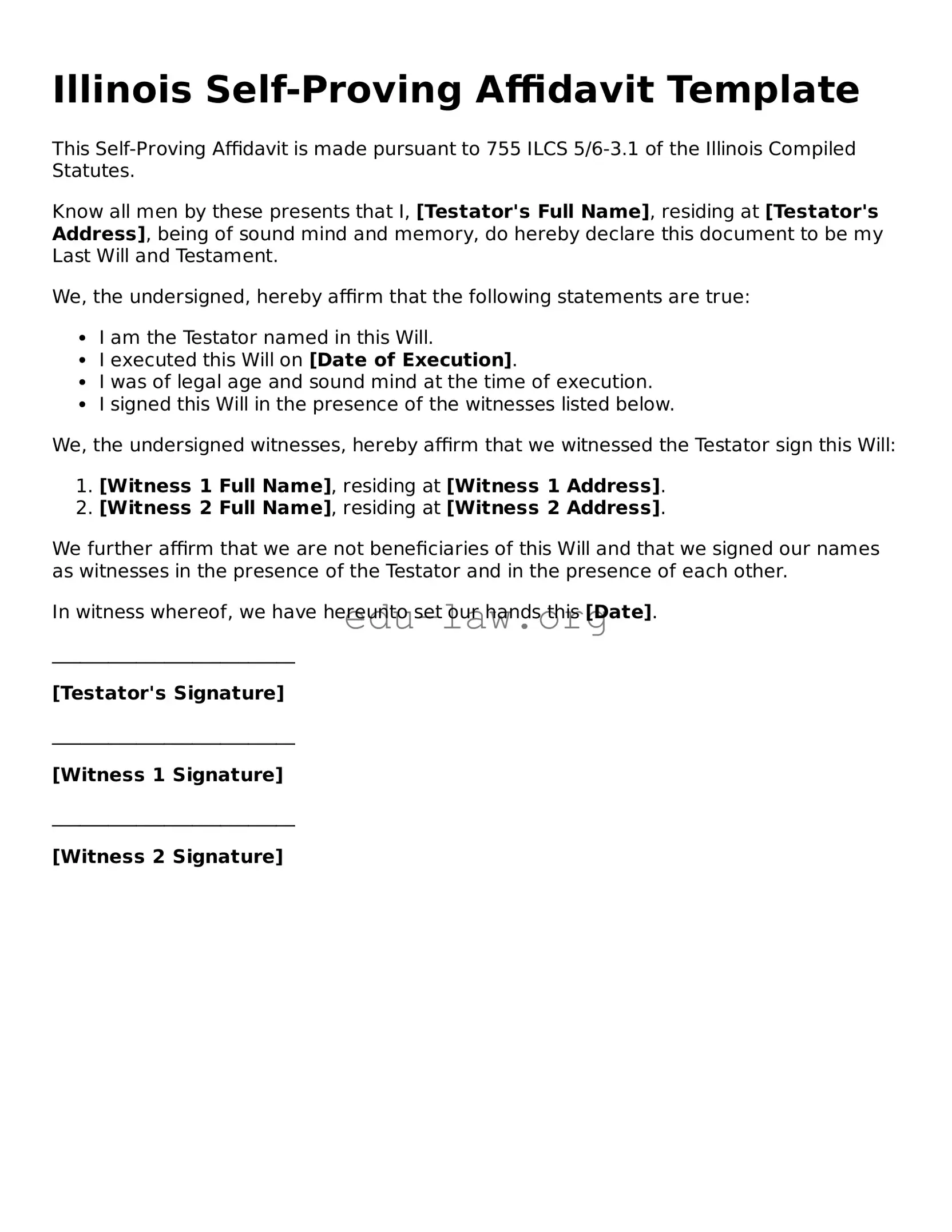
Illinois Self-Proving Affidavit Template
This Self-Proving Affidavit is made pursuant to 755 ILCS 5/6-3.1 of the Illinois Compiled Statutes.
Know all men by these presents that I, [Testator's Full Name], residing at [Testator's Address], being of sound mind and memory, do hereby declare this document to be my Last Will and Testament.
We, the undersigned, hereby affirm that the following statements are true:
We, the undersigned witnesses, hereby affirm that we witnessed the Testator sign this Will:
We further affirm that we are not beneficiaries of this Will and that we signed our names as witnesses in the presence of the Testator and in the presence of each other.
In witness whereof, we have hereunto set our hands this [Date].
__________________________
[Testator's Signature]
__________________________
[Witness 1 Signature]
__________________________
[Witness 2 Signature]
| Fact Name | Details |
|---|---|
| Definition | The Illinois Self-Proving Affidavit is a legal document that allows a will to be validated without the need for witness testimony during probate. |
| Governing Law | This form is governed by the Illinois Probate Act, specifically 755 ILCS 5/6-6. |
| Purpose | Its primary purpose is to streamline the probate process by confirming the validity of a will. |
| Requirements | The affidavit must be signed by the testator and at least two witnesses in the presence of each other. |
| Execution | The affidavit should be executed at the same time as the will to ensure validity. |
| Effectiveness | Once executed, the affidavit eliminates the need for witnesses to appear in court to prove the will. |
| Retention | It is advisable to keep the self-proving affidavit with the original will to ensure easy access during probate. |
| Notarization | While notarization is not required, having the affidavit notarized can add an extra layer of authenticity. |
After gathering the necessary information, you can begin filling out the Illinois Self-Proving Affidavit form. This document will require you to provide specific details about the testators and witnesses involved. Once completed, the form will be ready for submission or inclusion with the will.
What is an Illinois Self-Proving Affidavit?
The Illinois Self-Proving Affidavit is a legal document that allows a will to be validated without the need for witnesses to testify in court. This form is typically signed by the testator (the person making the will) and witnesses in the presence of a notary public. By using this affidavit, the process of probating a will can be streamlined, saving time and resources for the estate and its beneficiaries.
Why should I use a Self-Proving Affidavit?
Using a Self-Proving Affidavit can simplify the probate process. When a will includes this affidavit, it provides evidence that the will was executed properly. This can help avoid disputes and challenges from potential heirs who may question the validity of the will. It offers peace of mind, knowing that your wishes will be honored more easily after your passing.
Who can sign the Self-Proving Affidavit?
The Self-Proving Affidavit must be signed by the testator and at least two witnesses. All parties should be present at the same time when signing the document. Additionally, a notary public must witness the signing to certify the authenticity of the signatures. This ensures that the affidavit meets legal standards in Illinois.
How do I complete a Self-Proving Affidavit?
To complete a Self-Proving Affidavit, start by obtaining the form, which can be found online or through legal resources. Fill in the necessary information, including the names and addresses of the testator and witnesses. Each party must then sign the affidavit in the presence of the notary public, who will also sign and stamp the document. Ensure that all signatures are completed accurately to avoid any issues during probate.
Is the Self-Proving Affidavit required in Illinois?
Can I revoke a Self-Proving Affidavit?
Yes, a Self-Proving Affidavit can be revoked. If you create a new will or modify an existing one, the previous affidavit becomes invalid. To ensure clarity, it is advisable to explicitly state in the new will that the prior documents are revoked. Always consult with a legal professional if you have questions about making changes to your will or affidavit.
Where should I keep my Self-Proving Affidavit?
It is important to store your Self-Proving Affidavit in a safe and accessible location. Consider keeping it with your will, in a safe deposit box, or with a trusted family member or attorney. Make sure that your loved ones know where to find it, as this will help facilitate the probate process after your passing.
Incomplete Information: Failing to provide all required details can lead to complications. Each section of the affidavit must be filled out accurately to ensure its validity.
Incorrect Signatures: Signatures of witnesses and the testator must be present. Omitting any necessary signatures can invalidate the document.
Not Following Witness Requirements: Illinois law requires specific conditions for witnesses. If these requirements are not met, the affidavit may not hold up in court.
Improper Notarization: The affidavit must be notarized correctly. A failure to have a notary public witness the signatures can result in legal challenges.
Using Outdated Forms: Laws change, and so do forms. Utilizing an outdated version of the Self-Proving Affidavit can lead to issues with acceptance.
Neglecting to Review: Before submission, it's essential to review the entire document. Overlooking errors or omissions can cause significant delays or complications.
Not Keeping Copies: Failing to retain copies of the signed affidavit can create problems down the line. It is wise to keep both physical and digital copies for future reference.
The Illinois Self-Proving Affidavit form is commonly used in estate planning to simplify the probate process. Several other documents are often used in conjunction with this form to ensure that a will is valid and can be easily executed. Below is a list of these documents, along with brief descriptions of each.
These documents play important roles in the estate planning process. They help ensure that a person's wishes are honored and can facilitate a smoother transition of assets after death.
The Illinois Self-Proving Affidavit is similar to a Will in that both documents serve to outline an individual's wishes regarding the distribution of their assets after death. A Will requires the signature of the testator and typically must be witnessed. The Self-Proving Affidavit enhances the validity of a Will by providing a sworn statement from the witnesses, affirming that the testator was of sound mind and acted voluntarily when signing the document. This added layer of verification can simplify the probate process, as it may eliminate the need for witnesses to testify in court.
Another document akin to the Self-Proving Affidavit is the Durable Power of Attorney. This legal document allows an individual to designate someone to make financial or medical decisions on their behalf if they become incapacitated. Similar to the Self-Proving Affidavit, the Durable Power of Attorney often requires the signatures of the principal and witnesses. The presence of witnesses or a notary public can help confirm that the principal understood the implications of granting such powers, thereby enhancing the document's credibility.
The Revocable Trust is another document that bears resemblance to the Self-Proving Affidavit. A Revocable Trust allows individuals to manage their assets during their lifetime and specify how those assets will be distributed upon their death. While the Self-Proving Affidavit serves to affirm the validity of a Will, a Revocable Trust can operate independently of a Will. However, both documents require careful execution and may involve witnesses to ensure that the individual's intentions are clearly documented and legally binding.
The Affidavit of Heirship is similar in that it establishes the rightful heirs of a deceased individual. This document is often used when there is no Will, and it serves to clarify the distribution of assets among heirs. Like the Self-Proving Affidavit, the Affidavit of Heirship is a sworn statement, typically requiring the signatures of witnesses to validate the claims made regarding the deceased's heirs, thereby providing a level of assurance in the probate process.
A Codicil is another document that can be compared to the Self-Proving Affidavit. A Codicil serves as an amendment to an existing Will, allowing individuals to make changes without drafting an entirely new document. Similar to the Self-Proving Affidavit, a Codicil often requires the signatures of witnesses to validate the changes made. This ensures that the amendments are legally recognized and reflect the true intentions of the testator.
The Medical Power of Attorney also shares characteristics with the Self-Proving Affidavit. This document designates an individual to make healthcare decisions on behalf of another person if they are unable to do so themselves. Both documents require the principal's signature and may need witnesses to affirm that the principal understood their choices. The presence of witnesses adds an element of protection, ensuring that the individual’s wishes regarding medical treatment are honored.
The Estate Inventory is another document that resembles the Self-Proving Affidavit in that it provides a comprehensive list of a deceased person's assets. This document is typically required during the probate process and serves to inform the court and beneficiaries about the estate's contents. While the Self-Proving Affidavit affirms the validity of a Will, the Estate Inventory helps establish the value of the estate, ensuring that assets are distributed according to the deceased's wishes.
Finally, the Affidavit of Support is similar to the Self-Proving Affidavit in that it provides a sworn statement regarding financial responsibility. Often used in immigration processes, this document requires the sponsor to affirm their ability to support an immigrant financially. Like the Self-Proving Affidavit, the Affidavit of Support is a legal document that requires signatures and may need witnesses to validate the claims made, ensuring that the sponsor's commitment is recognized and enforceable.
When filling out the Illinois Self-Proving Affidavit form, it’s important to follow certain guidelines to ensure that the document is completed correctly and serves its intended purpose. Here are five things you should and shouldn’t do:
Understanding the Illinois Self-Proving Affidavit form can be challenging. Here are eight common misconceptions about this important legal document:
This form is useful for anyone who wants to ensure their will is accepted without additional witness testimony, regardless of their financial status.
While the affidavit simplifies the process, it does not eliminate the requirement for witnesses when signing the will.
Other states have similar forms, but the Illinois Self-Proving Affidavit is specifically designed for use within Illinois.
The affidavit does not need to be filed until the will is probated. It simply needs to be kept with the will.
The notary must be authorized to perform notarial acts in Illinois, ensuring the process is legally binding.
For the affidavit to be valid, it must be signed at the same time as the will or shortly thereafter.
The affidavit can be used with various types of wills, including holographic and formal wills, as long as they meet state requirements.
While it strengthens the will's validity, it does not completely prevent challenges from heirs or other interested parties.
By clarifying these misconceptions, individuals can better understand the role of the Illinois Self-Proving Affidavit in the estate planning process.
Filling out and using the Illinois Self-Proving Affidavit form is crucial for ensuring your will is accepted in probate without the need for witnesses to testify. Here are some key takeaways to keep in mind:
By understanding these key points, you can effectively navigate the requirements of the Illinois Self-Proving Affidavit form and ensure your wishes are honored after your passing.