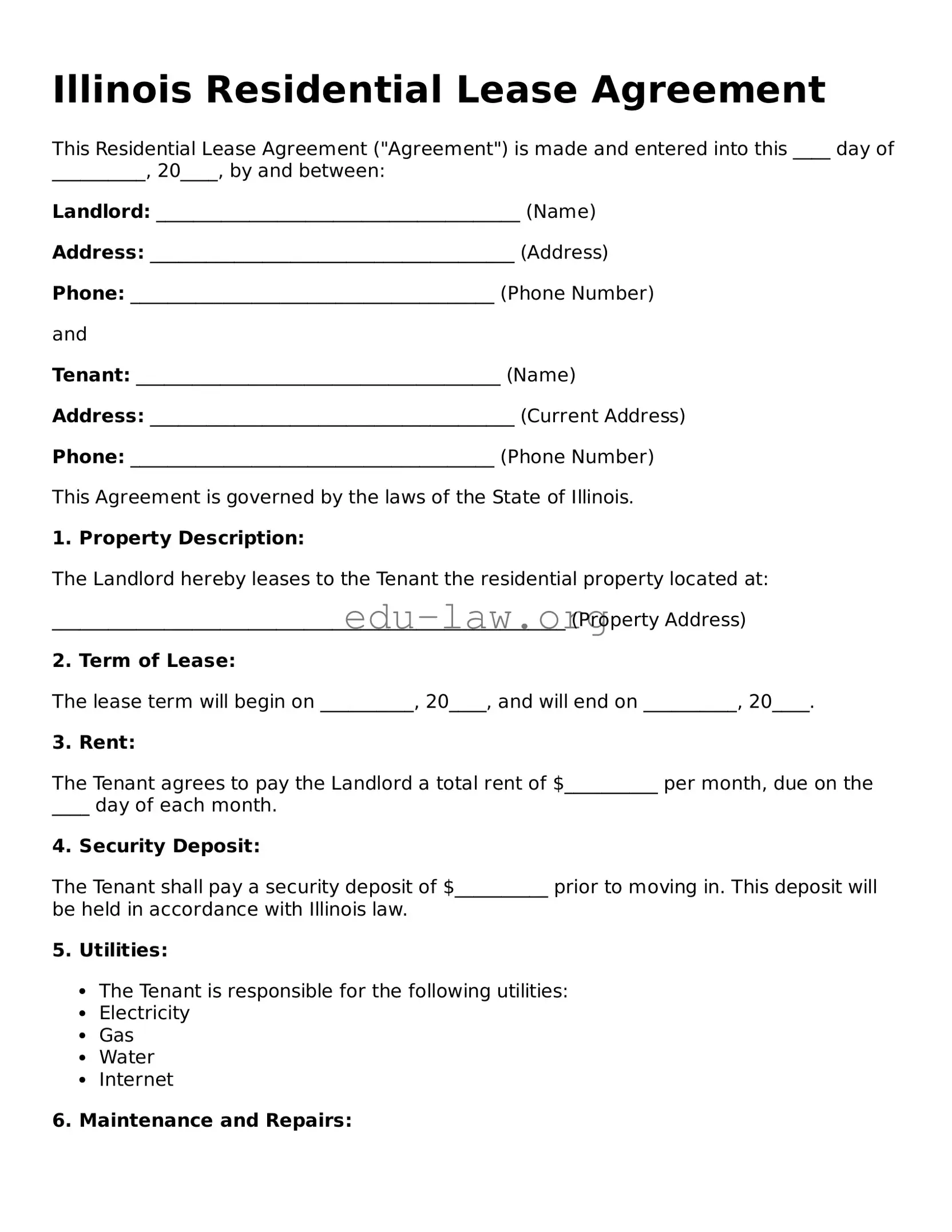
The Illinois Residential Lease Agreement form is a crucial document for both landlords and tenants, establishing the terms of a rental arrangement. This form outlines essential details such as the duration of the lease, rental payment amounts, and security deposit requirements. It also specifies the responsibilities of each party, including maintenance obligations and rules regarding property use. Additionally, the agreement addresses important issues like termination procedures, late fees, and conditions for renewing the lease. By clearly defining these aspects, the form helps prevent misunderstandings and disputes, ensuring a smoother rental experience for everyone involved. Understanding this document is vital for anyone entering into a rental agreement in Illinois, as it serves as the foundation for a successful landlord-tenant relationship.
Illinois Residential Lease Agreement
This Residential Lease Agreement ("Agreement") is made and entered into this ____ day of __________, 20____, by and between:
Landlord: _______________________________________ (Name)
Address: _______________________________________ (Address)
Phone: _______________________________________ (Phone Number)
and
Tenant: _______________________________________ (Name)
Address: _______________________________________ (Current Address)
Phone: _______________________________________ (Phone Number)
This Agreement is governed by the laws of the State of Illinois.
1. Property Description:
The Landlord hereby leases to the Tenant the residential property located at:
_______________________________________________________ (Property Address)
2. Term of Lease:
The lease term will begin on __________, 20____, and will end on __________, 20____.
3. Rent:
The Tenant agrees to pay the Landlord a total rent of $__________ per month, due on the ____ day of each month.
4. Security Deposit:
The Tenant shall pay a security deposit of $__________ prior to moving in. This deposit will be held in accordance with Illinois law.
5. Utilities:
6. Maintenance and Repairs:
The Tenant agrees to keep the premises clean and in good condition. The Landlord will be responsible for major repairs unless damage is caused by the Tenant.
7. Termination:
Either party may terminate this Agreement by providing ____ days written notice to the other party.
8. Governing Law:
This Agreement shall be governed by the laws of the State of Illinois.
9. Signatures:
By signing below, both parties agree to the terms of this Agreement:
Landlord Signature: ___________________________ Date: __________
Tenant Signature: ___________________________ Date: __________
| Fact Name | Description |
|---|---|
| Governing Law | The Illinois Residential Lease Agreement is governed by the Illinois Compiled Statutes, particularly the Illinois Lease Act. |
| Parties Involved | The agreement typically involves a landlord (lessor) and a tenant (lessee), both of whom must sign the document. |
| Duration of Lease | Leases can be for a fixed term, such as one year, or can be month-to-month, depending on the agreement between the parties. |
| Security Deposit | Illinois law allows landlords to collect a security deposit, which cannot exceed one and a half times the monthly rent. |
| Notice Requirements | Landlords must provide written notice to tenants before terminating a lease, with the notice period varying based on the lease duration. |
| Habitability Standards | Landlords are required to maintain the property in a habitable condition, ensuring it meets health and safety standards. |
| Disclosures | Landlords must disclose certain information to tenants, including lead paint hazards for properties built before 1978. |
| Late Fees | Illinois law permits landlords to charge late fees, but these must be reasonable and specified in the lease agreement. |
| Termination Rights | Tenants have the right to terminate the lease under specific circumstances, such as domestic violence or uninhabitable conditions. |
Filling out the Illinois Residential Lease Agreement form is an important step in establishing a rental relationship. This document outlines the terms and conditions that both the landlord and tenant must agree upon. By carefully completing this form, both parties can ensure clarity and mutual understanding regarding the lease terms.
After completing the form, it’s essential to keep a copy for your records. This ensures that both parties have access to the agreed-upon terms throughout the lease period. Understanding the details of the lease can help foster a positive rental experience.
What is an Illinois Residential Lease Agreement?
An Illinois Residential Lease Agreement is a legal document that outlines the terms and conditions between a landlord and a tenant for renting residential property. This agreement specifies the rights and responsibilities of both parties, including rent amount, payment due dates, lease duration, and maintenance obligations.
What should be included in the lease agreement?
A comprehensive lease agreement should include the names of the landlord and tenant, property address, lease term, rent amount, security deposit details, maintenance responsibilities, and any rules regarding pets or subletting. Additionally, it should address procedures for terminating the lease and handling disputes.
How long is a typical lease term?
Lease terms can vary, but they typically last for one year. However, short-term leases of six months or even month-to-month agreements are also common. The length of the lease should be clearly stated in the agreement to avoid confusion.
Can the lease be modified after signing?
Yes, the lease can be modified, but both the landlord and tenant must agree to any changes. Modifications should be documented in writing and signed by both parties to ensure clarity and enforceability.
What happens if rent is not paid on time?
If rent is not paid on time, the lease agreement typically allows the landlord to charge a late fee. The specific amount and grace period for payment should be detailed in the lease. If the tenant continues to miss payments, the landlord may initiate eviction proceedings, following the legal process outlined in the lease.
Is a security deposit required?
A security deposit is commonly required to protect the landlord against potential damages or unpaid rent. In Illinois, the law regulates the maximum amount a landlord can charge for a security deposit, and it mandates that the deposit be returned within a specific timeframe after the lease ends, minus any deductions for damages.
What are the tenant's rights under this agreement?
Tenants have several rights, including the right to a habitable living environment, privacy, and protection against unlawful eviction. They also have the right to receive their security deposit back, minus any lawful deductions, and to be informed of any changes to the lease terms.
What should I do if I have a dispute with my landlord?
If a dispute arises, the first step is to communicate directly with the landlord to try to resolve the issue amicably. If that fails, tenants can seek mediation services or legal assistance. It is important to document all communications and keep records of the lease agreement and any related correspondence.
Not reading the entire lease agreement thoroughly. Many people skim through the document, missing important details.
Failing to include all necessary tenant and landlord information. This includes names, addresses, and contact details.
Overlooking the lease term. It’s crucial to specify the start and end dates clearly.
Neglecting to state the rent amount and payment details. This includes the due date and acceptable payment methods.
Not addressing security deposits. It's important to specify the amount and conditions for its return.
Forgetting to include maintenance responsibilities. Clarifying who handles repairs can prevent future disputes.
Ignoring rules about pets. If pets are allowed, terms should be explicitly stated; if not, that should be clear as well.
Leaving out provisions for lease termination. This includes notice periods and conditions for ending the lease.
Not signing and dating the agreement. An unsigned lease is not legally binding.
When entering into a rental agreement in Illinois, several additional forms and documents often accompany the Residential Lease Agreement. These documents help clarify the terms of the lease and protect the rights of both landlords and tenants. Here are five commonly used forms:
These documents play a crucial role in establishing clear expectations and responsibilities for both landlords and tenants. By ensuring that all necessary forms are completed, both parties can enjoy a smoother rental experience.
The Illinois Residential Lease Agreement is similar to a Commercial Lease Agreement. Both documents outline the terms under which a property is leased, but while the Residential Lease focuses on living spaces, the Commercial Lease pertains to business premises. Key elements like rent, duration, and responsibilities are included in both, ensuring that the rights and obligations of the landlord and tenant are clearly defined. The Commercial Lease may also address specific business needs, such as zoning regulations and modifications for business operations.
Another document akin to the Illinois Residential Lease Agreement is the Month-to-Month Rental Agreement. This type of lease provides more flexibility than a standard lease, allowing tenants to rent on a monthly basis without a long-term commitment. Similar to the Residential Lease, it outlines rent, security deposits, and maintenance responsibilities. However, it often includes provisions for shorter notice periods when either party wishes to terminate the agreement.
The Lease Purchase Agreement shares similarities with the Illinois Residential Lease Agreement as well. It allows tenants to rent a property with the option to buy it later. This document includes terms related to the lease, such as rent and duration, but also specifies the purchase price and conditions under which the tenant can buy the property. It combines elements of both leasing and purchasing, providing an opportunity for tenants to invest in their living space.
A Rental Application is another document that complements the Illinois Residential Lease Agreement. Before signing a lease, potential tenants typically fill out a rental application. This document collects personal information, rental history, and financial details to help landlords assess the suitability of applicants. While not a lease itself, it plays a crucial role in the leasing process by determining who qualifies to rent the property.
The Sublease Agreement is also similar to the Illinois Residential Lease Agreement. This document allows a tenant to rent out their leased space to another person, known as a subtenant. It must adhere to the original lease terms and often requires the landlord's approval. Like the Residential Lease, it covers rent, duration, and responsibilities, ensuring that all parties understand their obligations.
Lastly, the Rental Termination Notice is closely related to the Illinois Residential Lease Agreement. This document is used when either the landlord or tenant wishes to end the lease. It outlines the necessary notice period and any specific conditions that must be met before the lease can be terminated. While it does not establish the lease terms, it is essential for maintaining clear communication and ensuring compliance with the lease agreement.
When filling out the Illinois Residential Lease Agreement form, it's essential to follow certain guidelines to ensure clarity and legality. Here are some do's and don'ts to consider:
By adhering to these guidelines, you can help ensure that your lease agreement is clear, comprehensive, and legally binding.
When it comes to the Illinois Residential Lease Agreement, many people have misunderstandings. Here are seven common misconceptions:
Many assume that all lease agreements follow the same format and rules. In reality, each lease can be tailored to fit the specific needs of the landlord and tenant, including terms, duration, and obligations.
While verbal agreements can be enforceable, they are often difficult to prove. A written lease agreement provides clear evidence of the terms and can help avoid disputes.
Many tenants believe landlords have unrestricted access to their rental units. However, landlords must provide reasonable notice before entering, typically 24 hours, except in emergencies.
Some tenants think that security deposits are always kept by landlords. In Illinois, landlords must return the deposit within 45 days after the lease ends, minus any deductions for damages or unpaid rent.
People often think that once a lease is signed, its terms cannot be changed. However, landlords and tenants can agree to modifications, but these should be documented in writing to avoid confusion.
Many tenants believe that maintenance is solely the landlord's responsibility. While landlords must ensure the property is habitable, tenants also have obligations to keep the unit clean and report issues promptly.
Some tenants think their lease will automatically renew at the end of the term. However, this depends on the lease agreement. Tenants should check their lease for renewal clauses and communicate with their landlord.
Understanding these misconceptions can help both landlords and tenants navigate their rights and responsibilities more effectively.
When filling out and using the Illinois Residential Lease Agreement form, keep these key takeaways in mind: