The Illinois Release of Liability form is a crucial document designed to protect individuals and organizations from legal claims related to injuries or damages that may occur during specific activities. This form serves as a written acknowledgment by participants that they understand the risks involved and voluntarily assume those risks. By signing this document, participants waive their right to hold the organization or individual responsible for any accidents or injuries that may arise. It is commonly used in various contexts, including recreational activities, sports events, and other situations where potential hazards exist. The form typically includes essential details such as the names of the parties involved, a description of the activity, and a clear statement of the risks. Additionally, it may require signatures from participants and, in some cases, parental consent for minors. Understanding the implications of this form is vital for both organizers and participants to ensure that everyone is aware of their rights and responsibilities.
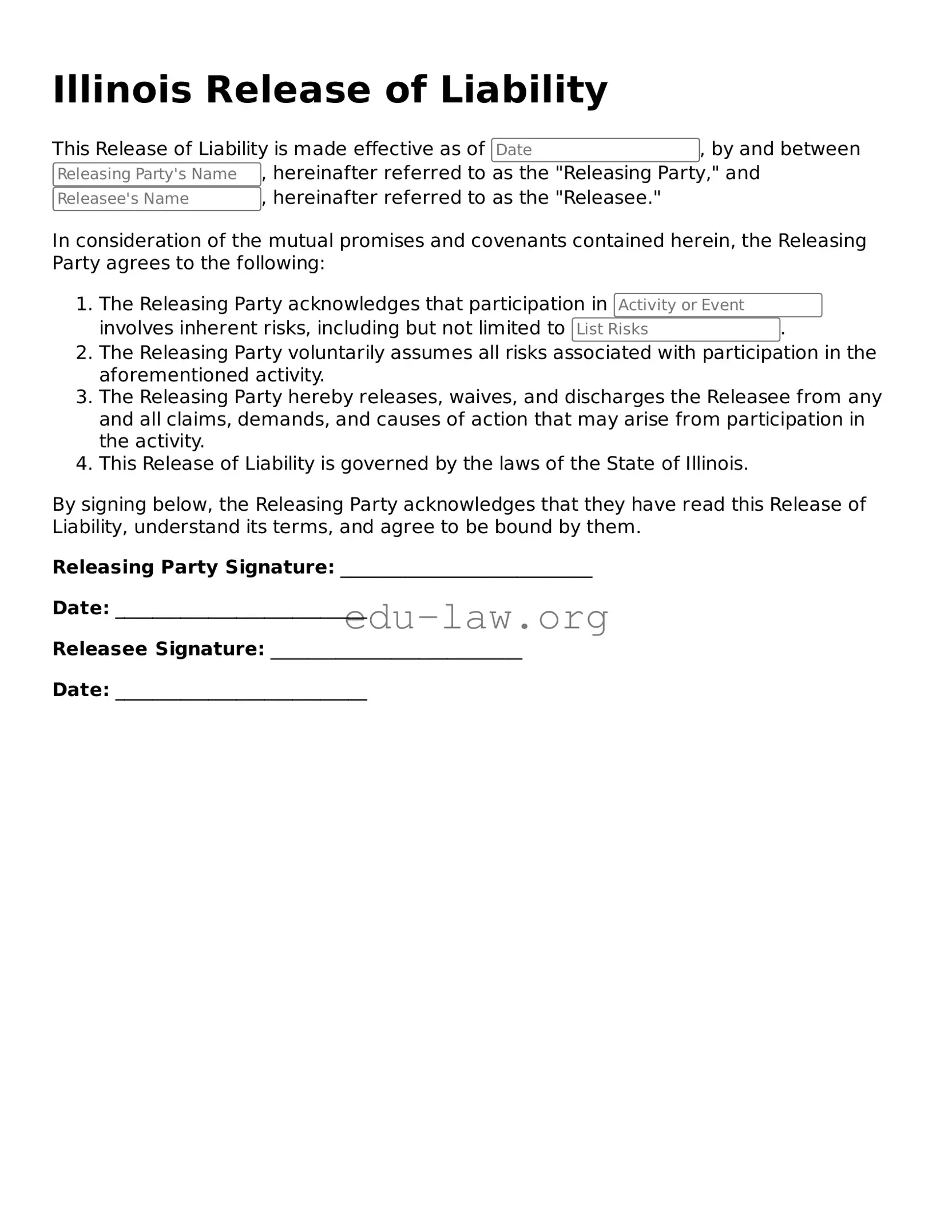
Illinois Release of Liability
This Release of Liability is made effective as of , by and between , hereinafter referred to as the "Releasing Party," and , hereinafter referred to as the "Releasee."
In consideration of the mutual promises and covenants contained herein, the Releasing Party agrees to the following:
By signing below, the Releasing Party acknowledges that they have read this Release of Liability, understand its terms, and agree to be bound by them.
Releasing Party Signature: ___________________________
Date: ___________________________
Releasee Signature: ___________________________
Date: ___________________________
| Fact Name | Description |
|---|---|
| Purpose | The Illinois Release of Liability form is used to protect individuals and organizations from legal claims arising from injuries or damages during an activity. |
| Governing Law | This form is governed by Illinois law, particularly the principles of tort law and contract law. |
| Voluntary Participation | Participants must voluntarily sign the form, indicating their understanding of the risks involved. |
| Scope of Release | The release typically covers all claims, including negligence, but may not cover gross negligence or intentional misconduct. |
| Minors | For minors, a parent or guardian must sign the form to ensure the minor's participation is legally acknowledged. |
| Limitations | Some activities may not be eligible for a release of liability due to specific state regulations or public policy concerns. |
| Enforceability | The enforceability of the form can depend on its clarity and whether it meets state legal requirements. |
Completing the Illinois Release of Liability form is an important step in ensuring that all parties involved understand the terms and conditions associated with the activity in question. After filling out the form, it will need to be signed and dated to make it legally binding.
What is the purpose of the Illinois Release of Liability form?
The Illinois Release of Liability form is designed to protect an organization or individual from legal claims related to injuries or damages that may occur during an activity. By signing this form, participants acknowledge the risks involved and agree not to hold the organizer liable for any injuries sustained while participating in the activity.
Who should use the Illinois Release of Liability form?
This form is commonly used by businesses, event organizers, sports teams, and recreational facilities. Any entity that offers activities with inherent risks, such as sports events, outdoor adventures, or workshops, can benefit from using this form to mitigate potential legal issues.
Is the Illinois Release of Liability form legally binding?
Generally, the form is considered legally binding if it meets certain criteria. The language must be clear and unambiguous, and participants must voluntarily sign it. However, courts may not enforce the release if it is deemed overly broad or if it attempts to waive liability for gross negligence or willful misconduct.
Can minors sign the Illinois Release of Liability form?
Minors cannot legally enter into contracts, including liability waivers. Therefore, a parent or legal guardian must sign the form on behalf of the minor. It is essential to ensure that the guardian understands the risks involved and the implications of signing the release.
How should the Illinois Release of Liability form be filled out?
The form should include the names of the parties involved, a detailed description of the activity, and a clear statement of the risks associated with the activity. It should also contain a signature line for participants or their guardians and a date line to indicate when the form was signed. Ensuring that all required information is complete will help reinforce the validity of the document.
What should be done with the Illinois Release of Liability form after it is signed?
Once the form is signed, it should be kept on file by the organization or individual that required it. This record may be necessary for legal protection in the event of a claim. It is advisable to store the forms securely and maintain them for a reasonable period, typically several years, depending on the nature of the activity and applicable laws.
Failing to read the entire form carefully. Many individuals overlook important sections, which can lead to misunderstandings about their rights and responsibilities.
Not providing complete information. Omitting details such as names, dates, or specific activities can invalidate the release.
Using unclear language. Vague terms or descriptions can create confusion and may not hold up in legal situations.
Neglecting to date the form. A missing date can lead to questions about when the release was signed, which may affect its enforceability.
Signing without understanding the implications. It’s crucial to comprehend what rights are being waived; otherwise, individuals may unintentionally forfeit important legal protections.
Not having witnesses or notarization when required. Certain situations may necessitate additional verification to ensure the release is binding.
Overlooking the need for a guardian's signature for minors. If the participant is underage, a parent or guardian must sign to validate the release.
Assuming all releases are the same. Each release of liability can vary significantly, and using a generic form without considering specific circumstances may lead to issues.
When engaging in activities that require a Release of Liability form in Illinois, it's essential to be aware of other documents that may complement it. These forms help clarify responsibilities and ensure all parties understand their rights. Here’s a list of commonly used forms and documents:
Understanding these forms can enhance your awareness of the legal landscape surrounding activities that involve risk. By using these documents appropriately, individuals and organizations can foster a safer environment for everyone involved.
The Illinois Release of Liability form shares similarities with the Waiver of Liability. Both documents serve to protect an organization or individual from legal claims resulting from injuries or damages incurred during an activity. By signing a Waiver of Liability, participants acknowledge the risks involved and agree not to hold the organization responsible. This mutual understanding fosters a safer environment for both parties, as participants willingly accept the inherent risks associated with the activity.
Another document akin to the Illinois Release of Liability is the Hold Harmless Agreement. This agreement involves one party agreeing not to hold the other liable for any claims, damages, or losses that may arise. Like the Release of Liability, it emphasizes the importance of informed consent. Participants in activities covered by a Hold Harmless Agreement recognize potential risks and agree to assume responsibility for any resulting injuries, thereby shielding the other party from legal repercussions.
The Participation Agreement is also comparable to the Illinois Release of Liability. This document outlines the terms and conditions under which an individual agrees to participate in an event or activity. It often includes a section on liability, where participants acknowledge risks and agree to waive certain rights to sue. The focus here is on ensuring that participants understand their role and the potential dangers involved, similar to the intent behind the Release of Liability form.
In addition, the Consent to Treat form bears resemblance to the Illinois Release of Liability. While primarily used in medical contexts, both documents require individuals to acknowledge risks. A Consent to Treat form allows medical professionals to provide care while ensuring that patients understand the potential risks involved in treatment. This acknowledgment is crucial in establishing a clear understanding between the parties, akin to what is achieved through a Release of Liability.
The Indemnity Agreement is another document that aligns closely with the Illinois Release of Liability. In an Indemnity Agreement, one party agrees to compensate the other for any losses or damages that may occur. This document often complements a Release of Liability by providing an additional layer of protection. While the Release focuses on preventing claims, the Indemnity Agreement ensures that any claims that do arise will be financially covered by the indemnifying party.
Lastly, the Assumption of Risk form shares fundamental characteristics with the Illinois Release of Liability. Participants sign this document to acknowledge their understanding of the risks associated with an activity. By doing so, they accept those risks and agree not to hold the organizers liable for any injuries sustained. This proactive approach to risk management aligns closely with the objectives of a Release of Liability, which seeks to inform and protect both parties involved.
When filling out the Illinois Release of Liability form, attention to detail is crucial. Here are some important dos and don'ts to keep in mind:
Following these guidelines can help ensure that your Release of Liability form is processed smoothly and effectively.
Understanding the Illinois Release of Liability form can be challenging, and several misconceptions often arise. Below is a list of common misunderstandings about this important document.
Being aware of these misconceptions can help individuals make informed decisions when it comes to signing a Release of Liability in Illinois. Understanding the nuances of this document is essential for both participants and organizers.
When considering the Illinois Release of Liability form, it is essential to understand its purpose and how to properly complete it. Here are some key takeaways to keep in mind:
Understanding these key points can help ensure that the Illinois Release of Liability form is used effectively and responsibly.