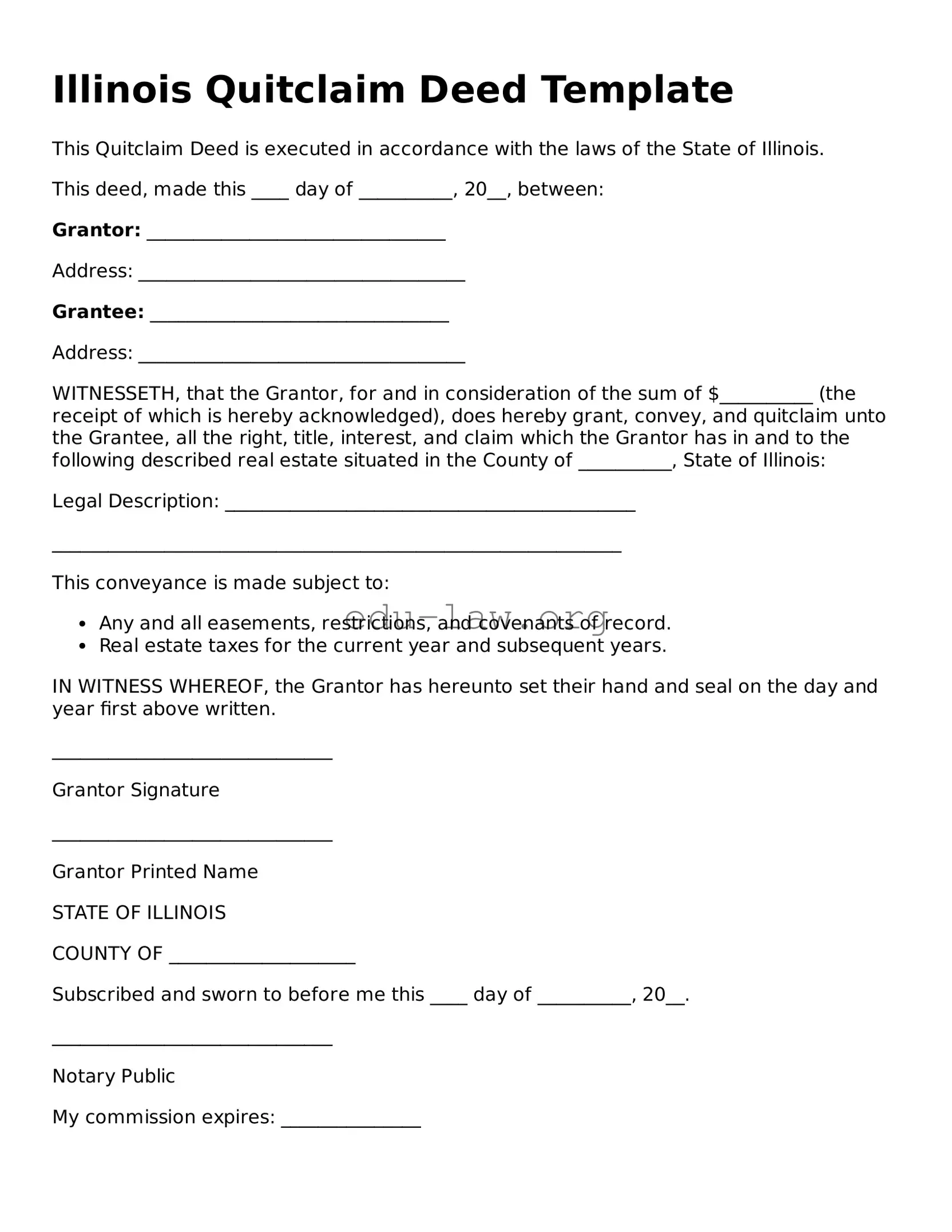
The Illinois Quitclaim Deed form serves as an important legal document in real estate transactions, allowing property owners to transfer their interest in a property to another individual or entity without making any guarantees about the title. This form is particularly useful in situations where the seller may not have complete knowledge of the property's title history or when the transfer is between family members or acquaintances. The quitclaim deed is straightforward, requiring essential information such as the names of the parties involved, a description of the property, and the date of the transfer. It is important to note that this deed does not provide any warranties, meaning the buyer assumes the risk regarding any potential claims or issues with the title. Understanding the nuances of this form can help individuals navigate property transfers more effectively while ensuring that all legal requirements are met for a valid transaction.
Illinois Quitclaim Deed Template
This Quitclaim Deed is executed in accordance with the laws of the State of Illinois.
This deed, made this ____ day of __________, 20__, between:
Grantor: ________________________________
Address: ___________________________________
Grantee: ________________________________
Address: ___________________________________
WITNESSETH, that the Grantor, for and in consideration of the sum of $__________ (the receipt of which is hereby acknowledged), does hereby grant, convey, and quitclaim unto the Grantee, all the right, title, interest, and claim which the Grantor has in and to the following described real estate situated in the County of __________, State of Illinois:
Legal Description: ____________________________________________
_____________________________________________________________
This conveyance is made subject to:
IN WITNESS WHEREOF, the Grantor has hereunto set their hand and seal on the day and year first above written.
______________________________
Grantor Signature
______________________________
Grantor Printed Name
STATE OF ILLINOIS
COUNTY OF ____________________
Subscribed and sworn to before me this ____ day of __________, 20__.
______________________________
Notary Public
My commission expires: _______________
| Fact Name | Description |
|---|---|
| Definition | The Illinois Quitclaim Deed is a legal document used to transfer ownership of real estate without any warranties or guarantees regarding the title. |
| Governing Law | This form is governed by the Illinois Compiled Statutes, specifically 765 ILCS 1005, which outlines the requirements and processes for property transfers. |
| Use Cases | Commonly used among family members, in divorce settlements, or to clear up title issues, the quitclaim deed provides a straightforward way to transfer property rights. |
| Requirements | To be valid, the deed must be signed by the grantor, notarized, and delivered to the grantee. It should also be recorded with the local county recorder's office. |
| Limitations | Since a quitclaim deed offers no guarantees, the grantee assumes the risk of any title defects. It's advisable to conduct a title search before accepting a property through this deed. |
Once you have the Illinois Quitclaim Deed form ready, it's time to fill it out correctly. This form is essential for transferring property ownership. Follow the steps below to ensure all necessary information is included and accurately presented.
After completing these steps, your Quitclaim Deed will be ready for submission. Make sure to keep a copy for your records once it has been filed.
What is a Quitclaim Deed in Illinois?
A Quitclaim Deed is a legal document used to transfer ownership of real estate from one person to another. In Illinois, this type of deed allows the grantor to relinquish any claim they may have on a property, without guaranteeing that they hold clear title. It is often used among family members or in situations where the parties know each other well.
When should I use a Quitclaim Deed?
You might consider using a Quitclaim Deed when transferring property between family members, adding or removing a spouse from the title, or clearing up title issues. It’s a straightforward way to transfer ownership without the need for extensive legal processes.
How do I fill out an Illinois Quitclaim Deed?
Filling out the Quitclaim Deed requires basic information about the property and the parties involved. You will need to include the names of the grantor and grantee, a legal description of the property, and the date of the transfer. Make sure to sign the document in front of a notary public to make it legally binding.
Do I need to notarize the Quitclaim Deed?
Yes, a Quitclaim Deed must be notarized in Illinois. This means that the person transferring the property (the grantor) needs to sign the document in front of a notary public. The notary will then add their seal, which helps confirm that the signature is valid.
Is a Quitclaim Deed the same as a Warranty Deed?
No, a Quitclaim Deed is not the same as a Warranty Deed. A Warranty Deed provides guarantees about the title, meaning the grantor assures the grantee that they own the property free and clear of any claims. In contrast, a Quitclaim Deed offers no such guarantees; it simply transfers whatever interest the grantor has in the property.
Are there any fees associated with a Quitclaim Deed?
Yes, there may be fees involved when filing a Quitclaim Deed. In Illinois, you will typically need to pay a recording fee to the county recorder’s office where the property is located. The fee can vary by county, so it’s a good idea to check with the local office for specific amounts.
How do I record a Quitclaim Deed in Illinois?
To record a Quitclaim Deed in Illinois, you will need to take the completed and notarized document to the county recorder’s office. There, you will submit the deed along with any required fees. Once recorded, the deed becomes part of the public record, providing official notice of the ownership transfer.
Can I revoke a Quitclaim Deed after it has been executed?
Once a Quitclaim Deed is executed and recorded, it cannot be revoked unilaterally. However, the grantor and grantee can agree to reverse the transfer by executing another deed. This new deed would need to be properly filled out, signed, and recorded to reflect the change in ownership.
Incorrect Property Description: One of the most common mistakes is failing to provide a complete and accurate description of the property. This includes the street address, legal description, and any relevant parcel numbers. Without this information, the deed may not be valid.
Missing Signatures: All parties involved in the transfer must sign the Quitclaim Deed. If even one signature is missing, the document may be deemed incomplete and unenforceable.
Not Notarizing the Document: A Quitclaim Deed must be notarized to be legally binding. Failing to have the document notarized can lead to issues when trying to record it with the county.
Incorrect Names: Using incorrect names or misspellings can create confusion and complications. Ensure that all names are spelled correctly and match the names on the original title.
Omitting the Date: The date on which the deed is executed is essential. Without it, the deed may not be considered valid, and this could affect the transfer of ownership.
Failure to Record the Deed: After completing the Quitclaim Deed, it is crucial to record it with the appropriate county office. Not recording the deed can lead to challenges in proving ownership in the future.
When dealing with property transfers in Illinois, the Quitclaim Deed form is often accompanied by several other important documents. These forms help ensure that the transfer is clear and legally binding. Below is a list of common documents used alongside the Quitclaim Deed.
Having these documents prepared and organized can streamline the property transfer process. Each form plays a specific role in ensuring that the transaction is completed smoothly and legally. Always consider consulting a professional to ensure all necessary paperwork is in order.
The Warranty Deed is a document that, like the Quitclaim Deed, transfers ownership of real property. However, it offers more protection to the buyer. In a Warranty Deed, the seller guarantees that they hold clear title to the property and have the right to sell it. This means that if any issues arise regarding ownership, the seller is responsible for resolving them. In contrast, the Quitclaim Deed does not provide such assurances, making it a riskier option for the buyer.
The Bargain and Sale Deed also shares similarities with the Quitclaim Deed. This type of deed transfers ownership but implies that the seller has some interest in the property. Unlike the Quitclaim Deed, which makes no promises about the title, the Bargain and Sale Deed suggests that the seller has the right to convey the property. However, it does not guarantee that the title is free of defects, leaving some uncertainty for the buyer.
A Special Purpose Deed, such as a Deed in Lieu of Foreclosure, resembles the Quitclaim Deed in that it transfers property without the usual guarantees. This type of deed is often used when a homeowner voluntarily gives up their property to the lender to avoid foreclosure. While it serves a specific purpose, it lacks the warranties found in other deeds, similar to the Quitclaim Deed’s straightforward transfer of ownership without assurances.
The Trustee’s Deed is another document similar to the Quitclaim Deed. It is used when property is transferred by a trustee, often in the context of a trust or bankruptcy. Like the Quitclaim Deed, the Trustee’s Deed does not provide warranties about the title. This means that the buyer must be cautious, as they may not receive the same level of protection as they would with a Warranty Deed.
Finally, the Gift Deed is akin to the Quitclaim Deed in that it typically involves a transfer of property without monetary compensation. When someone gifts property to another person, they may use a Gift Deed to formalize the transfer. Similar to the Quitclaim Deed, a Gift Deed does not guarantee clear title or the absence of liens, placing the onus on the recipient to investigate any potential issues with the property.
When filling out the Illinois Quitclaim Deed form, it is essential to follow certain guidelines to ensure accuracy and legality. Here are five things you should and shouldn't do:
When dealing with real estate transactions in Illinois, the Quitclaim Deed form can often lead to confusion. Here are ten common misconceptions about this form, along with clarifications to help you navigate its use.
Understanding these misconceptions can help you make informed decisions when using a quitclaim deed in Illinois. Always consider consulting with a legal professional for guidance tailored to your specific situation.
Filling out and using the Illinois Quitclaim Deed form can be straightforward if you keep a few key points in mind. Here are some important takeaways to consider:
By following these key takeaways, you can navigate the process of filling out and using the Illinois Quitclaim Deed form with confidence.