In Illinois, couples considering marriage often turn to a prenuptial agreement as a practical tool for managing their financial futures. This legal document outlines the rights and responsibilities of each partner regarding property, debts, and potential spousal support in the event of divorce or separation. By addressing these matters before marriage, individuals can protect their assets and clarify expectations, which can ultimately reduce conflicts later on. The Illinois Prenuptial Agreement form typically includes sections that specify how property will be divided, detail any premarital assets, and establish guidelines for financial support. It is essential for both parties to fully disclose their financial situations and to understand the implications of the agreement, as fairness and transparency are crucial for its enforceability. Additionally, the agreement must be signed voluntarily by both parties and ideally witnessed to ensure its validity. Understanding these major aspects can empower couples to make informed decisions about their marital arrangements and foster a sense of security as they embark on their journey together.
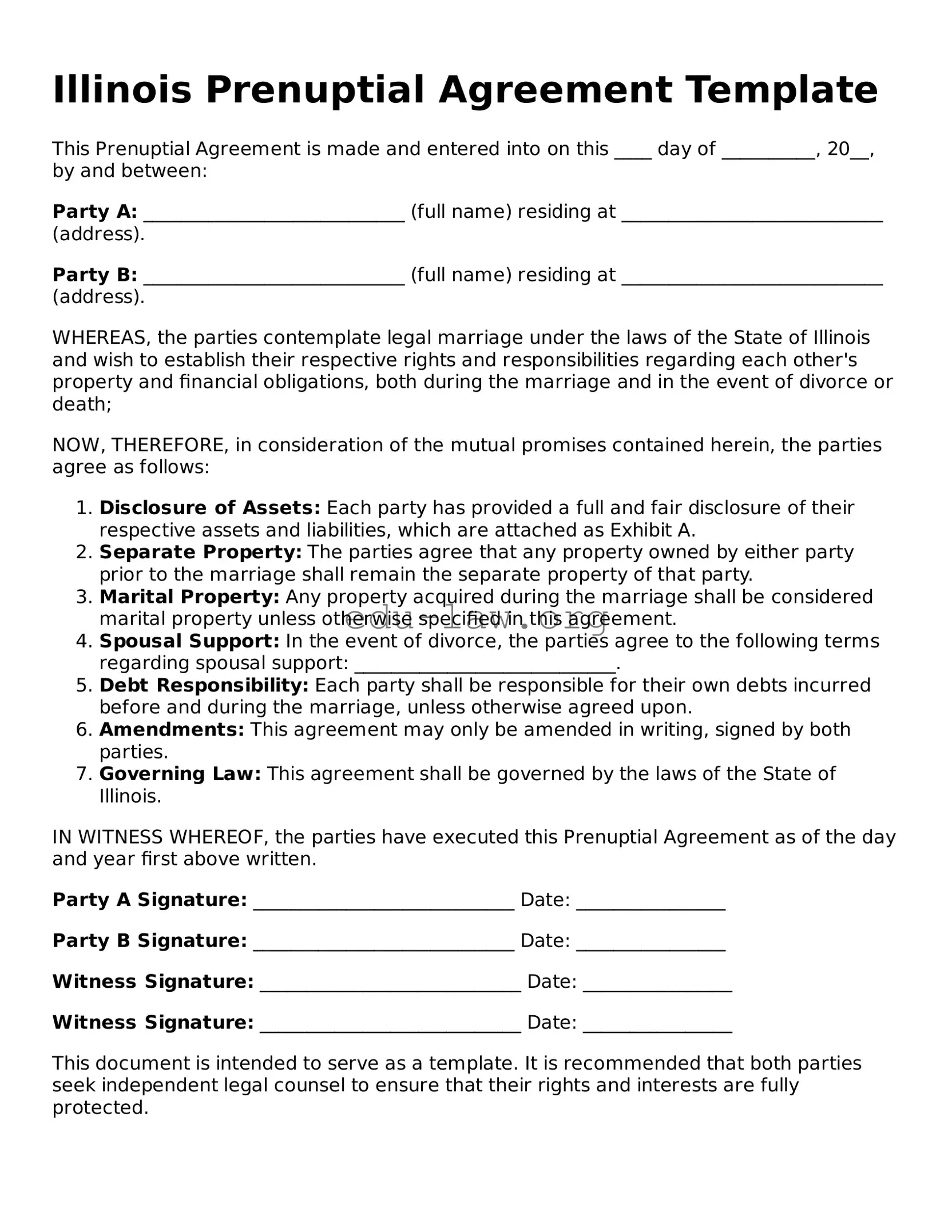
Illinois Prenuptial Agreement Template
This Prenuptial Agreement is made and entered into on this ____ day of __________, 20__, by and between:
Party A: ____________________________ (full name) residing at ____________________________ (address).
Party B: ____________________________ (full name) residing at ____________________________ (address).
WHEREAS, the parties contemplate legal marriage under the laws of the State of Illinois and wish to establish their respective rights and responsibilities regarding each other's property and financial obligations, both during the marriage and in the event of divorce or death;
NOW, THEREFORE, in consideration of the mutual promises contained herein, the parties agree as follows:
IN WITNESS WHEREOF, the parties have executed this Prenuptial Agreement as of the day and year first above written.
Party A Signature: ____________________________ Date: ________________
Party B Signature: ____________________________ Date: ________________
Witness Signature: ____________________________ Date: ________________
Witness Signature: ____________________________ Date: ________________
This document is intended to serve as a template. It is recommended that both parties seek independent legal counsel to ensure that their rights and interests are fully protected.
| Fact Name | Description |
|---|---|
| Definition | An Illinois prenuptial agreement is a legal document created by two individuals before marriage, outlining the division of assets and responsibilities in the event of divorce or separation. |
| Governing Laws | The Illinois Uniform Premarital Agreement Act governs prenuptial agreements in Illinois, providing a framework for their enforceability and requirements. |
| Requirements | For a prenuptial agreement to be valid in Illinois, it must be in writing and signed by both parties. Oral agreements are not enforceable. |
| Disclosure | Full financial disclosure is essential. Each party should provide complete information about their assets, debts, and income to ensure fairness. |
| Enforceability | Illinois courts will enforce a prenuptial agreement unless it is proven to be unconscionable or was signed under duress. |
| Amendments | Parties can amend a prenuptial agreement after marriage, but such changes must also be in writing and signed by both parties to be valid. |
Completing the Illinois Prenuptial Agreement form requires careful attention to detail. The following steps will guide you through the process of filling out the necessary information accurately and thoroughly.
What is a prenuptial agreement in Illinois?
A prenuptial agreement, often called a prenup, is a legal document that a couple signs before getting married. It outlines how assets and debts will be handled in the event of divorce or separation. In Illinois, this agreement must be in writing and signed by both parties to be enforceable.
Why should I consider a prenuptial agreement?
Many couples choose to create a prenup to protect their individual assets and clarify financial responsibilities. It can help prevent disputes in case of divorce and provide peace of mind. If one partner has significant assets, a prenup can also protect those assets from being divided in a divorce.
What should be included in an Illinois prenuptial agreement?
Typically, a prenup includes details about property ownership, debt management, and how income will be treated during the marriage. Couples can also address spousal support and other financial arrangements. It's important to be clear and specific to avoid misunderstandings later.
Do both parties need to have a lawyer?
While it is not legally required for both parties to have separate attorneys, it is highly recommended. Having independent legal advice ensures that both individuals fully understand their rights and the implications of the agreement. This can also help prevent claims of coercion or misunderstanding later on.
How do we create a prenuptial agreement in Illinois?
To create a prenuptial agreement, both parties should discuss their financial situations and what they want to include. It’s wise to draft the agreement with the help of an attorney. Once the document is prepared, both parties must review it, make any necessary changes, and sign it before the wedding.
Can a prenuptial agreement be changed after marriage?
Yes, a prenuptial agreement can be modified or revoked after marriage. Both parties must agree to any changes, and it’s best to document these changes in writing. Just like the original agreement, any modifications should be signed by both parties to be enforceable.
What happens if we don’t have a prenuptial agreement?
If a couple does not have a prenup, Illinois state laws will determine how assets and debts are divided in the event of a divorce. This can lead to outcomes that may not align with either party’s wishes. It’s often beneficial to have a prenup to ensure both parties’ interests are protected.
Is a prenuptial agreement enforceable in Illinois?
Yes, a prenuptial agreement is enforceable in Illinois as long as it meets certain requirements. It must be in writing, signed by both parties, and entered into voluntarily. If the agreement is deemed fair and reasonable at the time of signing, it is likely to be upheld in court.
What should we do if we have questions about our prenuptial agreement?
If you have questions about your prenuptial agreement, it’s best to consult with a qualified attorney who specializes in family law. They can provide guidance specific to your situation and help ensure that your agreement is valid and enforceable.
Not fully disclosing assets and debts. It is important for both parties to list all their assets and debts accurately. Failing to do so can lead to disputes later.
Using vague or unclear language. Specificity is key in a prenuptial agreement. Ambiguous terms can create confusion and may not hold up in court.
Not having the agreement reviewed by a lawyer. Legal advice is valuable. A lawyer can ensure that the agreement meets all legal requirements and protects both parties' interests.
Signing under pressure. Both parties should feel comfortable and free to discuss the terms. Signing the agreement without adequate time for consideration can lead to claims of coercion.
A prenuptial agreement is an important document that can help couples define their financial rights and responsibilities before marriage. Along with this agreement, several other forms and documents may be useful for a comprehensive understanding of marital rights and obligations. Here is a list of commonly used documents that often accompany a prenuptial agreement in Illinois.
Understanding these documents can help couples navigate their financial landscape and prepare for their future together. Each document serves a unique purpose and can provide clarity and protection for both parties involved.
The Illinois Prenuptial Agreement form shares similarities with a Cohabitation Agreement. Both documents outline the rights and responsibilities of partners, whether married or living together. They address property division, financial obligations, and other important matters, ensuring clarity and reducing potential conflicts in the event of separation or divorce.
A Marriage Contract is another document akin to the Illinois Prenuptial Agreement. Like a prenuptial agreement, it specifies how assets and debts will be managed during the marriage. This contract can also include provisions for spousal support and property distribution, providing a framework for financial arrangements during the marriage.
The Postnuptial Agreement is closely related to the Prenuptial Agreement. While a prenuptial agreement is created before marriage, a postnuptial agreement is established after the wedding. Both serve to protect individual assets and define financial responsibilities, but the timing of their creation distinguishes them.
When filling out the Illinois Prenuptial Agreement form, it's important to approach the process carefully. Here are some essential do's and don'ts to keep in mind:
Understanding prenuptial agreements can be challenging, especially with many misconceptions surrounding them. Here are nine common misunderstandings about the Illinois Prenuptial Agreement form:
This is not true. Anyone can benefit from a prenuptial agreement, regardless of their financial status. It helps clarify financial expectations and protect individual assets.
While they are often associated with divorce, these agreements can also clarify financial responsibilities during the marriage, providing peace of mind.
In Illinois, prenuptial agreements are generally enforceable as long as they meet specific legal requirements, such as being in writing and signed by both parties.
While many topics can be included, some issues, like child custody and support, are typically not enforceable in prenuptial agreements.
Both parties should seek independent legal advice to ensure that the agreement is fair and that their rights are protected.
These agreements can be amended or revoked by mutual consent, allowing couples to adapt to changing circumstances.
Many couples view them as a practical tool for open communication about finances, rather than a lack of trust.
While typically established before marriage, prenuptial agreements can also be created during the marriage, often referred to as postnuptial agreements.
While they require legal knowledge, many resources and templates are available to help couples understand and create an agreement that suits their needs.
When considering a prenuptial agreement in Illinois, it is important to understand several key aspects of the process. Here are some essential takeaways: