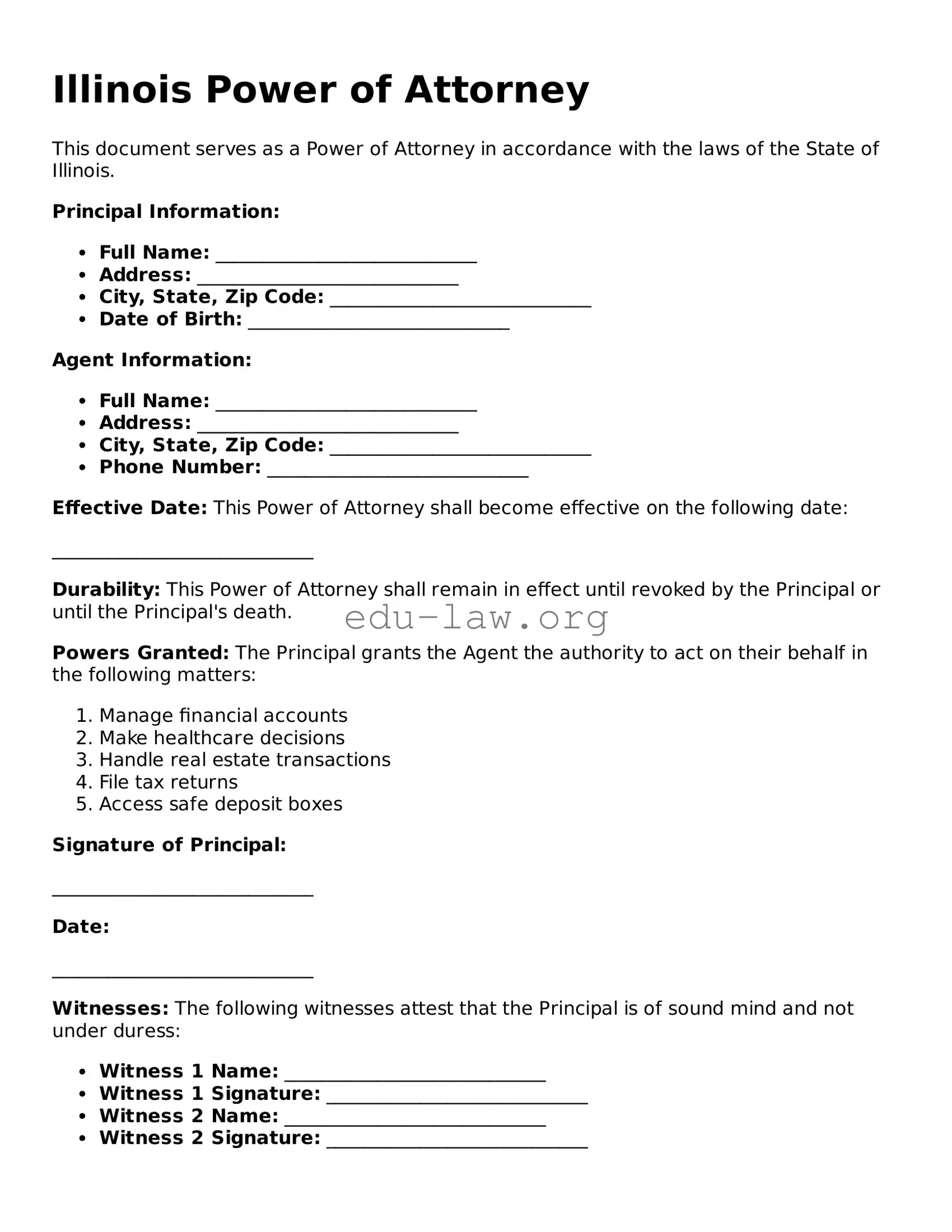
The Illinois Power of Attorney form serves as a vital legal document, empowering individuals to designate another person to make decisions on their behalf in various situations, particularly concerning financial and healthcare matters. This form is essential for anyone looking to ensure that their wishes are honored when they may not be in a position to communicate them. By completing this document, individuals can specify the scope of authority granted to their chosen agent, whether it be for general purposes or limited to specific tasks. Importantly, the Illinois Power of Attorney also allows for the designation of a healthcare representative, who can make medical decisions if the principal becomes incapacitated. Understanding the nuances of this form, including the rights and responsibilities of both the principal and the agent, is crucial for effective planning. Furthermore, the document requires proper execution, which includes signatures and, in some cases, notarization, to ensure its validity. As individuals navigate the complexities of life, having a Power of Attorney in place can provide peace of mind, knowing that their interests will be safeguarded by a trusted person when needed most.
Illinois Power of Attorney
This document serves as a Power of Attorney in accordance with the laws of the State of Illinois.
Principal Information:
Agent Information:
Effective Date: This Power of Attorney shall become effective on the following date:
____________________________
Durability: This Power of Attorney shall remain in effect until revoked by the Principal or until the Principal's death.
Powers Granted: The Principal grants the Agent the authority to act on their behalf in the following matters:
Signature of Principal:
____________________________
Date:
____________________________
Witnesses: The following witnesses attest that the Principal is of sound mind and not under duress:
Notary Public: This document must be notarized to be valid.
____________________________
Notary Public Signature
____________________________
Date
| Fact Name | Description |
|---|---|
| Definition | The Illinois Power of Attorney form allows an individual to designate someone else to make decisions on their behalf regarding financial or health matters. |
| Governing Law | This form is governed by the Illinois Power of Attorney Act (755 ILCS 45/1-1 et seq.), which outlines the legal framework for powers of attorney in the state. |
| Types of Powers | There are two main types of powers of attorney: one for financial decisions and another for healthcare decisions. Each serves a distinct purpose. |
| Durability | The Illinois Power of Attorney can be durable, meaning it remains effective even if the principal becomes incapacitated, or it can be non-durable, which means it becomes void upon incapacitation. |
| Signature Requirements | The form must be signed by the principal and witnessed by at least one individual or notarized to ensure its validity. |
| Revocation | The principal has the right to revoke the power of attorney at any time, provided they are mentally competent to do so. |
Filling out the Illinois Power of Attorney form is a straightforward process. It requires careful attention to detail to ensure that all necessary information is provided accurately. Once completed, the form will need to be signed and possibly notarized, depending on your specific requirements.
What is a Power of Attorney in Illinois?
A Power of Attorney (POA) in Illinois is a legal document that allows one person, known as the principal, to grant another person, called the agent or attorney-in-fact, the authority to make decisions on their behalf. This can include financial matters, healthcare decisions, or both. The principal must be of sound mind when creating the document, and the agent must act in the best interest of the principal. The POA can be tailored to be effective immediately or only upon the principal’s incapacitation.
How do I create a Power of Attorney in Illinois?
To create a Power of Attorney in Illinois, you must complete a specific form that outlines the powers you wish to grant to your agent. Illinois law requires that the form be signed by the principal in the presence of a witness or a notary public. It is crucial to choose an agent you trust, as they will have significant control over your affairs. Once the document is signed and notarized, it is advisable to provide copies to your agent and any relevant institutions, such as banks or healthcare providers.
Can I revoke a Power of Attorney in Illinois?
Yes, you can revoke a Power of Attorney in Illinois at any time, as long as you are mentally competent. To do this, you should create a written revocation document that clearly states your intention to revoke the previous POA. It is important to notify your agent and any institutions that may have relied on the original document. Additionally, you should destroy any copies of the original POA to prevent confusion.
What happens if I do not have a Power of Attorney in place?
If you do not have a Power of Attorney in place and become incapacitated, your loved ones may face challenges in managing your affairs. In such cases, they might need to go through a court process to obtain guardianship, which can be time-consuming and costly. Having a POA allows you to designate someone you trust to make decisions for you, ensuring that your wishes are respected and reducing the burden on your family during difficult times.
Not understanding the scope of authority: Many individuals fail to fully grasp what powers they are granting to their agent. This can lead to unintended consequences if the agent makes decisions that the principal did not intend.
Choosing the wrong agent: Selecting someone who is not trustworthy or lacks the necessary judgment can create significant issues. It's crucial to choose an agent who is reliable and understands your wishes.
Failing to specify limitations: Without clear limitations, agents may have broad powers that could be misused. Clearly outlining what decisions the agent can and cannot make is essential.
Not signing the document correctly: The Power of Attorney must be signed by the principal and may require witnesses or notarization. Failing to follow these requirements can invalidate the document.
Neglecting to update the form: Life changes, such as divorce or the death of an agent, necessitate updates to the Power of Attorney. Failing to revise the document can lead to confusion and disputes.
Overlooking state-specific requirements: Each state has its own rules regarding Power of Attorney forms. Ignoring Illinois-specific requirements can result in the form being deemed invalid.
Not discussing the document with the agent: Many people fill out the form without informing the chosen agent of their role. This lack of communication can lead to misunderstandings about expectations and responsibilities.
When establishing a Power of Attorney in Illinois, several other forms and documents may be relevant. These documents can help clarify your intentions and ensure your wishes are respected. Below is a list of commonly used forms alongside the Illinois Power of Attorney.
Having these documents in place can provide clarity and ensure that your wishes are honored in various situations. It is advisable to consult with a legal professional to ensure all forms are completed correctly and meet your needs.
The Illinois Power of Attorney form shares similarities with the Durable Power of Attorney. Both documents allow individuals to appoint someone to make decisions on their behalf. The key difference lies in the durability; a Durable Power of Attorney remains effective even if the principal becomes incapacitated, ensuring that the appointed agent can continue to act without interruption.
Another document comparable to the Illinois Power of Attorney is the Medical Power of Attorney. This form specifically grants authority to an agent to make healthcare decisions when the principal is unable to do so. While the general Power of Attorney can cover a wide range of decisions, the Medical Power of Attorney focuses solely on medical matters, ensuring that the agent can make informed health-related choices.
The Living Will is also similar in purpose, but it serves a distinct function. A Living Will outlines an individual's wishes regarding end-of-life care and medical treatments. Unlike the Power of Attorney, which appoints someone to make decisions, a Living Will communicates the principal's preferences directly to healthcare providers, guiding them in critical situations.
The Financial Power of Attorney is another related document. This form specifically allows an agent to manage financial matters, such as banking and investments, on behalf of the principal. While the Illinois Power of Attorney can include financial powers, the Financial Power of Attorney is dedicated solely to financial affairs, making it a more focused option for those looking to delegate financial responsibilities.
The Guardianship document is similar in that it involves decision-making on behalf of another person. However, Guardianship typically arises when a court determines that an individual is unable to care for themselves. This legal arrangement grants a guardian the authority to make personal and financial decisions, often after a more formal process than what is required for a Power of Attorney.
The Trust document also bears resemblance to the Illinois Power of Attorney, particularly in its ability to manage assets. A Trust allows a person to transfer their assets to a trustee, who manages them for the benefit of beneficiaries. While a Power of Attorney grants authority to an agent to act on behalf of the principal, a Trust involves the transfer of ownership and management of assets, providing a different level of control and protection.
Lastly, the Advance Directive is similar as it combines elements of both the Living Will and the Medical Power of Attorney. This document allows individuals to specify their healthcare preferences and appoint someone to make decisions if they become incapacitated. It ensures that both the individual's wishes and their appointed agent's authority are clearly outlined, providing comprehensive guidance for medical situations.
Filling out the Illinois Power of Attorney form is an important task that requires attention to detail. Here are some essential dos and don’ts to keep in mind:
By following these guidelines, you can ensure that your Power of Attorney form is filled out correctly and effectively. This important document can help manage your affairs according to your wishes.
The Illinois Power of Attorney form is a crucial legal document that allows individuals to designate someone to make decisions on their behalf. However, several misconceptions can lead to confusion about its purpose and use. Here are six common misconceptions:
Understanding these misconceptions can help individuals make informed decisions about creating a Power of Attorney in Illinois. Properly executed, this document serves as an essential tool for managing one’s affairs and ensuring that personal wishes are honored.
Filling out and using the Illinois Power of Attorney form is an important step in ensuring your wishes are respected when you can no longer make decisions for yourself. Here are some key takeaways to keep in mind:
By following these guidelines, you can create a Power of Attorney that effectively communicates your wishes and protects your interests.