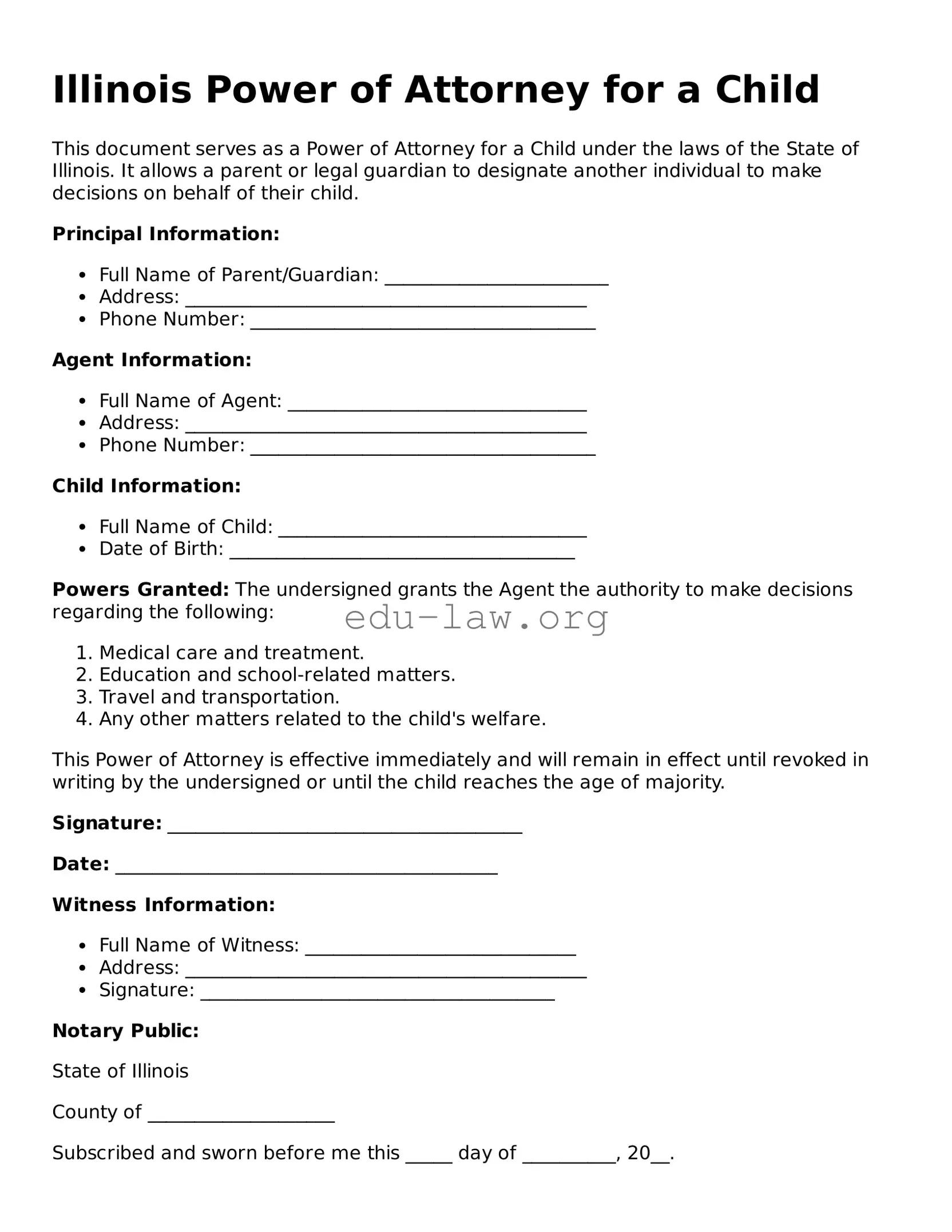
In the realm of parental responsibilities and guardianship, the Illinois Power of Attorney for a Child form serves as a vital tool for parents and guardians alike. This legal document allows a parent to designate another individual to make decisions on behalf of their child, particularly in situations where the parent may be temporarily unavailable. The form encompasses a range of responsibilities, including making healthcare decisions, managing educational matters, and overseeing general welfare. Notably, it is important for parents to understand that this form is not a permanent transfer of custody; rather, it is a temporary delegation of authority that can be tailored to specific time frames and situations. Additionally, the form requires the signatures of both the parent granting the power and the individual receiving it, ensuring that all parties are in agreement. By utilizing this form, parents can ensure that their children receive the care and attention they need, even when they cannot be present, thereby fostering a sense of security and continuity in the child's life.
Illinois Power of Attorney for a Child
This document serves as a Power of Attorney for a Child under the laws of the State of Illinois. It allows a parent or legal guardian to designate another individual to make decisions on behalf of their child.
Principal Information:
Agent Information:
Child Information:
Powers Granted: The undersigned grants the Agent the authority to make decisions regarding the following:
This Power of Attorney is effective immediately and will remain in effect until revoked in writing by the undersigned or until the child reaches the age of majority.
Signature: ______________________________________
Date: _________________________________________
Witness Information:
Notary Public:
State of Illinois
County of ____________________
Subscribed and sworn before me this _____ day of __________, 20__.
Notary Public Signature: _____________________________
My commission expires: _____________________________
| Fact Name | Details |
|---|---|
| Purpose | The Illinois Power of Attorney for a Child form allows a parent or guardian to designate another adult to make decisions on behalf of their child. |
| Governing Law | This form is governed by the Illinois Power of Attorney Act, 755 ILCS 45/1-1 et seq. |
| Eligibility | Any parent or legal guardian of a child can complete this form to grant authority to another individual. |
| Duration | The authority granted can be effective for a specific period or until revoked by the parent or guardian. |
| Types of Decisions | The designated adult can make decisions regarding education, health care, and other important aspects of the child's life. |
| Notarization | The form must be signed in the presence of a notary public to be legally binding. |
| Revocation | A parent or guardian can revoke the power of attorney at any time, provided they follow the proper procedures. |
| Limitations | This form does not grant the designated adult the right to make decisions regarding the child's adoption or custody. |
| Emergency Situations | The form can be particularly useful in emergency situations where the parent or guardian is unable to make decisions. |
| Accessibility | The Illinois Power of Attorney for a Child form is available online and can be completed and printed for use. |
Filling out the Illinois Power of Attorney for a Child form is a straightforward process. This document allows a parent or guardian to designate someone else to make decisions for their child. Follow the steps below to complete the form accurately.
What is a Power of Attorney for a Child in Illinois?
A Power of Attorney for a Child is a legal document that allows a parent or guardian to appoint someone else to make decisions on behalf of their child. This can include decisions about healthcare, education, and general welfare. The appointed individual, often referred to as the agent, can act in the best interest of the child when the parent or guardian is unavailable. This document is particularly useful for parents who travel frequently or for those who need temporary assistance in caring for their child.
Who can be appointed as an agent in the Power of Attorney for a Child?
In Illinois, the agent can be any responsible adult, such as a relative, family friend, or neighbor. However, it is essential to choose someone trustworthy who understands your values and can make decisions that align with your wishes. The agent must be at least 18 years old and capable of handling the responsibilities associated with caring for your child.
How long does the Power of Attorney for a Child remain in effect?
The Power of Attorney for a Child remains in effect until a specific date that you set in the document or until you revoke it. If no end date is specified, the authority granted to the agent typically lasts until the child turns 18 years old. Parents can also revoke the document at any time, provided they notify the agent and any relevant parties of the revocation.
Do I need to have the Power of Attorney for a Child notarized?
Yes, in Illinois, the Power of Attorney for a Child must be signed in the presence of a notary public. This notarization adds a layer of authenticity to the document and helps ensure that it is legally binding. It is advisable to keep a copy of the notarized document in a safe place and provide copies to the agent and any relevant institutions, such as schools or medical providers.
Can I modify the Power of Attorney for a Child after it has been created?
Yes, you can modify the Power of Attorney for a Child at any time. To make changes, you will need to create a new document that outlines the modifications. It is crucial to ensure that the new document is properly executed and notarized. Always communicate any changes to the appointed agent and keep copies of all versions of the document for your records.
Incomplete Information: One common mistake is failing to provide all required information. This includes not listing the child's full name, date of birth, or the names of the parents or guardians. Ensure every section is filled out accurately.
Not Specifying Powers Clearly: It's crucial to clearly outline the powers granted to the agent. Vague language can lead to misunderstandings about what the agent is authorized to do. Be specific about the decisions the agent can make on behalf of the child.
Forgetting Signatures: The form must be signed by both the parent or guardian and the agent. Omitting signatures invalidates the document. Always double-check that all necessary signatures are present before submission.
Not Notarizing the Document: In Illinois, the Power of Attorney for a Child form needs to be notarized to be legally binding. Failing to have the document notarized can render it ineffective. Make sure to visit a notary public for this step.
Using Outdated Forms: Laws and forms can change. Using an outdated version of the Power of Attorney for a Child form can lead to legal complications. Always obtain the latest version from a reliable source.
Neglecting to Discuss with the Agent: Before filling out the form, it is important to discuss the responsibilities and expectations with the chosen agent. Not doing so can result in confusion and potential issues in the future.
When establishing a Power of Attorney for a Child in Illinois, several additional forms and documents may be necessary to ensure comprehensive legal authority and protection for the child. Below is a list of commonly used documents that complement the Power of Attorney for a Child form.
These documents help clarify roles and responsibilities, ensuring that the child's best interests are prioritized. It is advisable to consult with a legal professional to ensure that all necessary forms are completed accurately and in compliance with Illinois law.
The Illinois Power of Attorney for a Child form is similar to the standard Power of Attorney document used for adults. Both forms allow an individual to designate someone else to make decisions on their behalf. In the case of a child, the parent or legal guardian assigns authority to another adult, typically for specific purposes such as medical decisions or educational needs. This document ensures that the designated person can act in the best interests of the child when the parent is unavailable.
Another related document is the Medical Power of Attorney. This form specifically grants authority to another person to make medical decisions for someone who is unable to do so. Like the Power of Attorney for a Child, it is crucial for emergencies. It allows the designated individual to access medical information and make choices about treatment, ensuring that the child's health needs are met promptly.
The Durable Power of Attorney is another similar document, which remains effective even if the person granting the power becomes incapacitated. This is particularly relevant for adults, but it has implications for children in situations where a guardian may need to act on behalf of the child if the parent is unable to do so due to illness or injury.
The Temporary Guardianship form also bears similarities to the Illinois Power of Attorney for a Child. This document allows a designated individual to care for a child for a limited period. While the Power of Attorney can be more flexible in terms of duration and scope, both documents serve to ensure that a responsible adult can make decisions for a child in the absence of their parent or guardian.
Another relevant document is the Child Custody Agreement. While primarily focused on the legal custody arrangement between parents, it often includes provisions that outline who can make decisions for the child in various situations. This agreement can complement the Power of Attorney by clarifying the roles and responsibilities of each party involved in the child's care.
The Consent to Medical Treatment form is also similar, as it allows a parent or guardian to authorize another adult to make medical decisions for their child. This form is often used in situations where a parent cannot be present, such as during school trips or extracurricular activities, ensuring that the child receives necessary medical attention without delay.
The Affidavit of Guardianship is another document that parallels the Illinois Power of Attorney for a Child. This affidavit allows an adult to assume temporary guardianship of a child, often used in situations where the parent is unable to care for the child for a short period. While it does not grant the same level of authority as a Power of Attorney, it serves a similar purpose in ensuring the child's welfare.
The Authorization for Release of Information form is also relevant. This document allows a parent to grant permission for another individual to access specific information about the child, such as educational or medical records. This is important for ensuring that the designated person can make informed decisions regarding the child's care and well-being.
Lastly, the Standby Guardian form is similar as it allows a designated individual to step in as a guardian for a child in the event of an emergency. This document is often used in situations where a parent anticipates being unable to care for their child temporarily. It ensures that there is a clear plan in place for the child's care and decision-making during that time.
Filling out the Illinois Power of Attorney for a Child form is an important step in ensuring that your child's needs are met when you are unable to be there. Here are six essential things to keep in mind as you complete this form.
By following these guidelines, you can confidently complete the Illinois Power of Attorney for a Child form, ensuring that your child's best interests are protected.
Understanding the Illinois Power of Attorney for a Child form is essential for parents and guardians. However, several misconceptions can cloud its importance and usage. Here are five common misunderstandings:
By clearing up these misconceptions, parents can better understand the benefits and limitations of the Illinois Power of Attorney for a Child form. Being informed helps ensure that children are cared for in the best possible way, no matter the circumstances.
Filling out and using the Illinois Power of Attorney for a Child form can be a straightforward process, but it is essential to understand its key aspects. Here are some important takeaways to consider:
Understanding these key points can help ensure that the Power of Attorney for a Child form is filled out correctly and used effectively. Taking these steps can provide peace of mind for parents and guardians while ensuring the child's needs are met.