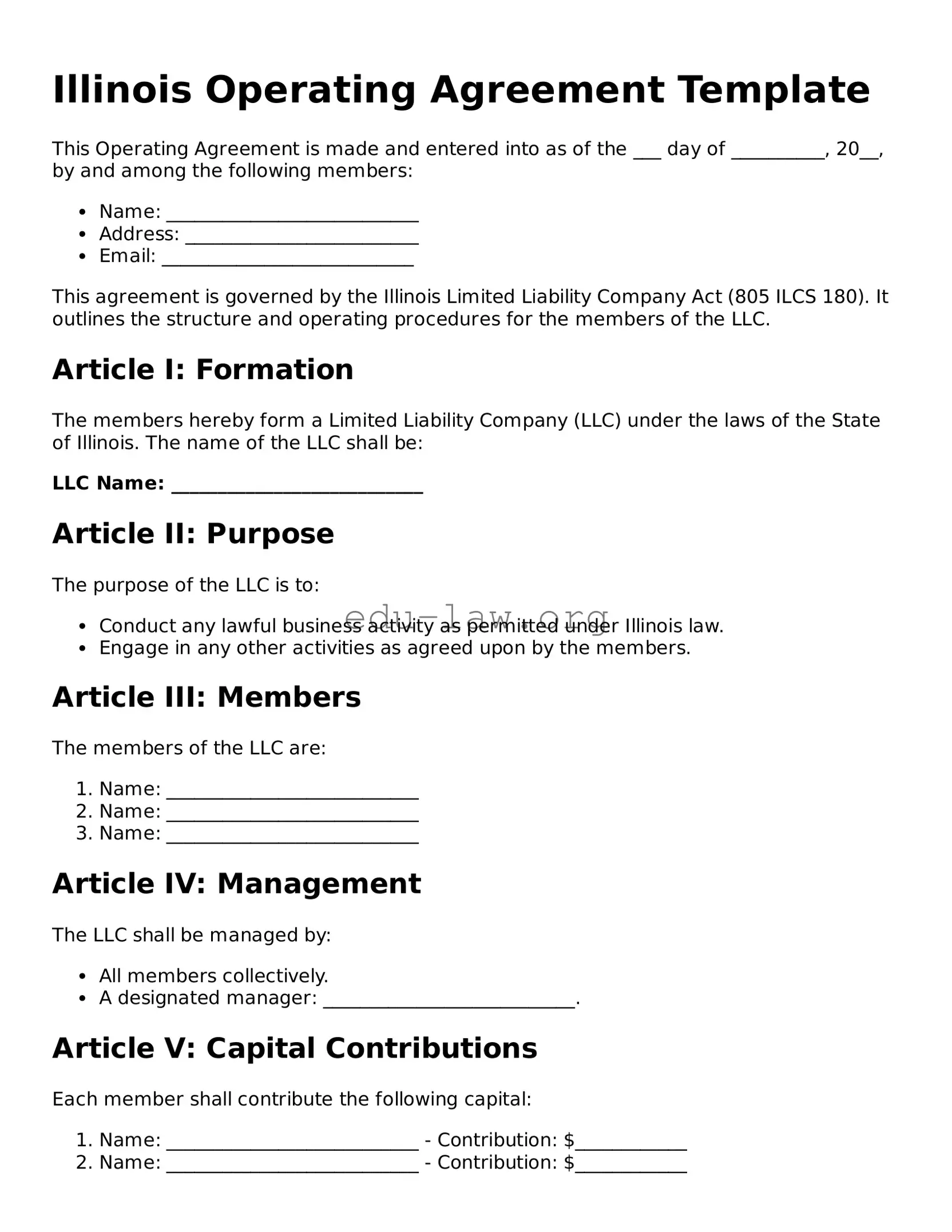
The Illinois Operating Agreement form plays a crucial role in the management and structure of Limited Liability Companies (LLCs) within the state. This document outlines the internal operations of the LLC, detailing the rights and responsibilities of its members. It typically includes provisions regarding the distribution of profits and losses, voting rights, and the process for making decisions. Additionally, the form addresses the procedures for adding or removing members, as well as the dissolution of the company. By establishing clear guidelines, the Operating Agreement helps prevent disputes and ensures that all members are on the same page regarding the management of the LLC. It serves as an essential tool for both new and existing businesses, providing a framework that supports the company's goals and facilitates smooth operations.
Illinois Operating Agreement Template
This Operating Agreement is made and entered into as of the ___ day of __________, 20__, by and among the following members:
This agreement is governed by the Illinois Limited Liability Company Act (805 ILCS 180). It outlines the structure and operating procedures for the members of the LLC.
Article I: Formation
The members hereby form a Limited Liability Company (LLC) under the laws of the State of Illinois. The name of the LLC shall be:
LLC Name: ___________________________
Article II: Purpose
The purpose of the LLC is to:
Article III: Members
The members of the LLC are:
Article IV: Management
The LLC shall be managed by:
Article V: Capital Contributions
Each member shall contribute the following capital:
Article VI: Distributions
Distributions shall be made to the members as follows:
Article VII: Amendments
This Operating Agreement may be amended only by:
Article VIII: Miscellaneous
This agreement constitutes the entire understanding between the members. It supersedes all prior agreements and understandings.
IN WITNESS WHEREOF, the members have executed this Operating Agreement as of the date first above written.
Member Signature: ___________________________
Member Signature: ___________________________
Member Signature: ___________________________
| Fact Name | Details |
|---|---|
| Purpose | The Illinois Operating Agreement form outlines the management structure and operating procedures of a limited liability company (LLC) in Illinois. |
| Governing Law | This form is governed by the Illinois Limited Liability Company Act. |
| Member Rights | The agreement specifies the rights and responsibilities of each member, including voting rights and profit distribution. |
| Flexibility | Illinois allows LLCs to customize their operating agreements, providing flexibility to meet the unique needs of the business. |
| Not Mandatory | While having an operating agreement is not legally required in Illinois, it is highly recommended to prevent disputes among members. |
Completing the Illinois Operating Agreement form is an important step in establishing the framework for your business. This document outlines the management structure and operational guidelines for your limited liability company (LLC). Once the form is filled out, it should be reviewed carefully to ensure all details are accurate before submission.
What is an Illinois Operating Agreement?
An Illinois Operating Agreement is a legal document that outlines the management structure and operating procedures of a limited liability company (LLC) in Illinois. This agreement serves as an internal guideline for the members of the LLC, detailing how decisions will be made, how profits and losses will be distributed, and the roles and responsibilities of each member. While Illinois law does not require LLCs to have an operating agreement, having one is highly recommended as it helps prevent misunderstandings and disputes among members.
Why is an Operating Agreement important for an LLC?
The importance of an Operating Agreement cannot be overstated. It provides clarity and structure, which can be particularly beneficial in times of conflict. By clearly defining each member's rights and obligations, the agreement helps to establish a framework for governance and decision-making. Additionally, an operating agreement can protect the limited liability status of the LLC. Without it, members may inadvertently expose themselves to personal liability if disputes arise or if the company is sued.
What should be included in an Illinois Operating Agreement?
When drafting an Illinois Operating Agreement, several key components should be included. First, the agreement should specify the name and purpose of the LLC. Next, it should outline the ownership structure, detailing each member's capital contributions and percentage of ownership. Governance procedures, such as how decisions will be made and how meetings will be conducted, should also be addressed. Furthermore, the agreement should include provisions for profit and loss distribution, member withdrawal, and the process for adding or removing members. Finally, it is advisable to include dispute resolution mechanisms to handle potential conflicts.
Can an Operating Agreement be amended?
Yes, an Operating Agreement can be amended. In fact, it is often necessary to update the agreement as the LLC grows or changes. To amend the operating agreement, members typically must follow the procedures outlined within the original document. This may involve obtaining a majority or unanimous consent from all members. It is essential to document any amendments in writing and keep a record of these changes to ensure that all members are aware of the current terms of the agreement.
Failing to include all members' names and addresses. Every member of the LLC should be listed to ensure proper identification.
Not specifying the ownership percentages. Each member’s share in the LLC should be clearly defined to avoid future disputes.
Omitting the purpose of the LLC. A clear statement of the business purpose is essential for legal clarity.
Using vague language. Precise terms should be used to avoid misinterpretation of the agreement.
Neglecting to outline management structure. Whether the LLC is member-managed or manager-managed should be clearly stated.
Not including provisions for adding or removing members. This can lead to complications if the membership changes over time.
Failing to address profit and loss distribution. Members should understand how profits and losses will be shared among them.
Overlooking dispute resolution methods. Clear procedures for resolving conflicts can prevent escalation and legal issues.
Not having the agreement signed by all members. Signatures are crucial to validate the agreement and confirm consent.
Forgetting to keep a copy of the agreement. All members should retain a copy for their records to ensure everyone is on the same page.
When establishing a business in Illinois, particularly a Limited Liability Company (LLC), it is essential to have a comprehensive understanding of various forms and documents that complement the Illinois Operating Agreement. These documents help clarify the operational structure and legal framework of the business, ensuring that all members are on the same page. Below is a list of commonly used forms that often accompany the Illinois Operating Agreement.
Understanding these documents is crucial for anyone looking to establish or manage an LLC in Illinois. Each form plays a unique role in ensuring that the business operates smoothly and complies with state laws. By preparing these documents alongside the Illinois Operating Agreement, members can create a solid foundation for their business venture.
The Illinois Operating Agreement form shares similarities with the Limited Liability Company (LLC) Articles of Organization. Both documents are essential for establishing an LLC in Illinois. The Articles of Organization serve as the foundational document that officially registers the LLC with the state. In contrast, the Operating Agreement outlines the internal governance and operational procedures of the LLC. While the Articles of Organization are filed with the Secretary of State, the Operating Agreement is typically kept internally among members. Together, they provide a comprehensive framework for the LLC's structure and operations.
Another document akin to the Illinois Operating Agreement is the Partnership Agreement. This agreement is used by general partnerships and outlines the roles, responsibilities, and profit-sharing arrangements among partners. Like the Operating Agreement, it serves as a guiding document that helps prevent disputes by clearly defining each partner's contributions and obligations. Both documents emphasize the importance of having a written agreement to facilitate smooth operations and clarify expectations among the parties involved.
The Shareholders' Agreement is also comparable to the Illinois Operating Agreement, particularly for corporations. This document governs the relationship between shareholders, detailing their rights, responsibilities, and the management of the corporation. Similar to the Operating Agreement, it aims to provide clarity on decision-making processes and ownership stakes. Both agreements help ensure that all parties understand their roles and the operational framework, thereby minimizing potential conflicts.
The Bylaws of a corporation can be likened to the Illinois Operating Agreement as well. Bylaws establish the rules for the corporation's internal management, including the structure of the board of directors, meeting procedures, and voting rights. Like the Operating Agreement, bylaws are vital for maintaining order and clarity within the organization. They serve as a reference point for governance, ensuring that all members are aware of the procedures and policies that guide the corporation's operations.
Finally, the Non-Disclosure Agreement (NDA) bears some resemblance to the Illinois Operating Agreement in terms of establishing clear expectations among parties. An NDA protects confidential information shared between parties, ensuring that sensitive business information remains private. While the focus of an NDA is on confidentiality, both documents underscore the importance of having clear, written agreements to govern relationships and operations. They help safeguard the interests of the parties involved, promoting trust and transparency in business dealings.
When filling out the Illinois Operating Agreement form, it's important to be thorough and accurate. Here are some dos and don'ts to keep in mind:
Understanding the Illinois Operating Agreement form is crucial for anyone involved in a business partnership or limited liability company (LLC). However, several misconceptions can lead to confusion and potential issues down the line. Here are nine common misconceptions:
Many believe that an Operating Agreement is not necessary for an LLC. In Illinois, while it is not legally required, having one is highly recommended to outline the management structure and protect members' interests.
Some assume that a standard template will suffice for every business. Each LLC has unique needs and goals, so it’s essential to tailor the agreement to fit your specific situation.
This misconception leads many small business owners to overlook the importance of an Operating Agreement. Regardless of size, every LLC can benefit from clear guidelines and protections.
Some believe that an Operating Agreement is set in stone. In reality, it can be amended as needed, provided all members agree to the changes.
Many think that a verbal agreement among members is enough. However, having a written Operating Agreement is vital for clarity and legal protection.
While it primarily serves the members, an Operating Agreement can also be important for external parties, such as banks or investors, who may require proof of the business structure.
Some believe financial aspects are not covered in these agreements. In fact, they can outline profit distribution, capital contributions, and other financial responsibilities.
This can lead to the misconception that unanimous consent is required for any decision. An Operating Agreement can specify how decisions are made, including majority rules.
Some may think they can draft an Operating Agreement without professional help. However, consulting an attorney ensures that the agreement complies with state laws and effectively protects the members' interests.
Addressing these misconceptions can help ensure that your Illinois Operating Agreement serves its intended purpose, providing clarity and protection for all members involved.
When filling out and using the Illinois Operating Agreement form, several key points should be considered to ensure clarity and compliance.
By paying attention to these elements, members can create a comprehensive and effective Operating Agreement that protects their interests and clarifies their roles within the LLC.