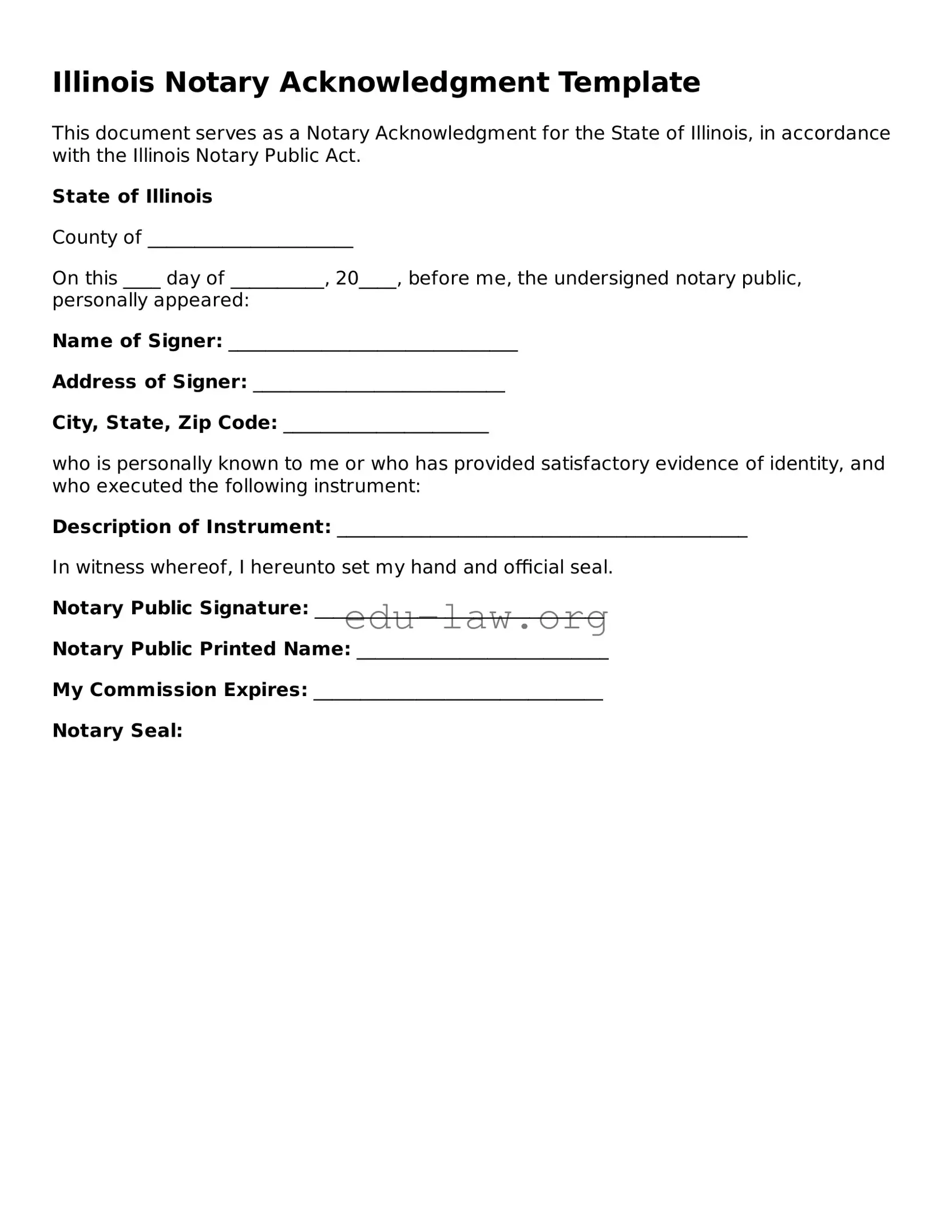
The Illinois Notary Acknowledgement form serves as a vital tool in the realm of legal documentation, ensuring that signatures are verified and authentic. This form is commonly utilized in various transactions, such as real estate deals, legal agreements, and financial contracts. By providing a clear statement that a signer has willingly and knowingly signed a document, the form helps to prevent fraud and misunderstandings. It typically includes essential elements like the name of the signer, the date of the acknowledgment, and the notary's details, including their signature and seal. Furthermore, it emphasizes the importance of the notary's role in witnessing the signing process, thereby enhancing the credibility of the documents involved. The Illinois Notary Acknowledgement form not only protects the interests of all parties involved but also upholds the integrity of the legal system by ensuring that the documentation is executed in accordance with state laws.
Illinois Notary Acknowledgment Template
This document serves as a Notary Acknowledgment for the State of Illinois, in accordance with the Illinois Notary Public Act.
State of Illinois
County of ______________________
On this ____ day of __________, 20____, before me, the undersigned notary public, personally appeared:
Name of Signer: _______________________________
Address of Signer: ___________________________
City, State, Zip Code: ______________________
who is personally known to me or who has provided satisfactory evidence of identity, and who executed the following instrument:
Description of Instrument: ____________________________________________
In witness whereof, I hereunto set my hand and official seal.
Notary Public Signature: _______________________________
Notary Public Printed Name: ___________________________
My Commission Expires: _______________________________
Notary Seal:
| Fact Name | Description |
|---|---|
| Purpose | The Illinois Notary Acknowledgement form is used to verify the identity of a signer and confirm that they willingly signed a document. |
| Governing Law | This form is governed by the Illinois Notary Public Act (5 ILCS 312). |
| Signature Requirement | The signer must personally appear before the notary public to sign the document. |
| Notary's Role | The notary public must complete the acknowledgment by filling out the form and signing it. |
| Identification | The signer should provide valid identification, such as a driver's license or passport, to the notary. |
| Form Availability | The form can be obtained from various legal stationery stores or online legal resources. |
| Record Keeping | Notaries are required to keep a record of all acknowledgments they perform in their notary journal. |
Once you have the Illinois Notary Acknowledgment form, you will need to complete it accurately to ensure it is valid. Follow these steps to fill out the form correctly.
What is an Illinois Notary Acknowledgement form?
The Illinois Notary Acknowledgement form is a document used to verify that a signer has willingly signed a document in the presence of a notary public. This form serves as proof that the individual identified in the document has acknowledged their signature and the content of the document before the notary.
When is a Notary Acknowledgement necessary?
A Notary Acknowledgement is often required for legal documents such as deeds, mortgages, and contracts. It provides assurance to third parties that the signer has been properly identified and that they understand the document they are signing. Some institutions may require this form for specific transactions, so it is important to check the requirements beforehand.
Who can act as a notary public in Illinois?
In Illinois, a notary public must be at least 18 years old, a resident of the state, or employed in Illinois. They must also complete an application process and pass a background check. Once appointed, notaries have the authority to perform notarizations throughout the state.
What information is required on the Notary Acknowledgement form?
The form typically requires the name of the signer, the date of the acknowledgment, and the notary's signature and seal. Additionally, it may include a description of the document being acknowledged. Ensuring all necessary information is included is crucial for the form to be valid.
How does a signer complete the Notary Acknowledgement?
The signer must appear in person before the notary. They should bring the document they wish to acknowledge and provide valid identification. The notary will then complete the acknowledgment section, confirming that the signer has acknowledged their signature on the document.
Can a notary refuse to acknowledge a signature?
Yes, a notary can refuse to acknowledge a signature if they have doubts about the signer's identity, if the signer appears to be under duress, or if the document does not meet legal requirements. It is the notary's responsibility to ensure that the notarization process is conducted properly.
Is there a fee for notarization in Illinois?
Yes, Illinois law allows notaries to charge a fee for their services. The maximum fee for a standard acknowledgment is set by the state. However, many notaries may choose to offer their services for free, especially for community members or charitable organizations. It is advisable to discuss fees upfront with the notary.
Failing to include the date of the acknowledgment. This is essential for the document's validity.
Not providing the signer's name clearly. It should match the name on the identification provided.
Leaving out the notary's signature. Without this, the acknowledgment is incomplete.
Using an incorrect notary seal. Ensure the seal is current and meets state requirements.
Not specifying the capacity in which the signer is acting, if applicable. This adds clarity to the acknowledgment.
Forgetting to fill in the county where the acknowledgment takes place. This is important for jurisdiction.
Providing an expired identification for the signer. Always verify that the ID is valid.
Not witnessing the signature in person. The notary must be present when the signer signs the document.
Using a non-compliant format for the acknowledgment. Follow the state’s prescribed format closely.
Neglecting to keep a record of the notarization in the notary's journal. This is crucial for accountability.
The Illinois Notary Acknowledgement form is a crucial document in the notarization process, often used to verify the identity of individuals signing various legal documents. Alongside this form, several other documents frequently accompany it to ensure a smooth and legally compliant transaction. Below is a list of common forms and documents that may be utilized in conjunction with the Illinois Notary Acknowledgement form.
Understanding these documents and their roles in the notarization process can help individuals navigate legal transactions more effectively. Utilizing the Illinois Notary Acknowledgement form alongside these related documents can enhance the integrity and legality of the agreements made.
The Illinois Notary Acknowledgment form is similar to the Affidavit. An affidavit is a written statement confirmed by oath or affirmation, used as evidence in court. Both documents require a notary public's signature to verify the identity of the person making the statement. This process ensures that the information provided is truthful and can be relied upon in legal matters.
Another document that shares similarities is the Power of Attorney. This legal document allows one person to act on behalf of another in legal or financial matters. Like the Notary Acknowledgment, a Power of Attorney must be signed in the presence of a notary public. This requirement helps confirm the identity of the individual granting the authority and ensures that the document is executed willingly and without coercion.
The Deed is also comparable to the Notary Acknowledgment form. A deed is a legal document that transfers property ownership from one party to another. Both documents require notarization to validate the signatures of the parties involved. This notarization helps prevent fraud and ensures that the transaction is conducted fairly and transparently.
The Certificate of Acknowledgment is another document with similar characteristics. This certificate is often used to confirm that a signer has appeared before a notary and acknowledged their signature. It serves to affirm the authenticity of the document, much like the Notary Acknowledgment form, which verifies that the signer has willingly signed the document in the presence of a notary.
Additionally, the Bill of Sale shares some similarities with the Notary Acknowledgment. A Bill of Sale is a document that transfers ownership of personal property from one person to another. Notarization may be required for certain transactions to ensure that the parties involved are who they claim to be. This helps protect both the buyer and the seller during the transfer of ownership.
Lastly, the Will can be compared to the Notary Acknowledgment form. A Will is a legal document that outlines how a person's assets will be distributed after their death. While not all Wills require notarization, having a notary present can help validate the document and the signatures involved. This added layer of verification helps ensure that the testator's wishes are honored and reduces the chances of disputes among heirs.
When filling out the Illinois Notary Acknowledgement form, it is important to follow certain guidelines to ensure the document is valid and properly executed. Below are some dos and don’ts to consider:
Understanding the Illinois Notary Acknowledgement form is essential for anyone involved in legal documents. However, several misconceptions can lead to confusion. Here are eight common misconceptions about this form:
Many people believe that notary acknowledgements are exclusively for real estate documents. In reality, they can be used for a variety of legal documents, including contracts and powers of attorney.
Some individuals think that notaries can offer legal advice or interpret documents. However, notaries are not allowed to provide legal counsel; their role is to verify identities and witness signatures.
People often assume that all notaries have the same qualifications and authority. In Illinois, notaries must be commissioned by the state and adhere to specific regulations, which may vary by state.
Some may think that including a notary acknowledgement is optional for all documents. In many cases, especially for legal documents, a notary acknowledgement is required to ensure validity.
It is a common belief that a notary can notarize their own signature. In Illinois, this is prohibited to avoid conflicts of interest and maintain the integrity of the notarization process.
Some individuals think that identification is not needed for notarization. However, a notary must verify the identity of the signer, typically through a government-issued ID.
Many confuse notary acknowledgements with general notarizations. An acknowledgement specifically confirms the identity of the signer and their intent to sign, while notarization can encompass various acts.
People often believe that a notarized document is set in stone. While notarization adds a layer of authenticity, changes can still be made, but they may require a new notarization.
Understanding these misconceptions can help individuals navigate the process of using the Illinois Notary Acknowledgement form more effectively.
When filling out and using the Illinois Notary Acknowledgement form, it is important to understand its purpose and the requirements involved. Below are key takeaways to guide you through the process.
By keeping these points in mind, you can navigate the process of using the Illinois Notary Acknowledgement form with confidence.