In the realm of business, protecting sensitive information is crucial for maintaining a competitive edge. The Illinois Non-disclosure Agreement (NDA) serves as a vital tool for individuals and organizations seeking to safeguard proprietary information from unauthorized disclosure. This legally binding document outlines the terms under which confidential information is shared between parties, ensuring that sensitive data remains protected. Key components of the Illinois NDA include definitions of what constitutes confidential information, the obligations of the parties involved, and the duration of confidentiality. Additionally, the agreement may specify exceptions to confidentiality, such as information that becomes public knowledge or is independently developed by the receiving party. By establishing clear guidelines and expectations, the Illinois Non-disclosure Agreement fosters trust and encourages open communication, making it an essential instrument in various business transactions, partnerships, and employment relationships.
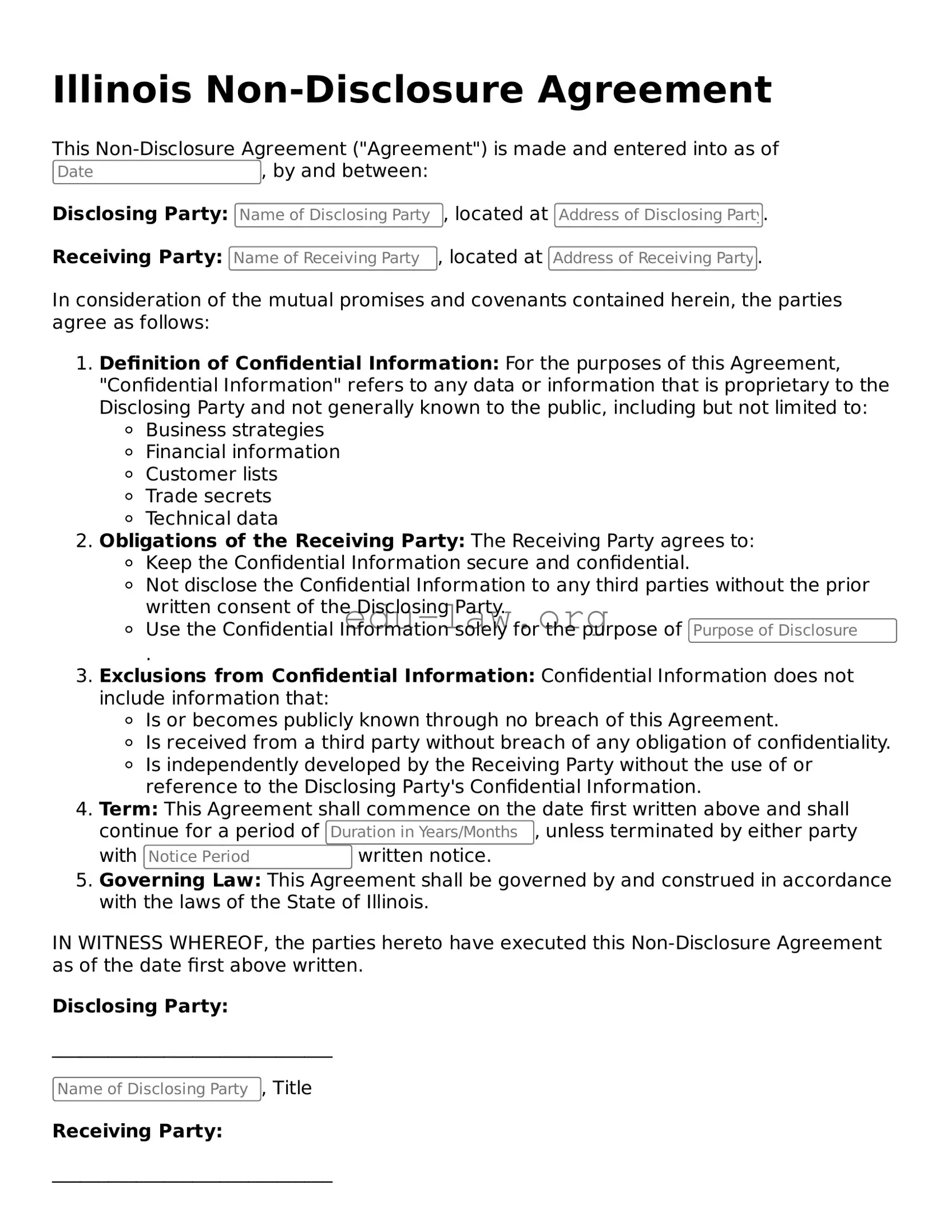
Illinois Non-Disclosure Agreement
This Non-Disclosure Agreement ("Agreement") is made and entered into as of , by and between:
Disclosing Party: , located at .
Receiving Party: , located at .
In consideration of the mutual promises and covenants contained herein, the parties agree as follows:
IN WITNESS WHEREOF, the parties hereto have executed this Non-Disclosure Agreement as of the date first above written.
Disclosing Party:
______________________________
, Title
Receiving Party:
______________________________
, Title
| Fact Name | Description |
|---|---|
| Definition | An Illinois Non-disclosure Agreement (NDA) is a legal contract that protects confidential information shared between parties. |
| Governing Law | The NDA is governed by the laws of the State of Illinois. |
| Parties Involved | The agreement typically involves a disclosing party and a receiving party. |
| Purpose | The primary purpose is to prevent the unauthorized sharing of sensitive information. |
| Duration | The NDA should specify the duration for which the confidentiality obligation lasts. |
| Exceptions | Common exceptions include information that is publicly available or already known to the receiving party. |
| Enforcement | Violating the NDA can result in legal consequences, including monetary damages. |
| Mutual vs. Unilateral | NDAs can be mutual, where both parties share confidential information, or unilateral, where only one party discloses information. |
| Signature Requirement | For the NDA to be enforceable, both parties must sign the agreement. |
Filling out the Illinois Non-disclosure Agreement (NDA) form is a straightforward process that requires attention to detail. Once completed, this form helps protect confidential information between parties. Follow the steps below to ensure that you fill it out correctly.
What is an Illinois Non-disclosure Agreement (NDA)?
An Illinois Non-disclosure Agreement is a legal contract that helps protect confidential information shared between parties. It ensures that sensitive information, such as trade secrets, business plans, or proprietary data, remains private and is not disclosed to unauthorized individuals or entities.
Who typically uses an NDA in Illinois?
NDAs are commonly used by businesses, entrepreneurs, and individuals who need to share confidential information. This includes companies sharing trade secrets with employees or partners, investors looking at business plans, or freelancers accessing proprietary data while working on projects.
What are the key components of an Illinois NDA?
A typical Illinois NDA includes several essential components: a definition of confidential information, the obligations of the receiving party, the duration of confidentiality, and any exclusions from what is considered confidential. Additionally, it may outline the consequences of breaching the agreement.
How long does the confidentiality obligation last?
The duration of confidentiality obligations can vary. Generally, NDAs specify a time frame during which the information must remain confidential. This period can range from a few years to indefinitely, depending on the nature of the information and the agreement between the parties.
Can an NDA be enforced in Illinois?
Yes, NDAs can be enforced in Illinois as long as they meet certain legal standards. The agreement must be clear, reasonable, and not violate public policy. If a party breaches the NDA, the other party may seek legal remedies, which could include monetary damages or injunctive relief.
What happens if someone breaches an NDA?
If a breach occurs, the injured party can take legal action against the offending party. This may involve seeking damages for any losses incurred or requesting that the court enforce the NDA. The specific remedies available will depend on the terms outlined in the agreement and the nature of the breach.
Is it advisable to consult a lawyer before signing an NDA?
Yes, it is highly advisable to consult a lawyer before signing an NDA. A legal professional can help ensure that the terms are fair, clear, and protect your interests. They can also provide guidance on any potential risks associated with the agreement.
Inadequate Definition of Confidential Information: Failing to clearly define what constitutes confidential information can lead to misunderstandings. It's crucial to specify the types of information being protected.
Missing Signatures: Not obtaining the necessary signatures from all parties involved can invalidate the agreement. Ensure that every party signs and dates the document.
Vague Timeframe: Leaving the duration of confidentiality vague can create confusion. Specify how long the information must remain confidential to avoid potential disputes.
Ignoring State-Specific Requirements: Each state may have its own regulations regarding non-disclosure agreements. Failing to comply with Illinois-specific laws can render the agreement unenforceable.
Not Including Exceptions: Omitting exceptions to the confidentiality obligations can lead to complications. Clearly outline circumstances under which disclosure is permitted.
Neglecting to Review the Agreement: Skipping a thorough review of the document can result in errors. It's wise to have a legal professional review the agreement before signing.
Assuming Oral Agreements are Sufficient: Relying solely on verbal agreements can be risky. Always put agreements in writing to ensure clarity and enforceability.
When entering into a Non-disclosure Agreement (NDA) in Illinois, it is often necessary to consider additional forms and documents that support the agreement and clarify the relationship between the parties involved. These documents help ensure that all parties understand their rights and obligations, providing a clearer framework for collaboration. Below is a list of commonly used forms and documents that may accompany an NDA.
By utilizing these forms and documents alongside the Illinois Non-disclosure Agreement, parties can create a comprehensive framework that protects their interests and fosters a secure environment for collaboration. It is essential to ensure that all agreements are tailored to the specific needs of the parties involved, promoting clarity and mutual understanding.
A Non-Disclosure Agreement (NDA) is often compared to a Confidentiality Agreement. Both documents serve the same primary purpose: to protect sensitive information from being disclosed to unauthorized parties. A Confidentiality Agreement may be used in various contexts, including employment relationships or business partnerships, and it emphasizes the importance of maintaining secrecy regarding proprietary information. The core idea remains the same—ensuring that parties involved do not share confidential information without permission.
Another document similar to an NDA is the Proprietary Information Agreement. This agreement specifically focuses on protecting proprietary information, which can include trade secrets, business strategies, and other intellectual property. Like an NDA, it binds parties to keep specific information confidential, but it often delves deeper into the ownership and use of proprietary information, making it particularly relevant in industries where innovation is crucial.
A Mutual Non-Disclosure Agreement is also akin to an NDA. Unlike a standard NDA, which typically protects one party’s information, a Mutual NDA protects both parties' sensitive information. This type of agreement is particularly useful in negotiations where both sides are sharing confidential information, ensuring that neither party can disclose the other’s secrets without consent.
The Non-Circumvention Agreement is another related document. While it primarily prevents one party from bypassing the other to engage directly with a business opportunity, it often includes confidentiality provisions. This means that not only must parties refrain from circumventing each other, but they must also keep any shared information private, similar to an NDA.
A Service Agreement can also bear similarities to an NDA, especially when it includes clauses regarding confidentiality. In many service agreements, service providers may gain access to sensitive information about the client. Therefore, confidentiality clauses are included to ensure that the service provider does not disclose any proprietary information learned during the course of their work.
Employment Agreements often contain non-disclosure provisions that align closely with NDAs. When employees are hired, they may be required to sign an agreement that outlines their responsibilities regarding confidential information. This ensures that employees understand their obligation to keep sensitive company information private, similar to the commitments outlined in a standalone NDA.
Lastly, a Licensing Agreement can share some common ground with an NDA. When a company licenses its technology or intellectual property to another entity, it often includes confidentiality clauses to protect proprietary information. This ensures that the licensee does not disclose or misuse the licensed information, reinforcing the protective intent of an NDA.
When filling out the Illinois Non-disclosure Agreement form, it's important to follow certain guidelines to ensure accuracy and compliance. Here are seven things to do and avoid:
By following these guidelines, you can help ensure that the Non-disclosure Agreement is completed correctly and serves its intended purpose.
Many individuals and businesses have misconceptions about the Illinois Non-disclosure Agreement (NDA) form. These misunderstandings can lead to ineffective agreements and potential legal issues. Below are four common misconceptions:
Understanding these misconceptions is essential for anyone considering an NDA in Illinois. A well-drafted agreement can provide valuable protection for all parties involved.
When considering the Illinois Non-disclosure Agreement (NDA) form, it is essential to understand its purpose and proper usage. Here are some key takeaways to guide you through the process:
By following these guidelines, you can effectively utilize the Illinois Non-disclosure Agreement form to protect your sensitive information.