The Illinois Motor Vehicle Power of Attorney form is a crucial legal document that enables individuals to designate another person to act on their behalf regarding motor vehicle transactions. This form is particularly useful in situations where the vehicle owner cannot be present to complete necessary paperwork, such as during the sale, transfer, or registration of a vehicle. It grants the designated agent the authority to handle various tasks, including signing documents, obtaining titles, and making decisions related to the vehicle. To ensure the form is valid, it must be completed accurately, including the names of both the principal and the agent, along with specific details about the vehicle in question. Additionally, the form requires the signature of the principal and may need to be notarized to enhance its legal standing. Understanding the nuances of this document can help individuals navigate the complexities of vehicle ownership and transactions in Illinois effectively.
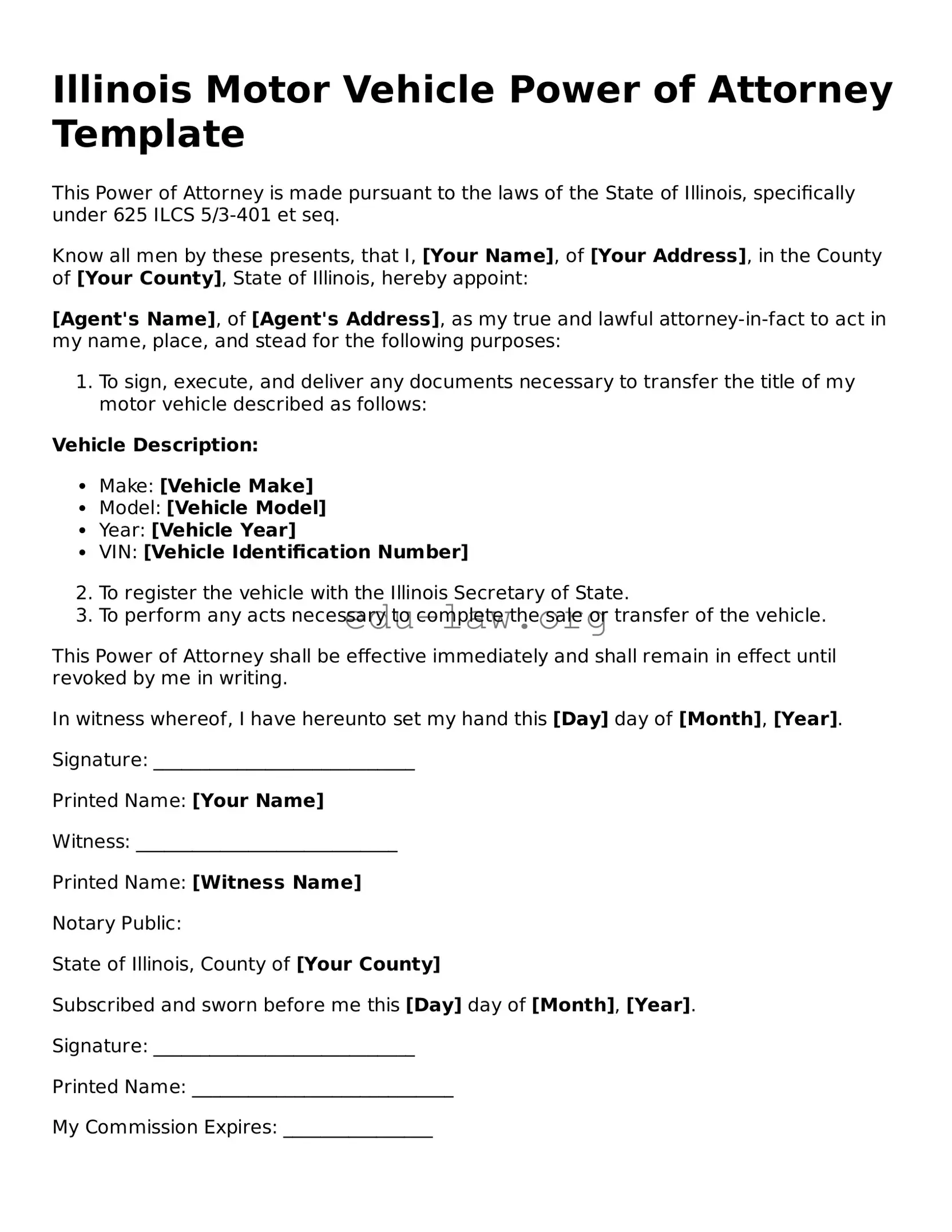
Illinois Motor Vehicle Power of Attorney Template
This Power of Attorney is made pursuant to the laws of the State of Illinois, specifically under 625 ILCS 5/3-401 et seq.
Know all men by these presents, that I, [Your Name], of [Your Address], in the County of [Your County], State of Illinois, hereby appoint:
[Agent's Name], of [Agent's Address], as my true and lawful attorney-in-fact to act in my name, place, and stead for the following purposes:
Vehicle Description:
This Power of Attorney shall be effective immediately and shall remain in effect until revoked by me in writing.
In witness whereof, I have hereunto set my hand this [Day] day of [Month], [Year].
Signature: ____________________________
Printed Name: [Your Name]
Witness: ____________________________
Printed Name: [Witness Name]
Notary Public:
State of Illinois, County of [Your County]
Subscribed and sworn before me this [Day] day of [Month], [Year].
Signature: ____________________________
Printed Name: ____________________________
My Commission Expires: ________________
| Fact Name | Details |
|---|---|
| Purpose | The Illinois Motor Vehicle Power of Attorney form allows an individual to designate another person to act on their behalf regarding motor vehicle transactions. |
| Governing Law | This form is governed by the Illinois Vehicle Code, specifically 625 ILCS 5/3-202.5. |
| Signatory Requirements | The form must be signed by the principal (the person granting the power) and should ideally be notarized to enhance its validity. |
| Duration | The authority granted remains in effect until it is revoked by the principal or until the specified task is completed. |
| Scope of Authority | The appointed agent can perform various tasks, including signing documents, transferring titles, and registering vehicles. |
| Revocation | The principal can revoke the Power of Attorney at any time, provided they notify the agent and relevant parties. |
| Multiple Agents | The form allows for the appointment of multiple agents, but it is advisable to specify whether they act jointly or independently. |
| Use Cases | This form is often used when the principal is unable to attend a transaction in person, such as during travel or illness. |
| Accessibility | The form is available online through the Illinois Secretary of State's website, making it easy to access and download. |
| Limitations | While the form is powerful, it cannot be used for all types of transactions; it is specifically limited to motor vehicle matters. |
Filling out the Illinois Motor Vehicle Power of Attorney form is a straightforward process. After completing the form, you will need to submit it to the appropriate authority to ensure it is processed correctly.
What is the Illinois Motor Vehicle Power of Attorney form?
The Illinois Motor Vehicle Power of Attorney form is a legal document that allows an individual, known as the principal, to appoint another person, known as the agent, to act on their behalf regarding motor vehicle transactions. This can include tasks such as transferring ownership, registering a vehicle, or obtaining a duplicate title. The form is particularly useful when the principal cannot be present to complete these tasks themselves, whether due to absence, illness, or other reasons.
Who can be designated as an agent in the Illinois Motor Vehicle Power of Attorney?
Any adult can be designated as an agent in the Illinois Motor Vehicle Power of Attorney. This includes family members, friends, or professionals such as attorneys or car dealerships. It is essential that the chosen agent is trustworthy, as they will have the authority to make decisions regarding the principal's vehicle. The principal should discuss the responsibilities with the agent before completing the form to ensure that both parties understand the scope of the authority being granted.
How do I complete the Illinois Motor Vehicle Power of Attorney form?
To complete the form, the principal must provide their name, address, and signature, along with the same information for the designated agent. The specific powers granted should be clearly outlined in the document. It is important to be precise about what actions the agent can take. Once completed, the form must be signed in the presence of a notary public to ensure its validity. After notarization, the principal should keep a copy for their records and provide a copy to the agent.
Is the Illinois Motor Vehicle Power of Attorney form revocable?
Yes, the Illinois Motor Vehicle Power of Attorney can be revoked at any time by the principal, as long as they are mentally competent to do so. To revoke the power of attorney, the principal should notify the agent in writing and may also file a revocation form with the appropriate state agency, if necessary. It is advisable to inform any institutions or individuals that may have relied on the original power of attorney that it has been revoked to avoid any confusion in the future.
Not using the correct form. Ensure you are using the Illinois Motor Vehicle Power of Attorney form specifically designed for this purpose. Using an outdated or incorrect form can lead to issues.
Failing to provide accurate information. Double-check all personal details, including names, addresses, and vehicle information. Inaccuracies can invalidate the document.
Not signing the form. The principal must sign the form. Without a signature, the Power of Attorney is not legally binding.
Missing witness or notarization requirements. Depending on the situation, you may need a witness or notary public to validate the document. Failing to meet these requirements can cause complications.
Not specifying the powers granted. Clearly outline what powers are being granted to the agent. Vague language may lead to misunderstandings or disputes.
Ignoring expiration dates. If you intend for the Power of Attorney to be temporary, specify an expiration date. Failing to do so may lead to unintended authority being granted indefinitely.
Not informing the agent. Make sure the person you designate as your agent knows they have been chosen and understands their responsibilities. Communication is key.
Overlooking state-specific requirements. Each state may have unique laws regarding Power of Attorney forms. Familiarize yourself with Illinois-specific regulations to avoid pitfalls.
Not keeping copies of the document. After filling out the form, retain copies for your records and provide one to your agent. This ensures everyone involved has access to the information.
When dealing with the Illinois Motor Vehicle Power of Attorney form, several other documents may be necessary to ensure a smooth process. These forms help clarify authority, protect interests, and facilitate the transfer or management of vehicle-related matters. Below is a list of commonly used documents that often accompany the Power of Attorney.
Understanding these documents can greatly assist individuals in navigating the complexities of vehicle ownership and transactions in Illinois. Each form plays a specific role in ensuring that all legal requirements are met and that the rights of all parties involved are protected.
The Illinois Motor Vehicle Power of Attorney form shares similarities with the General Power of Attorney. Both documents allow individuals to designate someone else to act on their behalf. In the case of the General Power of Attorney, the appointed agent can handle a wide range of financial and legal matters, not limited to motor vehicle transactions. This flexibility makes it a versatile tool for individuals who wish to delegate authority across various domains.
Another related document is the Durable Power of Attorney. This form is designed to remain effective even if the principal becomes incapacitated. Like the Motor Vehicle Power of Attorney, it allows the designated agent to make decisions and take actions on behalf of the principal. The key distinction lies in its durability; it is particularly useful for long-term planning and ensuring that an agent can continue to act in the principal's best interest during times of diminished capacity.
The Limited Power of Attorney is also similar, as it grants specific powers to an agent for a defined period or purpose. This document can be tailored to address particular needs, such as selling a vehicle or managing a real estate transaction. In contrast to the Illinois Motor Vehicle Power of Attorney, which is specifically geared towards vehicle-related matters, the Limited Power of Attorney can cover various tasks based on the principal’s requirements.
The Medical Power of Attorney is another relevant document, focusing on healthcare decisions rather than financial or property matters. This form allows individuals to appoint someone to make medical decisions on their behalf if they are unable to do so. While the scope differs from the Motor Vehicle Power of Attorney, both documents emphasize the importance of appointing a trusted individual to act in critical situations.
The Revocation of Power of Attorney is also noteworthy. This document serves to nullify any existing power of attorney arrangements, including the Motor Vehicle Power of Attorney. It provides a formal mechanism for individuals to withdraw the authority they have previously granted, ensuring that their wishes are respected and that they maintain control over their affairs.
The Affidavit of Heirship, while distinct in purpose, shares a commonality in its use within the context of property and asset management. This document is often used to establish the heirs of a deceased individual, particularly when no will exists. Similar to the Motor Vehicle Power of Attorney, it facilitates the transfer of ownership, though it operates within the realm of estate law rather than vehicle transactions.
The Vehicle Title Application is another document that relates closely to the Illinois Motor Vehicle Power of Attorney. This form is necessary for registering a vehicle or transferring ownership. While the Motor Vehicle Power of Attorney allows someone to act on behalf of the owner, the Vehicle Title Application requires the completion of specific information about the vehicle and its new owner, making it essential for the legal transfer of vehicle ownership.
The Bill of Sale also connects to the Motor Vehicle Power of Attorney in the context of vehicle transactions. A Bill of Sale serves as a legal document that records the sale of a vehicle, detailing the transaction between the buyer and seller. While the Motor Vehicle Power of Attorney allows an agent to execute the sale on behalf of the owner, the Bill of Sale formalizes the agreement and provides proof of the transaction.
The Warranty Deed is another document that, while primarily used in real estate, shares a similar function of transferring ownership. Like the Motor Vehicle Power of Attorney, it allows one party to grant property rights to another. Both documents require the involvement of an agent or representative to facilitate the transfer, emphasizing the importance of authorized actions in property ownership changes.
Lastly, the Consent to Transfer Vehicle Registration is akin to the Illinois Motor Vehicle Power of Attorney in that it addresses the transfer of vehicle ownership. This document provides the necessary consent from the current owner for the registration of a vehicle under a new owner’s name. Both forms streamline the process of transferring ownership, ensuring that all legal requirements are met for a smooth transition.
When filling out the Illinois Motor Vehicle Power of Attorney form, it is essential to approach the task with care. This document grants someone else the authority to handle specific vehicle-related matters on your behalf. To ensure the process goes smoothly, here are ten important do's and don'ts to consider.
By adhering to these guidelines, you can help ensure that your Power of Attorney form is filled out correctly and serves its intended purpose without unnecessary complications.
Many people have misunderstandings about the Illinois Motor Vehicle Power of Attorney form. Clearing up these misconceptions can help ensure that individuals use the form correctly and effectively. Here are nine common misconceptions:
Understanding these misconceptions can empower individuals to use the Illinois Motor Vehicle Power of Attorney form effectively. Proper knowledge ensures that vehicle-related matters are handled smoothly and legally.
Filling out the Illinois Motor Vehicle Power of Attorney form can seem daunting, but it’s straightforward once you understand the basics. Here are some key takeaways to keep in mind:
Understanding these points will help you navigate the process smoothly and ensure that your vehicle matters are handled as you wish.