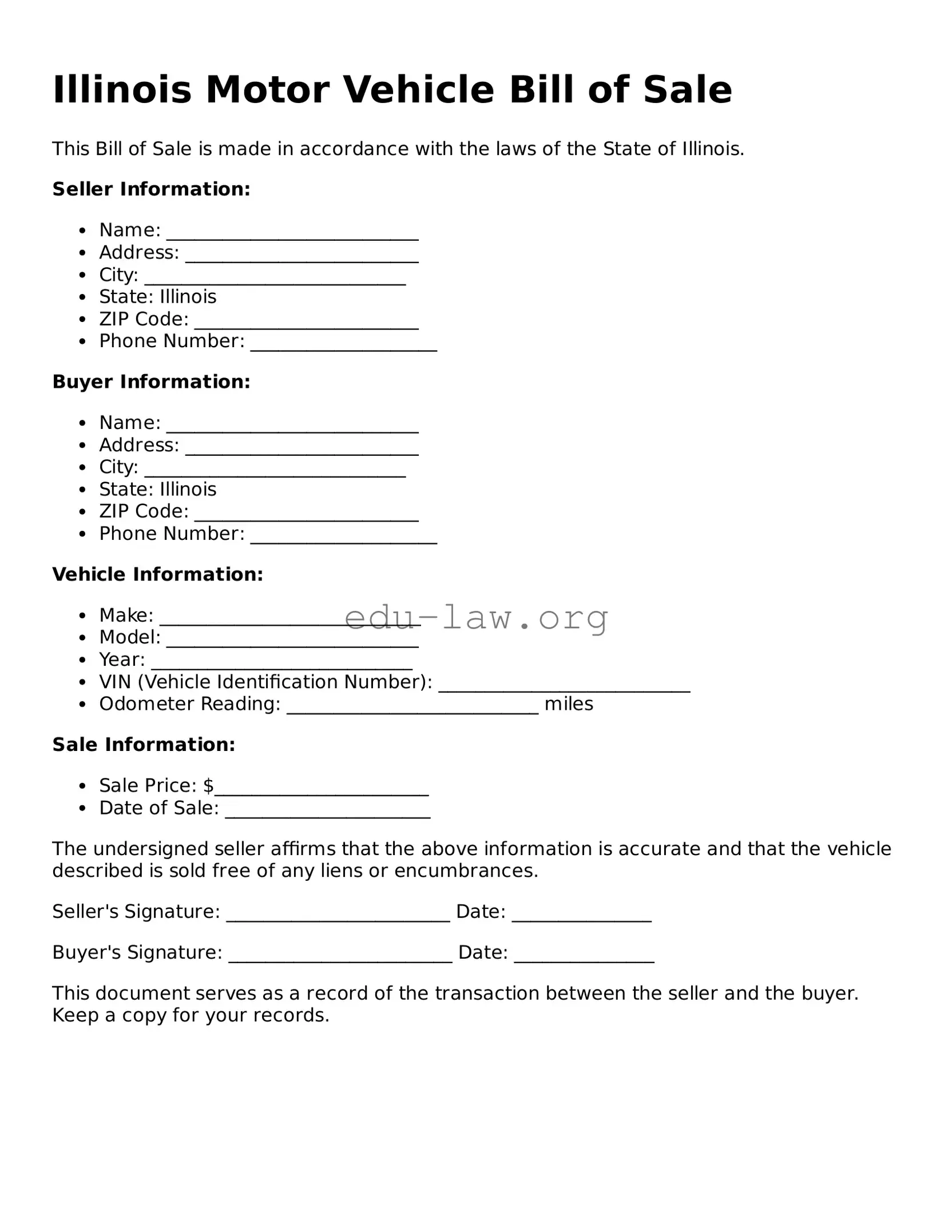
The Illinois Motor Vehicle Bill of Sale form serves as a crucial document for anyone involved in the buying or selling of a vehicle within the state. This form provides essential information that protects both the buyer and the seller during the transaction. It includes details such as the vehicle's make, model, year, and identification number, which are vital for confirming ownership and ensuring that the vehicle is not stolen or encumbered by liens. Additionally, the form captures the sale price, which is important for tax purposes and helps establish the value of the vehicle. Both parties must sign the document to validate the sale, making it a legally binding agreement. Furthermore, it’s advisable to include the date of the transaction, as this can impact the registration process and the transfer of ownership. Understanding the significance of this form can help facilitate a smooth transaction and provide peace of mind for both buyers and sellers.
Illinois Motor Vehicle Bill of Sale
This Bill of Sale is made in accordance with the laws of the State of Illinois.
Seller Information:
Buyer Information:
Vehicle Information:
Sale Information:
The undersigned seller affirms that the above information is accurate and that the vehicle described is sold free of any liens or encumbrances.
Seller's Signature: ________________________ Date: _______________
Buyer's Signature: ________________________ Date: _______________
This document serves as a record of the transaction between the seller and the buyer. Keep a copy for your records.
| Fact Name | Description |
|---|---|
| Purpose | The Illinois Motor Vehicle Bill of Sale form is used to document the sale of a vehicle between a buyer and a seller. |
| Governing Law | This form is governed by the Illinois Vehicle Code, specifically 625 ILCS 5/3-101 et seq. |
| Required Information | The form requires details such as the vehicle identification number (VIN), make, model, year, and the sale price. |
| Signatures | Both the buyer and seller must sign the form to validate the transaction. |
| Notarization | While notarization is not mandatory, it is recommended for added legal protection. |
| Record Keeping | It is advisable for both parties to keep a copy of the completed Bill of Sale for their records. |
Completing the Illinois Motor Vehicle Bill of Sale form is an essential step in transferring ownership of a vehicle. After filling out the form, both the buyer and seller should retain copies for their records. This documentation serves as proof of the transaction and may be required for future reference.
What is a Motor Vehicle Bill of Sale in Illinois?
A Motor Vehicle Bill of Sale is a legal document that records the sale of a vehicle between a buyer and a seller in Illinois. This form serves as proof of the transaction and includes essential details such as the vehicle's make, model, year, Vehicle Identification Number (VIN), the sale price, and the names and addresses of both parties involved. It is important for both the buyer and seller to keep a copy of this document for their records, as it may be needed for registration or tax purposes.
Do I need a Bill of Sale to sell a vehicle in Illinois?
While a Bill of Sale is not legally required to sell a vehicle in Illinois, it is highly recommended. This document provides a clear record of the transaction and protects both the buyer and seller. In the event of any disputes or issues that arise after the sale, having a Bill of Sale can help clarify the terms of the sale and confirm ownership transfer. Additionally, it can be useful for the buyer when registering the vehicle with the Illinois Secretary of State.
What information should be included in the Bill of Sale?
When completing a Motor Vehicle Bill of Sale, several key pieces of information should be included. This includes the names and addresses of both the buyer and seller, the vehicle's make, model, year, and VIN. The sale price must be clearly stated, and the date of the transaction should also be included. It's advisable to note any conditions of the sale, such as whether the vehicle is sold "as-is" or if there are warranties involved. Both parties should sign the document to validate the transaction.
How do I obtain a Motor Vehicle Bill of Sale form?
You can obtain a Motor Vehicle Bill of Sale form from various sources. Many local government offices, such as the Secretary of State's office, provide a downloadable version of the form on their websites. Additionally, there are numerous templates available online that you can fill out. Ensure that the form you choose complies with Illinois state requirements. Always double-check to make sure all necessary information is included before finalizing the sale.
What should I do after completing the Bill of Sale?
After completing the Motor Vehicle Bill of Sale, both the buyer and seller should keep a signed copy for their records. The seller should also notify the Illinois Secretary of State of the sale, which can often be done online or by mail. This step is crucial as it officially removes the seller's liability for the vehicle and updates the ownership records. The buyer will need the Bill of Sale to register the vehicle in their name and to apply for a new title. Ensuring that these steps are followed helps facilitate a smooth transfer of ownership.
Failing to include the date of the sale. This information is crucial for record-keeping and legal purposes.
Not providing the full name and address of both the buyer and seller. Incomplete information can lead to disputes.
Omitting the vehicle identification number (VIN). This number uniquely identifies the vehicle and is essential for registration.
Incorrectly listing the make and model of the vehicle. Ensure accuracy to avoid confusion later.
Not indicating the purchase price. This figure is necessary for tax purposes and future reference.
Failing to sign the form. Both parties must sign to validate the transaction.
Leaving out the odometer reading at the time of sale. This protects both parties from potential fraud.
Not checking for liens on the vehicle. Ensure the seller has the right to sell the vehicle free of any claims.
Using an old or outdated version of the form. Always use the most current version to ensure compliance with state regulations.
Neglecting to make copies of the completed form for both parties. Keeping records is essential for future reference.
The Illinois Motor Vehicle Bill of Sale form is an important document for transferring ownership of a vehicle. However, several other forms and documents are often used in conjunction with it to ensure a smooth transaction. Below is a list of these documents, each serving a specific purpose in the vehicle sale process.
Having these documents ready can help facilitate a smoother vehicle transaction in Illinois. Each document plays a role in ensuring that the sale is legal and that both parties are protected throughout the process.
The Illinois Motor Vehicle Bill of Sale form is similar to a general Bill of Sale used for personal property transactions. Both documents serve as proof of a sale between a buyer and a seller. They typically include details such as the names of the parties involved, a description of the item being sold, and the sale price. However, a general Bill of Sale might be used for items like furniture or electronics, while the Illinois Motor Vehicle Bill of Sale specifically addresses the transfer of ownership for motor vehicles.
Another document that shares similarities is the Vehicle Title. The Vehicle Title is an official document issued by the state that proves ownership of a vehicle. When a vehicle is sold, the title must be signed over to the new owner, often accompanying the Bill of Sale. Both documents are essential for legally transferring ownership, but the title serves as a more formal record of ownership recognized by the state, while the Bill of Sale acts as a receipt for the transaction.
The Purchase Agreement is another document comparable to the Illinois Motor Vehicle Bill of Sale. A Purchase Agreement outlines the terms and conditions of a sale, including payment details and any warranties or guarantees. While the Bill of Sale is a simple proof of transaction, the Purchase Agreement can be more detailed and may cover aspects like financing arrangements or trade-ins, making it a more comprehensive document for significant purchases.
The Odometer Disclosure Statement is also similar, as it is often required when selling a vehicle. This document records the mileage on the vehicle at the time of sale, ensuring transparency about the vehicle's condition. While the Bill of Sale confirms the sale itself, the Odometer Disclosure Statement provides important information that helps protect the buyer from potential fraud regarding the vehicle's true mileage.
The Affidavit of Ownership is another document that can be related to the Illinois Motor Vehicle Bill of Sale. This document may be used when the seller cannot provide a title for the vehicle, such as in cases of lost titles. The Affidavit serves as a sworn statement affirming the seller's ownership and the details of the vehicle. While it does not replace the Bill of Sale, it can be used in conjunction with it to facilitate the sale when the title is unavailable.
The Vehicle Registration application is similar in that it is a necessary step following the sale of a vehicle. After purchasing a vehicle, the new owner must register it with the state. The registration process often requires the Bill of Sale as proof of ownership and purchase price. Both documents work together to ensure that the vehicle is legally registered to the new owner.
The Lease Agreement for a vehicle can also be compared to the Bill of Sale. While the Bill of Sale involves the outright purchase of a vehicle, a Lease Agreement allows a person to use a vehicle for a specified period while making monthly payments. Both documents outline the terms of the transaction, but the Lease Agreement focuses on rental terms rather than ownership transfer.
The Insurance Policy is another document that relates to vehicle ownership. When a vehicle is sold, the new owner must obtain insurance coverage. The Bill of Sale may be required by the insurance company to establish ownership before they can issue a policy. While the Bill of Sale confirms the sale, the Insurance Policy provides the necessary coverage for the vehicle, emphasizing the importance of both documents in the ownership process.
The Release of Liability form is similar in that it protects the seller after the vehicle has been sold. This document releases the seller from any future claims or liabilities related to the vehicle once the sale is complete. While the Bill of Sale confirms the transaction, the Release of Liability ensures that the seller is no longer responsible for the vehicle, providing peace of mind for both parties involved.
Lastly, the Bill of Sale for a trailer or boat is comparable to the Illinois Motor Vehicle Bill of Sale. While the former specifically addresses the sale of non-motorized vehicles, the format and purpose remain largely the same. Both documents serve to transfer ownership and provide proof of sale, with specific details tailored to the type of vehicle being sold. This highlights how the principles of ownership transfer apply across various types of vehicles.
When filling out the Illinois Motor Vehicle Bill of Sale form, it's essential to follow certain guidelines to ensure that the transaction is smooth and legally binding. Here’s a list of things you should and shouldn't do:
The Illinois Motor Vehicle Bill of Sale form is an important document for anyone buying or selling a vehicle in the state. However, several misconceptions can lead to confusion. Here are six common misunderstandings:
Understanding these misconceptions can help ensure a smooth transaction when buying or selling a vehicle in Illinois. Always prioritize having a properly completed bill of sale to protect your interests.
When completing the Illinois Motor Vehicle Bill of Sale form, several important points should be kept in mind to ensure a smooth transaction.
Using the Bill of Sale properly can facilitate the transfer of ownership and protect both parties involved in the transaction.