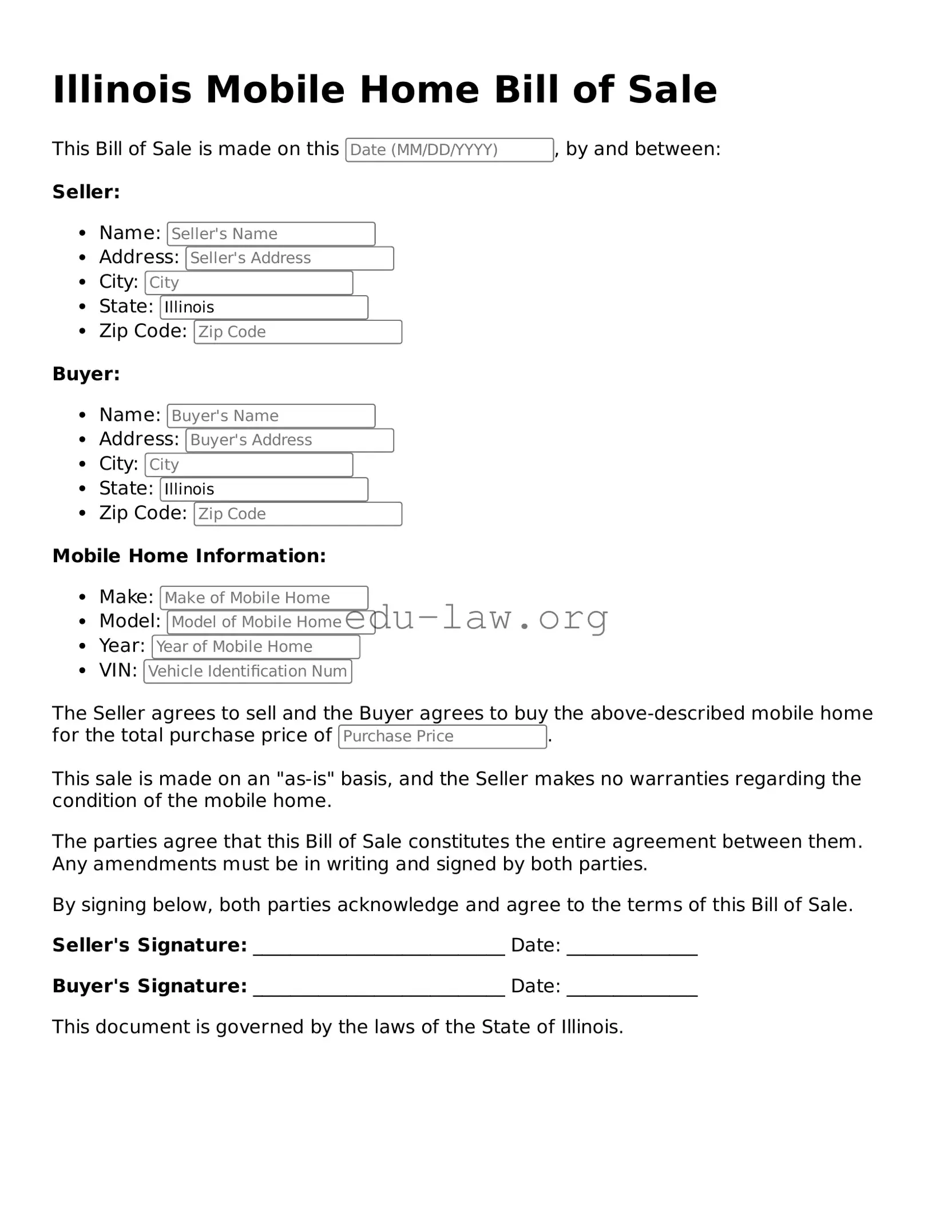
The Illinois Mobile Home Bill of Sale form is an essential document for anyone involved in the buying or selling of mobile homes in the state. This form serves as a legal record of the transaction, ensuring that both parties are protected and have a clear understanding of the terms. Key components include the identification of the mobile home, including its make, model, and Vehicle Identification Number (VIN), which helps to establish ownership and prevent disputes. Additionally, the form outlines the sale price, payment terms, and any warranties or disclosures relevant to the condition of the mobile home. By using this form, buyers and sellers can facilitate a smooth transfer of ownership, while also complying with state regulations. Understanding the importance of this document can help streamline the process and provide peace of mind for all parties involved.
Illinois Mobile Home Bill of Sale
This Bill of Sale is made on this , by and between:
Seller:
Buyer:
Mobile Home Information:
The Seller agrees to sell and the Buyer agrees to buy the above-described mobile home for the total purchase price of .
This sale is made on an "as-is" basis, and the Seller makes no warranties regarding the condition of the mobile home.
The parties agree that this Bill of Sale constitutes the entire agreement between them. Any amendments must be in writing and signed by both parties.
By signing below, both parties acknowledge and agree to the terms of this Bill of Sale.
Seller's Signature: ___________________________ Date: ______________
Buyer's Signature: ___________________________ Date: ______________
This document is governed by the laws of the State of Illinois.
| Fact Name | Description |
|---|---|
| Purpose | The Illinois Mobile Home Bill of Sale form is used to document the sale of a mobile home between a seller and a buyer. |
| Governing Law | This form is governed by the Illinois Compiled Statutes, specifically 625 ILCS 5/3-115. |
| Required Information | The form requires details such as the names and addresses of both the seller and buyer, the mobile home's identification number, and the sale price. |
| Signatures | Both the seller and buyer must sign the form to validate the transaction. |
| Notarization | Notarization is not required for the Illinois Mobile Home Bill of Sale, but it can enhance the document's credibility. |
| Transfer of Ownership | Completion of the form serves as a legal transfer of ownership from the seller to the buyer. |
| Record Keeping | It is advisable for both parties to keep a copy of the completed form for their records. |
| Tax Implications | Sales tax may apply to the transaction, depending on local regulations. |
| Additional Requirements | Buyers may need to register the mobile home with the Illinois Department of Revenue after the sale is completed. |
Once you have the Illinois Mobile Home Bill of Sale form in hand, you’ll need to fill it out carefully to ensure all necessary information is included. This document will facilitate the transfer of ownership of a mobile home from one party to another. Follow these steps to complete the form accurately.
After completing the form, it’s important to keep a copy for your records. The buyer should also receive a copy for their documentation. This will help both parties maintain a clear record of the transaction.
What is the Illinois Mobile Home Bill of Sale form?
The Illinois Mobile Home Bill of Sale form is a legal document used to transfer ownership of a mobile home from one party to another. This form serves as proof of the transaction and includes essential details such as the names of the buyer and seller, a description of the mobile home, and the sale price.
Why is a Bill of Sale important when selling a mobile home?
A Bill of Sale is crucial because it provides a record of the transaction. It protects both the buyer and seller by documenting the agreement and the terms of the sale. This can help prevent disputes in the future and is often required for registration and titling purposes.
What information is typically included in the form?
The form usually includes the names and addresses of both the buyer and seller, the mobile home's make, model, year, and Vehicle Identification Number (VIN). Additionally, the sale price and the date of the transaction are also included. Some forms may require the seller's signature to confirm the sale.
Do I need to have the form notarized?
Notarization is not typically required for a Mobile Home Bill of Sale in Illinois. However, having the document notarized can add an extra layer of authenticity and may be beneficial if there are any disputes or if the buyer needs to register the mobile home with the state.
Can I use a generic Bill of Sale for my mobile home?
While you can use a generic Bill of Sale, it is recommended to use the specific Illinois Mobile Home Bill of Sale form. This ensures that all necessary information is included and complies with state requirements. Using the appropriate form can help avoid complications during the transfer process.
What should I do after completing the Bill of Sale?
After completing the Bill of Sale, both the buyer and seller should keep a copy for their records. The buyer may need to take the completed form to the local Department of Motor Vehicles (DMV) or equivalent agency to register the mobile home in their name. It’s important to check local requirements to ensure compliance.
Is there a fee associated with the transfer of ownership?
Yes, there may be fees associated with transferring ownership of a mobile home. These fees can vary by location and may include registration fees, title fees, and taxes. It’s advisable to check with local authorities or the DMV for specific costs related to the transfer process.
What if the mobile home has a lien against it?
If there is a lien on the mobile home, it’s essential to resolve it before completing the sale. The seller should pay off the lien or obtain a lien release from the creditor. This ensures that the buyer receives clear title to the mobile home, free of any encumbrances.
Failing to include all necessary personal information, such as the full names and addresses of both the buyer and seller.
Not providing the correct mobile home identification number, which can lead to issues with registration.
Omitting the sale price, which is essential for tax purposes and future reference.
Not signing the document, as both parties must provide their signatures to validate the sale.
Using incorrect or outdated forms, which can result in delays or rejection by the relevant authorities.
Neglecting to include the date of the sale, which is crucial for record-keeping and legal purposes.
Failing to indicate whether the mobile home is being sold "as is," which can lead to disputes over condition later.
Not providing a clear description of the mobile home, including its make, model, and year, which helps in proper identification.
Leaving out any necessary disclosures about the mobile home, such as liens or encumbrances, which can affect the buyer's ownership.
Forgetting to make copies of the completed form for both the buyer and seller, which is important for their records.
When buying or selling a mobile home in Illinois, several forms and documents may be necessary to ensure a smooth transaction. Each of these documents serves a specific purpose and helps protect the interests of both parties involved. Below is a list of commonly used forms alongside the Illinois Mobile Home Bill of Sale.
Using these forms and documents can help facilitate a successful transaction when buying or selling a mobile home in Illinois. It is important to ensure all paperwork is completed accurately to protect your rights and interests.
The Illinois Vehicle Bill of Sale serves a similar purpose to the Mobile Home Bill of Sale. Both documents facilitate the transfer of ownership from one party to another. In the case of the Vehicle Bill of Sale, it is specifically used for motor vehicles, detailing the sale price, vehicle identification number, and other pertinent information. This document provides legal protection for both the buyer and seller, ensuring that the transaction is documented properly and can be referenced in the future.
The Illinois Boat Bill of Sale is another document that shares similarities with the Mobile Home Bill of Sale. Just like the mobile home form, the Boat Bill of Sale is used to transfer ownership of a watercraft. It includes essential details such as the boat's make, model, year, and hull identification number. Both documents serve to protect the interests of the parties involved and provide proof of ownership, which is crucial for registration and legal purposes.
The Illinois Trailer Bill of Sale is also akin to the Mobile Home Bill of Sale. This form is specifically designed for the sale of trailers, whether they are utility trailers, travel trailers, or other types. It captures important information about the trailer, including its make, model, and identification number. Similar to the Mobile Home Bill of Sale, this document ensures that ownership is officially transferred and recorded, offering peace of mind to both the buyer and seller.
The Illinois Personal Property Bill of Sale is another relevant document. This form is used for the sale of personal items, ranging from furniture to electronics. While it may not be specific to mobile homes, it shares the same fundamental purpose: to provide a written record of the transaction. Both documents protect the rights of the parties involved and serve as evidence of ownership transfer, which can be beneficial in case of disputes or for tax purposes.
Lastly, the Illinois Lease Agreement can also be considered similar in its function to the Mobile Home Bill of Sale, albeit in a different context. While the Mobile Home Bill of Sale is used for outright ownership transfer, a Lease Agreement outlines the terms under which a mobile home is rented or leased. Both documents establish a legal relationship between parties, detailing rights and responsibilities. They ensure clarity and mutual understanding, which is essential for a smooth transaction or rental experience.
When filling out the Illinois Mobile Home Bill of Sale form, it's important to ensure that you provide accurate and complete information. Here are some essential do's and don'ts to keep in mind:
The Illinois Mobile Home Bill of Sale form is an important document for the sale and transfer of mobile homes. However, several misconceptions surround its use and requirements. Here are ten common misconceptions:
Understanding these misconceptions can help ensure that the process of buying or selling a mobile home in Illinois is smooth and legally compliant.
When filling out and using the Illinois Mobile Home Bill of Sale form, keep these key takeaways in mind: