In the realm of healthcare decision-making, having a clear plan in place can provide peace of mind for both individuals and their loved ones. The Illinois Medical Power of Attorney form serves as a vital tool, empowering individuals to designate a trusted person to make medical decisions on their behalf when they are unable to do so. This legal document outlines the specific powers granted to the appointed agent, ensuring that their healthcare preferences are honored even in times of crisis. It’s important to understand that this form not only facilitates communication between healthcare providers and the appointed agent but also allows individuals to express their wishes regarding life-sustaining treatments and other medical interventions. By filling out this form, individuals can articulate their values and preferences, making it easier for family members and healthcare professionals to navigate complex medical situations. Additionally, the Illinois Medical Power of Attorney form is designed to be straightforward, allowing individuals to customize their directives in a way that reflects their unique circumstances and beliefs.
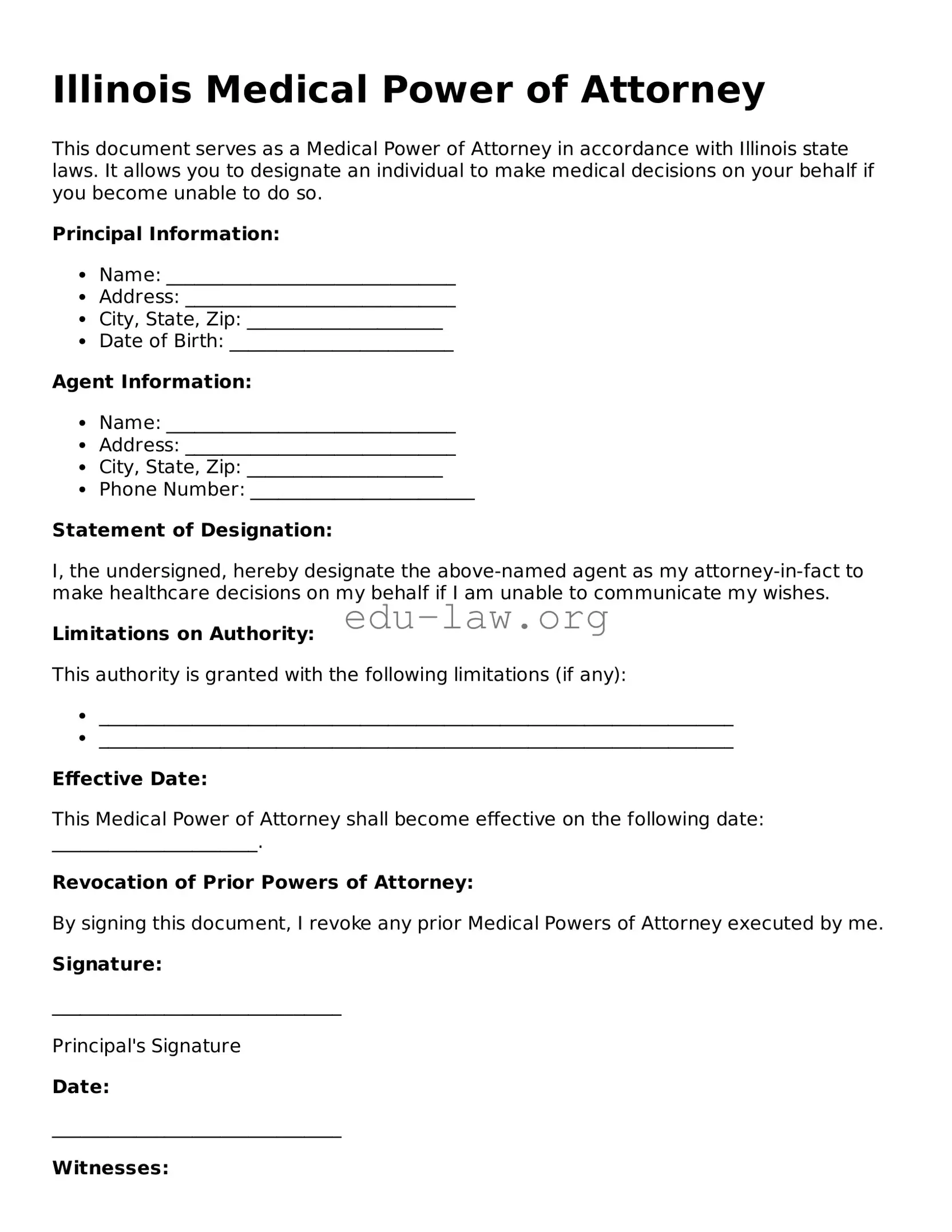
Illinois Medical Power of Attorney
This document serves as a Medical Power of Attorney in accordance with Illinois state laws. It allows you to designate an individual to make medical decisions on your behalf if you become unable to do so.
Principal Information:
Agent Information:
Statement of Designation:
I, the undersigned, hereby designate the above-named agent as my attorney-in-fact to make healthcare decisions on my behalf if I am unable to communicate my wishes.
Limitations on Authority:
This authority is granted with the following limitations (if any):
Effective Date:
This Medical Power of Attorney shall become effective on the following date: ______________________.
Revocation of Prior Powers of Attorney:
By signing this document, I revoke any prior Medical Powers of Attorney executed by me.
Signature:
_______________________________
Principal's Signature
Date:
_______________________________
Witnesses:
This document must be signed in the presence of two witnesses who are not related to the principal or the agent.
Notary Public:
State of Illinois
County of ______________________
Subscribed and sworn before me this ____ day of __________, 20__.
_______________________________
Notary Public Signature
My commission expires: ______________________
| Fact Name | Description |
|---|---|
| Purpose | The Illinois Medical Power of Attorney form allows an individual to designate someone to make healthcare decisions on their behalf if they become unable to do so. |
| Governing Law | This form is governed by the Illinois Power of Attorney Act, specifically 755 ILCS 45/1-1 et seq. |
| Signing Requirements | The form must be signed by the principal in the presence of a witness or a notary public. |
| Agent Authority | The appointed agent has the authority to make decisions regarding medical treatment, including end-of-life care. |
| Revocation | The principal can revoke the Medical Power of Attorney at any time, as long as they are mentally competent. |
| Durability | This form remains effective even if the principal becomes incapacitated, unless revoked. |
Filling out the Illinois Medical Power of Attorney form is an important step in ensuring that your healthcare wishes are respected in the event that you cannot communicate them yourself. The following steps will guide you through the process of completing this form accurately and effectively.
What is a Medical Power of Attorney in Illinois?
A Medical Power of Attorney is a legal document that allows a person to appoint someone else to make medical decisions on their behalf if they are unable to do so. This document ensures that your healthcare preferences are respected when you cannot communicate them yourself. The person you appoint is often referred to as your "agent" or "attorney-in-fact."
Who can serve as my agent under a Medical Power of Attorney?
In Illinois, you can choose any adult to be your agent, as long as they are not your healthcare provider or an employee of your healthcare provider. This means you can select a family member, friend, or trusted individual who understands your wishes and can advocate for your healthcare preferences.
How do I create a Medical Power of Attorney in Illinois?
To create a Medical Power of Attorney, you need to fill out the appropriate form, which is available through various sources, including hospitals and legal websites. After completing the form, you must sign it in the presence of a witness or a notary public. It is important to ensure that your chosen agent understands your wishes and is willing to take on this responsibility.
Can I change or revoke my Medical Power of Attorney?
Yes, you can change or revoke your Medical Power of Attorney at any time, as long as you are mentally competent. To revoke it, you can simply create a new document stating that the previous one is no longer valid. Additionally, you should inform your agent and any healthcare providers about the change to avoid confusion.
What happens if I do not have a Medical Power of Attorney?
If you do not have a Medical Power of Attorney and become unable to make your own medical decisions, your family members or friends may need to go to court to obtain guardianship. This process can be lengthy and may not reflect your wishes, which is why having a Medical Power of Attorney is important.
Is a Medical Power of Attorney the same as a Living Will?
No, a Medical Power of Attorney and a Living Will serve different purposes. A Medical Power of Attorney designates someone to make healthcare decisions for you, while a Living Will outlines your preferences regarding end-of-life care and treatments. Both documents can work together to ensure your healthcare wishes are honored.
Not choosing the right agent. It's essential to select someone who understands your values and wishes. Friends or family members may not always be the best choice. Consider their ability to make tough decisions.
Failing to discuss your wishes with the chosen agent. Communication is key. Without discussing your preferences, your agent may struggle to make decisions that align with your values.
Not updating the form when circumstances change. Life events, such as a divorce or the death of a chosen agent, require you to revisit your Medical Power of Attorney. Ensure that the document reflects your current situation.
Overlooking the witness and notarization requirements. In Illinois, the form must be signed in front of a witness or notarized. Skipping this step can invalidate the document, leaving your healthcare decisions unprotected.
When considering a Medical Power of Attorney in Illinois, it’s important to be aware of other related documents that can help ensure your healthcare wishes are respected. Each of these documents serves a unique purpose and can complement your Medical Power of Attorney effectively.
Having these documents in place can provide peace of mind for both you and your loved ones. They ensure that your healthcare wishes are clear and that your chosen representatives have the authority to act in your best interest when needed. It’s always a good idea to review and update these documents regularly to reflect any changes in your preferences or circumstances.
The Illinois Medical Power of Attorney form shares similarities with the Durable Power of Attorney. Both documents allow individuals to designate someone to make decisions on their behalf. However, while the Medical Power of Attorney focuses specifically on healthcare decisions, the Durable Power of Attorney can cover a broader range of financial and legal matters. This means that a Durable Power of Attorney can be used for everyday financial transactions, property management, and other legal issues, whereas the Medical Power of Attorney is strictly for health-related choices.
Another document that resembles the Illinois Medical Power of Attorney is the Living Will. A Living Will outlines an individual's wishes regarding medical treatment in situations where they cannot express their preferences. Like the Medical Power of Attorney, it addresses end-of-life care and decisions about life-sustaining treatments. The key difference lies in the fact that a Living Will does not appoint someone to make decisions; instead, it clearly states the individual's wishes, leaving no room for interpretation by a designated agent.
The Healthcare Proxy is also similar to the Illinois Medical Power of Attorney. This document allows a person to appoint someone to make medical decisions on their behalf when they are unable to do so. Both documents empower a trusted individual to act in the best interest of the patient. However, the Healthcare Proxy is often used in specific states, while the Medical Power of Attorney is recognized across Illinois and may have specific requirements that vary from state to state.
The Advance Directive is another document that aligns closely with the Illinois Medical Power of Attorney. An Advance Directive encompasses both a Medical Power of Attorney and a Living Will, serving as a comprehensive guide for healthcare decisions. It allows individuals to express their preferences regarding medical treatment and appoint a healthcare agent. This dual function provides clarity and direction for medical professionals and loved ones, ensuring that the individual's wishes are honored in various scenarios.
Lastly, the Do Not Resuscitate (DNR) Order is similar in purpose but differs in scope. A DNR Order specifically instructs medical personnel not to perform CPR if a patient stops breathing or their heart stops. While the Illinois Medical Power of Attorney allows for broader healthcare decisions, the DNR focuses solely on resuscitation preferences. Both documents are essential for ensuring that individuals receive care aligned with their values and wishes, particularly in critical situations.
Filling out the Illinois Medical Power of Attorney form is a crucial step in ensuring your healthcare wishes are respected. Here are ten important do's and don'ts to consider:
Understanding the Illinois Medical Power of Attorney (MPOA) form is crucial for making informed decisions about healthcare. Unfortunately, several misconceptions can lead to confusion. Here are six common misunderstandings:
This is not true. While the MPOA is often associated with end-of-life care, it actually covers a wide range of medical decisions. It allows your designated agent to make choices about your health care when you are unable to do so yourself, regardless of the situation.
Many believe that only one MPOA can exist at a time. In reality, you can revoke an existing MPOA and create a new one whenever you wish. However, it is essential to ensure that the new document clearly states the revocation of the previous one.
While both documents address healthcare decisions, they serve different purposes. A Living Will outlines your preferences for medical treatment in specific situations, while the MPOA designates someone to make decisions on your behalf when you cannot communicate your wishes.
Although having legal assistance can be helpful, it is not a requirement. Illinois law allows individuals to complete an MPOA form on their own, as long as they follow the necessary guidelines and ensure the document is properly signed and witnessed.
This is a common myth. You have the right to modify or revoke your MPOA at any time, as long as you are mentally competent. It’s important to communicate any changes to your healthcare providers and the designated agent.
Many people think that only seniors need an MPOA, but this is not the case. Accidents and sudden illnesses can affect anyone, regardless of age. Having an MPOA ensures that your healthcare preferences are respected at any stage of life.
By dispelling these misconceptions, individuals can better prepare for their healthcare decisions and ensure their wishes are honored.
Understanding the Illinois Medical Power of Attorney form is crucial for ensuring your healthcare preferences are honored. Here are some key takeaways to consider:
By taking these steps, you can ensure that your medical wishes are respected and that your loved ones are prepared to act on your behalf when necessary.