Creating a Last Will and Testament is an essential step in planning for the future and ensuring that your wishes are honored after you pass away. In Illinois, this legal document allows you to outline how your assets will be distributed, designate guardians for minor children, and name an executor to manage your estate. The Illinois Last Will and Testament form is designed to be straightforward, making it accessible for individuals to fill out without needing extensive legal knowledge. It includes sections for naming beneficiaries, specifying the distribution of property, and addressing any debts or taxes. Additionally, the form requires witnesses to validate your intentions, ensuring that your will is legally binding. Understanding the key components of this form can help you navigate the process with confidence, allowing you to take control of your legacy and provide peace of mind for your loved ones.
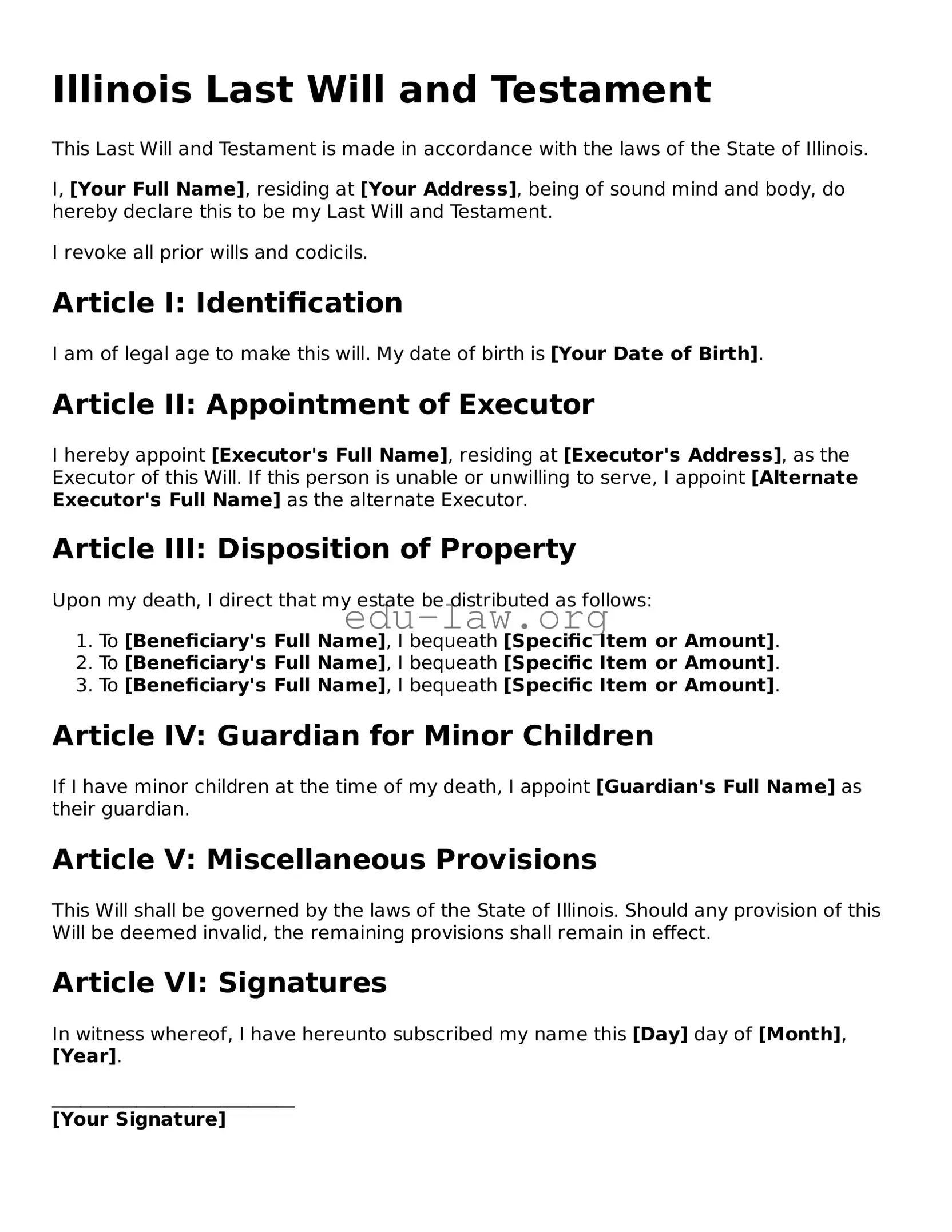
Illinois Last Will and Testament
This Last Will and Testament is made in accordance with the laws of the State of Illinois.
I, [Your Full Name], residing at [Your Address], being of sound mind and body, do hereby declare this to be my Last Will and Testament.
I revoke all prior wills and codicils.
Article I: Identification
I am of legal age to make this will. My date of birth is [Your Date of Birth].
Article II: Appointment of Executor
I hereby appoint [Executor's Full Name], residing at [Executor's Address], as the Executor of this Will. If this person is unable or unwilling to serve, I appoint [Alternate Executor's Full Name] as the alternate Executor.
Article III: Disposition of Property
Upon my death, I direct that my estate be distributed as follows:
Article IV: Guardian for Minor Children
If I have minor children at the time of my death, I appoint [Guardian's Full Name] as their guardian.
Article V: Miscellaneous Provisions
This Will shall be governed by the laws of the State of Illinois. Should any provision of this Will be deemed invalid, the remaining provisions shall remain in effect.
Article VI: Signatures
In witness whereof, I have hereunto subscribed my name this [Day] day of [Month], [Year].
__________________________
[Your Signature]
We, the undersigned witnesses, do hereby declare that we witnessed the signing of this Will by [Your Full Name] on the date above written.
__________________________
[Witness 1's Name]
__________________________
[Witness 2's Name]
| Fact Name | Description |
|---|---|
| Governing Law | The Illinois Last Will and Testament is governed by the Illinois Probate Act. |
| Age Requirement | In Illinois, you must be at least 18 years old to create a valid will. |
| Testamentary Capacity | Testators must be of sound mind, understanding the nature of their actions. |
| Written Document | The will must be in writing; oral wills are not recognized in Illinois. |
| Signature Requirement | The testator must sign the will at the end of the document. |
| Witnesses | At least two witnesses are required to validate the will. |
| Witness Eligibility | Witnesses must be at least 18 years old and not beneficiaries of the will. |
| Self-Proving Will | A self-proving will can simplify the probate process by including a notarized affidavit. |
| Revocation | A will can be revoked by creating a new will or by physically destroying the existing one. |
| Filing Requirement | Wills must be filed with the probate court after the testator's death for validation. |
Filling out the Illinois Last Will and Testament form is an important step in ensuring that your wishes regarding your assets and responsibilities are clearly communicated. After completing the form, it will need to be signed and witnessed to be legally valid. Following these steps will help guide you through the process.
What is a Last Will and Testament in Illinois?
A Last Will and Testament is a legal document that outlines how a person's assets and affairs should be handled after their death. In Illinois, this document allows you to specify who will inherit your property, appoint guardians for minor children, and name an executor to manage your estate. Creating a will is an essential step in ensuring your wishes are respected and can help prevent disputes among family members later on.
Do I need a lawyer to create a Last Will and Testament in Illinois?
While it's not mandatory to hire a lawyer to draft your will, consulting with one can provide valuable insights and help avoid potential pitfalls. If your estate is straightforward, you might choose to use an online template or software. However, if you have complex assets, multiple beneficiaries, or specific wishes, a lawyer can ensure that your will complies with Illinois law and accurately reflects your intentions.
What are the requirements for a valid will in Illinois?
For a will to be valid in Illinois, it must be written, signed by the testator (the person making the will), and witnessed by at least two individuals. These witnesses must be present at the same time when the testator signs the document. It's important that the witnesses are not beneficiaries of the will, as this could lead to complications regarding the validity of the will.
Can I change my Last Will and Testament after it's been created?
Yes, you can change your will at any time while you are still alive and mentally competent. This is often done through a process called a codicil, which is a legal document that modifies your existing will. Alternatively, you can create a new will that revokes the previous one. Just remember to follow the same legal requirements for signing and witnessing as you did with the original will.
What happens if I die without a will in Illinois?
If you pass away without a will, your estate will be distributed according to Illinois intestacy laws. This means that the state will determine how your assets are divided, which may not align with your wishes. Your property might go to relatives you wouldn't have chosen, and the process can be more time-consuming and costly. To avoid this, it's wise to create a will that clearly states your preferences.
Can I revoke my Last Will and Testament?
Yes, you can revoke your will whenever you choose. In Illinois, this can be done by creating a new will that explicitly states it revokes any previous wills or by physically destroying the original will. However, it's advisable to inform your executor or family members about your decision to revoke a will to prevent confusion or disputes later on.
Failing to clearly identify the testator. It is crucial to include the full legal name and address of the person creating the will.
Not specifying the beneficiaries properly. Each beneficiary should be named explicitly, and their relationship to the testator should be clear.
Overlooking the inclusion of an executor. An executor is responsible for carrying out the wishes expressed in the will, and their absence can lead to complications.
Neglecting to date the document. A will must be dated to establish its validity and to differentiate it from any previous wills.
Using ambiguous language. Clear and precise language is essential to avoid misinterpretation of the testator's intentions.
Failing to sign the will properly. The testator must sign the document in the presence of witnesses, as required by Illinois law.
Not having the required number of witnesses. Illinois law mandates that at least two witnesses must sign the will.
Forgetting to include a self-proving affidavit. This document can simplify the probate process by affirming the will's validity.
Ignoring state-specific requirements. Each state has unique laws governing wills, and failing to adhere to Illinois regulations can invalidate the document.
Neglecting to review and update the will. Life changes such as marriage, divorce, or the birth of a child may necessitate revisions to the will.
When creating a Last Will and Testament in Illinois, several other documents may be necessary to ensure that your wishes are fully realized and legally recognized. These documents can help clarify your intentions, manage your estate, and address various aspects of your financial and personal affairs. Below is a list of commonly used forms and documents that often accompany a Last Will and Testament.
Utilizing these documents alongside your Last Will and Testament can provide clarity and ensure that your intentions are respected. It is advisable to consult with a legal professional to ensure all documents are properly executed and meet your specific needs.
The Illinois Last Will and Testament form shares similarities with a Living Will. A Living Will outlines an individual’s wishes regarding medical treatment in the event they become incapacitated. Both documents serve to express personal wishes, but while a Last Will addresses the distribution of assets after death, a Living Will focuses on healthcare decisions during life.
Another document akin to the Illinois Last Will is the Revocable Trust. A Revocable Trust allows individuals to place their assets into a trust during their lifetime. Like a Last Will, it dictates how assets will be managed and distributed, but it can avoid the probate process, offering a quicker and more private transfer of assets upon death.
The Durable Power of Attorney (DPOA) is also similar. This document grants someone the authority to make financial or medical decisions on your behalf if you become unable to do so. While a Last Will takes effect after death, a DPOA is active during your lifetime, ensuring that your affairs are managed according to your preferences.
A Healthcare Proxy is another related document. It designates a person to make medical decisions on your behalf if you are unable to communicate. Similar to a Living Will, it ensures your healthcare wishes are respected, but it is more focused on appointing a trusted individual to act in your stead.
The Illinois Declaration of Self-Proving Will is also relevant. This document simplifies the probate process by allowing witnesses to affirm the validity of the will without needing to testify in court. It streamlines the execution of the Last Will, ensuring that the deceased's wishes are honored without unnecessary delays.
The Codicil is a document that amends an existing Last Will. It allows individuals to make changes without drafting a new will entirely. Like a Last Will, a Codicil must be executed with the same formalities to ensure its legality and effectiveness in reflecting the testator's current intentions.
A Living Trust is similar in purpose to a Last Will, as it provides for the distribution of assets. However, it operates during the individual’s lifetime and can provide benefits such as asset management and avoidance of probate. This document allows for greater flexibility and control over how assets are handled while still alive.
Another important document is the Final Arrangements Document. This outlines preferences for funeral and burial arrangements. While a Last Will addresses asset distribution, the Final Arrangements Document ensures that personal wishes regarding end-of-life ceremonies are honored, providing peace of mind for both the individual and their family.
Lastly, the Joint Will is a document executed by two individuals, typically spouses, that serves as a single will for both parties. It reflects the mutual intentions regarding asset distribution. While it functions similarly to a Last Will, it is unique in its joint nature, requiring both parties to agree on the terms laid out.
When filling out the Illinois Last Will and Testament form, consider the following guidelines to ensure the process goes smoothly.
Following these steps can help ensure that your will accurately reflects your intentions.
Understanding the Illinois Last Will and Testament form can be challenging due to various misconceptions. Below is a list of common misunderstandings regarding this important legal document.
Being aware of these misconceptions can help individuals better understand the purpose and requirements of the Illinois Last Will and Testament form. Proper knowledge ensures that one's wishes are effectively communicated and legally recognized.
Filling out and using the Illinois Last Will and Testament form is an important step in ensuring your wishes are respected after your passing. Here are key takeaways to consider:
By keeping these points in mind, you can create a will that effectively communicates your wishes and provides peace of mind for you and your loved ones.