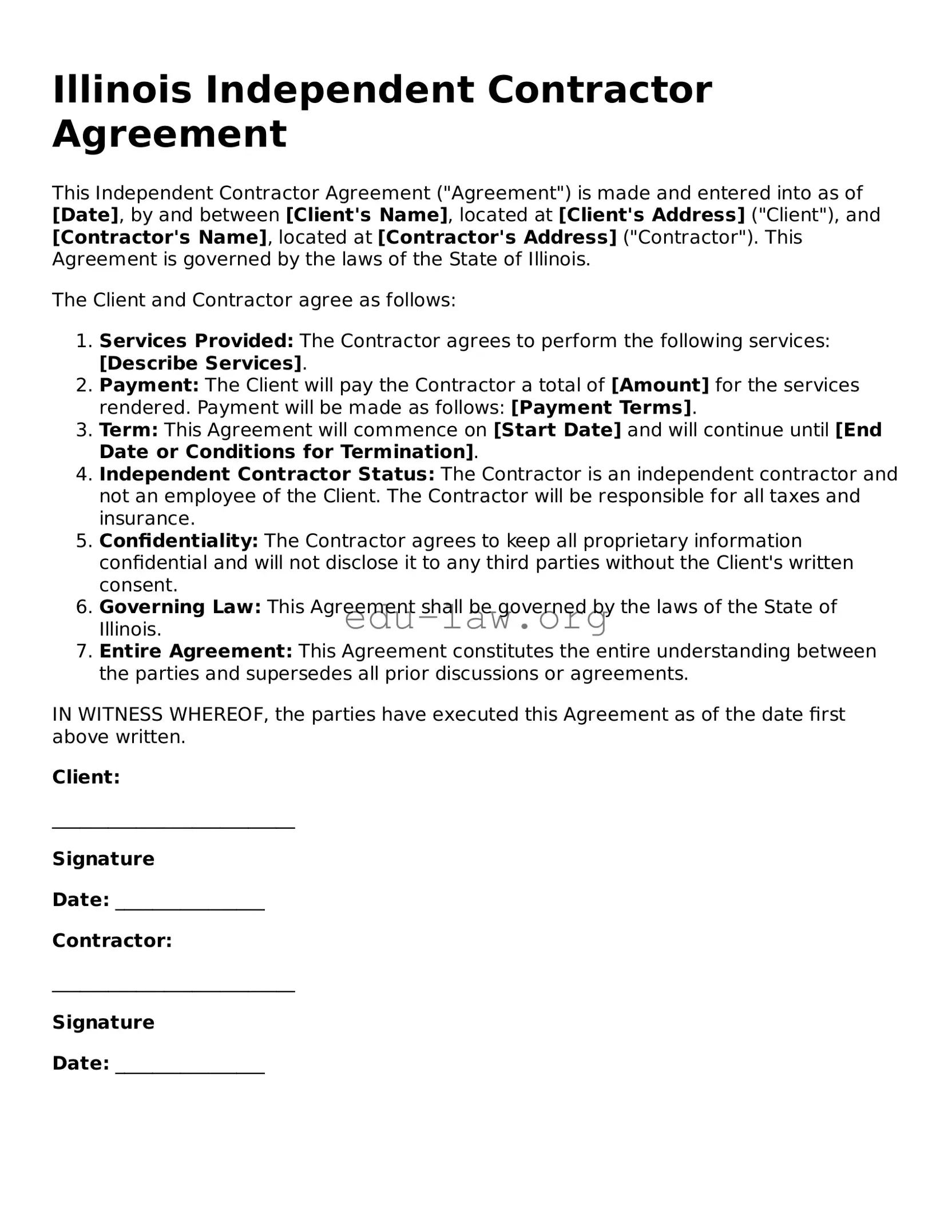
The Illinois Independent Contractor Agreement form serves as a crucial document for businesses and independent contractors alike, outlining the terms of their working relationship. This agreement clearly delineates the scope of work, payment terms, and the duration of the contract, ensuring both parties understand their rights and responsibilities. It addresses key elements such as confidentiality, intellectual property rights, and termination conditions, which are vital for protecting the interests of both the contractor and the hiring entity. By establishing these terms in writing, the agreement minimizes the risk of misunderstandings and disputes, fostering a professional environment. Additionally, it provides clarity on the independent contractor's status, differentiating them from employees, which is essential for tax and legal purposes. Overall, this form is not just a formal requirement; it is a foundational tool that supports a successful and transparent working relationship.
Illinois Independent Contractor Agreement
This Independent Contractor Agreement ("Agreement") is made and entered into as of [Date], by and between [Client's Name], located at [Client's Address] ("Client"), and [Contractor's Name], located at [Contractor's Address] ("Contractor"). This Agreement is governed by the laws of the State of Illinois.
The Client and Contractor agree as follows:
IN WITNESS WHEREOF, the parties have executed this Agreement as of the date first above written.
Client:
__________________________
Signature
Date: ________________
Contractor:
__________________________
Signature
Date: ________________
| Fact Name | Details |
|---|---|
| Definition | The Illinois Independent Contractor Agreement outlines the terms of engagement between a business and an independent contractor. |
| Governing Law | This agreement is governed by the laws of the State of Illinois. |
| Parties Involved | The agreement typically involves two parties: the hiring entity and the independent contractor. |
| Payment Terms | It specifies the payment structure, including rates and payment schedules. |
| Scope of Work | The document outlines the specific services to be provided by the contractor. |
| Termination Clause | It includes conditions under which either party may terminate the agreement. |
| Liability and Indemnification | The agreement often includes clauses regarding liability and indemnification responsibilities. |
After obtaining the Illinois Independent Contractor Agreement form, you are ready to begin filling it out. This document will require specific information about both the contractor and the hiring party. Be prepared to provide accurate details to ensure clarity and compliance.
Once the form is completed and signed, both parties should keep a copy for their records. This ensures that everyone has access to the agreement terms if needed in the future.
What is an Illinois Independent Contractor Agreement?
An Illinois Independent Contractor Agreement is a legal document that outlines the relationship between a business and an independent contractor. It specifies the terms of work, payment, and responsibilities, ensuring both parties understand their rights and obligations. This agreement is crucial for clarifying the nature of the working relationship, particularly in distinguishing between employees and independent contractors.
Why is it important to have an Independent Contractor Agreement?
Having an Independent Contractor Agreement is important for several reasons. It helps protect both parties by clearly defining the scope of work and payment terms. This can prevent misunderstandings and disputes. Additionally, it provides legal protection in case of disagreements and can serve as evidence in legal proceedings if necessary.
What should be included in the agreement?
The agreement should include several key elements: the names of the parties involved, a description of the services to be provided, payment terms, the duration of the contract, confidentiality clauses, and any termination conditions. It may also address intellectual property rights and liability issues, depending on the nature of the work.
How does this agreement affect taxes?
Independent contractors are responsible for their own taxes. Unlike employees, businesses do not withhold taxes from payments made to contractors. This means that contractors must report their income and pay self-employment taxes. The agreement should clarify that the contractor is responsible for their own tax obligations, which helps prevent any confusion about tax liabilities.
Can the agreement be modified after it is signed?
Yes, the agreement can be modified after it is signed, but both parties must agree to the changes. It is advisable to document any modifications in writing and have both parties sign the updated agreement. This ensures that any changes are legally binding and reduces the risk of disputes later on.
What happens if one party breaches the agreement?
If one party breaches the agreement, the other party may have several options. They can seek to resolve the issue through negotiation or mediation. If that does not work, they may pursue legal action for damages resulting from the breach. The agreement should outline the procedures for addressing breaches, which can help streamline the resolution process.
Is an Independent Contractor Agreement required by law?
While there is no specific law requiring an Independent Contractor Agreement, having one is highly recommended. It provides clarity and legal protection for both parties. Without a written agreement, misunderstandings can arise, and it may be difficult to enforce rights in case of disputes.
How can I ensure the agreement is enforceable?
To ensure the agreement is enforceable, both parties should sign it voluntarily and keep a copy for their records. It is also wise to have the agreement reviewed by a legal professional to ensure that it complies with applicable laws and regulations. Clear language and well-defined terms will enhance its enforceability.
Where can I obtain a template for the agreement?
Templates for an Illinois Independent Contractor Agreement can be found online through legal websites or business resources. However, it is advisable to customize any template to fit the specific needs of your situation. Consulting with a legal professional can also help ensure that the agreement meets all legal requirements and adequately protects your interests.
Incomplete Information: One common mistake is failing to provide all required information. The form asks for specific details about both the contractor and the hiring party. Omitting any of this information can lead to delays or misunderstandings.
Incorrect Classification: Some individuals mistakenly classify workers as independent contractors when they should be employees. This can have significant legal and tax implications. It is crucial to understand the differences between these classifications.
Failure to Specify Payment Terms: Not clearly outlining payment terms can create confusion later on. The agreement should detail how much the contractor will be paid, when payments will be made, and any other relevant financial arrangements.
Neglecting to Include Scope of Work: Another frequent error is not defining the scope of work. The agreement should specify the tasks the contractor is expected to complete. This helps set clear expectations for both parties.
Not Reviewing the Agreement: Lastly, many people fail to review the entire agreement before signing. It is important to read through the document carefully to ensure all terms are understood and agreed upon. This can prevent disputes in the future.
When engaging an independent contractor in Illinois, several forms and documents may accompany the Independent Contractor Agreement to ensure clarity and compliance. Each document serves a specific purpose, helping both parties understand their rights and responsibilities.
Using these documents alongside the Illinois Independent Contractor Agreement can help establish a clear and professional relationship. They provide a framework for communication, payment, and expectations, ultimately benefiting both the contractor and the hiring party.
The Illinois Independent Contractor Agreement shares similarities with the Employment Agreement. Both documents outline the terms of a working relationship, but they differ in the nature of the relationship established. An Employment Agreement typically involves a more structured arrangement, where an employer-employee relationship is defined. This includes benefits, job duties, and obligations that the employer must fulfill. In contrast, the Independent Contractor Agreement emphasizes the contractor's autonomy, detailing the scope of work and payment terms without creating an employer-employee dynamic.
Another document akin to the Illinois Independent Contractor Agreement is the Consulting Agreement. Like the Independent Contractor Agreement, a Consulting Agreement is utilized when a business seeks specialized expertise or services from an individual. Both documents specify the work to be performed, compensation, and timelines. However, a Consulting Agreement often delves deeper into the specific deliverables and may include clauses regarding confidentiality and intellectual property, reflecting the unique nature of consulting services.
The Service Agreement also bears resemblance to the Illinois Independent Contractor Agreement. This document is used when one party agrees to provide services to another, similar to the arrangement between a contractor and a client. Both agreements outline the services to be rendered and the payment structure. However, a Service Agreement can cover a broader range of services and may not strictly classify the provider as an independent contractor, allowing for more flexibility in the relationship.
Lastly, the Non-Disclosure Agreement (NDA) can be compared to the Illinois Independent Contractor Agreement in terms of protecting sensitive information. While the Independent Contractor Agreement may include clauses about confidentiality, an NDA is specifically focused on safeguarding proprietary information shared between parties. Both documents are essential in business relationships, ensuring that sensitive information remains protected, but they serve distinct purposes within the contractual framework.
When filling out the Illinois Independent Contractor Agreement form, it's essential to approach the task with care. Here’s a helpful list of things to do and avoid to ensure the process goes smoothly.
By following these guidelines, you can help ensure that your Independent Contractor Agreement is completed accurately and effectively. This will protect both you and the other party involved in the agreement.
Misconceptions about the Illinois Independent Contractor Agreement form can lead to confusion and potential issues for both contractors and businesses. Here are ten common misunderstandings:
Many people believe that all independent contractors operate under the same rules. However, different industries have specific requirements that can affect the agreement.
This is not true. Independent contractors do have rights, including the right to be paid for their work and to work in a safe environment.
In reality, contractors can negotiate terms of their agreements, including payment rates and deadlines.
Each agreement should be tailored to the specific relationship and work being performed. Generic agreements may not cover all necessary aspects.
Independent contractors have different tax responsibilities. They are generally responsible for self-employment taxes, which employees do not pay.
While verbal agreements can be binding, having a written contract is crucial for clarity and legal protection.
Including termination clauses is important. They outline how either party can end the agreement and under what circumstances.
Contractors can be held liable for negligence or breach of contract, just like any other party in a business agreement.
Many contractors overlook the importance of insurance. Depending on the work, liability insurance can protect against potential claims.
Agreements can be amended if both parties agree to the changes. Flexibility is often necessary as projects evolve.
When filling out and utilizing the Illinois Independent Contractor Agreement form, it is important to keep several key points in mind. Understanding these aspects can help ensure compliance and clarity in the relationship between the parties involved.
By adhering to these key takeaways, parties can better navigate the complexities of independent contractor relationships in Illinois.