The Illinois Hold Harmless Agreement form serves as a crucial legal document that protects one party from liability for certain actions or events that may occur during a specified activity or event. This agreement is commonly utilized in various contexts, including but not limited to recreational activities, construction projects, and events hosted by organizations. The primary function of the form is to ensure that one party agrees to assume the risk of loss or injury that may arise, thereby shielding the other party from potential claims. Essential elements of the agreement include clear identification of the parties involved, a detailed description of the activities covered, and the specific liabilities being waived. By signing this document, participants acknowledge their understanding of the risks involved and agree to hold the other party harmless from any related claims. This form is particularly important in mitigating legal disputes and fostering a sense of security among participants and organizers alike.
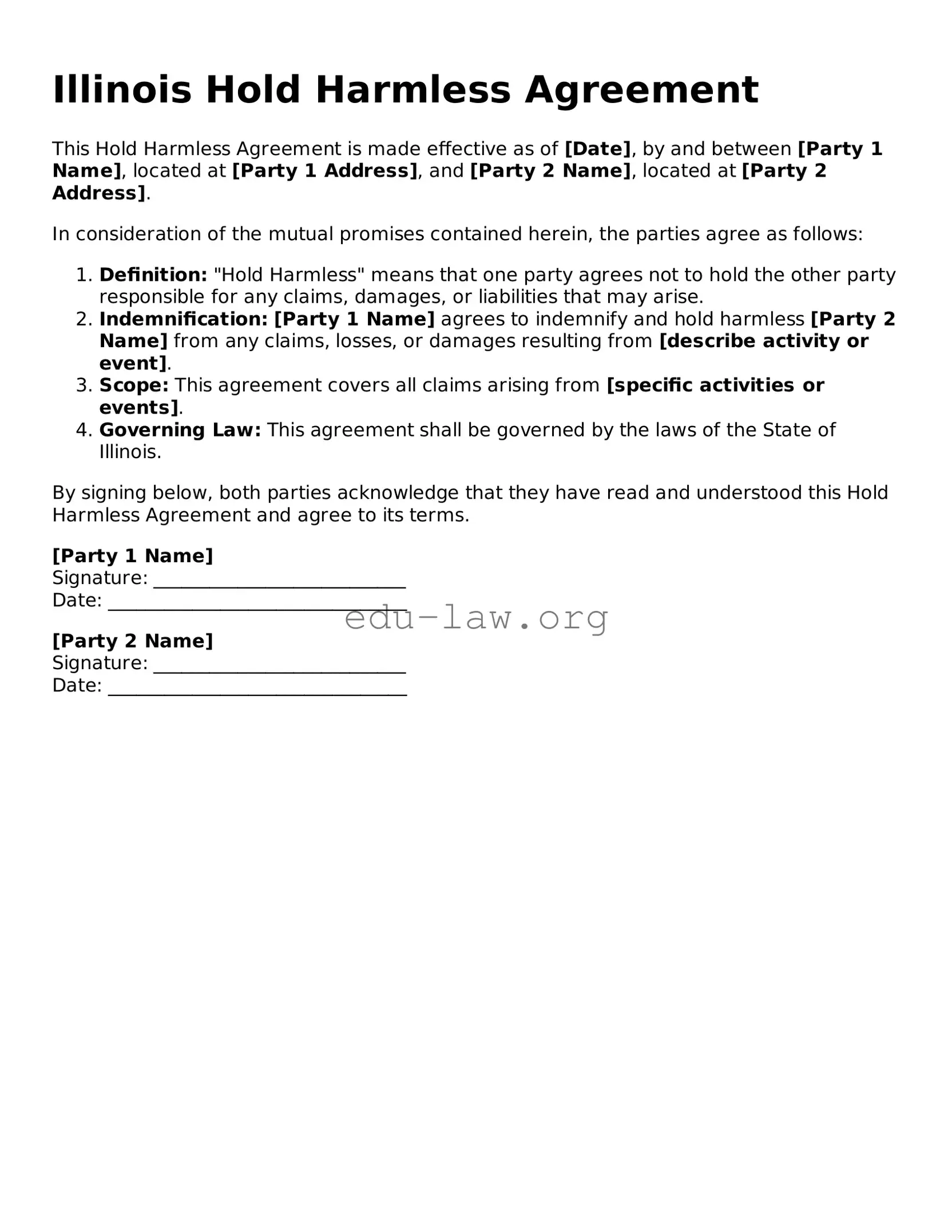
Illinois Hold Harmless Agreement
This Hold Harmless Agreement is made effective as of [Date], by and between [Party 1 Name], located at [Party 1 Address], and [Party 2 Name], located at [Party 2 Address].
In consideration of the mutual promises contained herein, the parties agree as follows:
By signing below, both parties acknowledge that they have read and understood this Hold Harmless Agreement and agree to its terms.
[Party 1 Name]
Signature: ___________________________
Date: ________________________________
[Party 2 Name]
Signature: ___________________________
Date: ________________________________
| Fact Name | Details |
|---|---|
| Purpose | The Illinois Hold Harmless Agreement form is designed to protect one party from liability for any injuries or damages that may occur during a specified activity or event. |
| Governing Law | This agreement is governed by Illinois state law, specifically under the principles of contract law and liability waivers. |
| Parties Involved | The agreement typically involves two parties: the indemnitor (the party assuming liability) and the indemnitee (the party being protected). |
| Enforceability | For the agreement to be enforceable, it must be clear, specific, and voluntarily signed by both parties, ensuring that all terms are understood. |
Filling out the Illinois Hold Harmless Agreement form is a straightforward process. Once you have completed the form, you will be ready to submit it according to the specific requirements outlined by the party requesting it. Follow these steps to ensure that you fill out the form correctly.
What is a Hold Harmless Agreement?
A Hold Harmless Agreement is a legal document that protects one party from liability or claims that may arise from specific activities or events. In Illinois, this agreement is often used in various contexts, such as rental agreements, event planning, and construction contracts. By signing this document, one party agrees not to hold the other party responsible for any damages or injuries that may occur during the specified activities.
Who typically uses a Hold Harmless Agreement in Illinois?
This agreement is commonly utilized by businesses, landlords, event organizers, and contractors. For example, a landlord may require tenants to sign a Hold Harmless Agreement to protect against claims related to injuries on the property. Similarly, event organizers may use it to shield themselves from liability during public events.
What should be included in a Hold Harmless Agreement?
A comprehensive Hold Harmless Agreement should clearly outline the parties involved, the specific activities covered, and the scope of liability protection. It should also specify any limitations or exclusions. Clarity is essential to ensure that all parties understand their rights and responsibilities. Additionally, including a section for signatures and dates is crucial for the agreement's enforceability.
Is a Hold Harmless Agreement legally binding in Illinois?
Yes, a Hold Harmless Agreement can be legally binding in Illinois, provided it meets certain requirements. The agreement must be clear, voluntary, and entered into by parties who have the legal capacity to contract. However, it is important to note that courts may not enforce such agreements if they are deemed overly broad or if they attempt to waive liability for gross negligence or willful misconduct.
Can I modify a Hold Harmless Agreement?
Yes, parties can modify a Hold Harmless Agreement to better fit their needs. Any changes should be made in writing and signed by all parties involved. This ensures that everyone is aware of and agrees to the modifications. It is advisable to consult with a legal professional when making significant changes to ensure that the agreement remains enforceable.
What should I do if I am asked to sign a Hold Harmless Agreement?
If you are asked to sign a Hold Harmless Agreement, it is important to read the document carefully. Consider the implications of the agreement and how it affects your rights. If you have any concerns or questions, seek legal advice before signing. Understanding the terms and potential liabilities is crucial to protect your interests.
Not reading the entire agreement before signing. It's crucial to understand all terms and conditions to avoid unintended obligations.
Failing to provide accurate personal information. Ensure that your name, address, and contact details are correct to avoid any issues later.
Leaving out important dates. Missing the date of the agreement can create confusion about when the terms take effect.
Not specifying the scope of the agreement. Clearly outline what activities or situations the agreement covers to prevent misunderstandings.
Neglecting to understand the implications of "hold harmless." This term means you agree not to hold someone liable for certain damages, which can have serious consequences.
Using vague language. Be specific in your wording to avoid ambiguity that could lead to disputes later on.
Forgetting to include any necessary signatures. Ensure all required parties sign the agreement to make it legally binding.
Not keeping a copy for personal records. After signing, always retain a copy for your own reference and protection.
Overlooking state-specific requirements. Illinois may have particular laws or stipulations that affect your agreement, so familiarize yourself with them.
Rushing through the process. Take your time to fill out the form carefully; hasty decisions can lead to costly mistakes.
The Illinois Hold Harmless Agreement is a crucial document that protects one party from legal liability for any injuries or damages that may occur during an event or activity. However, it is often accompanied by other forms and documents that further clarify responsibilities and expectations. Below is a list of common documents that might be used alongside the Hold Harmless Agreement.
Each of these documents plays a vital role in ensuring that all parties are aware of their rights and responsibilities. By utilizing these forms alongside the Illinois Hold Harmless Agreement, individuals and organizations can foster a safer and more organized environment for their events and activities.
The Illinois Waiver of Liability is similar to the Hold Harmless Agreement in that both documents aim to protect one party from legal claims resulting from injuries or damages. In a Waiver of Liability, an individual voluntarily relinquishes their right to sue, acknowledging the risks involved in an activity. This agreement is often used in recreational settings, such as sports or outdoor events, where participants understand the potential dangers but choose to proceed nonetheless. Like the Hold Harmless Agreement, it requires clear communication about risks and the assumption of those risks by the participant.
The Indemnity Agreement shares similarities with the Hold Harmless Agreement, as both documents involve one party agreeing to compensate another for losses or damages. An Indemnity Agreement specifically outlines the responsibilities of one party to cover any costs arising from claims made by third parties. This is particularly relevant in business contracts where one party may need to protect another from potential legal issues that could arise from their actions. Both agreements serve as a proactive measure to mitigate financial risk.
The Release of Liability form also parallels the Hold Harmless Agreement by seeking to limit legal exposure for one party. This document is commonly used in situations where individuals participate in activities that could lead to injury. By signing a Release of Liability, participants acknowledge the inherent risks and agree not to hold the organizer responsible for any injuries sustained. Both documents emphasize the importance of informed consent and the understanding of risks involved.
The Consent to Treat form is another document that shares a connection with the Hold Harmless Agreement, particularly in medical settings. While the Hold Harmless Agreement protects against claims related to negligence, the Consent to Treat form allows healthcare providers to perform medical procedures with the patient's informed consent. Patients acknowledge the risks associated with treatment, similar to how participants in a Hold Harmless Agreement recognize potential dangers. Both forms aim to establish clear expectations and responsibilities.
The Rental Agreement often includes clauses that resemble those found in a Hold Harmless Agreement. When renting property, landlords may require tenants to agree to indemnify them against any claims arising from the tenant's use of the property. This protects the landlord from liability while ensuring that tenants understand their responsibilities. The focus on risk management is a common thread that links these two documents.
The Contractor Agreement is similar to the Hold Harmless Agreement in that it often contains indemnification clauses to protect parties involved in a construction project. Contractors may agree to hold the property owner harmless from any claims resulting from their work. This is crucial in the construction industry, where accidents can occur. Both documents serve to clarify responsibilities and protect parties from unforeseen legal repercussions.
The Service Agreement can also bear resemblance to the Hold Harmless Agreement, especially when it involves service providers. In many cases, service providers may include clauses that limit their liability for issues arising during the course of their work. This is particularly important in fields such as consulting or maintenance, where unforeseen problems can lead to disputes. Both agreements focus on establishing clear terms to manage potential risks.
Finally, the Non-Disclosure Agreement (NDA) shares a conceptual similarity with the Hold Harmless Agreement, albeit in a different context. While NDAs primarily protect confidential information, they can also include provisions that shield one party from liability related to the misuse of that information. Both documents emphasize the importance of trust and responsibility in business relationships. They serve to establish boundaries and protect the interests of all parties involved.
When filling out the Illinois Hold Harmless Agreement form, it's essential to approach the process with care. This agreement can protect you from liability in various situations, but ensuring that it is completed correctly is crucial. Here are some important dos and don’ts to keep in mind.
By following these guidelines, you can navigate the completion of the Hold Harmless Agreement with confidence. Protecting yourself and your interests is the priority.
The Illinois Hold Harmless Agreement is often misunderstood. Below are ten common misconceptions about this form, along with explanations to clarify these misunderstandings.
Many believe that only businesses use Hold Harmless Agreements. In reality, individuals, organizations, and various entities can utilize this form to protect themselves from liability.
This agreement does not completely eliminate liability. It primarily shifts responsibility for certain risks from one party to another, but it does not cover gross negligence or willful misconduct.
While Hold Harmless Agreements can be legally binding, their enforceability can depend on specific circumstances, including the clarity of the language used and the context in which they are applied.
Not all risks can be covered by a Hold Harmless Agreement. Certain risks, especially those related to illegal activities or public policy, may not be enforceable.
Both parties involved typically need to sign the agreement for it to be valid. This mutual consent ensures that all parties understand their responsibilities.
Each Hold Harmless Agreement should be tailored to fit the specific situation. Generic templates may not adequately address the unique risks involved.
This agreement does not protect against all claims. Certain exclusions may apply, and parties should be aware of what is and isn’t covered.
Signing a Hold Harmless Agreement after an incident has occurred may not provide any protection. It is best to have the agreement in place before any potential risks arise.
A Hold Harmless Agreement is not a substitute for insurance. While it can mitigate some risks, it does not provide the financial protection that insurance does.
There is considerable variation among Hold Harmless Agreements. Each agreement can differ based on the parties involved, the risks being addressed, and the specific terms outlined.
Filling out and using the Illinois Hold Harmless Agreement form can be an important step in protecting your interests. Here are some key takeaways to keep in mind:
By following these key points, you can navigate the process of filling out and using the Illinois Hold Harmless Agreement more effectively.