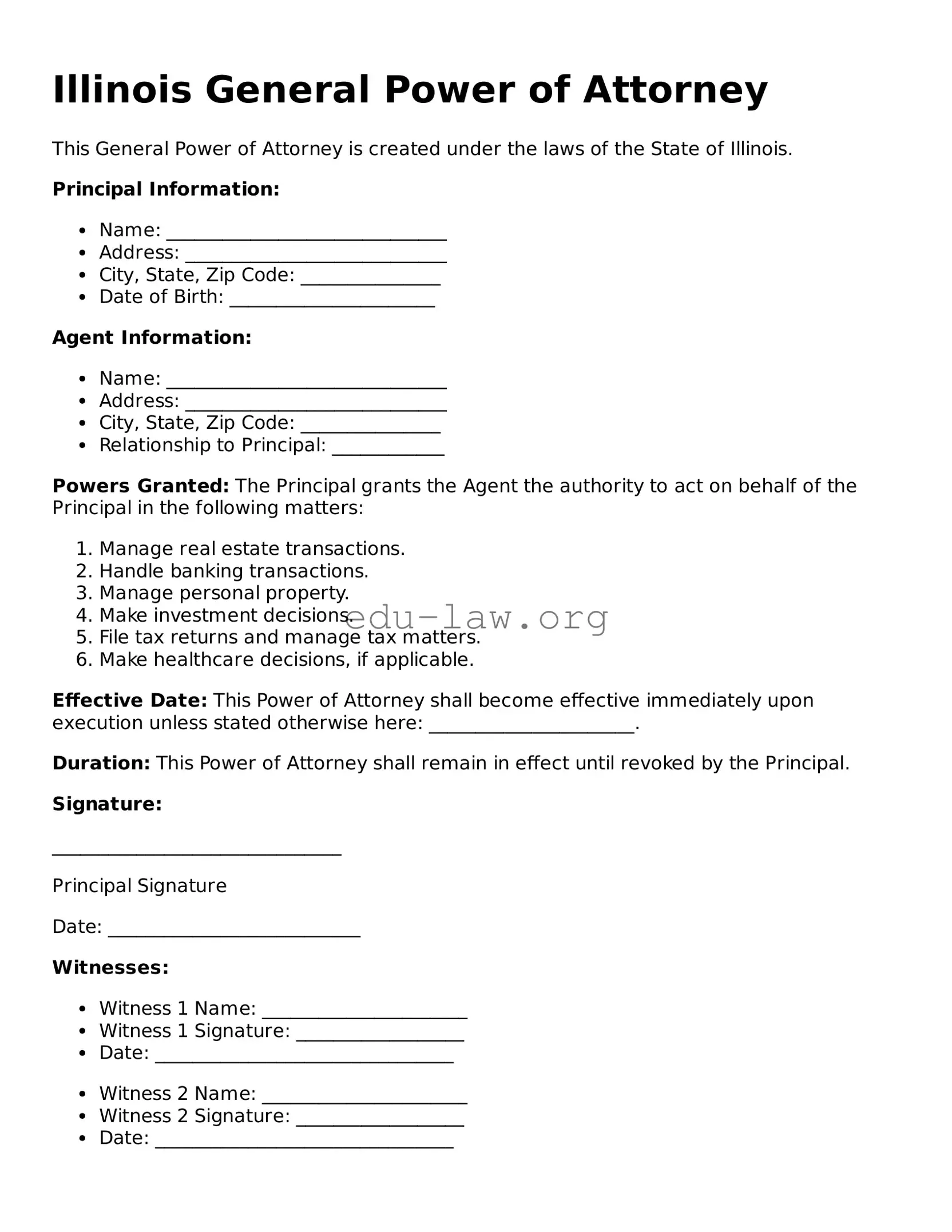
The Illinois General Power of Attorney form serves as a crucial legal document that empowers an individual, known as the agent or attorney-in-fact, to make decisions on behalf of another person, referred to as the principal. This form allows the agent to handle a wide range of financial and legal matters, including managing bank accounts, signing contracts, and making investment decisions. One of the key aspects of this form is its flexibility; it can be tailored to grant specific powers or to cover a broad scope of authority. Additionally, the Illinois General Power of Attorney can be effective immediately or can be set to take effect only upon the principal's incapacitation. It is important to note that the principal retains the right to revoke the power of attorney at any time, as long as they are mentally competent. Understanding the implications and responsibilities that come with this document is essential for both the principal and the agent, ensuring that the principal's wishes are honored and that the agent acts in the principal's best interests.
Illinois General Power of Attorney
This General Power of Attorney is created under the laws of the State of Illinois.
Principal Information:
Agent Information:
Powers Granted: The Principal grants the Agent the authority to act on behalf of the Principal in the following matters:
Effective Date: This Power of Attorney shall become effective immediately upon execution unless stated otherwise here: ______________________.
Duration: This Power of Attorney shall remain in effect until revoked by the Principal.
Signature:
_______________________________
Principal Signature
Date: ___________________________
Witnesses:
Notary Public:
State of Illinois
County of ___________________________
Subscribed and sworn to before me this _____ day of ____________, 20__.
_______________________________
Notary Public Signature
My Commission Expires: _______________
| Fact Name | Details |
|---|---|
| Definition | The Illinois General Power of Attorney form allows an individual to appoint someone else to manage their financial and legal affairs. |
| Governing Law | The form is governed by the Illinois Power of Attorney Act (755 ILCS 45/1-1 et seq.). |
| Principal and Agent | The person granting authority is known as the principal, while the person receiving authority is the agent or attorney-in-fact. |
| Durability | The power of attorney can be durable, meaning it remains effective even if the principal becomes incapacitated. |
| Limitations | Specific limitations can be included in the document to restrict the agent's authority. |
| Revocation | The principal can revoke the power of attorney at any time, as long as they are mentally competent. |
| Witness Requirement | The form must be signed in the presence of a witness who is not the agent or related to the principal. |
| Notarization | Although not required, notarizing the document can add an extra layer of validity. |
| Use Cases | This form is commonly used for managing bank accounts, real estate transactions, and other financial matters. |
| Expiration | The power of attorney does not expire unless revoked or if the principal passes away. |
Filling out the Illinois General Power of Attorney form is an important step in designating someone to make decisions on your behalf. Once completed, this form allows your chosen agent to act in your best interests, ensuring your wishes are followed if you are unable to make decisions yourself.
After completing the form, keep a copy for your records and provide a copy to your agent. It’s also wise to inform family members about your decision and the location of the document. This helps ensure that everyone is aware of your wishes and can support your agent when needed.
What is a General Power of Attorney in Illinois?
A General Power of Attorney in Illinois is a legal document that allows one person, known as the principal, to appoint another person, called the agent, to manage their financial and legal affairs. This authority can include making decisions regarding banking, real estate, and other financial transactions. The principal must be at least 18 years old and mentally competent to create this document. The powers granted can be broad or limited, depending on the principal's wishes.
How does one create a General Power of Attorney in Illinois?
To create a General Power of Attorney in Illinois, the principal must fill out the appropriate form, which can be obtained from various legal resources or online platforms. The form must clearly state the powers being granted to the agent. After completing the form, the principal must sign it in the presence of a notary public. It is important to ensure that the document complies with Illinois state laws to be valid and enforceable.
Can a General Power of Attorney be revoked in Illinois?
Yes, a General Power of Attorney can be revoked at any time by the principal, as long as they are mentally competent. The revocation should be made in writing and should ideally be notarized to prevent any disputes. It is advisable to inform the agent and any institutions or individuals who were relying on the original power of attorney about the revocation to ensure clarity and prevent unauthorized actions.
What happens if the principal becomes incapacitated?
If the principal becomes incapacitated, the General Power of Attorney typically remains in effect unless it was specifically stated to terminate upon incapacity. However, it is important to note that a General Power of Attorney does not allow the agent to make healthcare decisions for the principal. For medical decisions, a separate document, known as a Healthcare Power of Attorney, is required. This distinction is crucial for ensuring that the principal's wishes regarding healthcare are respected.
Failing to specify the powers granted. Individuals often overlook detailing the specific powers they wish to grant to their agent, which can lead to confusion and potential misuse.
Not naming an alternate agent. Many people neglect to designate a backup agent. If the primary agent is unavailable or unable to act, this can create complications.
Using outdated forms. Some individuals use older versions of the General Power of Attorney form, which may not comply with current Illinois laws, leading to invalidation.
Inadequate witness signatures. The form requires specific witness signatures. Failing to have the correct number of witnesses can render the document ineffective.
Not dating the document. Omitting the date when signing the form can create ambiguity about when the powers take effect.
Overlooking the agent's qualifications. Choosing an agent without considering their ability to handle financial matters can lead to poor decision-making.
Ignoring state-specific requirements. Some people do not familiarize themselves with Illinois-specific requirements, leading to potential legal issues.
Not discussing intentions with the agent. Failing to communicate the scope of authority and expectations with the chosen agent can result in misunderstandings.
Neglecting to review the document periodically. Life circumstances change. Not revisiting the Power of Attorney can lead to outdated provisions that no longer reflect current wishes.
Assuming the form is permanent. Some individuals believe that once the form is filled out, it cannot be revoked or changed. In reality, it can be revoked or amended as needed.
When creating a General Power of Attorney in Illinois, several other forms and documents may be beneficial to ensure comprehensive legal coverage. Each of these documents serves a specific purpose and can help clarify the intentions of the principal. Below is a list of commonly used forms that may accompany the General Power of Attorney.
Incorporating these documents along with the General Power of Attorney can help ensure that an individual’s wishes are respected and that their affairs are managed effectively. Each document plays a vital role in providing clarity and direction during challenging times.
The Illinois General Power of Attorney form is similar to the Durable Power of Attorney. Both documents allow an individual to appoint someone else to make decisions on their behalf. The key difference lies in durability; the Durable Power of Attorney remains effective even if the principal becomes incapacitated, while the General Power of Attorney may not. This makes the Durable Power of Attorney a preferred choice for long-term planning.
Another document that resembles the Illinois General Power of Attorney is the Medical Power of Attorney. This form specifically grants authority to an agent to make healthcare decisions for the principal. While the General Power of Attorney can cover a broad range of decisions, the Medical Power of Attorney is focused solely on health-related matters. This distinction is crucial for individuals wanting to designate someone to handle medical decisions during periods of incapacity.
The Financial Power of Attorney is also similar to the Illinois General Power of Attorney. Both documents allow a designated person to manage financial affairs. However, the Financial Power of Attorney typically focuses exclusively on financial matters, such as banking, investments, and property transactions, while the General Power of Attorney can encompass both financial and non-financial decisions.
The Limited Power of Attorney shares similarities with the Illinois General Power of Attorney but is more restrictive in scope. This document allows the principal to grant authority to an agent for a specific task or a limited period. Unlike the General Power of Attorney, which provides broad authority, the Limited Power of Attorney is tailored for particular situations, such as signing documents during a temporary absence.
The Springing Power of Attorney is another document that is comparable to the Illinois General Power of Attorney. This form becomes effective only under certain conditions, typically when the principal becomes incapacitated. In contrast, the General Power of Attorney is effective immediately upon signing. This makes the Springing Power of Attorney suitable for those who want to retain control until a specific event occurs.
The Revocable Living Trust is similar in that it allows for the management of assets, but it serves a different purpose. While the Illinois General Power of Attorney grants authority to an agent to act on behalf of the principal, a Revocable Living Trust is a legal entity that holds the principal’s assets. This document can help avoid probate and manage assets during incapacity, providing a comprehensive estate planning tool.
The Advance Healthcare Directive is another document that relates to the Illinois General Power of Attorney, particularly in healthcare decisions. This directive combines a Medical Power of Attorney with a living will, outlining the principal’s wishes regarding medical treatment. While the General Power of Attorney can authorize someone to make health decisions, the Advance Healthcare Directive specifies the types of treatments the principal would want or refuse.
The Healthcare Proxy is similar to the Medical Power of Attorney, as it designates someone to make healthcare decisions on behalf of the principal. However, the Healthcare Proxy often focuses on end-of-life decisions and may not cover broader medical decisions. This document ensures that the principal’s healthcare preferences are respected when they cannot communicate their wishes.
Lastly, the Will is a document that, while not a power of attorney, is related in the context of estate planning. A Will outlines how a person's assets should be distributed after their death. Unlike the Illinois General Power of Attorney, which is effective during the principal’s lifetime, a Will takes effect only after death. Both documents are essential for comprehensive estate planning but serve different functions.
When filling out the Illinois General Power of Attorney form, it is important to approach the task with care and attention to detail. Here are some essential dos and don’ts to consider:
Taking these steps can help ensure that your General Power of Attorney form is filled out correctly and serves your needs effectively.
Understanding the Illinois General Power of Attorney form can be challenging. Here are nine common misconceptions about this important legal document:
Many people believe that a General Power of Attorney (GPOA) is limited to financial decisions. In reality, it can also grant authority over health care decisions, depending on how it is drafted.
Some think that only seniors need a GPOA. However, anyone can benefit from having one, especially if they anticipate a time when they may be unable to make decisions for themselves.
Many assume that a GPOA only takes effect when they are incapacitated. In Illinois, a GPOA can be effective immediately upon signing, allowing the agent to act on behalf of the principal right away.
While the agent has significant authority, their powers are limited to what is specified in the document. They must act in the best interest of the principal and cannot use the authority for personal gain.
People often believe that a GPOA is permanent. In fact, you can revoke or change it at any time, as long as you are competent to do so.
Some think that a standard form will meet all their needs. However, the GPOA should be tailored to reflect specific wishes and circumstances.
This misconception is common. A spouse does not automatically have power of attorney unless you have designated them as your agent in a GPOA.
While the Illinois GPOA is governed by state law, it may still be recognized in other states. However, it is advisable to check local laws if you plan to use it outside Illinois.
This is not true. A General Power of Attorney ceases to be effective upon the death of the principal. After that, the estate plan takes over, typically through a will or trust.
Clarifying these misconceptions can help individuals make informed decisions about their legal and financial planning. Understanding the scope and limitations of a General Power of Attorney is crucial for effective management of personal affairs.
Filling out and using the Illinois General Power of Attorney form is an important step in ensuring your wishes are followed. Here are some key takeaways to keep in mind:
Taking these steps can help you feel more secure in your decision-making process. It’s about ensuring your voice is heard, even when you may not be able to speak for yourself.