In Illinois, the Do Not Resuscitate (DNR) Order form plays a critical role in ensuring that individuals receive the medical care they desire at the end of life. This legally recognized document allows patients to express their wishes regarding resuscitation efforts in the event of cardiac arrest or respiratory failure. By completing a DNR Order, individuals can communicate their preferences to healthcare providers, family members, and emergency responders, helping to prevent unwanted interventions. The form must be signed by a physician and can be honored in various settings, including hospitals, nursing homes, and private residences. It is essential for individuals to discuss their choices with loved ones and medical professionals to ensure that their intentions are understood and respected. Understanding the nuances of the DNR Order can empower individuals to make informed decisions about their healthcare and end-of-life preferences.
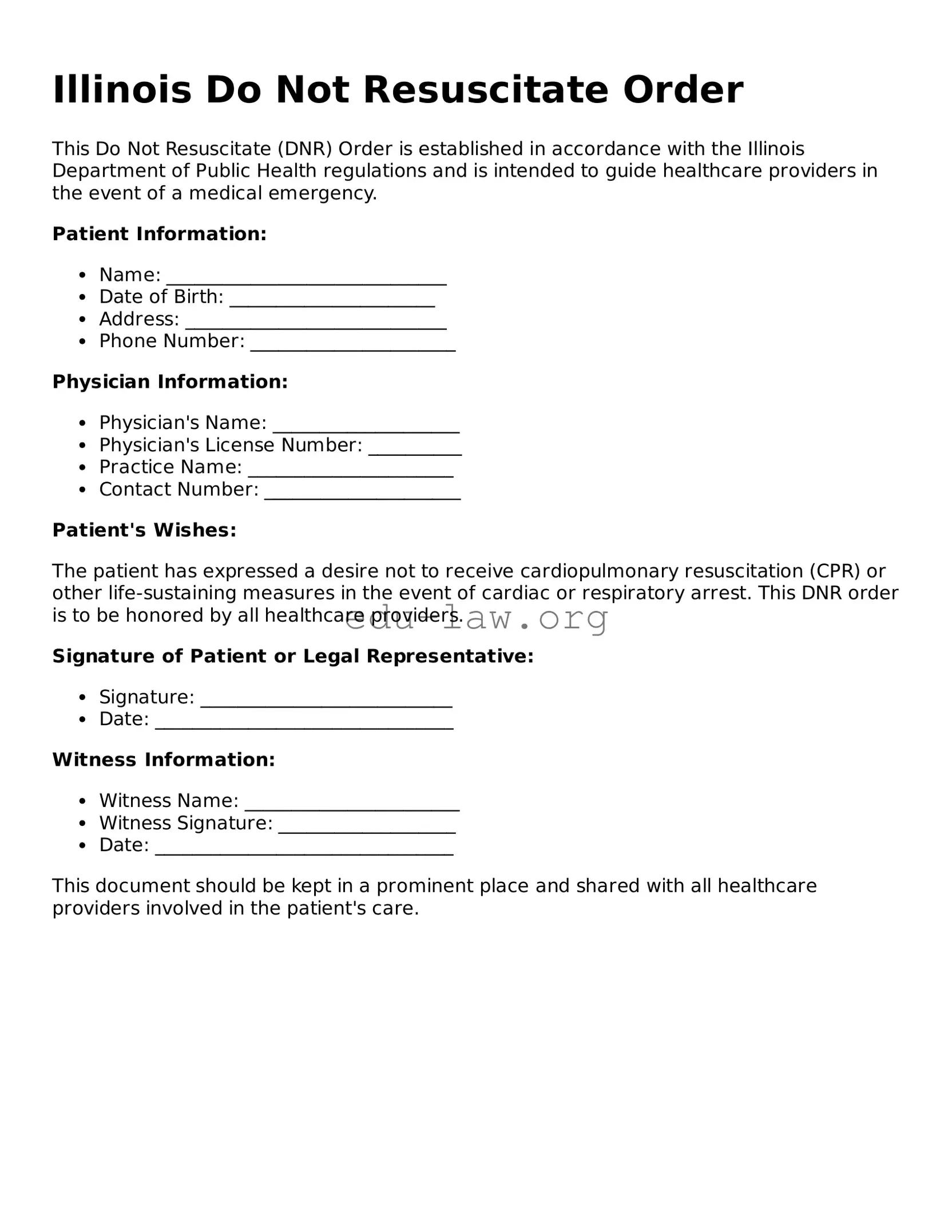
Illinois Do Not Resuscitate Order
This Do Not Resuscitate (DNR) Order is established in accordance with the Illinois Department of Public Health regulations and is intended to guide healthcare providers in the event of a medical emergency.
Patient Information:
Physician Information:
Patient's Wishes:
The patient has expressed a desire not to receive cardiopulmonary resuscitation (CPR) or other life-sustaining measures in the event of cardiac or respiratory arrest. This DNR order is to be honored by all healthcare providers.
Signature of Patient or Legal Representative:
Witness Information:
This document should be kept in a prominent place and shared with all healthcare providers involved in the patient's care.
| Fact Name | Description |
|---|---|
| Definition | The Illinois Do Not Resuscitate (DNR) Order form is a legal document that allows a person to refuse resuscitation efforts in the event of cardiac or respiratory arrest. |
| Governing Law | This form is governed by the Illinois DNR Law, specifically 410 ILCS 50/1 et seq., which outlines the rights of patients regarding resuscitation efforts. |
| Eligibility | Any adult who is of sound mind can complete a DNR Order. It is essential for individuals with terminal illnesses or those wishing to avoid aggressive medical interventions. |
| Signature Requirements | The form must be signed by the individual or their authorized representative. Additionally, it requires the signature of a physician to be valid. |
| Revocation | A DNR Order can be revoked at any time by the individual or their representative. This can be done verbally or by destroying the form. |
Completing the Illinois Do Not Resuscitate Order form is an important step in expressing your medical preferences. This document allows individuals to communicate their wishes regarding resuscitation efforts in emergency situations. Follow the steps below to accurately fill out the form.
Once the form is completed, it is crucial to ensure that it is easily accessible to medical personnel. Keep a copy at home, and inform your healthcare provider about your decision. This will help ensure that your wishes are respected in medical emergencies.
What is a Do Not Resuscitate (DNR) Order in Illinois?
A Do Not Resuscitate Order is a legal document that allows a person to refuse cardiopulmonary resuscitation (CPR) and other life-saving measures in the event of a medical emergency. In Illinois, this order is typically used by individuals who have a terminal illness or are in a condition where resuscitation would not improve their quality of life. The DNR Order must be signed by a physician and should be readily available to medical personnel in emergencies.
How can I obtain a DNR Order in Illinois?
To obtain a DNR Order, you must first discuss your wishes with your healthcare provider. If you and your physician agree that a DNR Order is appropriate for your situation, the physician will complete the DNR form. This form must be signed by the physician and should include your name, date of birth, and the physician's information. It is essential to keep copies of the signed order in accessible locations, such as with your medical records and at home.
Where should I keep my DNR Order?
Your DNR Order should be kept in a place where it can be easily accessed by emergency medical personnel. Common recommendations include placing it on the refrigerator, in your medical records, or carrying a copy in your wallet. Additionally, inform family members and caregivers about the location of the document to ensure that your wishes are honored in an emergency.
Can I change or revoke my DNR Order?
Yes, you can change or revoke your DNR Order at any time. To do so, you must inform your healthcare provider and complete a new DNR form if necessary. If you wish to revoke the order, simply destroying the document and informing your healthcare provider and family members will suffice. It is crucial to ensure that everyone involved in your care is aware of any changes to your DNR status.
Will a DNR Order affect my overall medical care?
A DNR Order specifically addresses resuscitation efforts and does not affect other aspects of your medical care. You will continue to receive appropriate medical treatment, including pain management and comfort care. It is important to communicate your wishes clearly with your healthcare team to ensure that your overall care aligns with your values and preferences.
Not Understanding the Purpose: Many individuals fill out the form without fully grasping what a Do Not Resuscitate (DNR) order entails. It is crucial to understand that this document specifically instructs medical personnel not to perform CPR or other life-saving measures in the event of cardiac arrest.
Inaccurate Personal Information: Filling out the form with incorrect personal details, such as name, date of birth, or medical record number, can lead to confusion during emergencies. Ensure that all information is accurate and up-to-date.
Failure to Sign: A common oversight is neglecting to sign the form. Without a signature, the document may not be considered valid. It is essential to ensure that the form is signed by the individual or their authorized representative.
Not Including Witnesses: Some people forget to have the DNR order witnessed, which is often a requirement for the document to be legally binding. Check local regulations to determine if witnesses are necessary and ensure they are present during the signing.
Ignoring State-Specific Requirements: Each state has its own rules regarding DNR orders. Failing to comply with Illinois-specific requirements can render the form invalid. Familiarize yourself with the state's regulations to avoid complications.
Not Communicating Wishes: After completing the form, individuals sometimes forget to discuss their wishes with family members and healthcare providers. Open communication is vital to ensure everyone involved understands the individual's preferences regarding end-of-life care.
In Illinois, the Do Not Resuscitate (DNR) Order form is a critical document that outlines a patient's wishes regarding resuscitation efforts in the event of a medical emergency. Along with the DNR form, several other documents may be utilized to ensure that a patient's healthcare preferences are respected. Below is a list of these important forms and documents.
Understanding these documents is essential for ensuring that a patient’s healthcare wishes are honored. Each form serves a distinct purpose and can significantly impact medical decisions during critical times.
The Illinois Do Not Resuscitate (DNR) Order form shares similarities with advance directives, which are legal documents that allow individuals to outline their preferences for medical treatment in the event they become unable to communicate their wishes. Like the DNR, advance directives can specify what types of medical interventions a person wants or does not want, ensuring that their healthcare aligns with their values and desires even when they cannot speak for themselves.
Another document akin to the DNR is the living will. A living will is a type of advance directive that specifically addresses end-of-life medical treatment. It allows individuals to express their wishes regarding life-sustaining treatments, including resuscitation efforts. Both the living will and the DNR focus on the importance of patient autonomy and provide guidance to healthcare providers about a patient's preferences during critical situations.
The healthcare power of attorney is also similar to the DNR form. This document designates a person to make healthcare decisions on behalf of someone else if they are unable to do so. While the DNR specifies preferences about resuscitation, the healthcare power of attorney can encompass a broader range of medical decisions, giving the appointed individual the authority to act in accordance with the patient's wishes, including decisions related to resuscitation.
Physician Orders for Life-Sustaining Treatment (POLST) forms are another document that parallels the DNR. POLST forms are designed for individuals with serious health conditions and provide specific medical orders regarding treatments such as resuscitation, intubation, and other life-sustaining measures. Like the DNR, POLST forms are actionable medical orders that healthcare providers must follow, ensuring that patients receive care consistent with their preferences.
Similar to the DNR is the medical order for scope of treatment (MOST) form, which is used primarily in certain states to outline a patient's treatment preferences. The MOST form addresses a range of interventions, including resuscitation, and is intended for patients with serious or chronic illnesses. It serves as a guide for medical professionals, much like the DNR, ensuring that treatment aligns with the patient's wishes.
Another related document is the do not intubate (DNI) order. While a DNR focuses on the broader aspect of resuscitation efforts, a DNI specifically addresses the decision to forgo intubation. Patients who have a DNI order wish to avoid being placed on a ventilator, which is a critical aspect of resuscitation. Both orders are essential in communicating patient preferences regarding life-sustaining measures.
The comfort care order is also similar, as it emphasizes the importance of providing comfort to patients rather than pursuing aggressive medical interventions. This order guides healthcare providers to focus on pain management and quality of life rather than life-prolonging treatments. Like the DNR, comfort care orders reflect the values of individuals who prioritize comfort and dignity in their final days.
Advance care planning documents, which include various forms and discussions about future healthcare preferences, also relate closely to the DNR. These documents encourage individuals to think about and communicate their healthcare wishes to family members and healthcare providers. They help ensure that a person's preferences, including those outlined in a DNR, are understood and respected.
Lastly, the end-of-life care plan can be compared to the DNR. This comprehensive plan outlines a patient’s wishes regarding all aspects of end-of-life care, including resuscitation preferences. It serves as a roadmap for healthcare providers and family members, ensuring that every decision made aligns with the patient’s values and desires, similar to how a DNR functions in emergencies.
When filling out the Illinois Do Not Resuscitate Order form, it’s essential to approach the task with care and consideration. Here’s a guide to help you navigate the process effectively.
Things You Should Do:
Things You Shouldn't Do:
By following these guidelines, you can ensure that your wishes are clearly communicated and respected. Remember, this is a personal decision that requires thoughtful consideration.
Many people have misunderstandings about the Illinois Do Not Resuscitate (DNR) Order form. Here are eight common misconceptions, along with clarifications to help you better understand this important document.
This is not true. A DNR specifically addresses resuscitation efforts during cardiac arrest or respiratory failure. Other medical treatments will still be provided unless stated otherwise.
While many people with terminal illnesses choose to have a DNR, it is not limited to them. Anyone can request a DNR based on their personal health care preferences.
These are different documents. A living will outlines your wishes regarding medical treatment in general, while a DNR specifically focuses on resuscitation efforts.
You can revoke or change a DNR order at any time. It’s important that your wishes are clearly communicated to your healthcare providers.
A DNR order is valid in any healthcare setting, including at home, nursing homes, and during emergency medical services.
You do not need a lawyer to complete a DNR form. However, it’s wise to discuss your decisions with your healthcare provider to ensure your wishes are understood.
This is a misconception. Age does not determine whether someone can have a DNR. It’s about personal choice and health status.
This is a common fear. A DNR does not hasten death. It simply respects your wishes regarding resuscitation efforts in case of a medical emergency.
Understanding these misconceptions can help individuals make informed decisions about their healthcare preferences. Always consult with healthcare professionals to clarify any doubts regarding DNR orders.
Filling out the Illinois Do Not Resuscitate (DNR) Order form is an important step for individuals who wish to express their preferences regarding medical treatment in emergency situations. Here are some key takeaways to consider:
By following these guidelines, individuals can ensure their wishes are respected in critical situations.