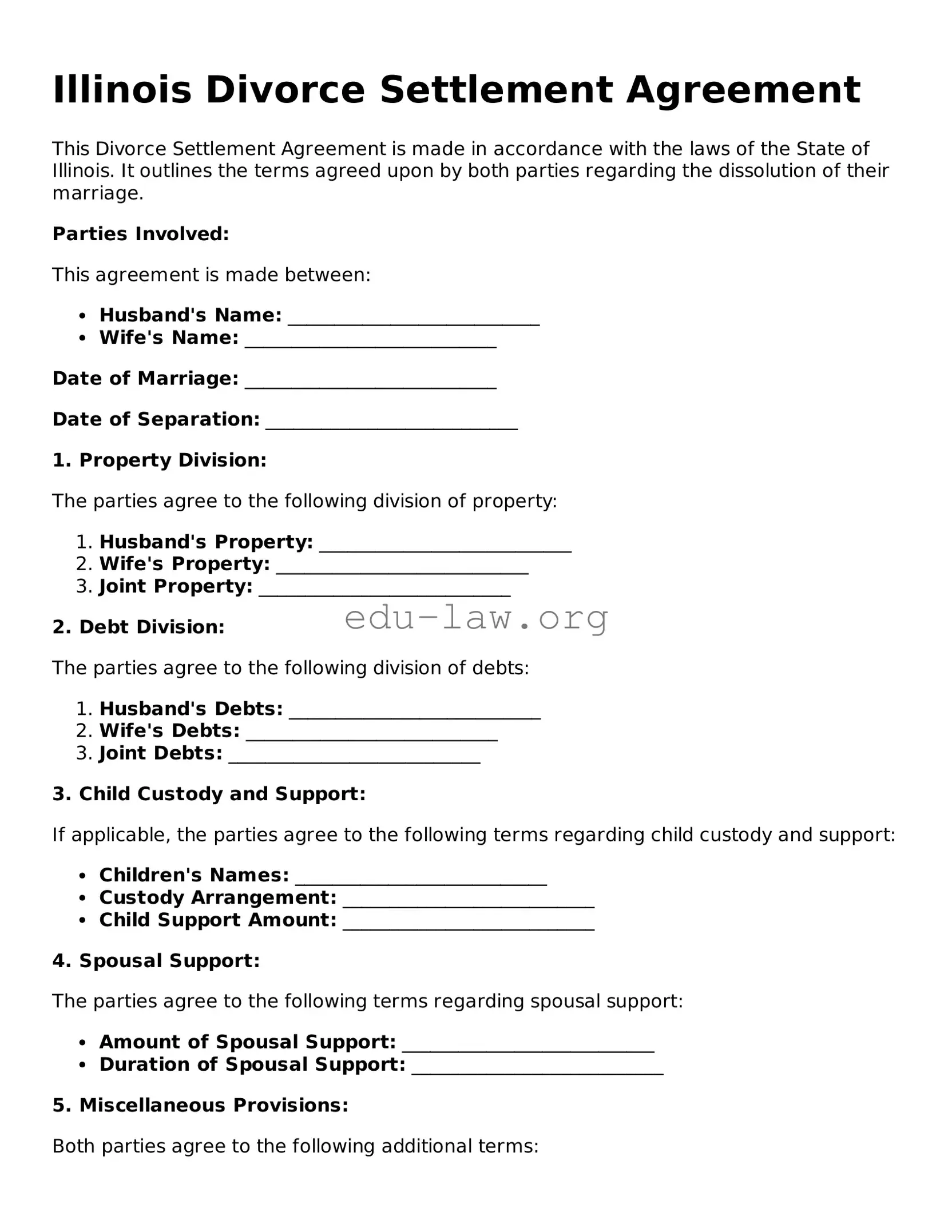
In the state of Illinois, navigating the complexities of divorce can be daunting, but a Divorce Settlement Agreement form plays a crucial role in streamlining this process. This form outlines the terms agreed upon by both parties, covering essential aspects such as the division of marital property, allocation of debts, child custody arrangements, and spousal support. By clearly documenting these agreements, the form helps to minimize misunderstandings and potential conflicts in the future. Each section of the form requires careful consideration, as it addresses not only financial matters but also the emotional well-being of any children involved. Completing this form accurately is vital, as it becomes a legally binding document once filed with the court. Understanding its components and implications can significantly ease the transition into post-divorce life, ensuring that both parties have clarity and protection moving forward.
Illinois Divorce Settlement Agreement
This Divorce Settlement Agreement is made in accordance with the laws of the State of Illinois. It outlines the terms agreed upon by both parties regarding the dissolution of their marriage.
Parties Involved:
This agreement is made between:
Date of Marriage: ___________________________
Date of Separation: ___________________________
1. Property Division:
The parties agree to the following division of property:
2. Debt Division:
The parties agree to the following division of debts:
3. Child Custody and Support:
If applicable, the parties agree to the following terms regarding child custody and support:
4. Spousal Support:
The parties agree to the following terms regarding spousal support:
5. Miscellaneous Provisions:
Both parties agree to the following additional terms:
This agreement is intended to be a complete and final settlement of all issues arising from the marriage. Both parties acknowledge that they have read and understood the terms of this agreement.
Signatures:
Husband's Signature: ___________________________
Date: ___________________________
Wife's Signature: ___________________________
Date: ___________________________
| Fact Name | Details |
|---|---|
| Purpose | The Illinois Divorce Settlement Agreement form outlines the terms agreed upon by both parties regarding asset division, child custody, and support obligations during a divorce. |
| Governing Law | This form is governed by the Illinois Marriage and Dissolution of Marriage Act (IMDMA), specifically 750 ILCS 5. |
| Filing Requirement | Both parties must sign the agreement, and it should be filed with the court as part of the divorce proceedings. |
| Modification | The terms of the agreement can be modified later, but any changes must be documented and approved by the court. |
After you gather the necessary information and documents, you can begin filling out the Illinois Divorce Settlement Agreement form. This form is essential for outlining the terms of your divorce, including property division, child custody, and support arrangements. Follow these steps to ensure accurate completion.
What is a Divorce Settlement Agreement in Illinois?
A Divorce Settlement Agreement is a written document that outlines how you and your spouse will divide your assets, debts, and responsibilities after your divorce. It serves as a roadmap for your post-divorce life and can cover issues like property division, child custody, and support payments.
Why do I need a Divorce Settlement Agreement?
This agreement is crucial because it helps prevent future disputes. By clearly defining each party's rights and obligations, both spouses can avoid misunderstandings and potential legal issues down the line. It can also expedite the divorce process.
How do I fill out the Divorce Settlement Agreement form?
To fill out the form, start by gathering all necessary information about your assets, debts, and any children involved. Be honest and thorough. Each section of the form will ask for specific details, so take your time to ensure everything is accurate.
Can I create my own Divorce Settlement Agreement?
Yes, you can create your own agreement as long as it meets Illinois legal requirements. However, it is advisable to consult with a legal professional to ensure that your agreement is fair and enforceable.
What happens if my spouse and I cannot agree on the terms?
If you and your spouse cannot reach an agreement, you may need to go through mediation or, in some cases, a court trial. Mediation can help facilitate a discussion to find common ground, while a trial will involve a judge making the final decisions.
Is the Divorce Settlement Agreement legally binding?
Yes, once both parties sign the agreement and it is approved by the court, it becomes legally binding. This means that both parties are obligated to adhere to the terms outlined in the document.
Can the Divorce Settlement Agreement be modified later?
Yes, modifications can be made, but they typically require both parties' consent and may need to be approved by the court. Significant life changes, such as job loss or relocation, may warrant a modification.
How long does it take to finalize a Divorce Settlement Agreement?
The time it takes can vary widely based on how quickly you and your spouse can agree on the terms. If both parties are cooperative, it may take a few weeks. However, if disputes arise, it could take several months or longer.
Do I need an attorney to file a Divorce Settlement Agreement?
While it is not required to have an attorney, it is highly recommended. An attorney can help ensure that your rights are protected and that the agreement is fair and legally sound.
Where do I file the Divorce Settlement Agreement?
You will file the agreement with the circuit court in the county where you or your spouse resides. Make sure to check with the court for any specific filing requirements or fees.
Incomplete Information: One of the most common mistakes is failing to fill out all required sections. Ensure that every relevant detail is provided, including names, addresses, and financial information.
Incorrect Financial Disclosures: Many individuals do not accurately report their income, assets, and debts. Double-check all figures to avoid future disputes.
Not Considering Tax Implications: Some people overlook how property division and alimony may affect their taxes. It’s crucial to understand these impacts before finalizing the agreement.
Ignoring State Requirements: Each state has specific rules regarding divorce agreements. Make sure the form complies with Illinois laws to avoid delays or rejections.
Failure to Seek Legal Advice: Many individuals attempt to complete the form without consulting a lawyer. This can lead to misunderstandings and unfavorable outcomes. It’s wise to get professional guidance.
When navigating the complexities of divorce in Illinois, several key documents often accompany the Divorce Settlement Agreement. Each of these forms plays a vital role in ensuring that the divorce process is thorough and legally sound. Below are some commonly used documents that may be necessary during this time.
Understanding these documents can significantly ease the divorce process. Each serves a unique purpose, ensuring that both parties are clear about their rights and responsibilities as they move forward. Being prepared with the necessary paperwork can lead to a smoother transition during this challenging time.
The Marital Settlement Agreement is closely related to the Illinois Divorce Settlement Agreement. Both documents outline the terms of the divorce, including asset division, child custody, and support obligations. They serve to clarify the rights and responsibilities of each party, ensuring that both individuals understand the agreed-upon terms. The Marital Settlement Agreement is often used in uncontested divorces, where both parties reach an agreement without the need for court intervention.
The Separation Agreement is another document that shares similarities with the Illinois Divorce Settlement Agreement. This agreement is typically used when a couple decides to live apart but is not yet ready to file for divorce. It addresses issues such as spousal support and property division, similar to the divorce settlement. The key difference lies in the fact that a Separation Agreement does not finalize the marriage, whereas a divorce settlement does.
The Child Custody Agreement is a crucial document that aligns with the Illinois Divorce Settlement Agreement when children are involved. This agreement specifies the custody arrangement, visitation rights, and parenting responsibilities. While the Divorce Settlement Agreement may include these terms, the Child Custody Agreement focuses solely on the welfare of the children, ensuring that their needs are prioritized during the divorce process.
The Parenting Plan is a specific type of Child Custody Agreement that details how parents will raise their children after separation or divorce. It covers aspects such as education, healthcare, and holiday schedules. Like the Divorce Settlement Agreement, it aims to provide a clear framework for co-parenting, ensuring that both parents are on the same page regarding their children's upbringing.
The Property Settlement Agreement is another document that parallels the Illinois Divorce Settlement Agreement. This agreement specifically addresses the division of marital property and debts. It outlines how assets will be divided, ensuring that both parties have a clear understanding of their financial responsibilities. While the Divorce Settlement Agreement may encompass broader terms, the Property Settlement Agreement focuses solely on financial matters.
The Spousal Support Agreement is similar to the Illinois Divorce Settlement Agreement in that it addresses financial support between spouses. This document outlines the amount and duration of spousal support, ensuring that one party is not left in a financially vulnerable position post-divorce. While the Divorce Settlement Agreement may include support terms, the Spousal Support Agreement provides a detailed framework for financial assistance.
The Financial Affidavit is a document that complements the Illinois Divorce Settlement Agreement by providing a clear picture of each party's financial situation. It includes details about income, expenses, assets, and liabilities. This information is crucial for negotiating terms in the divorce settlement, as it helps both parties understand their financial standing and make informed decisions.
The Affidavit of Disclosure is another important document that works in conjunction with the Illinois Divorce Settlement Agreement. This affidavit requires both parties to disclose their financial information fully and honestly. Transparency is key in divorce proceedings, and this document helps ensure that both parties are aware of each other’s assets and debts, promoting fair negotiations during the settlement process.
The Judgment of Dissolution of Marriage is a final document that results from the divorce process. While it is not directly similar to the Illinois Divorce Settlement Agreement, it incorporates the terms outlined in the settlement. This judgment officially ends the marriage and enforces the agreements made regarding property division, child custody, and support obligations, making it a critical component of the overall divorce process.
Finally, the Notice of Motion is a procedural document that may accompany the Illinois Divorce Settlement Agreement. It informs the court and the other party about a request for a specific ruling or action. While it does not directly address the terms of the divorce, it is essential for ensuring that the court is aware of any motions related to the divorce settlement, facilitating a smoother legal process.
When filling out the Illinois Divorce Settlement Agreement form, careful attention to detail is crucial. Here are nine important dos and don’ts to consider:
When it comes to the Illinois Divorce Settlement Agreement form, there are several misconceptions that can lead to confusion. Here are seven common misunderstandings:
Understanding these misconceptions can help you navigate the divorce process more effectively. Always consider consulting a legal professional for personalized guidance.
When navigating the Illinois Divorce Settlement Agreement form, there are several important aspects to consider. Understanding these can help ensure a smoother process for all parties involved.
By keeping these key points in mind, individuals can navigate the Illinois Divorce Settlement Agreement form more effectively, ultimately leading to a more organized and efficient divorce process.