In Illinois, homeowners facing financial difficulties may explore various options to avoid foreclosure, and one effective solution is the Deed in Lieu of Foreclosure form. This legal document allows a homeowner to voluntarily transfer ownership of their property back to the lender, effectively settling the mortgage debt without the lengthy and often stressful foreclosure process. By using this form, homeowners can mitigate the impact on their credit scores and potentially avoid the legal complications that accompany foreclosure. The Deed in Lieu of Foreclosure form typically requires the homeowner to provide key information, including property details, the mortgage account number, and any outstanding debts. Importantly, both parties—the homeowner and the lender—must agree to the terms outlined in the document for it to be valid. This process can offer a fresh start for homeowners, allowing them to move on from a burdensome financial situation while providing lenders with a more efficient way to reclaim their property. Understanding the nuances of this form is essential for anyone considering it as a viable option in challenging economic times.
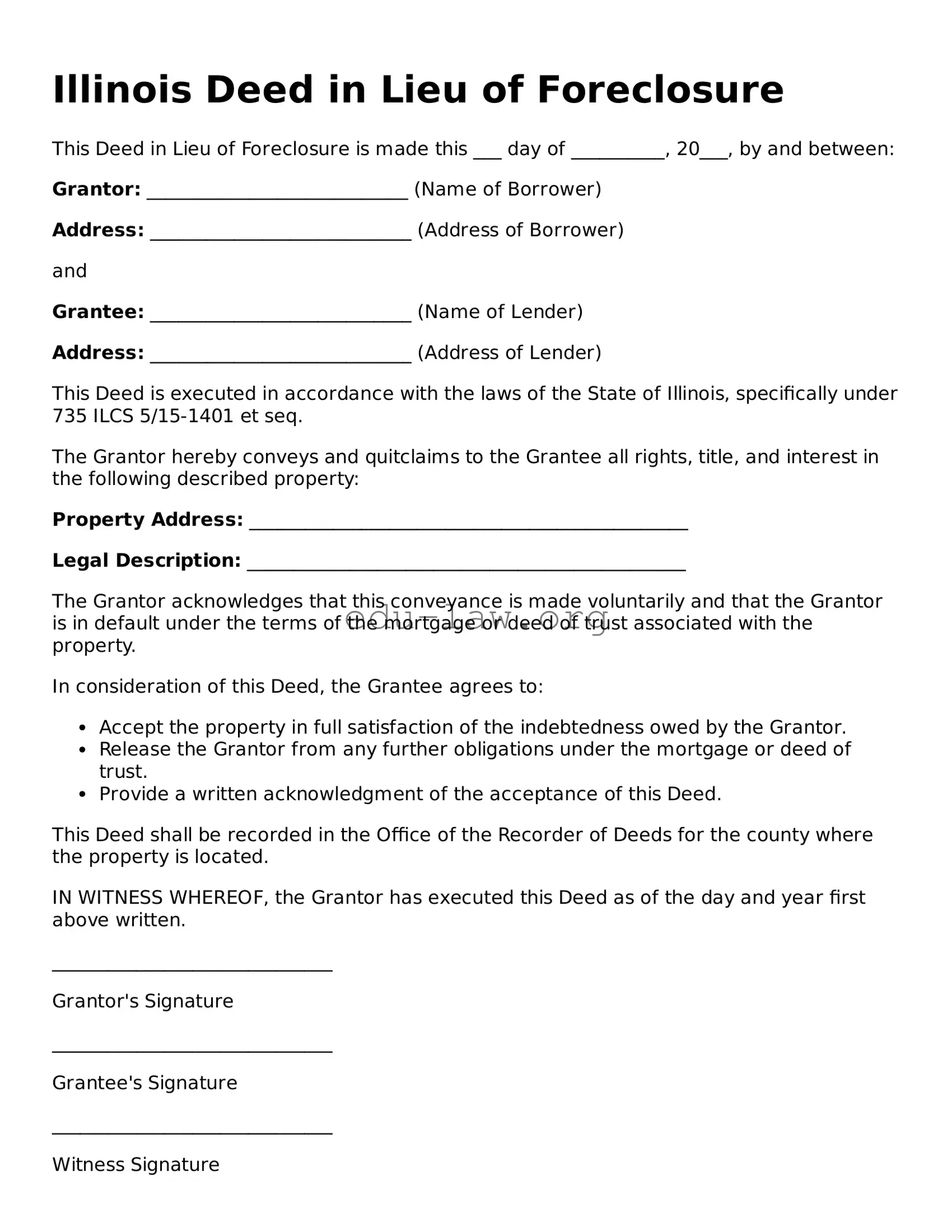
Illinois Deed in Lieu of Foreclosure
This Deed in Lieu of Foreclosure is made this ___ day of __________, 20___, by and between:
Grantor: ____________________________ (Name of Borrower)
Address: ____________________________ (Address of Borrower)
and
Grantee: ____________________________ (Name of Lender)
Address: ____________________________ (Address of Lender)
This Deed is executed in accordance with the laws of the State of Illinois, specifically under 735 ILCS 5/15-1401 et seq.
The Grantor hereby conveys and quitclaims to the Grantee all rights, title, and interest in the following described property:
Property Address: _______________________________________________
Legal Description: _______________________________________________
The Grantor acknowledges that this conveyance is made voluntarily and that the Grantor is in default under the terms of the mortgage or deed of trust associated with the property.
In consideration of this Deed, the Grantee agrees to:
This Deed shall be recorded in the Office of the Recorder of Deeds for the county where the property is located.
IN WITNESS WHEREOF, the Grantor has executed this Deed as of the day and year first above written.
______________________________
Grantor's Signature
______________________________
Grantee's Signature
______________________________
Witness Signature
______________________________
Witness Signature
STATE OF ILLINOIS
COUNTY OF ____________________
Before me, a Notary Public, personally appeared ____________________________ (Name of Grantor) and ____________________________ (Name of Grantee), known to me to be the persons whose names are subscribed to the within instrument, and acknowledged that they executed the same for the purposes therein contained.
Given under my hand and official seal this ___ day of __________, 20___.
______________________________
Notary Public
| Fact Name | Description |
|---|---|
| Definition | A deed in lieu of foreclosure is a legal document where a borrower voluntarily transfers property ownership to the lender to avoid foreclosure. |
| Governing Law | The deed in lieu of foreclosure in Illinois is governed by the Illinois Compiled Statutes, specifically 735 ILCS 5/15-1401. |
| Eligibility | Homeowners facing foreclosure may qualify for a deed in lieu if they are unable to keep up with mortgage payments. |
| Benefits | This process can help borrowers avoid the lengthy foreclosure process and potentially reduce the impact on their credit score. |
| Process | To initiate, the borrower must contact the lender, provide necessary documentation, and agree on the terms. |
| Impact on Credit | A deed in lieu may have a less severe impact on credit compared to a foreclosure, but it still may affect credit scores. |
| Tax Implications | Borrowers should be aware of potential tax implications, as forgiven debt may be considered taxable income. |
| Legal Advice | It is advisable to seek legal counsel before proceeding with a deed in lieu to understand all rights and obligations. |
After completing the Illinois Deed in Lieu of Foreclosure form, you will need to submit it to the appropriate parties. This typically includes your lender and may require additional documentation. Ensure that you keep copies of everything for your records.
What is a Deed in Lieu of Foreclosure?
A Deed in Lieu of Foreclosure is a legal process where a borrower voluntarily transfers ownership of their property to the lender to avoid foreclosure. This option allows the borrower to relinquish their property in exchange for the cancellation of the mortgage debt. It can be a beneficial alternative for those facing financial difficulties, as it typically results in less damage to the borrower’s credit score compared to a foreclosure proceeding.
How does the process work?
The process begins when a borrower contacts their lender to express interest in a Deed in Lieu of Foreclosure. The lender will then review the borrower’s financial situation and the property’s value. If both parties agree to proceed, the borrower signs the Deed in Lieu of Foreclosure form, transferring the property to the lender. The lender may also agree to release the borrower from the mortgage obligation. It’s essential for borrowers to ensure that they understand all terms before signing any documents.
What are the benefits of choosing a Deed in Lieu of Foreclosure?
Choosing a Deed in Lieu of Foreclosure can offer several advantages. First, it can help borrowers avoid the lengthy and stressful foreclosure process. Second, it often results in a less severe impact on credit scores compared to a foreclosure. Additionally, borrowers may be able to negotiate terms with their lender that could include forgiveness of remaining debt or assistance in finding new housing. This option can provide a smoother transition for those facing financial hardship.
Are there any drawbacks to a Deed in Lieu of Foreclosure?
While a Deed in Lieu of Foreclosure has its benefits, there are also potential drawbacks. Not all lenders accept this option, and eligibility may depend on the specific circumstances surrounding the borrower’s financial situation. Additionally, borrowers may still face tax implications if the lender forgives any remaining debt. It’s crucial for individuals to consult with a financial advisor or legal expert to fully understand the implications of this decision before proceeding.
Failing to provide accurate property information. This includes the correct legal description and address of the property.
Not including all necessary parties. All individuals or entities with an ownership interest must sign the document.
Omitting the date of execution. The form must clearly indicate when it was signed.
Not having the document notarized. A notary public must witness the signatures for the deed to be valid.
Using incorrect or outdated forms. Always ensure you are using the most current version of the Deed in Lieu of Foreclosure form.
Failing to understand the implications of the deed. Individuals should be aware of how it affects their credit and future ownership rights.
Not consulting with a legal professional. Seeking advice can help avoid mistakes and ensure compliance with state laws.
Leaving blank spaces. All sections must be completed to avoid delays or rejections.
Misunderstanding the timeline for submission. Submit the form promptly to avoid complications with the foreclosure process.
Ignoring local recording requirements. Check with the county recorder's office for specific filing rules.
A Deed in Lieu of Foreclosure is a legal document that allows a homeowner to transfer ownership of their property to the lender to avoid foreclosure. When preparing this document, it is often accompanied by several other forms and documents that facilitate the process and ensure all parties are informed. Below is a list of commonly used documents alongside the Illinois Deed in Lieu of Foreclosure form.
These documents are essential for ensuring a smooth transition during the deed in lieu of foreclosure process. Each serves a specific purpose that protects the interests of both the borrower and the lender, facilitating a clearer understanding of the transaction and its implications.
The Illinois Deed in Lieu of Foreclosure form shares similarities with a mortgage release document. Both documents facilitate the transfer of property ownership from the borrower to the lender. In a mortgage release, the lender formally relinquishes its claim on the property, while in a deed in lieu, the borrower voluntarily transfers ownership to avoid foreclosure. This process can help both parties resolve the situation without the lengthy and costly process of foreclosure proceedings.
Another related document is the short sale agreement. In a short sale, the homeowner sells the property for less than the amount owed on the mortgage, with lender approval. Like a deed in lieu, a short sale aims to prevent foreclosure. Both options allow homeowners to exit their mortgage obligations while minimizing financial damage. However, a short sale involves a third-party buyer, whereas a deed in lieu directly transfers ownership to the lender.
The loan modification agreement is also similar. This document modifies the terms of the existing loan to make it more manageable for the borrower. Both the loan modification and the deed in lieu aim to help homeowners avoid foreclosure. While a deed in lieu involves relinquishing the property, a loan modification allows the homeowner to retain ownership by adjusting payment terms, such as interest rates or loan duration.
The foreclosure notice is another document that relates to the deed in lieu of foreclosure. A foreclosure notice is a formal notification that the lender intends to take possession of the property due to default. While a deed in lieu is a proactive step taken by the borrower to prevent foreclosure, the foreclosure notice is often a precursor to the legal process. Both documents highlight the seriousness of the situation and the need for resolution.
Lastly, the bankruptcy filing can be compared to the deed in lieu. When a borrower files for bankruptcy, they seek relief from debts, including mortgage obligations. Both options can serve as solutions to avoid foreclosure. However, bankruptcy can have more extensive implications on a borrower’s credit and financial future, while a deed in lieu offers a more straightforward resolution by transferring ownership to the lender without the need for court proceedings.
When navigating the Illinois Deed in Lieu of Foreclosure process, there are important dos and don'ts to keep in mind. Following these guidelines can help ensure a smoother experience.
By adhering to these guidelines, you can navigate the Deed in Lieu of Foreclosure process with greater confidence and clarity.
Many homeowners facing financial difficulties may consider a Deed in Lieu of Foreclosure as a solution. However, several misconceptions can cloud understanding of this option. Here are seven common misconceptions about the Illinois Deed in Lieu of Foreclosure form:
Understanding these misconceptions can help homeowners make informed decisions about their financial situation. It’s essential to seek guidance to navigate this complex process effectively.
Filling out and using the Illinois Deed in Lieu of Foreclosure form can be a critical step for homeowners facing foreclosure. Understanding the nuances of this process is essential. Here are some key takeaways:
Understanding these key points can help homeowners navigate the complexities of the Illinois Deed in Lieu of Foreclosure process more effectively.