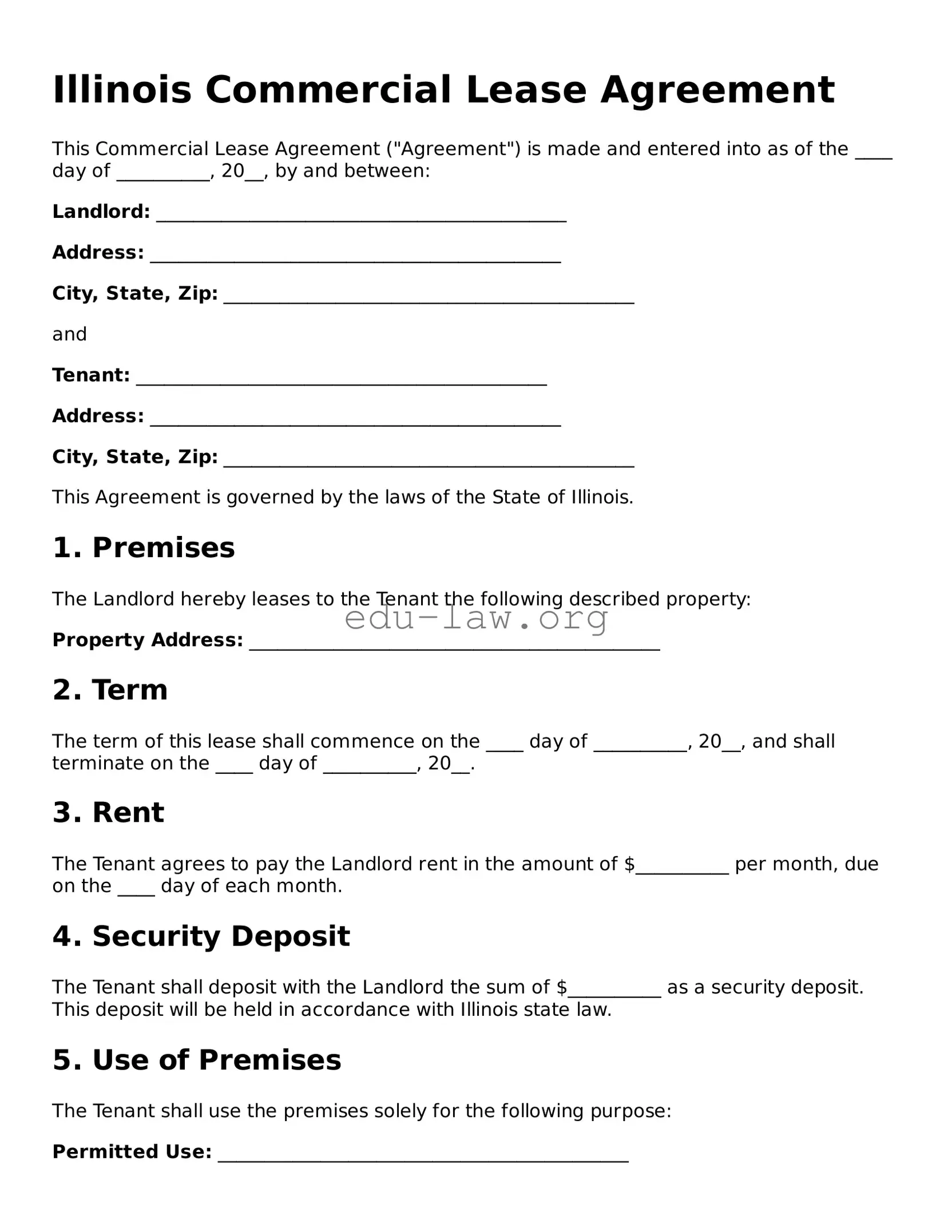
In the realm of commercial real estate, the Illinois Commercial Lease Agreement form serves as a crucial document that outlines the relationship between landlords and tenants. This agreement is designed to protect the interests of both parties while establishing clear expectations. Key components of the form include the lease term, which specifies the duration of the tenancy, and the rental amount, detailing how much the tenant is required to pay and when. Additionally, the agreement addresses maintenance responsibilities, ensuring that both the landlord and tenant understand their obligations regarding property upkeep. Other significant aspects include provisions for security deposits, options for renewal, and terms for early termination. By covering these essential elements, the Illinois Commercial Lease Agreement provides a structured framework that helps to minimize disputes and foster a positive leasing experience for all involved.
Illinois Commercial Lease Agreement
This Commercial Lease Agreement ("Agreement") is made and entered into as of the ____ day of __________, 20__, by and between:
Landlord: ____________________________________________
Address: ____________________________________________
City, State, Zip: ____________________________________________
and
Tenant: ____________________________________________
Address: ____________________________________________
City, State, Zip: ____________________________________________
This Agreement is governed by the laws of the State of Illinois.
1. Premises
The Landlord hereby leases to the Tenant the following described property:
Property Address: ____________________________________________
2. Term
The term of this lease shall commence on the ____ day of __________, 20__, and shall terminate on the ____ day of __________, 20__.
3. Rent
The Tenant agrees to pay the Landlord rent in the amount of $__________ per month, due on the ____ day of each month.
4. Security Deposit
The Tenant shall deposit with the Landlord the sum of $__________ as a security deposit. This deposit will be held in accordance with Illinois state law.
5. Use of Premises
The Tenant shall use the premises solely for the following purpose:
Permitted Use: ____________________________________________
6. Maintenance and Repairs
The Tenant shall be responsible for maintaining the premises in good condition. The Landlord shall be responsible for major repairs unless caused by Tenant's negligence.
7. Alterations
The Tenant shall not make any alterations to the premises without the prior written consent of the Landlord.
8. Termination
Either party may terminate this Agreement by providing written notice at least ____ days prior to the intended termination date.
9. Governing Law
This Agreement shall be governed by and construed in accordance with the laws of the State of Illinois.
10. Signatures
In witness whereof, the parties hereto have executed this Commercial Lease Agreement as of the date first above written.
Landlord Signature: _______________________________ Date: ____________
Tenant Signature: _______________________________ Date: ____________
| Fact Name | Description |
|---|---|
| Governing Law | The Illinois Commercial Lease Agreement is governed by the laws of the State of Illinois. |
| Parties Involved | The agreement typically involves a landlord (lessor) and a tenant (lessee). |
| Property Description | The lease must include a clear description of the leased commercial property. |
| Lease Term | The duration of the lease should be specified, including start and end dates. |
| Rent Payment | The agreement should outline the rent amount, payment schedule, and acceptable payment methods. |
| Security Deposit | Details regarding the security deposit, including amount and conditions for return, must be included. |
| Maintenance Responsibilities | The lease should clearly define the maintenance obligations of both the landlord and tenant. |
Filling out the Illinois Commercial Lease Agreement form is an important step in establishing a rental relationship between a landlord and a tenant. Completing this form accurately ensures that both parties understand their rights and responsibilities. Below are the steps to guide you through the process of filling out the form.
What is an Illinois Commercial Lease Agreement?
An Illinois Commercial Lease Agreement is a legal document that outlines the terms and conditions under which a landlord leases commercial property to a tenant. This agreement details the rights and responsibilities of both parties, including rent amounts, lease duration, maintenance obligations, and more. It serves to protect both the landlord's investment and the tenant's business interests.
What key terms should be included in the agreement?
Essential terms in a Commercial Lease Agreement include the lease duration, rent amount, payment schedule, security deposit requirements, and property use. Additionally, clauses regarding maintenance responsibilities, utilities, insurance, and renewal options are critical. Both parties should clearly understand these terms to avoid disputes later.
How is rent typically structured in a commercial lease?
Rent in a commercial lease can be structured in various ways. Common methods include a flat monthly rate, percentage rent based on sales, or a combination of both. Some leases may also include provisions for rent increases over time. It’s important for tenants to review these terms carefully and ensure they align with their financial capabilities.
What happens if either party wants to terminate the lease early?
Early termination of a lease can be complex. The agreement should specify the conditions under which either party may terminate the lease early. This may include penalties, notice requirements, and the process for returning the security deposit. It’s advisable for both parties to understand these provisions before signing the lease.
Can a tenant modify the space they are renting?
Modifications to the leased space often require the landlord's approval. The lease agreement should include a clause that outlines the process for making alterations, including any necessary permits or approvals. Tenants should be cautious and ensure they have the right to make changes that suit their business needs while complying with local regulations.
Failing to include all parties involved in the lease. It is essential to list both the landlord and tenant accurately. Omitting a party can lead to disputes later.
Not specifying the lease term clearly. The start and end dates should be defined to avoid confusion about the duration of the lease.
Ignoring the details of rent payments. Clearly outline the amount, due date, and acceptable payment methods. Ambiguity in this section can lead to misunderstandings.
Overlooking maintenance responsibilities. Both parties should understand who is responsible for repairs and maintenance of the property. This should be explicitly stated in the agreement.
Neglecting to include renewal options. If the tenant wishes to extend the lease, this should be addressed in the agreement to prevent any issues at the end of the term.
Not addressing the use of the property. Clearly define what activities are permitted on the premises to avoid conflicts and ensure compliance with zoning laws.
Failing to include a termination clause. A clear process for ending the lease should be established, including any required notice periods.
Omitting insurance requirements. Both parties should understand their insurance obligations to protect against potential liabilities.
Not reviewing the lease with legal counsel. It is wise to consult a lawyer before signing to ensure that all terms are fair and legally binding.
When entering into a commercial lease agreement in Illinois, several other forms and documents may accompany the lease to ensure clarity and legal compliance. These documents serve various purposes, from outlining terms to protecting the rights of both parties involved.
These documents play a crucial role in the leasing process, ensuring that both landlords and tenants are well-informed and protected. Properly managing these forms can lead to a smoother leasing experience and help mitigate potential conflicts.
The Illinois Commercial Lease Agreement is similar to the Residential Lease Agreement, which outlines the terms between a landlord and tenant for renting a residential property. Both documents specify the rental amount, duration of the lease, and responsibilities of each party. However, the Residential Lease Agreement focuses on living conditions and tenant rights, while the Commercial Lease Agreement addresses business-related concerns and often includes clauses about property use and modifications specific to commercial operations.
Another document that resembles the Illinois Commercial Lease Agreement is the Retail Lease Agreement. This type of lease is specifically tailored for businesses operating in retail spaces. Like the Commercial Lease Agreement, it includes terms regarding rent and duration, but it also often contains additional provisions related to foot traffic, signage, and common area maintenance, which are crucial for retail operations.
The Office Lease Agreement shares similarities with the Illinois Commercial Lease Agreement as well. This document governs the rental of office spaces and includes terms related to rent, lease duration, and maintenance responsibilities. Both agreements may include clauses about tenant improvements and the use of shared facilities, but the Office Lease Agreement often emphasizes aspects like parking arrangements and access to amenities that are important for office tenants.
A Warehouse Lease Agreement is another document that aligns closely with the Illinois Commercial Lease Agreement. This type of lease focuses on the rental of warehouse space for storage or distribution purposes. Both agreements detail the rental terms and responsibilities, but the Warehouse Lease Agreement typically includes specific provisions regarding loading docks, inventory management, and compliance with safety regulations, which are essential for warehouse operations.
The Industrial Lease Agreement also bears resemblance to the Illinois Commercial Lease Agreement. This document is used for leasing industrial spaces, such as factories or manufacturing facilities. Both agreements set out the terms of the lease, including rent and duration. However, the Industrial Lease Agreement often includes provisions about equipment use, environmental regulations, and zoning compliance, which are critical for industrial tenants.
The Ground Lease Agreement is another type of lease that is similar to the Illinois Commercial Lease Agreement. This document allows a tenant to lease land for a long term while retaining ownership of any buildings or improvements made on that land. While both agreements outline rental terms and responsibilities, the Ground Lease Agreement often includes specific clauses about land use and development rights, which are unique to land leasing arrangements.
The Sublease Agreement is also comparable to the Illinois Commercial Lease Agreement. This document allows a tenant to lease out their rented space to another party, known as the subtenant. Both agreements outline terms related to rent and responsibilities, but the Sublease Agreement must also address the relationship between the original tenant and the subtenant, including any restrictions imposed by the original lease.
Finally, the Lease Option Agreement shares similarities with the Illinois Commercial Lease Agreement. This document provides a tenant the option to purchase the leased property at a later date. Both agreements detail rental terms and responsibilities, but the Lease Option Agreement includes additional provisions regarding the purchase price and conditions under which the tenant may exercise their option to buy, making it unique in nature.
When filling out the Illinois Commercial Lease Agreement form, careful attention to detail is essential. Here are some guidelines to consider:
Understanding the Illinois Commercial Lease Agreement form is crucial for both landlords and tenants. However, several misconceptions can lead to confusion. Here are seven common misconceptions explained:
This is not true. Different types of commercial properties, such as retail spaces, office buildings, and industrial sites, often require different lease terms and conditions tailored to their specific needs.
While many terms in a lease can be negotiated, some aspects, such as local laws and building codes, are non-negotiable. It’s important to understand which terms can be modified and which cannot.
Although it is highly recommended to have a written lease for clarity and legal protection, verbal agreements can sometimes be enforceable, depending on the circumstances and local laws.
Commercial leases can vary significantly in length. While some may be long-term, others can be short-term or month-to-month, depending on the agreement between the parties involved.
This is a misconception. Many landlords require a security deposit to cover potential damages or unpaid rent, similar to residential leases.
Maintenance responsibilities can vary widely. Some leases may require the landlord to handle certain repairs, while others may place more responsibility on the tenant. It is essential to clarify these obligations in the lease.
This is not entirely accurate. While a lease is a binding contract, parties can agree to amendments or modifications as long as they are documented in writing and signed by both parties.
Being aware of these misconceptions can help both landlords and tenants navigate their agreements with confidence and clarity.
When filling out and using the Illinois Commercial Lease Agreement form, it is essential to understand several key points that can significantly impact both landlords and tenants. Here are four important takeaways: