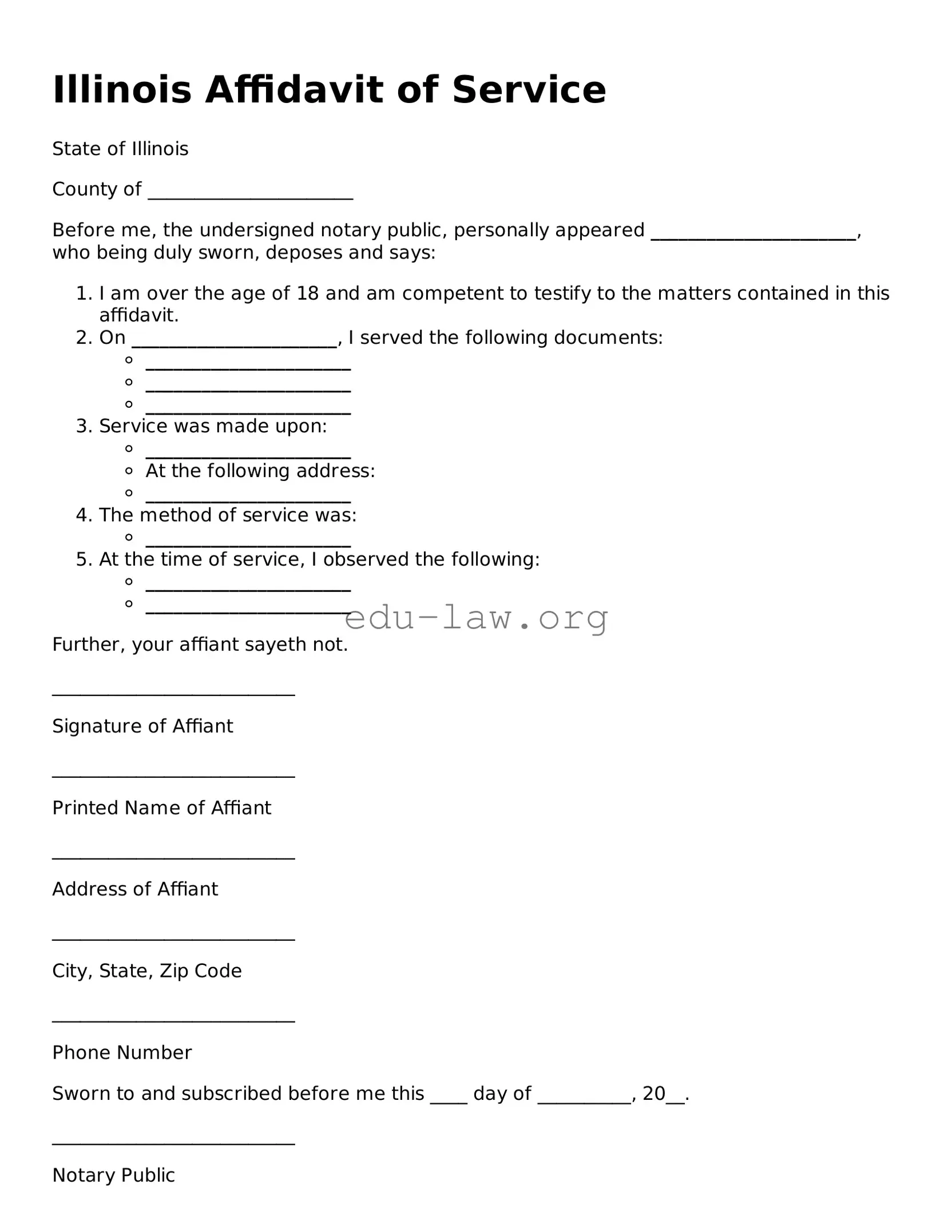
The Illinois Affidavit of Service form plays a crucial role in the legal process, ensuring that all parties involved in a case are properly notified of actions taken. This document serves as proof that legal papers, such as summons or complaints, have been delivered to the intended recipients. The form requires specific details, including the date and method of service, as well as the name and address of the individual served. Additionally, the affidavit must be signed by the person who performed the service, affirming that the information provided is accurate. Understanding the requirements and implications of this form is essential for anyone navigating the legal landscape in Illinois, as it upholds the principles of due process and transparency in legal proceedings.
Illinois Affidavit of Service
State of Illinois
County of ______________________
Before me, the undersigned notary public, personally appeared ______________________, who being duly sworn, deposes and says:
Further, your affiant sayeth not.
__________________________
Signature of Affiant
__________________________
Printed Name of Affiant
__________________________
Address of Affiant
__________________________
City, State, Zip Code
__________________________
Phone Number
Sworn to and subscribed before me this ____ day of __________, 20__.
__________________________
Notary Public
My Commission Expires: ________________
| Fact Name | Description |
|---|---|
| Definition | The Illinois Affidavit of Service is a legal document used to confirm that a party has been served with court documents. |
| Governing Law | The affidavit is governed by the Illinois Code of Civil Procedure, specifically 735 ILCS 5/2-203. |
| Purpose | Its primary purpose is to provide proof that legal documents have been delivered to the intended recipient. |
| Who Can Serve | Any person who is at least 18 years old and not a party to the case can serve documents. |
| Contents | The affidavit typically includes the server's name, the date of service, and details about how the service was performed. |
| Filing Requirement | After serving the documents, the affidavit must be filed with the court to complete the service process. |
| Deadline for Filing | The affidavit should generally be filed with the court within a reasonable time after service, often within 7 days. |
| Consequences of Non-Compliance | If the affidavit is not filed, it may lead to delays in the legal proceedings or affect the validity of the service. |
After completing the Illinois Affidavit of Service form, you'll need to file it with the appropriate court. This step is crucial as it provides proof that the necessary documents were served to the involved parties. Make sure to keep a copy for your records.
What is the Illinois Affidavit of Service form?
The Illinois Affidavit of Service form is a legal document used to confirm that a specific legal document has been delivered to a party involved in a legal proceeding. This form is essential for establishing proof that the recipient received the documents, which may include summons, complaints, or other court-related paperwork. Proper completion of this affidavit is crucial for ensuring that the court recognizes that the recipient has been adequately notified of the proceedings.
Who can serve documents and complete the Affidavit of Service?
In Illinois, documents can be served by various individuals, including a sheriff, a process server, or even a friend or family member who is at least 18 years old and not involved in the case. Once the documents have been served, the person who delivered them must complete the Affidavit of Service. This ensures that the court has a record of who served the documents, when they were served, and how they were delivered.
What information is required on the Affidavit of Service?
The Affidavit of Service must include specific details to be valid. This includes the name and address of the person served, the date and time of service, the method of service used (such as personal delivery or mail), and the name of the individual who performed the service. Additionally, the affidavit must be signed and dated by the person who served the documents, affirming that the information provided is accurate and true.
Why is the Affidavit of Service important?
The Affidavit of Service is crucial because it provides legal proof that the required documents were delivered to the appropriate party. Without this affidavit, a court may not proceed with a case, as it relies on the principle that all parties must be properly notified of legal actions against them. This document helps to protect the rights of all parties involved and ensures that due process is followed.
Failing to provide accurate information about the recipient. Ensure that names and addresses are correct.
Not signing the affidavit. A signature is required to validate the document.
Omitting the date of service. Always include the date when the service was completed.
Using incorrect service methods. Confirm that the method used complies with legal requirements.
Neglecting to include details about the server. The person who served the documents must be identified.
Not providing a clear description of the documents served. Specify what documents were delivered.
Failing to include the court case number. This is essential for proper identification of the case.
Using outdated forms. Always ensure that you are using the most current version of the affidavit.
Forgetting to file the affidavit with the court. Submission is necessary for the record.
Not keeping a copy for personal records. Retain a copy for your own documentation and reference.
The Illinois Affidavit of Service form is an important document used to confirm that legal papers have been delivered to the appropriate party. However, it often works in conjunction with several other forms and documents that help ensure the legal process runs smoothly. Below is a list of commonly used forms that complement the Affidavit of Service.
Understanding these documents is crucial for anyone involved in a legal proceeding. Each form plays a unique role in the process, ensuring that all parties are properly informed and that the legal system functions effectively.
The Illinois Affidavit of Service is similar to the Proof of Service document used in many states. Both serve to confirm that a legal document has been delivered to a party involved in a legal proceeding. The Proof of Service typically includes details such as the date, time, and method of service, along with the name of the individual who completed the service. This document is essential for ensuring that all parties are properly notified of legal actions, which upholds the principle of due process.
Another document akin to the Illinois Affidavit of Service is the Certificate of Service. This document is often used in civil cases to demonstrate that documents have been shared with all relevant parties. Like the Affidavit of Service, it outlines the method of service and the individuals served. The Certificate of Service is often included with filed documents to verify compliance with procedural rules, ensuring transparency in the legal process.
The Summons is another related document. It is a legal notice that informs a defendant of a lawsuit filed against them. While the Summons itself is the notification, the Affidavit of Service acts as proof that the Summons was delivered. Both documents are crucial for initiating legal proceedings, as they ensure that the defendant is aware of the claims against them and has the opportunity to respond.
In family law cases, the Notice of Hearing is similar to the Affidavit of Service. This document notifies parties of upcoming court dates and hearings. The Affidavit of Service can be used to confirm that the Notice of Hearing was delivered to the involved parties. Both documents work together to ensure that all parties are informed and can participate in the legal process.
The Return of Service is also comparable. This document is completed by the process server after delivering legal documents. It provides a detailed account of how and when the documents were served. The Return of Service serves as evidence in court, similar to the Affidavit of Service, which verifies that service was properly executed according to the law.
The Service of Process document is another related item. This encompasses the entire process of delivering legal documents to a party. The Affidavit of Service is a specific form that falls under this broader category. Both are essential for establishing that a party has been officially notified, which is a fundamental aspect of legal proceedings.
The Declaration of Service is akin to the Affidavit of Service in that it serves as a sworn statement confirming that documents were delivered. This declaration typically includes the same details regarding the service process, such as the date, time, and method of service. Both documents aim to provide a reliable account of service, ensuring that the legal process is followed correctly.
The Notice of Intent to Sue is another document that shares similarities. This notice informs a potential defendant that legal action may be taken against them. While it does not serve as proof of service, the Affidavit of Service can be used to confirm that the notice was delivered. Both documents play a role in ensuring that parties are aware of impending legal actions.
Finally, the Request for Waiver of Service is a document that asks a defendant to waive their right to formal service of process. While it is not a proof of service document, it often accompanies the Affidavit of Service when a defendant agrees to accept documents without formal delivery. Both documents facilitate communication and cooperation between parties, streamlining the legal process.
When filling out the Illinois Affidavit of Service form, it is important to follow certain guidelines to ensure the process goes smoothly. Here is a list of things to do and not to do:
The Illinois Affidavit of Service form is an important document in the legal process, but several misconceptions can lead to confusion. Here are five common misunderstandings:
Many believe that the Affidavit of Service is only necessary in court proceedings. In reality, it can be used in various situations, including administrative matters and other legal notifications.
While it may seem straightforward, serving legal documents must be done by a qualified individual. This can include a process server, sheriff, or someone over the age of 18 who is not involved in the case.
Some assume that notarization is a requirement for the Affidavit of Service. However, while notarization can add credibility, it is not always necessary for the affidavit to be valid.
Many think that submitting the Affidavit of Service is optional. In most cases, filing this document is essential to prove that service has been completed, especially in court settings.
There is a belief that once the Affidavit of Service is filed, it cannot be changed. In fact, if there are errors or omissions, it may be possible to amend the affidavit to ensure accuracy.
Understanding these misconceptions can help ensure that the affidavit is completed and filed correctly, supporting the legal process effectively.
When filling out and using the Illinois Affidavit of Service form, it is essential to understand its purpose and the requirements involved. Here are six key takeaways to consider:
Understanding these key points can help ensure that the Affidavit of Service is filled out and utilized correctly, facilitating a smoother legal process.