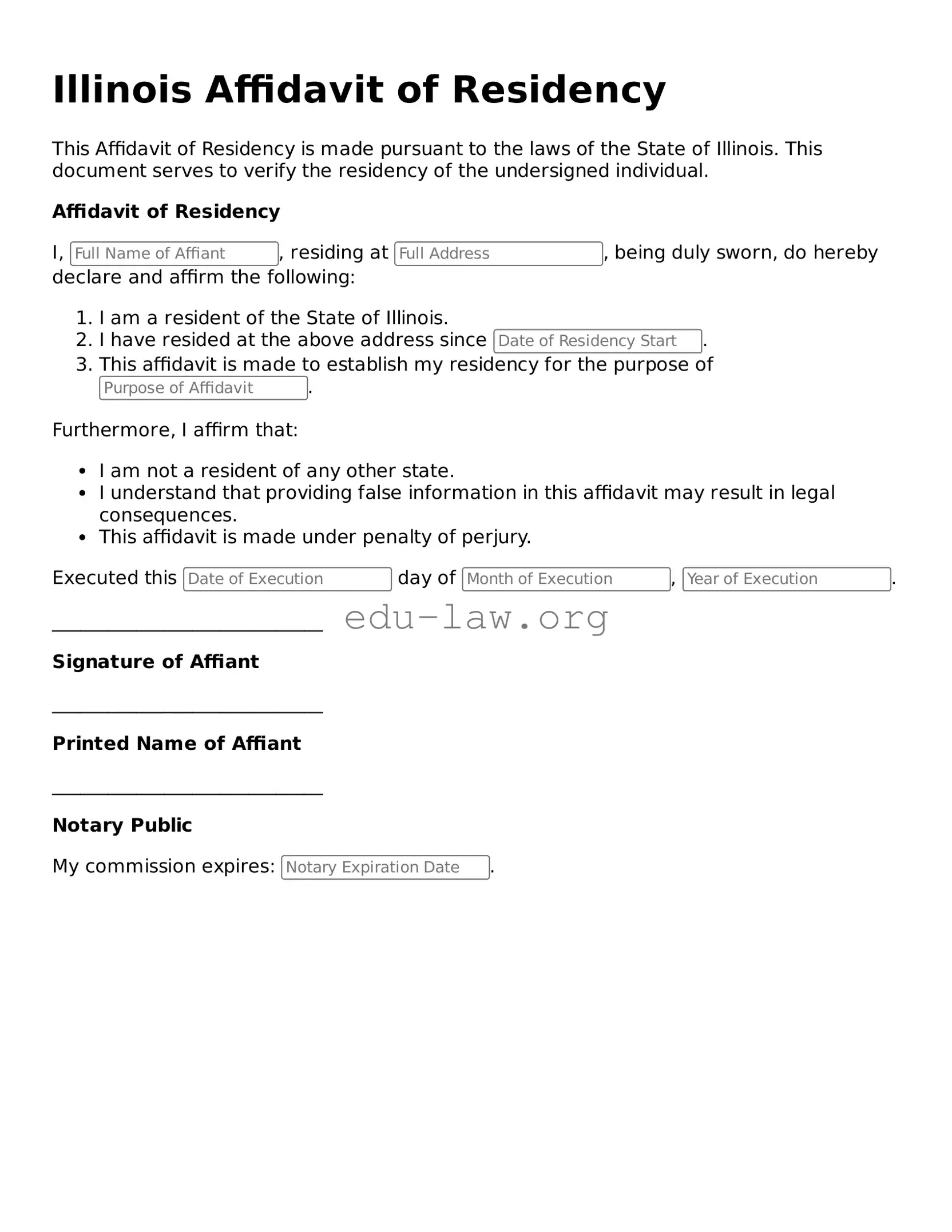
The Illinois Affidavit of Residency form plays a crucial role in various legal and administrative processes, particularly for individuals seeking to establish their residence within the state. This document serves as a sworn statement affirming a person's physical presence in Illinois, which can be essential for purposes such as enrolling in schools, obtaining a driver's license, or accessing certain public services. Typically, the form requires the individual to provide personal information, including their name, address, and the duration of their residency. In addition, it may necessitate the signatures of witnesses or a notary public to validate the claims made within the affidavit. Understanding the requirements and implications of this form is vital, as inaccuracies or omissions can lead to complications in legal matters or access to services. Proper completion of the Illinois Affidavit of Residency ensures compliance with state regulations and helps streamline various processes that depend on proof of residency.
Illinois Affidavit of Residency
This Affidavit of Residency is made pursuant to the laws of the State of Illinois. This document serves to verify the residency of the undersigned individual.
Affidavit of Residency
I, , residing at , being duly sworn, do hereby declare and affirm the following:
Furthermore, I affirm that:
Executed this day of , .
_____________________________
Signature of Affiant
_____________________________
Printed Name of Affiant
_____________________________
Notary Public
My commission expires: .
| Fact Name | Description |
|---|---|
| Purpose | The Illinois Affidavit of Residency form is used to verify an individual's residence in Illinois for various legal and administrative purposes. |
| Governing Law | This form is governed by the Illinois Compiled Statutes, specifically under the Illinois School Code. |
| Who Uses It | Individuals may use this form when enrolling children in school, applying for benefits, or verifying residency for legal matters. |
| Filing Requirements | The affidavit must be signed in the presence of a notary public to be considered valid. |
| Information Required | Personal information such as the affiant's name, address, and the duration of residency must be included. |
| Affidavit Format | The form typically includes a statement of truth, signature line, and notary acknowledgment section. |
| Submission | After completion, the affidavit may need to be submitted to a school district or relevant agency, depending on its purpose. |
| Legal Consequences | Providing false information on the affidavit can result in legal penalties, including fines or criminal charges. |
| Availability | The Illinois Affidavit of Residency form can typically be obtained online through state or local government websites. |
Once you have the Illinois Affidavit of Residency form, you will need to complete it accurately to ensure it meets the necessary requirements. Follow these steps to fill out the form properly.
After completing the form, review it for accuracy before submission. Ensure all necessary signatures and dates are included to avoid delays in processing.
What is the Illinois Affidavit of Residency form?
The Illinois Affidavit of Residency form is a legal document used to verify an individual's residence in Illinois. It is often required for various purposes, such as enrolling in schools, obtaining certain licenses, or applying for public benefits. This form serves as a sworn statement confirming that the individual resides at a specified address within the state.
Who needs to complete the Affidavit of Residency?
Individuals who need to prove their residency in Illinois may be required to complete this affidavit. This includes students enrolling in schools, applicants for state services, or individuals seeking to establish residency for legal purposes. If you are unsure whether you need this form, consult the specific agency or institution requesting it.
How do I fill out the Affidavit of Residency?
To fill out the Affidavit of Residency, provide your name, current address, and any other required personal information. Be sure to include the date and your signature. If necessary, have a witness or notary public sign the document to validate it. Follow any specific instructions provided by the institution requesting the affidavit.
Is there a fee associated with the Affidavit of Residency?
Where do I submit the Affidavit of Residency?
Submit the completed Affidavit of Residency to the agency or institution that requested it. This could be a school district, government office, or any other entity that requires proof of residency. Make sure to keep a copy for your records.
Can I use the Affidavit of Residency for multiple purposes?
Yes, the Affidavit of Residency can often be used for multiple purposes, provided that the information is accurate and relevant to each situation. However, some institutions may require a specific version or additional documentation, so it’s wise to check their requirements beforehand.
What if my residency status changes after I submit the affidavit?
If your residency status changes after you have submitted the affidavit, it is your responsibility to inform the relevant agency or institution. They may require you to submit a new affidavit reflecting your current address and residency status.
Can someone else complete the Affidavit of Residency on my behalf?
Generally, the individual who is claiming residency should complete the affidavit themselves. However, if you are unable to do so, a representative may assist you. Ensure that the affidavit is signed by you, as it is a sworn statement regarding your residency.
What happens if I provide false information on the affidavit?
Providing false information on the Affidavit of Residency can lead to serious consequences, including legal penalties. It is important to be truthful and accurate when filling out the form. If you are unsure about any details, seek clarification before submitting the affidavit.
Failing to provide accurate personal information. It's essential to ensure that your name, address, and contact details are correct. Any discrepancies can lead to delays or complications.
Not signing the affidavit. It may seem simple, but forgetting to sign can render the document invalid. Always double-check for your signature before submission.
Overlooking the date. The affidavit should include the date when you fill it out. This detail helps establish the timeline of your residency.
Using incorrect residency information. Make sure the address listed is your current and correct residence. Any errors can lead to legal issues down the line.
Neglecting to provide supporting documents. Some situations may require additional proof of residency. Ensure you attach any necessary documents to strengthen your affidavit.
Not understanding the purpose of the affidavit. Take time to comprehend why you are filling it out. This understanding can guide you in providing the right information.
Submitting the affidavit to the wrong office. Different agencies may require this form for various purposes. Confirm where to send your affidavit to avoid unnecessary delays.
Ignoring instructions. Each form comes with specific guidelines. Read them carefully to avoid mistakes that could affect your application.
Rushing through the process. Take your time when filling out the affidavit. A hasty approach can lead to errors that may complicate your residency status.
The Illinois Affidavit of Residency form is often accompanied by several other documents to support residency claims. These additional forms provide necessary evidence and verification. Below is a list of commonly used documents that complement the Affidavit of Residency.
Collecting these documents can help ensure that the Affidavit of Residency is supported with sufficient evidence. Each document plays a crucial role in establishing residency and may be required by various institutions.
The Illinois Affidavit of Residency form is similar to the Affidavit of Identity, which is often used to confirm an individual’s identity in various legal situations. Both documents require personal information and a signature, affirming that the information provided is true. The Affidavit of Identity may be necessary for processes like obtaining a passport or verifying identity for legal transactions, making it crucial for ensuring accurate representation of an individual’s identity.
Another document comparable to the Illinois Affidavit of Residency is the Declaration of Domicile. This declaration serves to establish a person's permanent residence in a specific location. Like the Affidavit of Residency, it often requires a sworn statement and may need to be notarized. Both documents are essential in determining residency for legal purposes, such as taxation or voting eligibility.
The Lease Agreement also shares similarities with the Illinois Affidavit of Residency. A lease outlines the terms under which one party agrees to rent property from another. Both documents serve as proof of residency, providing necessary details about the individual’s living situation. While a lease is a contractual agreement, the Affidavit serves as a sworn statement affirming the individual’s residence.
Similar to the Affidavit of Residency is the Proof of Residency Letter, often issued by landlords or employers. This letter confirms an individual’s address and is typically less formal than an affidavit. Both documents aim to establish residency, but the Proof of Residency Letter may not require a sworn statement, making it a more straightforward option for some situations.
The Certificate of Residency can also be compared to the Illinois Affidavit of Residency. This certificate is typically issued by a local government or educational institution to confirm a person's residency status. Both documents serve to verify where an individual resides and may be used in similar contexts, such as applying for in-state tuition or local services.
Another document that resembles the Affidavit of Residency is the Voter Registration Application. This application requires individuals to provide their address and affirm their residency status to vote. Both documents play a critical role in confirming where a person lives, which is essential for determining eligibility for various civic duties and benefits.
The Utility Bill can also be likened to the Illinois Affidavit of Residency. A utility bill typically includes the name and address of the account holder, serving as proof of residency. While a utility bill is a transactional document, the Affidavit of Residency is a sworn statement. Both, however, help establish where a person resides for various legal and administrative purposes.
The Homestead Exemption Application is another document similar to the Illinois Affidavit of Residency. This application is used to claim a tax exemption on a primary residence. Both documents require proof of residency, and individuals must provide information about their living situation. The Homestead Exemption Application often necessitates additional documentation, but both serve the purpose of verifying residency for financial benefits.
Lastly, the Change of Address Form is comparable to the Illinois Affidavit of Residency. This form is typically submitted to the postal service to inform them of a new address. Both documents confirm a change in residency, but the Change of Address Form is more administrative in nature. It helps ensure that mail is delivered to the correct location, while the Affidavit serves a more formal legal purpose.
When filling out the Illinois Affidavit of Residency form, it is important to follow specific guidelines to ensure accuracy and compliance. Here is a list of what you should and shouldn't do:
Understanding the Illinois Affidavit of Residency form is crucial for many residents. However, several misconceptions often cloud its purpose and use. Here are nine common misunderstandings:
Many believe that the Affidavit of Residency is exclusively for students. In reality, it can be used by anyone needing to prove their residency for various purposes, such as obtaining a driver's license or registering to vote.
Some people think that the affidavit must be notarized to be valid. While notarization can add an extra layer of authenticity, it is not a strict requirement for the form to be accepted.
Another misconception is that only the property owner can fill out the affidavit. In fact, anyone residing at the address can complete the form, as long as they provide accurate information.
Some individuals believe that once the affidavit is filed, it remains valid indefinitely. However, residency can change, and it may need to be updated or refiled to reflect a new address.
While legal matters often require proof of residency, the affidavit is also useful for practical purposes, such as enrolling children in school or accessing local services.
Many fear that completing the affidavit is a complex task. In reality, the form is straightforward and can typically be filled out in a matter of minutes.
Some think that a single affidavit suffices for everyone in a household. However, each resident may need to submit their own affidavit to confirm their individual residency status.
While this form is specific to Illinois, the concept of an affidavit of residency exists in other states as well. Each state may have its own version and requirements.
Lastly, some believe that the affidavit can be submitted online. In many cases, it must be printed and submitted in person or via mail, depending on the specific requirements of the agency requesting it.
Clearing up these misconceptions can help residents navigate the process more effectively and ensure they meet their residency requirements without unnecessary confusion.
Filling out the Illinois Affidavit of Residency form is an important step for various legal and administrative processes. Here are some key takeaways to consider:
Understanding these key points can help ensure that the process goes smoothly and that the affidavit serves its intended purpose effectively.