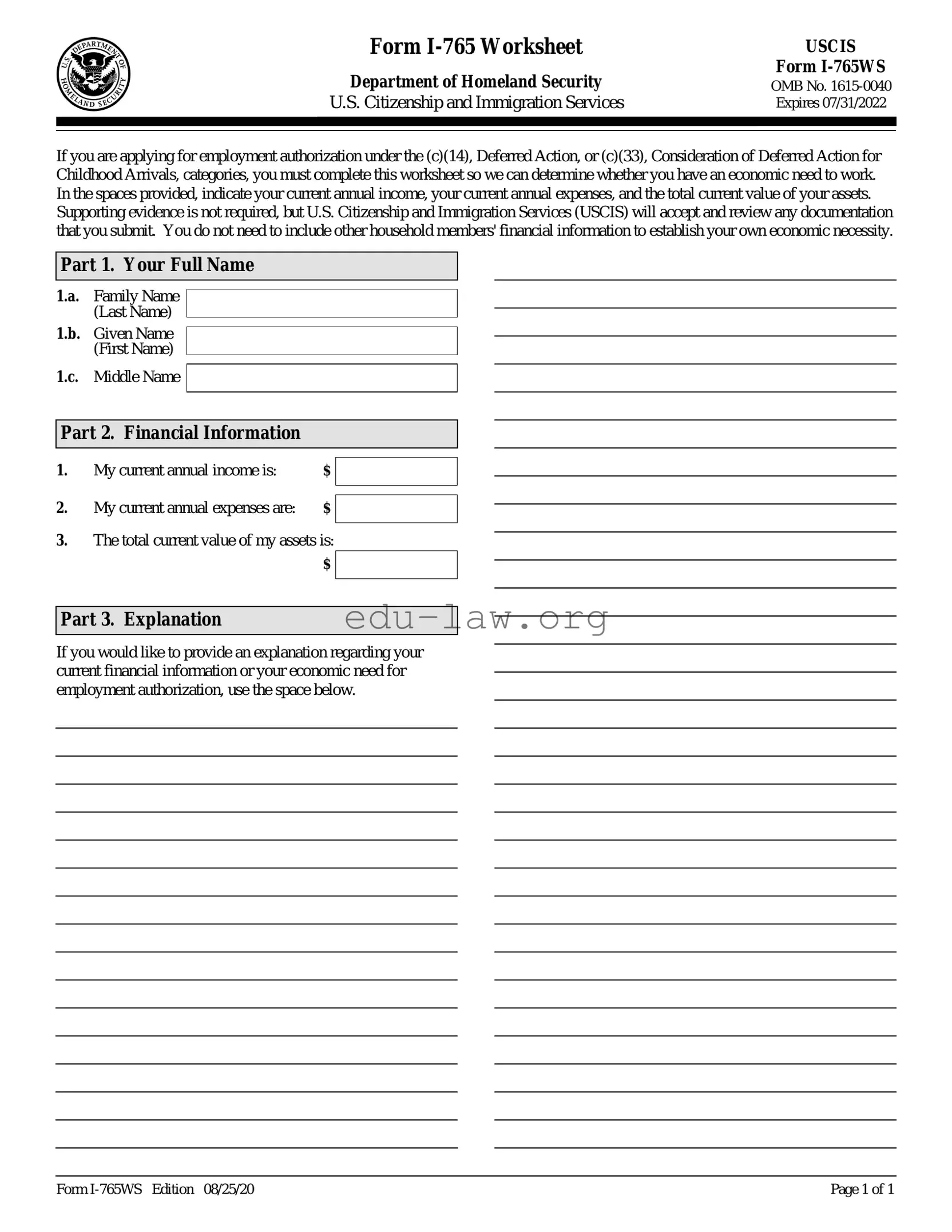
The I-765WS form plays a crucial role for individuals seeking employment authorization under specific categories such as Deferred Action or Deferred Action for Childhood Arrivals (DACA). This worksheet is designed to assess an applicant's economic need for work. To complete the form, you will need to provide essential financial details, including your annual income, expenses, and the total value of your assets. While supporting evidence is not mandatory, submitting relevant documentation can strengthen your case. It is important to note that you only need to report your own financial information; there is no requirement to include details about other household members. Additionally, the form allows space for an explanation, giving you the opportunity to elaborate on your financial situation and the necessity for employment authorization. Understanding these aspects of the I-765WS form is vital for those navigating the complexities of immigration and employment in the United States.
Form |
USCIS |
Department of Homeland Security |
Form |
OMB No. |
|
U.S. Citizenship and Immigration Services |
Expires 07/31/2022 |
If you are applying for employment authorization under the (c)(14), Deferred Action, or (c)(33), Consideration of Deferred Action for Childhood Arrivals, categories, you must complete this worksheet so we can determine whether you have an economic need to work. In the spaces provided, indicate your current annual income, your current annual expenses, and the total current value of your assets.
Supporting evidence is not required, but U.S. Citizenship and Immigration Services (USCIS) will accept and review any documentation that you submit. You do not need to include other household members' financial information to establish your own economic necessity.
Part 1. Your Full Name
1.a. Family Name
(Last Name)
1.b. Given Name
(First Name)
1.c. Middle Name
Part 2. Financial Information
1. |
My current annual income is: |
$ |
|
2. |
My current annual expenses are: |
$ |
|
|
|||
|
|||
3. |
The total current value of my assets is: |
|
|
|
|||
|
|
$ |
|
|
|
|
|
Part 3. Explanation
If you would like to provide an explanation regarding your current financial information or your economic need for employment authorization, use the space below.
Form |
Page 1 of 1 |
| Fact Name | Description |
|---|---|
| Purpose | The I-765WS form is a worksheet used to determine economic need for employment authorization under specific categories, including (c)(14) and (c)(33). |
| Governing Law | This form is governed by U.S. immigration laws, particularly those related to Deferred Action and DACA. |
| Annual Income | Applicants must report their current annual income on the form to assess their financial situation. |
| Annual Expenses | In addition to income, applicants are required to disclose their current annual expenses to provide a complete financial picture. |
| Asset Value | The total current value of assets must also be indicated, helping USCIS evaluate the applicant's economic need. |
| Supporting Evidence | While supporting evidence is not mandatory, USCIS will consider any documentation submitted by the applicant. |
| Household Information | Applicants do not need to include financial information from other household members to establish their economic necessity. |
After gathering the necessary information, you can proceed to fill out the I-765WS form. This worksheet is an important part of your application for employment authorization, especially if you are applying under specific categories. It helps the authorities assess your financial situation and determine your economic need for work.
Once you have completed the form, review it for accuracy. Make sure all information is correct and clearly written before submitting it with your application. This attention to detail can significantly impact the processing of your request.
What is Form I-765WS?
Form I-765WS, also known as the I-765 Worksheet, is a document required by U.S. Citizenship and Immigration Services (USCIS) for individuals applying for employment authorization under specific categories, such as Deferred Action or Deferred Action for Childhood Arrivals (DACA). This form helps USCIS assess the applicant's economic need to work.
Who needs to complete the I-765WS?
Individuals applying for employment authorization under the (c)(14) or (c)(33) categories must complete the I-765WS. This requirement ensures that USCIS has the necessary information to evaluate the applicant's financial situation and need for employment.
What information is required on the I-765WS?
The form requires applicants to provide their full name, current annual income, current annual expenses, and the total current value of their assets. Additionally, applicants have the option to include an explanation regarding their financial situation or economic need for employment authorization.
Do I need to submit supporting documents with the I-765WS?
While supporting evidence is not mandatory, USCIS will accept any documentation that you choose to submit. This can help provide additional context to your financial information, although it is not required for processing your application.
Is it necessary to include financial information from other household members?
No, applicants do not need to include financial information from other household members. The I-765WS focuses solely on the applicant's financial situation to establish their economic necessity for employment authorization.
What happens if I do not complete the I-765WS?
Failure to complete the I-765WS when required may result in delays or denials of your employment authorization application. It is crucial to provide this information to ensure that USCIS can make an informed decision regarding your request.
How can I explain my financial situation on the I-765WS?
Applicants can use the space provided on the form to explain their current financial situation or economic need for employment authorization. This explanation can include details about personal circumstances, unexpected expenses, or any other relevant information that may support your case.
When should I submit the I-765WS?
The I-765WS should be submitted along with your Form I-765 application for employment authorization. Ensure that all required forms are completed accurately and submitted in a timely manner to avoid any processing delays.
Failing to provide your full name accurately. Ensure that your family name, given name, and middle name are all included as they appear on your legal documents.
Incorrectly reporting your annual income. Double-check your figures to ensure they reflect your actual earnings.
Omitting annual expenses. Include all relevant expenses to give a clear picture of your financial situation.
Not providing the total value of your assets. This information is crucial for assessing your economic need.
Neglecting to use the explanation section effectively. Use this space to clarify any special circumstances that may impact your financial situation.
Submitting the form without reviewing it for errors. Mistakes can lead to delays or denials, so take the time to proofread.
Including household members' financial information. Only your financial details are necessary for this form.
Not attaching any supporting documentation if available. While not required, documentation can strengthen your case.
Failing to keep a copy of your completed form for your records. This can be useful for future reference or if questions arise.
When applying for employment authorization, particularly under the Deferred Action categories, several forms and documents may accompany the Form I-765 Worksheet. These documents help provide a comprehensive view of an applicant's situation and support their request for work authorization. Below are some commonly used forms that can enhance the application process.
Each of these forms plays a significant role in the application for employment authorization. By providing the necessary information and documentation, applicants can support their case effectively and increase their chances of receiving approval from USCIS.
The Form I-765, Application for Employment Authorization, is a primary document that allows individuals to request permission to work in the United States. Similar to the I-765WS, it requires applicants to provide personal information, including their name and reasons for seeking employment authorization. The I-765 is essential for those who qualify under various immigration categories, enabling them to legally work while their immigration status is being processed. The connection lies in both forms serving the purpose of establishing eligibility for work, with the I-765 being the formal application and the I-765WS providing additional financial context.
The Form I-131, Application for Travel Document, is another document that shares similarities with the I-765WS. This form is used by individuals who wish to apply for a re-entry permit, refugee travel document, or advance parole. Like the I-765WS, the I-131 requires applicants to provide personal information and may necessitate explanations regarding their travel needs. Both forms aim to assess the applicant's situation and eligibility, ensuring that individuals can maintain their legal status while pursuing opportunities, whether for work or travel.
Form I-485, Application to Register Permanent Residence or Adjust Status, also resembles the I-765WS in its purpose of evaluating an individual's circumstances. The I-485 allows eligible individuals to apply for a green card, transitioning from a temporary status to permanent residency. While the I-765WS focuses on employment needs, the I-485 considers broader aspects of an applicant's life, including financial stability and ties to the community. Both forms require detailed personal information and can significantly impact an applicant's future in the U.S.
The Form I-864, Affidavit of Support, is a document that complements the I-765WS by addressing financial responsibilities. When someone sponsors an immigrant, they must demonstrate their ability to support that individual financially. Similar to the I-765WS, the I-864 requires information about income and expenses. This form ensures that sponsored immigrants will not become a public charge, reinforcing the economic necessity theme found in the I-765WS.
Form I-601, Application for Waiver of Grounds of Inadmissibility, shares a connection with the I-765WS through the evaluation of an applicant's circumstances. This form is used by individuals who are otherwise inadmissible to the U.S. but seek a waiver based on hardship. The financial details provided in the I-765WS can play a role in demonstrating economic need, which may be relevant in a waiver application. Both forms require a clear presentation of personal situations to aid in decision-making by immigration authorities.
Form I-130, Petition for Alien Relative, is another document that aligns with the I-765WS. This form is filed by U.S. citizens or lawful permanent residents to establish a relationship with a foreign relative. While the I-765WS focuses on employment authorization, the I-130 lays the groundwork for family reunification. Both forms require detailed personal information and may involve financial considerations, especially when assessing the sponsor's ability to support the relative.
Lastly, the Form N-400, Application for Naturalization, relates to the I-765WS by addressing the applicant's overall status and eligibility for citizenship. The N-400 requires information about the applicant's residence, employment, and moral character. Like the I-765WS, it assesses the applicant's financial situation, as economic stability can influence the decision to grant citizenship. Both forms are integral to an individual's journey through the U.S. immigration system, focusing on different aspects of their legal standing and future opportunities.
When filling out the I-765WS form, it is important to follow specific guidelines to ensure your application is processed smoothly. Below is a list of things you should and shouldn't do.
Many people have misconceptions about the I-765WS form, which is crucial for those applying for employment authorization under specific categories. Here are eight common misunderstandings:
Filling out the I-765WS form is an important step for individuals seeking employment authorization under specific categories. Here are key takeaways to consider when completing and using this form: