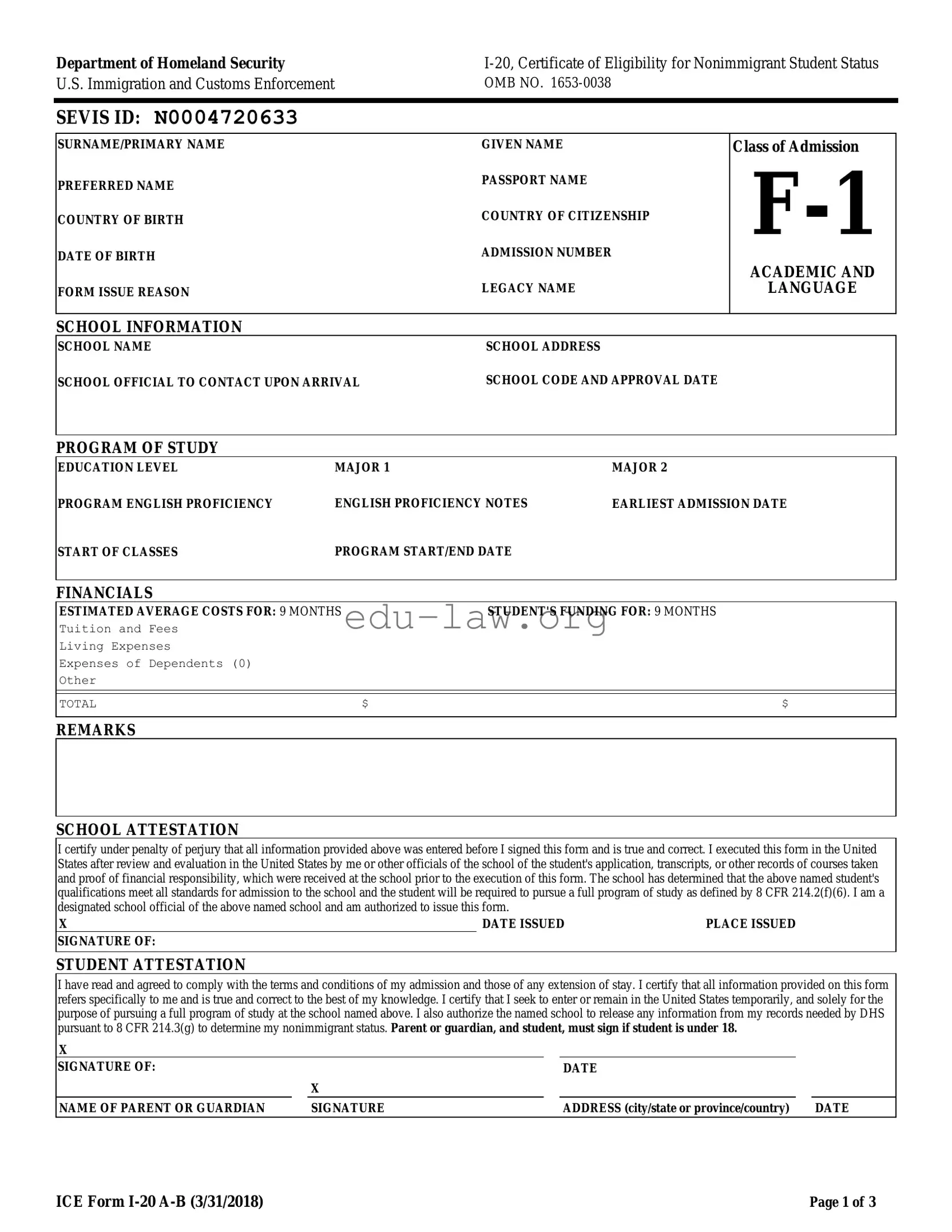
The Form I-20, officially known as the Certificate of Eligibility for Nonimmigrant Student Status, is a crucial document for international students wishing to study in the United States. Issued by a designated school official, this form serves as proof that you have been accepted into a U.S. academic program and are eligible to apply for an F-1 student visa. It contains essential details such as your personal information, the school you will attend, your program of study, and your financial responsibilities. Additionally, the I-20 outlines your rights and responsibilities as a nonimmigrant student, including guidelines on employment, maintaining your student status, and the importance of reporting any changes in your address or program. Understanding the significance of this document cannot be overstated; it is your gateway to educational opportunities in the U.S. and plays a vital role in your compliance with immigration regulations. Missing or incorrect information on your I-20 can lead to serious consequences, including the loss of your student status. Therefore, it’s imperative to handle this form with care and ensure that all details are accurate and up-to-date.
Department of Homeland Security |
|
U.S. Immigration and Customs Enforcement |
OMB NO. |
|
|
SEVIS ID: N0004720633
SURNAME/PRIMARY NAME |
GIVEN NAME |
Class of Admission |
PREFERRED NAME |
|
PASSPORT NAME |
|
|
|
|
|
||
|
|
|
|
|
COUNTRY OF BIRTH |
|
COUNTRY OF CITIZENSHIP |
|
|
|
|
|
|
|
DATE OF BIRTH |
|
ADMISSION NUMBER |
|
|
|
|
|
ACADEMIC AND |
|
|
|
|
|
|
FORM ISSUE REASON |
|
LEGACY NAME |
|
LANGUAGE |
|
|
|
|
|
SCHOOL INFORMATION |
|
|
|
|
SCHOOL NAME |
|
SCHOOL ADDRESS |
|
|
SCHOOL OFFICIAL TO CONTACT UPON ARRIVAL |
SCHOOL CODE AND APPROVAL DATE |
|
||
|
|
|
|
|
PROGRAM OF STUDY |
|
|
|
|
EDUCATION LEVEL |
MAJOR 1 |
|
MAJOR 2 |
|
PROGRAM ENGLISH PROFICIENCY |
ENGLISH PROFICIENCY NOTES |
EARLIEST ADMISSION DATE |
||
START OF CLASSES |
PROGRAM START/END DATE |
|
|
|
|
|
|
|
|
FINANCIALS |
|
|
|
|
ESTIMATED AVERAGE COSTS FOR: 9 MONTHS |
STUDENT'S FUNDING FOR: 9 MONTHS |
|
||
Tuition and Fees |
|
|
|
|
Living Expenses |
|
|
|
|
Expenses of Dependents (0) |
|
|
|
|
Other |
|
|
|
|
|
|
|
|
|
TOTAL |
$ |
|
|
$ |
REMARKS
SCHOOL ATTESTATION
I certify under penalty of perjury that all information provided above was entered before I signed this form and is true and correct. I executed this form in the United States after review and evaluation in the United States by me or other officials of the school of the student's application, transcripts, or other records of courses taken and proof of financial responsibility, which were received at the school prior to the execution of this form. The school has determined that the above named student's qualifications meet all standards for admission to the school and the student will be required to pursue a full program of study as defined by 8 CFR 214.2(f)(6). I am a designated school official of the above named school and am authorized to issue this form.
X |
DATE ISSUED |
PLACE ISSUED |
SIGNATURE OF: |
|
|
STUDENT ATTESTATION
I have read and agreed to comply with the terms and conditions of my admission and those of any extension of stay. I certify that all information provided on this form refers specifically to me and is true and correct to the best of my knowledge. I certify that I seek to enter or remain in the United States temporarily, and solely for the purpose of pursuing a full program of study at the school named above. I also authorize the named school to release any information from my records needed by DHS pursuant to 8 CFR 214.3(g) to determine my nonimmigrant status. Parent or guardian, and student, must sign if student is under 18.
X |
|
|
|
|
|
|
SIGNATURE OF: |
|
|
|
DATE |
||
|
|
X |
|
|
|
|
NAME OF PARENT OR GUARDIAN |
|
SIGNATURE |
|
ADDRESS (city/state or province/country) DATE |
||
ICE Form |
Page 1 of 3 |
Department of Homeland Security |
|
U.S. Immigration and Customs Enforcement |
OMB NO. |
|
|
SEVIS ID: N0004720633 |
NAME: Student Sample |
|||
EMPLOYMENT AUTHORIZATIONS |
|
|
|
|
TYPE |
STATUS |
START DATE |
END DATE |
|
CPT |
PART TIME |
APPROVED |
01 JULY 2016 |
15 JULY 2016 |
|
|
|
|
|
EMPLOYER INFORMATION |
|
|
|
|
|
|
|
|
|
TYPE |
|
AUTHORIZATION DATES |
|
|
CPT |
|
01 JULY 2016 - 15 JULY 2016 |
|
|
EMPLOYER NAME |
START DATE |
END DATE |
CITY & STATE |
|
SEVP applied labs |
01 JULY 2016 |
15 JULY 2016 |
Arlington, VA |
|
|
|
|
|
|
CHANGE OF |
|
|
|
|
|
|
|
|
|
|
|
|
|
|
AUTHORIZED REDUCED COURSE LOAD |
|
|
|
|
|
|
|
|
|
|
|
|
|
|
CURRENT SESSION DATES |
|
|
|
|
|
|
|
|
|
CURRENT SESSION START DATE |
|
CURRENT SESSION END DATE |
|
|
01 JUNE 2016 |
|
30 JUNE 2016 |
|
|
TRAVEL ENDORSEMENT
This page, when properly endorsed, may be used for
SCHOOL OFFICIAL |
|
TITLE |
|
SIGNATURE |
|
DATE ISSUED |
|
PLACE ISSUED |
|
|
|
|
X |
|
|
|
|
|
|
|
|
|
|
|
|
|
|
|
|
|
X |
|
|
|
|
|
|
|
|
|
|
|
|
|
|
|
|
|
X |
|
|
|
|
|
|
|
|
|
|
|
|
|
|
|
|
|
X |
|
|
|
|
|
|
|
|
|
|
|
|
|
ICE Form |
Page 2 of 3 |

Department of Homeland Security |
|
U.S. Immigration and Customs Enforcement |
OMB NO. |
|
|
INSTRUCTIONS TO STUDENTS
STUDENT ATTESTATION. You should read everything on this page carefully. Be sure that you understand the terms and conditions concerning your admission and stay in the United States as a nonimmigrant student before signing the student attestation on page 1 of the Form
FORM
VISA APPLICATION. You must give this Form
ADMISSION. When you enter the United States, you must present the following documents to the officer at the port of entry: 1) a Form
4)evidence of support for tuition and fees and living expenses while you are in the United States. The agent should return all documents to you before you leave the inspection area.
REPORT TO SCHOOL NAMED ON YOUR FORM
EMPLOYMENT. Unlawful employment in the United States is a reason for terminating your
PERIOD OF STAY. You may remain in the United States while taking a full course of study or during authorized employment after your program.
EXTENSION OF PROGRAM. If you cannot complete the education program by the program end date on page 1 of your Form
SCHOOL TRANSFER. To transfer schools, first notify the DSO at the school you are attending of your plan to transfer, then obtain a Form
NOTICE OF ADDRESS. When you arrive in the United States, you must report your U.S. address to your DSO. If you move, you must notify your DSO of your new address within 10 days of the change of address. The DSO will update SEVIS with your new address.
REENTRY.
AUTHORIZATION TO RELEASE INFORMATION BY SCHOOL. DHS requires your school to provide DHS with your name, country of birth, current address, immigration status, and certain other information on a regular basis or upon request. Your signature on the Form
PENALTY. To maintain your nonimmigrant student status, you must: 1) remain a
INSTRUCTIONS TO SCHOOLS
Failure to comply with 8 CFR 214.3(k) and 8 CFR 214.4 when issuing Forms I- 20 will subject you and your school to criminal prosecution. If you issue this form improperly, provide false information, or fail to submit required reports, DHS may withdraw its certification of your school for attendance by nonimmigrant students.
ISSUANCE OF FORM
1)plans to apply to enter the United States in
ENDORSEMENT OF PAGE 2 FOR REENTRY. If there have been no substantive changes in information, DSOs may endorse page 2 of the Form
RECORDKEEPING. DHS may request information concerning the student's immigration status for various reasons. DSOs should retain all evidence of academic ability and financial resources on which admission was based, until SEVIS shows the student's record completed or terminated.
AUTHORITY FOR COLLECTING INFORMATION. Authority for collecting the information on this and related student forms is contained in 8 U.S.C. 1101 and 1184. The Department of State and DHS use this information to determine eligibility for the benefits requested.The law provides severe penalties for knowingly and willfully falsifying or concealing a material fact, or using any false document in the submission of this form.
REPORTING BURDEN. U.S. Immigration and Customs Enforcement collects this information as part of its agency mission under the Department of Homeland Security. The estimated average time to review the instructions, search existing data sources, gather and maintain the needed data, and complete and review the collection of information is 30 minutes (.50 hours) per response. An agency may not conduct or sponsor, and a person is not required to respond to an information collection unless a form displays a currently valid OMB Control number. Send comments regarding this burden estimate or any other aspect of this collection of information, including suggestions for reducing this burden, to: Office of the Chief Information Officer/Forms Management Branch, U.S. Immigration and Customs Enforcement. 801 I Street NW Stop 5800, Washington, DC 20536- 5800. Do not send the form to this address.
ICE Form |
Page 3 of 3 |
| Fact Name | Details |
|---|---|
| Purpose | The I-20 form certifies eligibility for nonimmigrant student status in the U.S. |
| Issuing Authority | Issued by designated school officials (DSOs) at U.S. educational institutions. |
| SEVIS ID | Each I-20 form contains a unique SEVIS ID number for tracking. |
| Visa Requirement | Students must present the I-20 form when applying for an F-1 visa. |
| Full-time Study | Students must maintain full-time enrollment to keep their status. |
| Travel Endorsement | The form can be endorsed for re-entry into the U.S. after travel. |
| Employment Authorization | Employment is limited and requires prior approval from the DSO. |
| State-Specific Forms | Some states may have additional requirements; refer to local immigration laws. |
| Legal Authority | The form operates under 8 U.S.C. 1101 and 1184. |
Filling out the I-20 form is a crucial step for nonimmigrant students planning to study in the United States. After completing this form, you will submit it with your visa application. Ensure that all information is accurate and up to date, as this will affect your ability to enter and stay in the U.S.
What is the I-20 form and why is it important?
The I-20 form, officially known as the Certificate of Eligibility for Nonimmigrant Student Status, is a crucial document for international students who wish to study in the United States. It indicates that a student has been accepted into a U.S. educational institution and is eligible to apply for an F-1 visa. This form must be presented during the visa application process and upon entry into the United States. It also serves as proof of a student's enrollment and status while studying in the U.S.
How do I obtain an I-20 form?
To receive an I-20 form, a student must first apply and be accepted into a Student and Exchange Visitor Program (SEVP)-certified school. After acceptance, the designated school official (DSO) will issue the I-20 form based on the student's application and supporting documents, such as proof of financial support and academic qualifications. It is essential to ensure that all information provided is accurate and complete to avoid delays in the issuance of the form.
What should I do if I lose my I-20 form?
If the I-20 form is lost, it is important to act quickly. The student should contact the designated school official (DSO) at their school to request a replacement. The DSO will verify the student's status and issue a new I-20 form. Students should keep their I-20 forms in a safe place and carry a copy when traveling, as it is a vital document for maintaining their student status.
Can I work while on an I-20?
International students on an I-20 form have specific guidelines regarding employment. Students may work on-campus without additional authorization. Off-campus employment, however, requires prior approval from the DSO and may involve applying for Curricular Practical Training (CPT) or Optional Practical Training (OPT). It is essential to comply with all regulations to maintain F-1 status, as unauthorized employment can lead to severe consequences, including loss of student status.
What happens if I need to extend my stay in the U.S.?
If a student needs to extend their stay in the U.S., they must contact their DSO at least 15 days before the program end date listed on their I-20 form. The DSO can assist in submitting a request for an extension, provided the student continues to meet the eligibility requirements. It is crucial to take action promptly to avoid any lapse in status, which could lead to deportation.
Incorrect Personal Information: Many individuals mistakenly enter incorrect details such as their name, date of birth, or country of citizenship. It is crucial to ensure that this information matches your passport exactly. Any discrepancies can lead to delays or complications in your visa application process.
Missing Signatures: Failing to sign the form can be a common oversight. Both the student and, if applicable, a parent or guardian must sign the form. Without these signatures, the form may be considered incomplete, which can hinder your application.
Inaccurate Financial Information: Providing incorrect financial details is another frequent mistake. You must accurately report your estimated costs and funding sources for your education. Inconsistencies can raise red flags with immigration authorities and jeopardize your student status.
Not Reporting Changes: After submitting the I-20 form, some students fail to report changes in their circumstances, such as a change of address or a shift in their academic program. Keeping your designated school official informed is essential to maintain compliance with immigration regulations.
The Form I-20 is a crucial document for nonimmigrant students seeking to study in the United States. It serves as proof of acceptance to a U.S. educational institution and eligibility to apply for an F-1 visa. In addition to the I-20, there are several other important forms and documents that students may need during their studies. Below is a list of these documents, along with a brief description of each.
Understanding these documents and their purposes is vital for nonimmigrant students. Proper preparation can help ensure a smooth transition into studying in the United States.
The Form I-20 is similar to the DS-2019, which is used for J-1 Exchange Visitors. Both documents serve as proof of eligibility for nonimmigrant status in the United States. The DS-2019, like the I-20, is issued by a designated school official or program sponsor and outlines the participant's program of study or training. Both forms require detailed information about the individual, including their personal information and program specifics, and are essential for obtaining the appropriate visa to enter the U.S.
Another document comparable to the I-20 is the Form I-94, which is the Arrival/Departure Record issued to foreign visitors upon entry into the United States. The I-94 indicates the individual's immigration status and the duration of their authorized stay. While the I-20 certifies eligibility for student status, the I-94 serves as an official record of the individual's entry and can be used to verify their legal status while in the country.
The Form I-797 is also similar, as it is a Notice of Action that communicates the approval of various immigration petitions or applications. For instance, when an application for a change of status or extension of stay is approved, the I-797 is issued. Both the I-20 and I-797 serve as critical documents that validate a person's immigration status and their eligibility to remain in the U.S. for specific purposes.
In addition, the Employment Authorization Document (EAD) is relevant for individuals who wish to work while in the U.S. The EAD provides proof of the holder's right to work and is often required for certain nonimmigrant statuses, including those on an I-20. Just as the I-20 outlines the student's eligibility to study, the EAD confirms their eligibility to work under specific conditions.
The Form I-485, Application to Register Permanent Residence or Adjust Status, is another important document. While the I-20 is focused on nonimmigrant student status, the I-485 is used by individuals who wish to transition from nonimmigrant to immigrant status. Both forms require substantial documentation and verification of eligibility, but they serve different purposes in the immigration process.
Similarly, the Form N-400, Application for Naturalization, is a key document for individuals seeking U.S. citizenship. While the I-20 is for nonimmigrant students, the N-400 is for those who have met residency requirements and wish to become citizens. Both documents are integral to their respective processes and require accurate personal information and supporting documentation.
The Form I-131, Application for Travel Document, is also relevant. This form is used to apply for a re-entry permit, refugee travel document, or advance parole. While the I-20 allows students to re-enter the U.S. after travel, the I-131 specifically addresses the need for travel authorization for various immigration statuses, including students.
The Form G-28, Notice of Entry of Appearance as Attorney or Accredited Representative, can be compared as well. While the I-20 is focused on student eligibility, the G-28 is used by attorneys or representatives to officially represent individuals in immigration matters. Both documents facilitate communication with immigration authorities, but they serve different roles within the process.
Another document that bears similarity is the Form I-539, Application to Extend/Change Nonimmigrant Status. This form is used by individuals seeking to extend their stay or change their nonimmigrant status, which may include students on an I-20. Both forms require proof of eligibility and supporting documentation, and they are critical for maintaining legal status in the U.S.
Finally, the Form I-864, Affidavit of Support, is relevant for individuals applying for family-based immigration. While the I-20 focuses on educational eligibility, the I-864 demonstrates that the applicant has adequate financial support. Both documents are essential in the immigration process, ensuring that individuals meet specific requirements to maintain their status in the U.S.
When filling out the I-20 form, there are important guidelines to follow to ensure accuracy and compliance with U.S. immigration regulations. Below is a list of things you should and shouldn't do.
In reality, the I-20 form is also essential for students seeking to change their nonimmigrant status or transfer schools. It serves multiple purposes beyond just initial admission.
This is not true. The I-20 has specific dates that dictate when you can enter the U.S. You must arrive before the program start date listed on the form.
Actually, it is crucial to keep your I-20 on you. You must present it when entering the U.S. and during your stay, especially if asked by immigration officials.
The I-20 is not a visa. It is a supporting document for your visa application. You still need to meet all visa requirements to be granted entry into the U.S.
This is misleading. You can only work under specific conditions and with proper authorization. Unauthorized work can jeopardize your status.
In fact, if you lose your I-20, you can request a replacement from your designated school official (DSO). It’s important to act quickly to avoid complications.
This is incorrect. You are required to notify your DSO of any address changes within 10 days to ensure your records are up to date.
The I-20 can be updated or reissued as needed, such as for program extensions or changes in your academic status. Staying in touch with your DSO is vital.
Filling out and using the I-20 form is a crucial step for nonimmigrant students in the United States. Here are nine key takeaways to consider:
Understanding these key aspects of the I-20 form will help ensure a smoother experience as a nonimmigrant student in the United States.