Horse riding offers a unique blend of excitement, freedom, and connection with nature. However, it also comes with its own set of risks that every rider must acknowledge. Before mounting a horse, riders should understand the inherent dangers involved. Horses, by their nature, can be unpredictable. They might buck, rear, or make sudden movements without warning. These actions can lead to falls or serious injuries. It’s essential to recognize that horseback riding is classified as an inherently dangerous activity. Riders must be aware that the risks are not limited to the horse itself but also include the equipment used, such as saddles and bridles, which can malfunction. To participate in this thrilling experience, riders often sign a release and waiver of liability. This document outlines the responsibilities and risks associated with riding, emphasizing that riders are assuming these risks voluntarily. It also clarifies that riders and their guardians are giving up certain legal rights, including the right to sue for injuries that may occur. Understanding these aspects is crucial for anyone looking to enjoy horseback riding safely and responsibly.
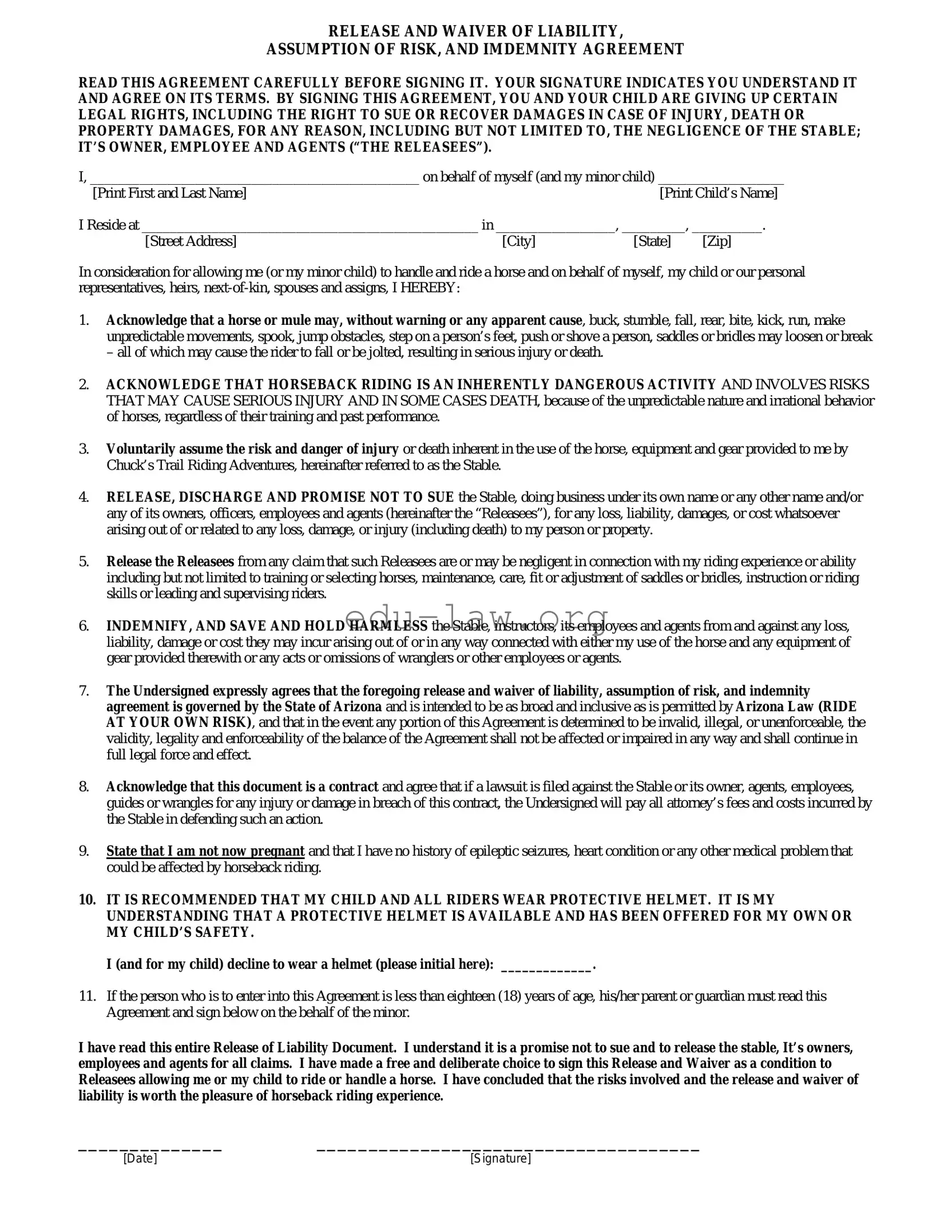
RELEASE AND WAIVER OF LIABILITY,
ASSUMPTION OF RISK, AND IMDEMNITY AGREEMENT
READ THIS AGREEMENT CAREFULLY BEFORE SIGNING IT. YOUR SIGNATURE INDICATES YOU UNDERSTAND IT AND AGREE ON ITS TERMS. BY SIGNING THIS AGREEMENT, YOU AND YOUR CHILD ARE GIVING UP CERTAIN LEGAL RIGHTS, INCLUDING THE RIGHT TO SUE OR RECOVER DAMAGES IN CASE OF INJURY, DEATH OR PROPERTY DAMAGES, FOR ANY REASON, INCLUDING BUT NOT LIMITED TO, THE NEGLIGENCE OF THE STABLE; IT’S OWNER, EMPLOYEE AND AGENTS (“THE RELEASEES”).
I, _______________________________________________ on behalf of myself (and my minor child) __________________
[Print First and Last Name][Print Child’s Name]
I Reside at ________________________________________________ in _________________, _________, __________.
[Street Address] |
[City] |
[State] |
[Zip] |
In consideration for allowing me (or my minor child) to handle and ride a horse and on behalf of myself, my child or our personal representatives, heirs,
1.Acknowledge that a horse or mule may, without warning or any apparent cause, buck, stumble, fall, rear, bite, kick, run, make unpredictable movements, spook, jump obstacles, step on a person’s feet, push or shove a person, saddles or bridles may loosen or break
– all of which may cause the rider to fall or be jolted, resulting in serious injury or death.
2.ACKNOWLEDGE THAT HORSEBACK RIDING IS AN INHERENTLY DANGEROUS ACTIVITY AND INVOLVES RISKS THAT MAY CAUSE SERIOUS INJURY AND IN SOME CASES DEATH, because of the unpredictable nature and irrational behavior of horses, regardless of their training and past performance.
3.Voluntarily assume the risk and danger of injury or death inherent in the use of the horse, equipment and gear provided to me by Chuck’s Trail Riding Adventures, hereinafter referred to as the Stable.
4.RELEASE, DISCHARGE AND PROMISE NOT TO SUE the Stable, doing business under its own name or any other name and/or any of its owners, officers, employees and agents (hereinafter the “Releasees”), for any loss, liability, damages, or cost whatsoever arising out of or related to any loss, damage, or injury (including death) to my person or property.
5.Release the Releasees from any claim that such Releasees are or may be negligent in connection with my riding experience or ability including but not limited to training or selecting horses, maintenance, care, fit or adjustment of saddles or bridles, instruction or riding skills or leading and supervising riders.
6.INDEMNIFY, AND SAVE AND HOLD HARMLESS the Stable, instructors, its employees and agents from and against any loss, liability, damage or cost they may incur arising out of or in any way connected with either my use of the horse and any equipment of gear provided therewith or any acts or omissions of wranglers or other employees or agents.
7.The Undersigned expressly agrees that the foregoing release and waiver of liability, assumption of risk, and indemnity agreement is governed by the State of Arizona and is intended to be as broad and inclusive as is permitted by Arizona Law (RIDE AT YOUR OWN RISK), and that in the event any portion of this Agreement is determined to be invalid, illegal, or unenforceable, the validity, legality and enforceability of the balance of the Agreement shall not be affected or impaired in any way and shall continue in full legal force and effect.
8.Acknowledge that this document is a contract and agree that if a lawsuit is filed against the Stable or its owner, agents, employees, guides or wrangles for any injury or damage in breach of this contract, the Undersigned will pay all attorney’s fees and costs incurred by the Stable in defending such an action.
9.State that I am not now pregnant and that I have no history of epileptic seizures, heart condition or any other medical problem that could be affected by horseback riding.
10.IT IS RECOMMENDED THAT MY CHILD AND ALL RIDERS WEAR PROTECTIVE HELMET. IT IS MY UNDERSTANDING THAT A PROTECTIVE HELMET IS AVAILABLE AND HAS BEEN OFFERED FOR MY OWN OR MY CHILD’S SAFETY.
I (and for my child) decline to wear a helmet (please initial here): _____________.
11.If the person who is to enter into this Agreement is less than eighteen (18) years of age, his/her parent or guardian must read this Agreement and sign below on the behalf of the minor.
I have read this entire Release of Liability Document. I understand it is a promise not to sue and to release the stable, It’s owners, employees and agents for all claims. I have made a free and deliberate choice to sign this Release and Waiver as a condition to Releasees allowing me or my child to ride or handle a horse. I have concluded that the risks involved and the release and waiver of liability is worth the pleasure of horseback riding experience.
______________ _____________________________________
[Date] |
[Signature] |
| Fact Name | Details |
|---|---|
| Nature of Agreement | This form is a Release and Waiver of Liability, Assumption of Risk, and Indemnity Agreement that participants must read and understand before signing. |
| Inherent Risks | Horseback riding is acknowledged as an inherently dangerous activity, with risks that may lead to serious injury or even death due to the unpredictable behavior of horses. |
| Assumption of Risk | By signing, participants voluntarily assume all risks associated with horseback riding, including potential injuries from the horse or equipment. |
| Release of Liability | Participants release the stable and its employees from any claims related to injuries or damages incurred during horseback riding. |
| Indemnification Clause | The agreement includes an indemnification clause, where participants agree to hold the stable harmless for any losses arising from their horseback riding activities. |
| Governing Law | This agreement is governed by the laws of the State of Arizona, which emphasizes the principle of "RIDE AT YOUR OWN RISK." |
Filling out the Horse Riding form requires careful attention to detail. This form serves as a legal document acknowledging the inherent risks associated with horseback riding. It is essential to provide accurate information and ensure all sections are completed before submission.
What is the purpose of the Horse Riding form?
The Horse Riding form serves as a legal agreement that outlines the risks associated with horseback riding. By signing it, participants acknowledge these risks and agree not to hold the stable or its employees responsible for any injuries or damages that may occur during the riding experience.
What risks are associated with horseback riding?
Horseback riding is inherently risky. Horses can behave unpredictably, which may lead to falls or injuries. Participants may face dangers such as being kicked, bitten, or thrown off a horse. The form emphasizes that these risks exist regardless of the horse's training or past behavior.
What does it mean to waive liability?
Waiving liability means that you agree not to hold the stable or its employees legally responsible for any injuries or damages that occur while riding. This includes situations where negligence may be involved. By signing the form, you accept these terms and give up certain legal rights.
Is this form legally binding?
Yes, the Horse Riding form is a legally binding contract. It is important to read it carefully before signing. If you have any concerns about the terms, it may be wise to consult with a legal professional before proceeding.
What should I do if I don’t agree with the terms?
If you do not agree with the terms outlined in the Horse Riding form, you should refrain from participating in the riding activities. Signing the form is a requirement for participation, and you cannot ride without agreeing to the terms.
Can a parent or guardian sign for a minor?
Yes, if the participant is under 18 years old, a parent or guardian must read and sign the form on their behalf. This ensures that the minor is also protected under the terms of the agreement.
What happens if I get injured while riding?
If you get injured while riding, the signed form indicates that you cannot sue the stable or its employees for damages. It is crucial to understand that by signing, you are accepting the risks associated with the activity.
Are helmets required?
While wearing a helmet is strongly recommended for safety, it is not mandatory according to the form. Participants have the option to decline wearing a helmet, but they must acknowledge this choice on the form.
What if I have a medical condition?
The form requires participants to confirm that they do not have any medical conditions that could be affected by horseback riding, such as heart conditions or epilepsy. If you have such a condition, it is advisable to consult a doctor before participating.
What should I do if I have more questions?
If you have additional questions about the Horse Riding form or the riding experience, it is best to contact the stable directly. They can provide clarification and address any concerns you may have.
Incomplete Personal Information: Failing to provide your full name, address, or the name of your child can lead to confusion and delays.
Not Reading the Agreement: Skimming through the document without understanding the terms can result in unexpected consequences later.
Missing Signatures: Forgetting to sign the form for yourself and your child can invalidate the agreement.
Incorrect Age Information: Misrepresenting your child’s age may lead to issues with safety protocols and insurance coverage.
Declining Helmet Use: Not indicating whether you or your child will wear a helmet can raise safety concerns.
Ignoring Medical History: Failing to disclose relevant medical conditions may put you or your child at risk while riding.
Overlooking the Indemnity Clause: Not understanding the indemnity section can lead to unexpected financial responsibilities in case of an accident.
Assuming Waivers are Unimportant: Believing that waivers don’t matter can leave you unprotected in case of an incident.
Not Keeping a Copy: Failing to keep a copy of the signed agreement for your records can create issues later if questions arise.
When participating in horseback riding activities, several additional forms and documents may be necessary to ensure safety and legal compliance. Each of these documents serves a specific purpose, enhancing the overall experience for both riders and operators. Below is a list of commonly used forms alongside the Horse Riding form.
Understanding these documents is essential for a safe and enjoyable horseback riding experience. Each form plays a vital role in protecting both the rider and the stable, ensuring that everyone involved is aware of their rights and responsibilities.
The Horse Riding form closely resembles a Liability Waiver commonly used in various recreational activities, such as zip-lining or rock climbing. These waivers serve to inform participants of the inherent risks involved in the activity. By signing, individuals acknowledge that they understand these risks and agree not to hold the organization responsible for any injuries or damages that may occur. Just like the Horse Riding form, these waivers aim to protect the service provider from legal claims arising from accidents that are part of the activity.
Another document similar to the Horse Riding form is the Assumption of Risk Agreement often used in sports leagues. This agreement outlines the potential dangers associated with the sport, such as injuries from falls or collisions. Participants must sign to confirm their understanding and acceptance of these risks. Much like the Horse Riding form, it emphasizes the voluntary nature of participation and the waiver of the right to sue for injuries sustained during the activity.
In the realm of adventure tourism, the Adventure Activity Release is akin to the Horse Riding form. This document outlines the risks associated with activities like white-water rafting or bungee jumping. By signing, participants acknowledge the dangers involved and agree to release the provider from liability. Both documents share the goal of ensuring that participants are fully aware of the risks before engaging in the activity.
Furthermore, the Ski Release of Liability is another document that mirrors the Horse Riding form. Ski resorts use this release to inform skiers of the risks inherent in skiing, such as falling or colliding with other skiers. By signing, individuals agree not to hold the resort liable for injuries sustained while skiing. Both documents require participants to recognize the potential for injury and accept responsibility for their safety.
The Parental Consent Form is also similar, particularly when it involves minors participating in activities like horseback riding. This form requires a parent or guardian's signature, indicating their understanding of the risks involved and their consent for the minor to participate. It aligns with the Horse Riding form's requirement for parental acknowledgment and agreement when a child is involved.
In addition, the Medical Release Form is a crucial document that often accompanies activity waivers. This form collects information about any medical conditions that could affect a participant’s ability to safely engage in the activity. Like the Horse Riding form, it emphasizes the importance of understanding one’s health status in relation to the risks of the activity.
The Event Participation Agreement is another document that shares similarities with the Horse Riding form. This agreement outlines the terms and conditions of participation in events, including potential risks. Participants sign to indicate their understanding and acceptance of these terms, thereby waiving their right to claim damages from the event organizers, similar to the waiver in the Horse Riding form.
Moreover, the Fitness Center Waiver is comparable, as it informs gym members of the risks associated with physical activities. By signing this waiver, members acknowledge the potential for injury and agree not to hold the gym liable for any accidents. Both documents serve to protect the organization while ensuring participants are aware of the inherent risks involved.
Lastly, the Scuba Diving Waiver is another document that aligns with the Horse Riding form. This waiver informs divers of the risks associated with scuba diving, such as decompression sickness or equipment failure. By signing, divers accept these risks and agree not to hold the diving school or instructors liable for any injuries. Both forms emphasize the importance of understanding the risks involved in potentially dangerous activities.
When filling out the Horse Riding form, there are several important dos and don'ts to keep in mind. This will help ensure that the process goes smoothly and that you understand what you're agreeing to.
Here are five common misconceptions about the Horse Riding form that participants should be aware of:
While the form includes a waiver, it does not eliminate all rights to seek legal recourse. If there is gross negligence or intentional harm, you may still have options.
The waiver covers a broad range of risks, including those associated with equipment, the environment, and the actions of instructors or staff. It is not limited to incidents involving the horse alone.
While the form states that wearing a helmet is recommended, it is crucial for safety. Helmets can significantly reduce the risk of serious head injuries in case of falls.
The form must be signed by a parent or guardian for minors. This ensures that all riders, regardless of age, are informed about the risks involved in horseback riding.
Once signed, the agreement is binding, but participants should fully understand the terms before signing. If you have questions or concerns, it is best to address them beforehand.
When filling out and using the Horse Riding form, it is essential to keep the following key points in mind:
Filling out this form accurately and understanding its implications is crucial for a safe horseback riding experience.