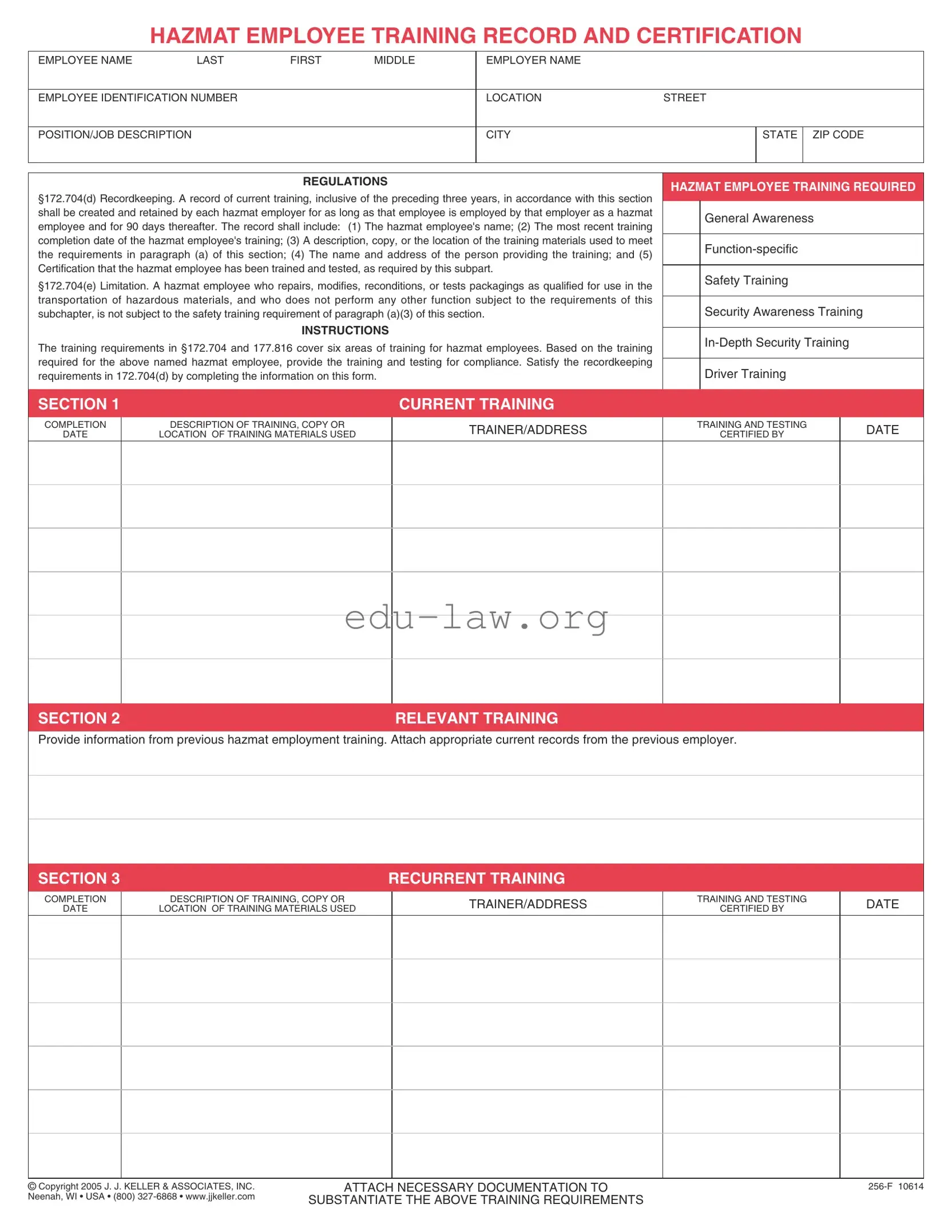
When it comes to handling hazardous materials, the importance of proper training cannot be overstated. The Hazmat Employee Training Record form serves as a crucial tool for employers in ensuring that their employees are adequately trained and compliant with federal regulations. This form captures essential details about the employee, including their name, identification number, and job description, while also documenting their training history. It highlights the need for a record of current training, which must be maintained for the duration of employment and for 90 days thereafter. Employers are required to keep track of the most recent training completion date, the training materials used, and the qualifications of the trainer. Furthermore, the form emphasizes the necessity of recurrent training and provides sections for documenting previous hazmat training from prior employment. By adhering to these guidelines, employers can not only meet regulatory requirements but also foster a safer work environment for all employees involved in the transportation of hazardous materials.

HAZMAT EMPLOYEE TRAINING RECORD AND CERTIFICATION
EMPLOYEE NAME |
LAST |
FIRST |
MIDDLE |
EMPLOYER NAME |
|
|
|
|
|
|
|
|
|
|
|
EMPLOYEE IDENTIFICATION NUMBER |
|
|
LOCATION |
STREET |
|||
|
|
|
|
|
|
|
|
POSITION/JOB DESCRIPTION |
|
|
|
CITY |
|
STATE |
ZIP CODE |
|
|
|
|
|
|
|
|
REGULATIONS |
HAZMAT EMPLOYEE TRAINING REQUIRED |
|
|
||
¤172.704(d) Recordkeeping. A record of current training, inclusive of the preceding three years, in accordance with this section |
|
|
shall be created and retained by each hazmat employer for as long as that employee is employed by that employer as a hazmat |
|
General Awareness |
employee and for 90 days thereafter. The record shall include: (1) The hazmat employee's name; (2) The most recent training |
|
|
|
|
|
completion date of the hazmat employee's training; (3) A description, copy, or the location of the training materials used to meet |
|
|
the requirements in paragraph (a) of this section; (4) The name and address of the person providing the training; and (5) |
|
|
|
|
|
Certification that the hazmat employee has been trained and tested, as required by this subpart. |
|
|
|
Safety Training |
|
¤172.704(e) Limitation. A hazmat employee who repairs, modifies, reconditions, or tests packagings as qualified for use in the |
|
|
|
|
|
transportation of hazardous materials, and who does not perform any other function subject to the requirements of this |
|
|
|
Security Awareness Training |
|
subchapter, is not subject to the safety training requirement of paragraph (a)(3) of this section. |
|
|
INSTRUCTIONS |
|
|
|
||
The training requirements in ¤172.704 and 177.816 cover six areas of training for hazmat employees. Based on the training |
|
|
|
|
|
required for the above named hazmat employee, provide the training and testing for compliance. Satisfy the recordkeeping |
|
|
|
Driver Training |
|
requirements in 172.704(d) by completing the information on this form. |
|
|
|
|
|
SECTION 1 |
|
CURRENT TRAINING |
|
|
|
|
|
|
|
|
|
COMPLETION |
DESCRIPTION OF TRAINING, COPY OR |
TRAINER/ADDRESS |
TRAINING AND TESTING |
DATE |
|
DATE |
LOCATION OF TRAINING MATERIALS USED |
CERTIFIED BY |
|||
|
|
||||
|
|
|
|
|
|
|
|
|
|
|
|
|
|
|
|
|
|
|
|
|
|
|
|
|
|
|
|
|
|
|
|
|
|
|
SECTION 2 |
|
|
RELEVANT TRAINING |
|
|
|
|
||||
Provide information from previous hazmat employment training. Attach appropriate current records from the previous employer. |
|
||||
|
|
|
|
|
|
|
|
|
|
|
|
|
|
|
|
|
|
SECTION 3 |
|
RECURRENT TRAINING |
|
|
|
|
|
|
|
|
|
COMPLETION |
DESCRIPTION OF TRAINING, COPY OR |
|
TRAINER/ADDRESS |
TRAINING AND TESTING |
DATE |
DATE |
LOCATION OF TRAINING MATERIALS USED |
|
CERTIFIED BY |
||
|
|
|
|||
|
|
|
|
|
|
|
|
|
|
|
|
|
|
|
|
|
|
|
|
|
|
|
|
|
|
|
|
|
|
|
|
|
|
|
|
© Copyright 2005 J. J. KELLER & ASSOCIATES, INC.ATTACH NECESSARY DOCUMENTATION TO256-F 10614
Neenah, WI ¥ USA ¥ (800) |
SUBSTANTIATE THE ABOVE TRAINING REQUIREMENTS |
|
| Fact Name | Description |
|---|---|
| Employee Information | The form requires detailed information about the hazmat employee, including their name, employer, identification number, and job description. |
| Training Recordkeeping | Employers must maintain a record of the hazmat employee's training for the duration of their employment and for 90 days after termination, as per regulation §172.704(d). |
| Training Content | Records must include the training completion date, a description of the training materials, and the trainer's information, ensuring compliance with federal regulations. |
| Exemptions | Certain hazmat employees, such as those who only repair or test packaging without performing other functions, may be exempt from specific safety training requirements. |
| Previous Employment Records | Section 2 of the form allows for the inclusion of training records from previous hazmat employment, which must be attached to ensure comprehensive compliance. |
Completing the Hazmat Employee Training Record form is essential for maintaining accurate records of training compliance. This document ensures that all necessary training information is documented and retained as required by regulations. Follow these steps to fill out the form correctly.
What is the Hazmat Employee Training Record form?
The Hazmat Employee Training Record form is a document used by employers to keep track of the training that hazmat employees have received. It ensures that records are maintained for compliance with federal regulations regarding the transportation of hazardous materials.
Who needs to fill out this form?
This form must be filled out by employers for every hazmat employee. It is essential for those who handle hazardous materials in any capacity related to their job. The employer is responsible for maintaining these records for as long as the employee is employed and for an additional 90 days after their employment ends.
What information is required on the form?
The form requires the employee's name, the employer's name, identification number, job description, and training details. Specifically, it must include the training completion date, a description of the training materials, the trainer's name and address, and a certification statement confirming that the employee has been trained and tested.
How long must training records be kept?
According to regulations, employers must keep training records for as long as the employee is employed in a hazmat role. After employment ends, records must be retained for an additional 90 days. This ensures that there is a clear history of training for compliance and safety audits.
What types of training are covered under this form?
The training covered includes general awareness, function-specific training, safety training, security awareness, and in-depth security training. Each of these areas is crucial for ensuring that employees are prepared to handle hazardous materials safely and in compliance with the law.
What happens if an employee does not complete the required training?
If an employee does not complete the required training, they may not be allowed to perform tasks related to hazardous materials. This can lead to legal penalties for the employer and increased risk of safety incidents. Compliance with training requirements is essential for both employee safety and regulatory adherence.
Can previous training records be included on this form?
Yes, previous training records can be included. Employers should attach relevant documentation from the employee's past hazmat training. This helps create a comprehensive record of the employee's training history and ensures that all required training is accounted for.
What should be done if training materials change?
If training materials change, the employer must update the records to reflect the new materials. This includes noting the updated materials on the form and ensuring that employees are trained with the latest information. Keeping training materials current is vital for maintaining safety standards.
Who certifies the training on the form?
The certification of training is typically completed by the trainer or the person responsible for the training program. This individual must ensure that all training requirements have been met and sign the form to confirm that the employee has been adequately trained and tested.
Where can I find more information about hazmat training requirements?
For more information about hazmat training requirements, you can refer to the U.S. Department of Transportation's Pipeline and Hazardous Materials Safety Administration (PHMSA) website. They provide detailed guidance on training requirements and compliance for hazmat employees.
Incomplete Employee Information: Failing to provide all necessary details about the employee, such as their full name, identification number, and job description, can lead to confusion and issues in recordkeeping.
Missing Training Dates: Omitting the most recent training completion date can result in non-compliance with recordkeeping requirements. It is essential to accurately document when the training occurred.
Improper Documentation of Training Materials: Not including a description or copy of the training materials used can hinder verification of compliance. Ensure that this information is clearly documented.
Incorrect Trainer Information: Providing inaccurate details about the trainer, including their name and address, can complicate the validation of the training received. Always double-check this information.
Lack of Certification: Failing to include a certification statement confirming that the employee has been trained and tested is a significant oversight. This certification is crucial for compliance.
Neglecting Previous Employment Records: Not attaching records from previous hazmat employment training can result in incomplete training documentation. Always include relevant records to ensure a comprehensive training history.
Omitting Recurrent Training Information: Forgetting to fill out the recurrent training section can lead to gaps in training records. This information is vital for maintaining compliance over time.
Failure to Attach Necessary Documentation: Not including required supporting documents can hinder the verification process. Always ensure that all necessary documentation is attached to the form.
The Hazmat Employee Training Record form is essential for documenting the training and certification of employees who handle hazardous materials. However, it is often used in conjunction with other important forms and documents that further ensure compliance with safety regulations and training requirements. Below are five such documents.
These documents collectively support the safe handling of hazardous materials and help organizations comply with federal regulations. Maintaining accurate records not only protects employees but also enhances overall workplace safety.
The Occupational Safety and Health Administration (OSHA) Training Record is similar to the Hazmat Employee Training Record in that it documents employee training related to workplace safety. Like the Hazmat form, it includes the employee's name, training completion dates, and a description of the training materials. Employers must maintain these records for a specified duration, ensuring compliance with safety regulations. Both documents serve as essential tools for tracking training and verifying that employees have received the necessary education to perform their jobs safely.
The Employee Training and Development Record is another document that shares similarities with the Hazmat Employee Training Record. This record typically outlines the training programs an employee has completed within an organization. It includes details such as the training dates, topics covered, and the trainer's information. Both records emphasize the importance of ongoing training and development, reflecting an employer's commitment to enhancing employee skills and ensuring compliance with industry standards.
The Safety Data Sheet (SDS) is also related to the Hazmat Employee Training Record, as both documents are essential for handling hazardous materials. The SDS provides critical information about the properties of a chemical substance, including health hazards and safe handling practices. While the Hazmat Training Record focuses on employee training, the SDS serves as a reference for safe practices. Together, they ensure that employees are informed and prepared to manage hazardous materials responsibly.
The First Aid Training Record is another document that bears similarities to the Hazmat Employee Training Record. This record tracks the completion of first aid training by employees, documenting the training dates, instructor details, and certification status. Both records are vital for ensuring that employees are equipped to respond effectively to emergencies. They highlight the employer's responsibility to provide training that promotes a safe working environment.
The Forklift Operator Certification Record is comparable to the Hazmat Employee Training Record in that it documents specialized training for operating equipment safely. This record includes the operator's name, training completion date, and a description of the training received. Both documents reflect the necessity of training for specific job functions and ensure that employees possess the skills required to operate equipment or handle hazardous materials safely.
Lastly, the Compliance Training Record serves a similar purpose to the Hazmat Employee Training Record by documenting mandatory training for compliance with various regulations. This record includes details about the training topics, completion dates, and trainer information. Both records are crucial for demonstrating adherence to legal requirements and ensuring that employees are informed about relevant safety protocols and regulations.
When filling out the Hazmat Employee Training Record form, there are important dos and don'ts to keep in mind. Here’s a helpful list:
Understanding the Hazmat Employee Training Record form is crucial for both employers and employees in the hazardous materials sector. However, several misconceptions can lead to confusion. Here are seven common misunderstandings about this important document:
In reality, the record must be retained for as long as the employee is employed as a hazmat employee and for an additional 90 days after their departure.
The form requires specific information, including the employee's name, the most recent training completion date, and a description of the training materials used.
The form must include the name and address of the person or organization providing the training, ensuring accountability and traceability.
Employers must maintain records of training for the previous three years, which includes recurrent training and any updates or changes in training protocols.
This record is a legal requirement under federal regulations, making it essential for compliance and safety in hazardous materials handling.
Hazmat training encompasses various areas, including security awareness and function-specific training, depending on the employee's role.
Accurate and thorough completion of the form is critical. Employers must ensure that all required fields are filled out correctly to avoid potential penalties.
By clearing up these misconceptions, employers and employees can better navigate the requirements of the Hazmat Employee Training Record form and ensure compliance with safety regulations.
Filling out and using the Hazmat Employee Training Record form is essential for compliance and safety. Here are key takeaways to keep in mind:
Following these guidelines will help ensure compliance with federal regulations and promote safety in handling hazardous materials.