In the picturesque state of Hawaii, planning for the future often involves considering how to best transfer property to loved ones. One effective tool for this purpose is the Transfer-on-Death (TOD) Deed form. This legal document allows property owners to designate beneficiaries who will automatically receive the property upon their passing, bypassing the often lengthy and costly probate process. The TOD Deed provides flexibility, as it can be revoked or amended at any time during the owner's lifetime. Additionally, it ensures that the property owner retains full control over their property while alive, allowing for the sale or modification of the property without any restrictions. This approach not only simplifies the transfer of real estate but also provides peace of mind, knowing that one's wishes will be honored after death. Understanding the nuances of the TOD Deed form can empower individuals to make informed decisions about their estate planning, ensuring a smoother transition for their heirs.
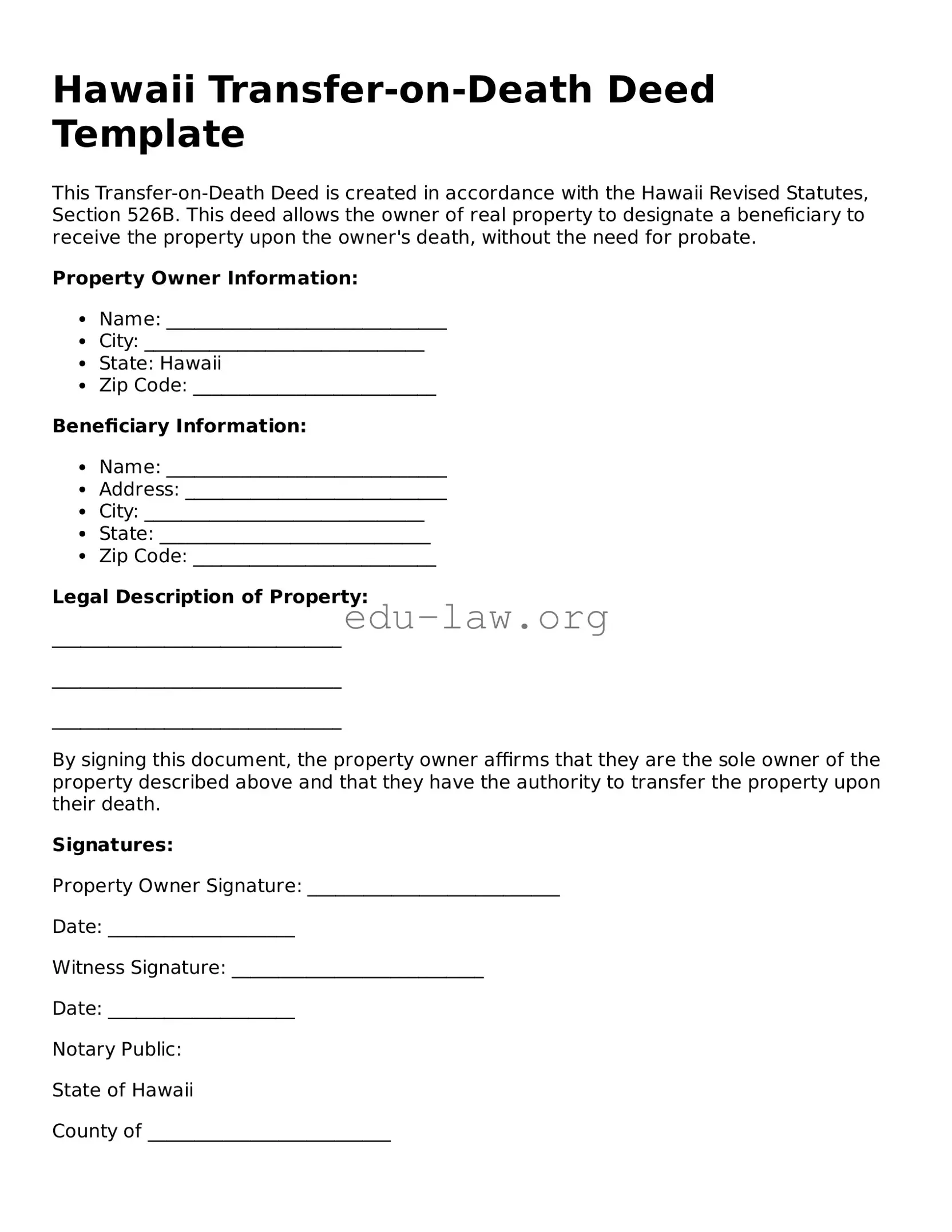
Hawaii Transfer-on-Death Deed Template
This Transfer-on-Death Deed is created in accordance with the Hawaii Revised Statutes, Section 526B. This deed allows the owner of real property to designate a beneficiary to receive the property upon the owner's death, without the need for probate.
Property Owner Information:
Beneficiary Information:
Legal Description of Property:
_______________________________
_______________________________
_______________________________
By signing this document, the property owner affirms that they are the sole owner of the property described above and that they have the authority to transfer the property upon their death.
Signatures:
Property Owner Signature: ___________________________
Date: ____________________
Witness Signature: ___________________________
Date: ____________________
Notary Public:
State of Hawaii
County of __________________________
On this _____ day of __________, 20__, before me, the undersigned notary public, personally appeared __________________________, known to me to be the person whose name is subscribed to the within instrument, and acknowledged that they executed the same.
Notary Public Signature: ___________________________
My Commission Expires: ___________________________
| Fact Name | Details |
|---|---|
| Purpose | The Hawaii Transfer-on-Death Deed allows property owners to transfer real estate to beneficiaries upon their death without going through probate. |
| Governing Law | This deed is governed by Hawaii Revised Statutes, Section 526B. |
| Eligibility | Only individuals who own real property in Hawaii can create a Transfer-on-Death Deed. |
| Revocation | Property owners can revoke or change the deed at any time before their death. |
| Filing Requirements | The deed must be recorded with the Bureau of Conveyances in Hawaii to be effective. |
After obtaining the Hawaii Transfer-on-Death Deed form, you will need to fill it out accurately to ensure it serves its purpose. Follow these steps carefully to complete the form correctly.
What is a Transfer-on-Death Deed in Hawaii?
A Transfer-on-Death Deed (TODD) is a legal document that allows a property owner in Hawaii to designate one or more beneficiaries who will automatically receive the property upon the owner's death. This deed helps avoid probate, which can be a lengthy and costly process.
Who can create a Transfer-on-Death Deed?
Any individual who is the sole owner of real property in Hawaii can create a Transfer-on-Death Deed. This includes individuals who hold title to the property in their name alone. However, joint owners must consider other legal options, as a TODD typically applies only to properties owned solely by one person.
How do I complete a Transfer-on-Death Deed?
To complete a Transfer-on-Death Deed, you will need to provide specific information, including the legal description of the property, your name as the owner, and the names of the beneficiaries. The form must be signed in the presence of a notary public to ensure its validity. Make sure to follow the instructions carefully to avoid any issues.
Is there a fee to file a Transfer-on-Death Deed?
Yes, there is typically a fee associated with filing a Transfer-on-Death Deed in Hawaii. This fee may vary depending on the county where the property is located. It’s important to check with your local county recorder’s office for the exact amount and any additional requirements.
Can I revoke or change a Transfer-on-Death Deed after it has been filed?
Yes, you can revoke or change a Transfer-on-Death Deed at any time before your death. To do this, you will need to file a revocation form with the same county recorder’s office where the original deed was filed. Additionally, you may create a new TODD to replace the existing one if you wish to change beneficiaries.
What happens if a beneficiary predeceases me?
If a beneficiary named in your Transfer-on-Death Deed passes away before you do, their share of the property will typically go to their heirs, unless you specify otherwise in the deed. It’s wise to consider including alternate beneficiaries to avoid complications.
Will a Transfer-on-Death Deed affect my property taxes?
No, creating a Transfer-on-Death Deed does not affect your property taxes while you are alive. The property remains in your name, and you continue to be responsible for all taxes. However, upon your death, the new owner may be subject to reassessment based on current market value.
Do I need an attorney to create a Transfer-on-Death Deed?
While it is not legally required to have an attorney, consulting with one is highly recommended. An attorney can provide valuable guidance, ensuring that the deed is completed correctly and that your wishes are clearly reflected.
When does a Transfer-on-Death Deed take effect?
A Transfer-on-Death Deed takes effect only upon the death of the property owner. Until that time, the owner retains full control over the property and can sell, lease, or otherwise manage it as they see fit.
Can I use a Transfer-on-Death Deed for all types of property?
A Transfer-on-Death Deed can only be used for real property, such as land and buildings. It does not apply to personal property, bank accounts, or other assets. For those types of assets, different estate planning tools may be more appropriate.
Not including all required information. The form requires specific details about the property and the beneficiaries. Omitting any of this information can lead to delays or rejection.
Failing to sign the deed. A Transfer-on-Death Deed must be signed by the owner(s) of the property. Without a signature, the document is not valid.
Not having the deed notarized. In Hawaii, the deed must be notarized to be legally binding. Skipping this step can invalidate the transfer.
Incorrectly identifying the beneficiaries. Ensure that the names and details of the beneficiaries are accurate. Mistakes can cause complications during the transfer process.
Not recording the deed with the county. After completing the form, it must be recorded with the appropriate county office. Failing to do so can result in the deed not being recognized.
Using outdated forms. Always check for the most current version of the Transfer-on-Death Deed form. Using an outdated form can lead to legal issues.
Neglecting to consult with a professional. While it’s possible to fill out the form independently, seeking advice from a legal professional can prevent mistakes and ensure compliance with state laws.
Not considering tax implications. Understand the potential tax consequences of transferring property upon death. This can affect both the owner and the beneficiaries.
When dealing with property transfers in Hawaii, the Transfer-on-Death Deed form is just one piece of the puzzle. There are several other documents that may be necessary to ensure a smooth transition of property ownership. Below is a list of commonly used forms and documents that often accompany the Transfer-on-Death Deed.
Understanding these additional documents can help simplify the process of transferring property through a Transfer-on-Death Deed in Hawaii. Each document plays a crucial role in ensuring that the transfer is legally valid and recognized by the appropriate authorities.
The Hawaii Transfer-on-Death Deed (TODD) is similar to a Last Will and Testament in that both documents allow individuals to express their wishes regarding the distribution of their property after death. However, a TODD specifically addresses real estate and allows for the direct transfer of property to designated beneficiaries without the need for probate. This can simplify the process for heirs and expedite the transfer of ownership, whereas a will must go through probate court, which can be time-consuming and costly.
Another document comparable to the TODD is a Revocable Living Trust. Like the TODD, a revocable living trust allows individuals to manage their assets during their lifetime and dictate how those assets should be distributed upon death. The key difference lies in the fact that a trust can encompass a wider range of assets beyond real estate, including bank accounts and personal property. Furthermore, assets placed in a living trust avoid probate, similar to a TODD, making the transfer process smoother for beneficiaries.
A Beneficiary Deed is also akin to the TODD, as it serves the purpose of transferring real estate upon the owner’s death. This type of deed allows property owners to designate beneficiaries who will automatically receive the property without going through probate. While both documents facilitate a direct transfer, a Beneficiary Deed may not be recognized in all states, whereas the TODD is specifically legislated in Hawaii, providing clarity for residents.
Power of Attorney (POA) documents share some similarities with the TODD, particularly in the context of property management. A POA grants an individual the authority to make decisions on behalf of another, including the management and transfer of property. However, a POA is effective during the grantor’s lifetime and ceases upon their death, whereas a TODD takes effect after death, ensuring that the property transfers seamlessly to the designated beneficiaries.
A Joint Tenancy Agreement is another document that resembles the TODD. In a joint tenancy arrangement, two or more individuals hold ownership of a property, and upon the death of one owner, the property automatically transfers to the surviving owner(s). This right of survivorship feature is similar to the TODD’s intent to transfer property directly to beneficiaries without probate. However, joint tenancy requires the co-owners to hold equal shares, which may not always align with an individual’s estate planning goals.
The Life Estate Deed is also comparable to the TODD in terms of property transfer. A life estate deed allows an individual to retain the right to use and occupy a property during their lifetime, while designating a remainder beneficiary who will receive the property upon their death. While both documents facilitate a transfer of property, a life estate deed involves a retained interest, whereas a TODD transfers full ownership to the beneficiary immediately upon death.
Another relevant document is the Family Limited Partnership (FLP). An FLP allows family members to pool resources and manage assets collectively, often including real estate. While it does not function as a direct transfer mechanism like the TODD, it can be used as an estate planning tool to manage property and facilitate its transfer to heirs. The FLP can help reduce estate taxes and provide a structured approach to asset management, differing from the straightforward nature of a TODD.
Lastly, a Declaration of Trust can be likened to the TODD, particularly in its role in estate planning. A declaration outlines the terms of a trust, specifying how assets, including real estate, will be managed and distributed. While both documents aim to simplify the transfer of property, a declaration of trust typically requires more ongoing management and oversight than a TODD, which is a more direct and passive means of ensuring property passes to beneficiaries upon death.
When filling out the Hawaii Transfer-on-Death Deed form, it’s important to approach the process with care. This deed allows property owners to transfer their real estate to a designated beneficiary upon their death, bypassing the probate process. Here are ten essential do's and don'ts to keep in mind:
By following these guidelines, you can help ensure that the transfer of your property goes smoothly and according to your wishes.
The Hawaii Transfer-on-Death Deed (TOD) form is a legal instrument that allows property owners to transfer their real estate to designated beneficiaries upon their death. Despite its usefulness, several misconceptions exist regarding this form. Below are six common misunderstandings:
This is incorrect. The property owner can execute the TOD deed without needing approval from the beneficiaries. The deed only takes effect upon the owner's death.
While a TOD deed does allow for the transfer of property outside of probate, it does not eliminate the need for probate in all cases, especially if other assets are involved.
This is misleading. The TOD deed is specifically designed for real estate and cannot be used for personal property or bank accounts.
This is not true. The property owner retains the right to revoke or modify the TOD deed at any time before their death, as long as they follow the proper legal procedures.
This is false. The TOD deed only applies to the specific property listed in the deed. Other properties not mentioned will not be transferred under this deed.
This is misleading. While the transfer itself may not trigger immediate tax consequences, beneficiaries may still face property tax assessments or capital gains taxes upon the sale of the property.
Understanding the Hawaii Transfer-on-Death Deed form is essential for effective estate planning. Here are some key takeaways: