The Hawaii Small Estate Affidavit form serves as a vital tool for individuals dealing with the estate of a deceased person who left behind limited assets. This form simplifies the process of transferring property without the need for a lengthy probate procedure. In Hawaii, the Small Estate Affidavit is applicable when the total value of the estate does not exceed a specific threshold, which is subject to change based on state law. The form requires the affiant, typically a close relative or heir, to provide essential information such as the decedent’s name, date of death, and details about the assets being claimed. Additionally, the affiant must affirm that the estate qualifies under the small estate provisions and that all debts and taxes have been settled. By using this affidavit, heirs can efficiently claim their rightful inheritance while minimizing legal complexities and expenses. Understanding the requirements and implications of this form can significantly ease the burden during a challenging time.
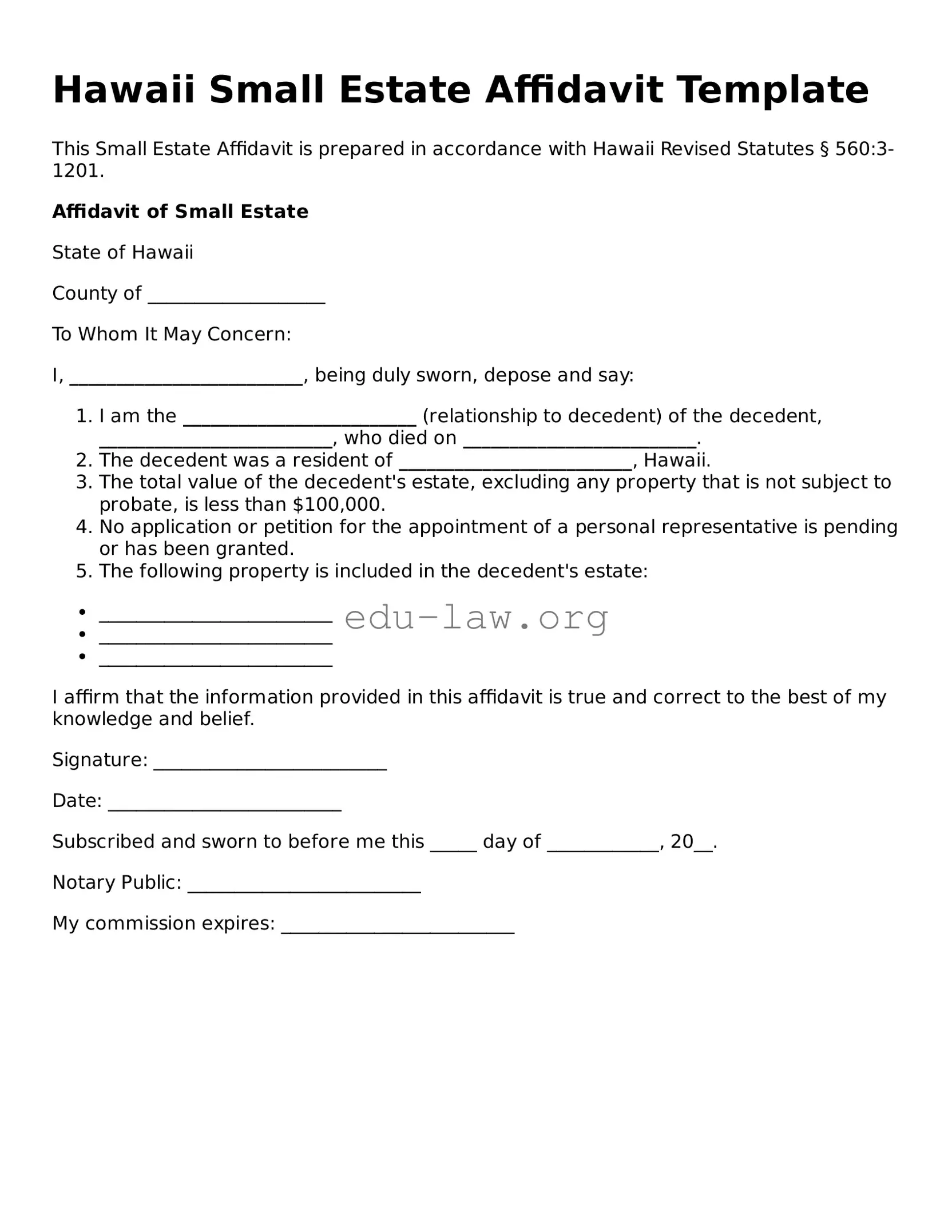
Hawaii Small Estate Affidavit Template
This Small Estate Affidavit is prepared in accordance with Hawaii Revised Statutes § 560:3-1201.
Affidavit of Small Estate
State of Hawaii
County of ___________________
To Whom It May Concern:
I, _________________________, being duly sworn, depose and say:
I affirm that the information provided in this affidavit is true and correct to the best of my knowledge and belief.
Signature: _________________________
Date: _________________________
Subscribed and sworn to before me this _____ day of ____________, 20__.
Notary Public: _________________________
My commission expires: _________________________
| Fact Name | Description |
|---|---|
| Definition | The Hawaii Small Estate Affidavit is a legal document that allows heirs to claim a deceased person's assets without going through formal probate, provided the estate meets certain criteria. |
| Eligibility | To qualify for using the Small Estate Affidavit, the total value of the estate must be $100,000 or less, excluding real property. |
| Governing Law | The use of the Small Estate Affidavit in Hawaii is governed by Hawaii Revised Statutes, Section 560:3-1201. |
| Required Information | The affidavit must include details such as the names of the heirs, the value of the estate, and a statement confirming that no probate proceedings are pending. |
| Filing Process | After completing the affidavit, heirs must present it to the financial institutions or other entities holding the deceased's assets to claim them. |
| Limitations | While the Small Estate Affidavit simplifies the transfer of assets, it cannot be used for estates that include real property or if the total value exceeds the specified limit. |
After gathering the necessary information, you can begin filling out the Hawaii Small Estate Affidavit form. This process involves providing details about the deceased and the estate. Make sure to have all relevant documents on hand to ensure accuracy.
What is a Small Estate Affidavit in Hawaii?
A Small Estate Affidavit is a legal document that allows individuals to transfer assets of a deceased person without going through the formal probate process. In Hawaii, this option is available for estates valued at $100,000 or less, excluding certain types of property, such as real estate. This affidavit simplifies the process of settling an estate, making it more accessible for heirs and beneficiaries.
Who can use a Small Estate Affidavit?
Any person who is entitled to inherit from the deceased can use a Small Estate Affidavit. This typically includes heirs, beneficiaries named in a will, or individuals who would inherit under Hawaii's intestacy laws if there is no will. It is important to ensure that the total value of the estate does not exceed the specified limit to qualify for this process.
What assets are included in the Small Estate Affidavit?
The Small Estate Affidavit can include various types of assets, such as bank accounts, personal property, and vehicles. However, real estate is generally excluded from this process. It is crucial to accurately assess the value of all assets to ensure they fall within the $100,000 limit.
How do I complete a Small Estate Affidavit?
To complete a Small Estate Affidavit, you will need to gather information about the deceased, including their name, date of death, and a list of their assets. You can then fill out the affidavit form, which typically requires details about the heirs and the value of the estate. After completing the form, it must be signed in the presence of a notary public to validate it.
Where do I submit the Small Estate Affidavit?
The completed Small Estate Affidavit should be submitted to the financial institutions or entities that hold the deceased's assets. For instance, if there are bank accounts involved, the affidavit must be presented to the bank. Each institution may have its own requirements for accepting the affidavit, so it is advisable to contact them in advance.
Is there a fee associated with filing a Small Estate Affidavit?
Generally, there are no court fees associated with filing a Small Estate Affidavit since it is not submitted to a court. However, some financial institutions may charge a fee for processing the affidavit. It is recommended to check with each institution to understand any potential costs involved.
What happens if the estate exceeds the Small Estate limit?
If the estate's value exceeds the $100,000 limit, the Small Estate Affidavit cannot be used. In such cases, the estate will need to go through the formal probate process. This process is more complex and may require the assistance of an attorney to navigate the legal requirements and ensure that the estate is settled appropriately.
Can a Small Estate Affidavit be contested?
Incorrectly identifying the decedent: It’s crucial to accurately state the full name of the deceased person. Any errors in spelling or missing middle names can lead to complications.
Failing to meet the estate value threshold: Ensure that the total value of the estate falls within Hawaii's small estate limits. If the value exceeds this limit, the affidavit cannot be used.
Not listing all assets: Every asset belonging to the decedent must be accounted for. Omitting any property, bank accounts, or other valuables can invalidate the affidavit.
Missing signatures: All required signatures must be present on the form. This includes the signatures of the affiant and any witnesses, if applicable.
Inadequate documentation: Supporting documents, such as death certificates or proof of ownership, should be included. Without these, the affidavit may be rejected.
The Hawaii Small Estate Affidavit is an important document for settling the affairs of a deceased person with a small estate. In addition to this affidavit, several other forms and documents may be required to facilitate the process. Below is a list of these documents, each serving a specific purpose in the estate settlement process.
Having these documents ready can streamline the process of settling a small estate in Hawaii. It is crucial to ensure all paperwork is accurate and complete to avoid delays.
The Small Estate Affidavit is similar to the Affidavit of Heirship. Both documents are used to establish the rightful heirs to a deceased person's estate without going through the probate process. The Affidavit of Heirship is often used when the deceased did not leave a will. It provides a sworn statement regarding the identity of the heirs and their relationship to the deceased, making it easier to transfer property ownership.
Another similar document is the Will. While a Small Estate Affidavit helps distribute assets without probate, a Will outlines how a person's assets should be distributed after their death. A Will requires probate to validate its terms, whereas the Small Estate Affidavit allows for a quicker transfer of assets for smaller estates, bypassing the lengthy probate process.
The Declaration of Trust is also comparable. This document is used to manage assets held in a trust during a person's lifetime and after their death. Like the Small Estate Affidavit, it allows for the direct transfer of assets without the need for probate. However, a Declaration of Trust is more comprehensive, detailing how the trust operates and how assets are to be distributed among beneficiaries.
The Transfer on Death Deed (TOD) shares similarities as well. This deed allows individuals to transfer real estate to beneficiaries upon their death without going through probate. The Small Estate Affidavit can be used for personal property, while the TOD specifically addresses real estate, providing a streamlined method for asset transfer.
The Affidavit of Collection of Personal Property is another related document. This affidavit allows a person to collect personal property from a deceased individual without going through probate. It is typically used for small amounts of personal property, similar to the Small Estate Affidavit, which simplifies the process of transferring assets to heirs.
The Petition for Summary Administration is also relevant. This document is filed in court to request a simplified probate process for small estates. Like the Small Estate Affidavit, it aims to expedite the distribution of assets, but it requires court approval, whereas the Small Estate Affidavit does not.
Lastly, the Notice to Creditors is akin to the Small Estate Affidavit in that it deals with the estate's liabilities. This document is used to inform creditors of a deceased person's passing and provides a time frame for them to make claims against the estate. While the Small Estate Affidavit focuses on asset distribution, the Notice to Creditors addresses the estate's debts, ensuring that all financial obligations are settled before assets are distributed.
When filling out the Hawaii Small Estate Affidavit form, it's important to follow certain guidelines to ensure accuracy and compliance. Below are ten key do's and don'ts to consider.
Understanding the Hawaii Small Estate Affidavit can be tricky. Here are seven common misconceptions about this important legal tool:
This is not true. The Small Estate Affidavit is only applicable to estates valued at $100,000 or less in Hawaii.
While it's best practice to have agreement among heirs, the affidavit can still be used if some heirs do not consent, as long as the law allows it.
The affidavit simplifies the process and can bypass formal probate, but it does not eliminate the need for probate in all cases.
Individuals can file the Small Estate Affidavit themselves, without the need for an attorney, as long as they meet the requirements.
This form cannot be used for real property. If real estate is involved, a different process must be followed.
The Small Estate Affidavit serves a different purpose than a will. It is used to collect assets, not to distribute them according to a testamentary plan.
Each estate is unique. The Small Estate Affidavit may not be appropriate for every situation, and specific circumstances must be considered.
By clarifying these misconceptions, individuals can better navigate the process of settling small estates in Hawaii.
When dealing with the Hawaii Small Estate Affidavit form, it is essential to understand several key points. The following takeaways will help you navigate the process effectively: