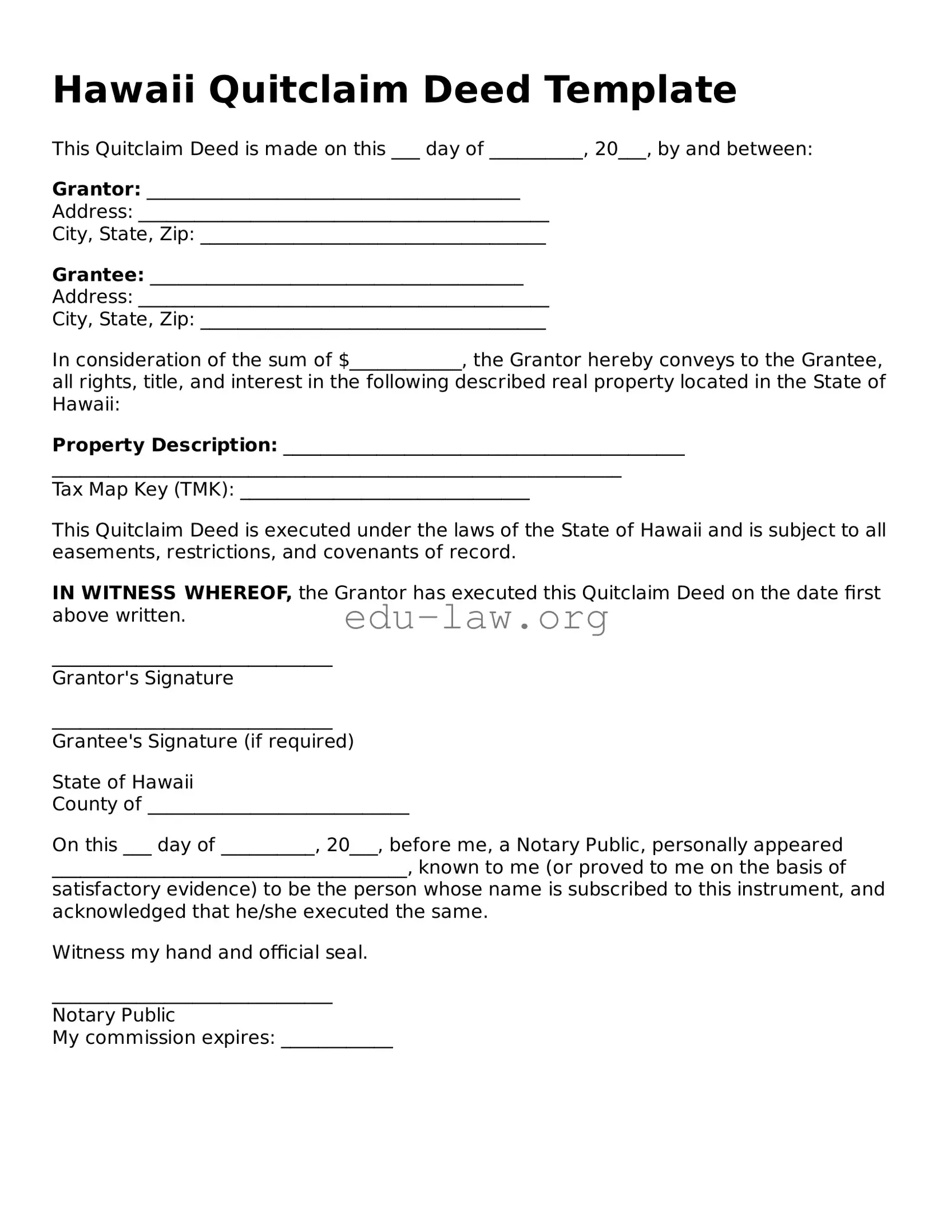
In Hawaii, the Quitclaim Deed is a valuable tool for property owners looking to transfer their interest in real estate. This straightforward form allows one party, the grantor, to relinquish their rights to a property to another party, the grantee. It’s often used in various situations, such as transferring property between family members, settling disputes, or clarifying ownership. Unlike other deed types, a Quitclaim Deed does not guarantee that the grantor holds clear title to the property. Instead, it simply conveys whatever interest the grantor may have at the time of transfer. This means that the grantee assumes the risk regarding the title's status. Understanding the implications of using a Quitclaim Deed is essential for anyone involved in property transactions in Hawaii. The process is generally straightforward, but it’s crucial to ensure that the deed is properly executed and recorded to protect all parties involved.
Hawaii Quitclaim Deed Template
This Quitclaim Deed is made on this ___ day of __________, 20___, by and between:
Grantor: ________________________________________
Address: ____________________________________________
City, State, Zip: _____________________________________
Grantee: ________________________________________
Address: ____________________________________________
City, State, Zip: _____________________________________
In consideration of the sum of $____________, the Grantor hereby conveys to the Grantee, all rights, title, and interest in the following described real property located in the State of Hawaii:
Property Description: ___________________________________________
_____________________________________________________________
Tax Map Key (TMK): _______________________________
This Quitclaim Deed is executed under the laws of the State of Hawaii and is subject to all easements, restrictions, and covenants of record.
IN WITNESS WHEREOF, the Grantor has executed this Quitclaim Deed on the date first above written.
______________________________
Grantor's Signature
______________________________
Grantee's Signature (if required)
State of Hawaii
County of ____________________________
On this ___ day of __________, 20___, before me, a Notary Public, personally appeared ______________________________________, known to me (or proved to me on the basis of satisfactory evidence) to be the person whose name is subscribed to this instrument, and acknowledged that he/she executed the same.
Witness my hand and official seal.
______________________________
Notary Public
My commission expires: ____________
| Fact Name | Description |
|---|---|
| Definition | A quitclaim deed is a legal document that transfers ownership of real property from one party to another without any warranties. |
| Governing Law | The Hawaii Quitclaim Deed is governed by the Hawaii Revised Statutes, specifically Section 501-101 et seq. |
| Use Cases | This form is commonly used among family members, in divorce settlements, or to clear title issues. |
| No Guarantees | Unlike warranty deeds, quitclaim deeds do not guarantee that the grantor has clear title to the property. |
| Filing Requirements | After execution, the quitclaim deed must be recorded with the Bureau of Conveyances in Hawaii. |
| Signature Requirement | The deed must be signed by the grantor in the presence of a notary public. |
| Consideration | While consideration is not always required, it is customary to include a nominal amount, such as $1, to validate the transfer. |
After obtaining the Hawaii Quitclaim Deed form, you are ready to begin the process of completing it. This form requires specific information about the property and the parties involved. Ensuring that all details are accurate is essential for a smooth transfer of ownership.
Once the Quitclaim Deed is filed, it will be recorded in the public records. This ensures that the transfer of ownership is officially recognized. Keep a copy of the recorded deed for your records, as it serves as proof of the transaction.
What is a Quitclaim Deed in Hawaii?
A Quitclaim Deed is a legal document used to transfer ownership of real estate from one party to another in Hawaii. Unlike a warranty deed, a quitclaim deed does not guarantee that the person transferring the property has clear title to it. Instead, it simply conveys whatever interest the grantor has in the property, if any. This type of deed is often used in situations such as transferring property between family members or during divorce proceedings.
When should I use a Quitclaim Deed?
You might consider using a Quitclaim Deed in various scenarios. Common situations include transferring property between family members, adding or removing a spouse from the title after marriage or divorce, or clearing up title issues. It's important to remember that this deed does not provide any assurances about the property's title, so it's best suited for situations where the parties trust each other.
How do I complete a Quitclaim Deed in Hawaii?
Completing a Quitclaim Deed in Hawaii involves several steps. First, you need to obtain the form, which can often be found online or at local government offices. Fill in the required information, including the names of the grantor (the person transferring the property) and the grantee (the person receiving the property), along with a legal description of the property. After signing the document in the presence of a notary public, you must file it with the Bureau of Conveyances in Hawaii to make the transfer official.
Do I need a lawyer to create a Quitclaim Deed?
Are there any fees associated with filing a Quitclaim Deed in Hawaii?
Yes, there are fees associated with filing a Quitclaim Deed in Hawaii. When you submit the deed to the Bureau of Conveyances, you will typically need to pay a recording fee. The exact amount can vary, so it's a good idea to check the Bureau’s website or contact them directly for the most current fee schedule. Additionally, if you choose to consult a lawyer or a title company for assistance, their services may incur additional costs.
What happens after I file a Quitclaim Deed?
Once you file a Quitclaim Deed, the Bureau of Conveyances will record the document, which makes the transfer of ownership public. This means that anyone can see who owns the property. The grantee should keep a copy of the filed deed for their records. It’s also wise for the grantee to check the title to ensure there are no outstanding liens or claims against the property that could affect ownership.
Incorrect Names: One common mistake is failing to use the full legal names of all parties involved. If a person’s name is misspelled or an abbreviation is used, it can lead to issues later on.
Missing Signatures: All required signatures must be present. If one party forgets to sign, the deed may not be valid, which can complicate ownership transfers.
Improper Notarization: A quitclaim deed must be notarized. If the notarization is incomplete or done incorrectly, the document may not be accepted by the county recorder.
Inaccurate Property Description: The property description should be precise. Vague descriptions can lead to confusion about what property is being transferred, potentially causing disputes.
Failure to Record: After filling out the quitclaim deed, it must be recorded with the appropriate county office. Neglecting this step means the transfer may not be recognized legally.
Not Checking for Liens: Before transferring property, it’s crucial to check for any existing liens or encumbrances. Failing to do so can result in unexpected legal issues for the new owner.
Ignoring Local Laws: Each state may have specific requirements for quitclaim deeds. Ignoring these local laws can lead to complications, so it’s essential to be aware of Hawaii’s regulations.
The Hawaii Quitclaim Deed is an important document used to transfer property ownership. However, several other forms and documents often accompany it to ensure a smooth transaction and proper record-keeping. Below is a list of common forms that may be utilized alongside the Quitclaim Deed in Hawaii.
Utilizing these forms and documents alongside the Hawaii Quitclaim Deed can help facilitate a clear and legally sound property transfer. It is crucial for both buyers and sellers to understand their roles and responsibilities in this process to avoid potential disputes in the future.
A warranty deed is a legal document that transfers ownership of real property from one party to another. Unlike a quitclaim deed, which offers no guarantees about the title, a warranty deed includes a promise that the grantor holds clear title to the property and has the right to transfer it. This type of deed provides the grantee with a higher level of protection, as it ensures that the property is free from any encumbrances or claims, except those specifically noted in the deed.
A special warranty deed is similar to a warranty deed but with a key difference. It guarantees that the grantor has not encumbered the property during their ownership. However, it does not cover any issues that may have arisen before the grantor took ownership. This type of deed is often used in commercial transactions, where the seller wants to limit their liability regarding the title.
A bargain and sale deed transfers property without any warranties. The grantor conveys their interest in the property but does not guarantee that the title is clear. This type of deed is often used in foreclosure sales or tax sales, where the seller may not have full knowledge of the property’s title status.
A deed of trust is not a transfer of ownership but rather a security instrument. It involves three parties: the borrower, the lender, and a trustee. The borrower conveys the property to the trustee as collateral for a loan. If the borrower defaults, the trustee can sell the property to satisfy the debt. This document is often used in real estate financing.
A mortgage is a legal agreement that secures a loan with real property. In this arrangement, the borrower retains ownership of the property while the lender holds a lien against it. If the borrower fails to repay the loan, the lender has the right to foreclose on the property. While a quitclaim deed transfers ownership, a mortgage simply provides security for a loan.
An easement deed allows one party to use a portion of another party's property for a specific purpose. This document grants rights, such as access to a road or utility lines, without transferring ownership. Like a quitclaim deed, an easement deed may not provide warranties about the property’s title, but it establishes the rights of the parties involved.
A lease agreement is a contract between a landlord and a tenant that outlines the terms for renting a property. While a quitclaim deed transfers ownership, a lease allows the tenant to use the property for a specified period without transferring ownership rights. Both documents involve real property but serve different purposes in real estate transactions.
A land contract is an agreement between a buyer and seller where the buyer makes payments to the seller for the purchase of property over time. The seller retains legal title until the buyer pays the full purchase price. This document is similar to a quitclaim deed in that it involves the transfer of interest in property, but it does not convey full ownership until all terms are met.
A title transfer form is used to officially change the ownership of a vehicle or other property. This document ensures that the new owner is recognized legally. While it serves a different purpose than a quitclaim deed, both documents facilitate the transfer of property rights from one individual to another.
When filling out the Hawaii Quitclaim Deed form, it’s essential to approach the process with care. Here are some important dos and don'ts to keep in mind:
Taking these steps seriously will help ensure a smoother process as you navigate the intricacies of real estate transactions in Hawaii.
Many people have misunderstandings about the Hawaii Quitclaim Deed form. Here are five common misconceptions and clarifications for each:
Understanding these misconceptions can help individuals make informed decisions regarding property transfers in Hawaii.
When filling out and using the Hawaii Quitclaim Deed form, keep these key takeaways in mind:
Following these guidelines will help ensure a smooth transfer of property in Hawaii.