In the beautiful state of Hawaii, the Power of Attorney form serves as a vital legal document that empowers individuals to make important decisions on behalf of another person. This form is particularly crucial for those who may be unable to manage their affairs due to health issues, travel, or other circumstances. It designates an agent, also known as an attorney-in-fact, who is entrusted with the authority to handle financial, legal, or medical matters as specified by the principal. The form can be tailored to grant broad or limited powers, depending on the needs of the principal. It is essential for residents to understand the implications of this document, including the rights and responsibilities it entails for both the principal and the agent. In addition, the Power of Attorney form must be executed in accordance with Hawaii’s legal requirements to ensure its validity, including signatures and notarization. Understanding these key aspects is crucial for anyone considering the use of a Power of Attorney in Hawaii, as it can provide peace of mind and ensure that one's wishes are respected when it matters most.
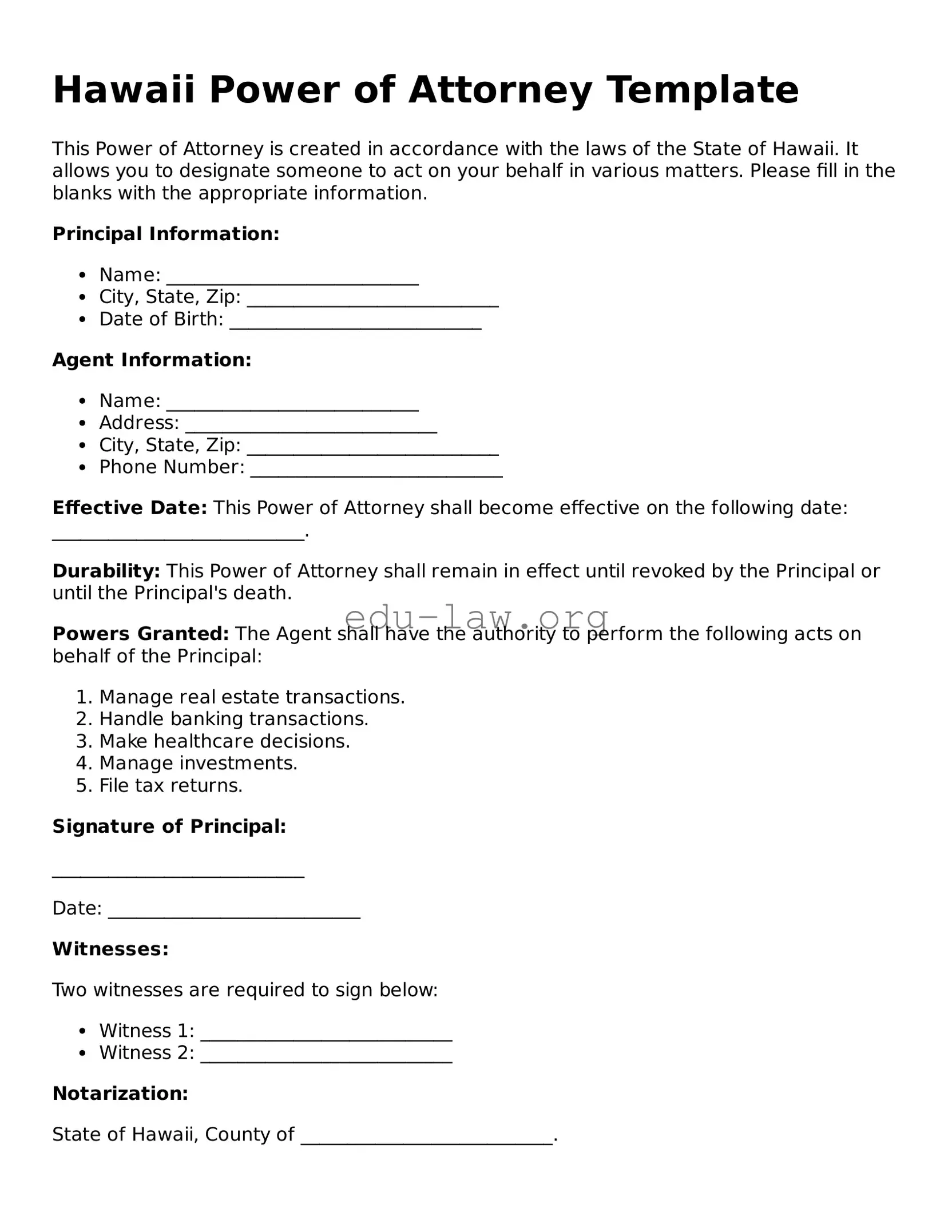
Hawaii Power of Attorney Template
This Power of Attorney is created in accordance with the laws of the State of Hawaii. It allows you to designate someone to act on your behalf in various matters. Please fill in the blanks with the appropriate information.
Principal Information:
Agent Information:
Effective Date: This Power of Attorney shall become effective on the following date: ___________________________.
Durability: This Power of Attorney shall remain in effect until revoked by the Principal or until the Principal's death.
Powers Granted: The Agent shall have the authority to perform the following acts on behalf of the Principal:
Signature of Principal:
___________________________
Date: ___________________________
Witnesses:
Two witnesses are required to sign below:
Notarization:
State of Hawaii, County of ___________________________.
On this ______ day of ____________, 20__, before me, a Notary Public, personally appeared ___________________________, known to me to be the person whose name is subscribed to this Power of Attorney, and acknowledged that he/she executed the same.
___________________________
Notary Public Signature
My Commission Expires: ___________________________
| Fact Name | Description |
|---|---|
| Definition | A Power of Attorney (POA) in Hawaii allows an individual to designate someone else to make decisions on their behalf. |
| Types of POA | Hawaii recognizes several types of POA, including general, limited, and durable powers of attorney. |
| Governing Law | The Hawaii Uniform Power of Attorney Act governs the creation and use of POAs in the state. |
| Durability | A durable power of attorney remains effective even if the principal becomes incapacitated. |
| Execution Requirements | The principal must sign the POA in the presence of a notary public or two witnesses for it to be valid. |
| Revocation | The principal can revoke a power of attorney at any time, as long as they are competent to do so. |
| Filing Not Required | In Hawaii, there is no requirement to file the POA with any government agency, but it should be kept in a safe place. |
After obtaining the Hawaii Power of Attorney form, it is essential to complete it accurately to ensure it serves its intended purpose. Follow these steps carefully to fill out the form correctly.
Completing these steps will help ensure that your Power of Attorney is valid and effective. Be sure to keep a copy for your records.
What is a Power of Attorney in Hawaii?
A Power of Attorney (POA) in Hawaii is a legal document that allows one person, known as the principal, to designate another person, called the agent or attorney-in-fact, to act on their behalf. This can include making decisions related to finances, property, or healthcare, depending on the type of POA created.
What types of Power of Attorney forms are available in Hawaii?
Hawaii recognizes several types of Power of Attorney forms. The most common include the General Power of Attorney, which grants broad powers to the agent; the Limited Power of Attorney, which restricts the agent's authority to specific tasks; and the Durable Power of Attorney, which remains effective even if the principal becomes incapacitated. There is also a Healthcare Power of Attorney that allows the agent to make medical decisions on behalf of the principal.
Do I need to notarize my Power of Attorney in Hawaii?
Yes, in Hawaii, a Power of Attorney must be notarized to be considered valid. This means that the principal must sign the document in the presence of a notary public, who will then affix their seal to the document. This step helps to ensure that the document is authentic and that the principal is acting voluntarily.
Can I revoke a Power of Attorney in Hawaii?
Absolutely. A Power of Attorney can be revoked at any time by the principal, as long as they are mentally competent. To revoke a POA, the principal should create a written revocation document and notify the agent and any relevant third parties, such as banks or healthcare providers, that the Power of Attorney is no longer in effect.
What happens if the principal becomes incapacitated?
If the principal becomes incapacitated, a Durable Power of Attorney allows the agent to continue acting on their behalf. However, if the Power of Attorney is not durable, it will become void upon the principal's incapacitation. It is crucial for the principal to consider their needs when choosing the type of POA.
Can I name more than one agent in my Power of Attorney?
Yes, you can name multiple agents in your Power of Attorney. However, it is essential to specify whether they will act jointly (both must agree on decisions) or separately (each can act independently). Clear instructions will help prevent confusion and ensure that your wishes are followed.
Is a Power of Attorney effective immediately?
A Power of Attorney can be effective immediately upon signing, or it can be set to become effective at a later date or upon a specific event, such as the principal's incapacitation. This is known as a springing Power of Attorney. The principal should clearly outline their preferences in the document.
Can I use a Power of Attorney from another state in Hawaii?
Generally, a Power of Attorney executed in another state may be recognized in Hawaii as long as it complies with the laws of the state where it was created. However, it is advisable to consult with a legal professional to ensure that the document meets Hawaii's requirements and to avoid any potential issues.
Are there any limitations to what an agent can do under a Power of Attorney?
Yes, there are limitations to what an agent can do under a Power of Attorney. The principal can specify certain actions that the agent is not authorized to take. Additionally, agents are generally prohibited from making decisions that would benefit themselves at the expense of the principal, ensuring that the agent acts in the principal's best interests.
How can I find a Power of Attorney form for Hawaii?
Power of Attorney forms for Hawaii can be found through various sources, including legal websites, local government offices, and legal aid organizations. It is essential to use a form that complies with Hawaii law to ensure its validity. Consulting with a legal professional can also provide guidance in selecting the appropriate form for your needs.
Not specifying the powers granted: Many people fail to clearly outline what powers they are granting. This can lead to confusion and disputes later on.
Forgetting to date the document: A common oversight is neglecting to include the date on the Power of Attorney form. Without a date, the validity of the document may be questioned.
Not signing in front of a notary: In Hawaii, the Power of Attorney must be notarized. Skipping this step can render the document invalid.
Overlooking witness signatures: Some individuals forget that, in addition to notarization, certain types of Power of Attorney forms require witnesses to sign. This is crucial for the document's acceptance.
Failing to inform the agent: It’s essential to communicate with the person you are appointing as your agent. Not doing so can lead to misunderstandings about their responsibilities.
Using outdated forms: Laws can change, and using an old version of the Power of Attorney form might not comply with current regulations. Always ensure you have the most recent version.
When preparing a Power of Attorney in Hawaii, you may find it beneficial to have additional documents ready. These forms can help clarify your intentions and ensure that your wishes are followed. Below is a list of common documents that are often used in conjunction with the Power of Attorney form.
Having these documents prepared alongside your Power of Attorney can provide peace of mind. They ensure that your wishes are respected and that your loved ones have clear guidance during challenging times. Always consider consulting with a professional to ensure that these documents meet your specific needs and comply with local laws.
The Hawaii Power of Attorney form shares similarities with the General Power of Attorney. Both documents grant an individual, known as the agent or attorney-in-fact, the authority to act on behalf of another person, referred to as the principal. This authority can cover a wide range of decisions, including financial and legal matters. The general power of attorney is often broad in scope, allowing the agent to manage the principal’s affairs comprehensively, much like the Hawaii version. The key difference often lies in the specific provisions and limitations that the principal may choose to include in each document.
Another document that resembles the Hawaii Power of Attorney is the Durable Power of Attorney. While both forms empower an agent to make decisions for the principal, the durable version remains effective even if the principal becomes incapacitated. This is a crucial distinction, especially for individuals concerned about their future health. In Hawaii, a durable power of attorney ensures that the designated agent can continue to act on behalf of the principal during times when they may be unable to do so themselves.
The Medical Power of Attorney is yet another document akin to the Hawaii Power of Attorney. This particular form specifically focuses on healthcare decisions. It allows the agent to make medical choices on behalf of the principal if they are unable to communicate their wishes. While the Hawaii Power of Attorney can include healthcare provisions, a medical power of attorney is exclusively dedicated to health-related matters, ensuring that the agent can make informed decisions about treatment and care.
A Living Will is similar to the Hawaii Power of Attorney in that both address the principal's wishes regarding medical care. However, a living will explicitly outlines the types of medical treatment an individual wishes to receive or refuse in the event of terminal illness or incapacitation. While the Hawaii Power of Attorney appoints an agent to make decisions, the living will provides direct instructions to healthcare providers. This document can work in tandem with a medical power of attorney to clarify the principal's desires.
The Financial Power of Attorney is closely related to the Hawaii Power of Attorney, particularly in its focus on financial matters. This document allows the agent to manage the principal’s financial affairs, such as handling bank accounts, paying bills, and managing investments. While the Hawaii Power of Attorney can cover financial decisions, a financial power of attorney is often more detailed and tailored specifically to financial transactions, making it a vital tool for those who want to ensure their financial interests are protected.
The Revocable Trust can also be compared to the Hawaii Power of Attorney. Both documents allow for the management of assets, but they do so in different ways. A revocable trust enables the principal to place their assets into a trust, which can be managed by a trustee, often the principal themselves, during their lifetime. Upon incapacitation or death, the trust assets can be distributed according to the principal’s wishes. In contrast, a power of attorney grants authority to an agent to manage assets directly, without the need for a trust structure.
The Advance Directive shares similarities with the Hawaii Power of Attorney, particularly in the realm of healthcare decisions. An advance directive encompasses both a living will and a medical power of attorney, providing a comprehensive approach to end-of-life care. Like the Hawaii Power of Attorney, it ensures that the principal's healthcare preferences are respected. However, the advance directive is more focused on outlining specific wishes regarding medical treatment, while the power of attorney designates an individual to make those decisions.
The Guardianship document is another legal instrument that can be compared to the Hawaii Power of Attorney. While a power of attorney allows a principal to appoint someone to act on their behalf voluntarily, guardianship is often established through a court process when an individual is deemed unable to manage their own affairs. Guardianship grants the guardian the authority to make decisions for the ward, which can include financial, medical, and personal matters. The key difference lies in the voluntary nature of a power of attorney versus the court-appointed nature of guardianship.
The Business Power of Attorney is similar to the Hawaii Power of Attorney, especially for individuals who own businesses. This document allows an agent to act on behalf of the principal in business-related matters, such as signing contracts, managing company finances, and making operational decisions. While the Hawaii Power of Attorney can encompass various aspects of personal and financial decisions, the business power of attorney specifically targets the realm of business management, ensuring that the principal’s interests in their business are effectively handled.
Lastly, the Special Power of Attorney is akin to the Hawaii Power of Attorney in that it grants authority to an agent, but it does so in a limited capacity. This document specifies particular tasks or decisions that the agent is authorized to handle, rather than providing broad authority. For instance, a special power of attorney might only allow the agent to sell a specific piece of property or manage a particular financial transaction. This contrasts with the more general provisions typically found in the Hawaii Power of Attorney, which can cover a wider range of powers.
When filling out the Hawaii Power of Attorney form, it is crucial to ensure accuracy and compliance with legal requirements. Here are some guidelines to follow:
When it comes to legal documents like the Hawaii Power of Attorney (POA) form, misconceptions can lead to confusion and potentially serious consequences. Here are four common misunderstandings about this important document.
This is not true. While many people associate a Power of Attorney with financial decisions, it can also cover healthcare decisions, property management, and more. A POA can be tailored to meet specific needs, allowing the appointed agent to act in various capacities.
While a standard POA does become invalid upon the principal's death, there are other types, such as a durable Power of Attorney, that can remain effective even if the principal becomes incapacitated. This ensures that decisions can still be made on their behalf.
Although it may seem simple, choosing an agent requires careful consideration. The agent should be someone trustworthy and capable of making decisions in the principal's best interest. In Hawaii, certain restrictions may apply, such as age and mental competency.
This is a common misunderstanding. A principal has the right to revoke a Power of Attorney at any time, as long as they are mentally competent. This can be done by creating a new POA or by providing a written notice of revocation to the agent.
Understanding these misconceptions can help individuals make informed decisions about their legal rights and responsibilities. It is always advisable to consult with a legal professional for personalized guidance.
When filling out and using the Hawaii Power of Attorney form, consider the following key takeaways: