When it comes to ensuring the well-being of a child in Hawaii, the Power of Attorney for a Child form serves as a vital tool for parents and guardians. This legal document allows a parent or legal guardian to grant another individual the authority to make decisions on behalf of their child, particularly in situations where the parent may be temporarily unavailable or unable to care for the child. The form typically outlines specific powers, such as the ability to make medical decisions, enroll the child in school, and manage day-to-day activities. It is important to note that the powers granted can be tailored to meet the unique needs of the child and the circumstances of the family. Additionally, the form requires signatures from both the parent and the designated agent, ensuring that the arrangement is consensual and legally binding. Understanding the intricacies of this form can provide peace of mind for parents, knowing that their child will be cared for in their absence by someone they trust.
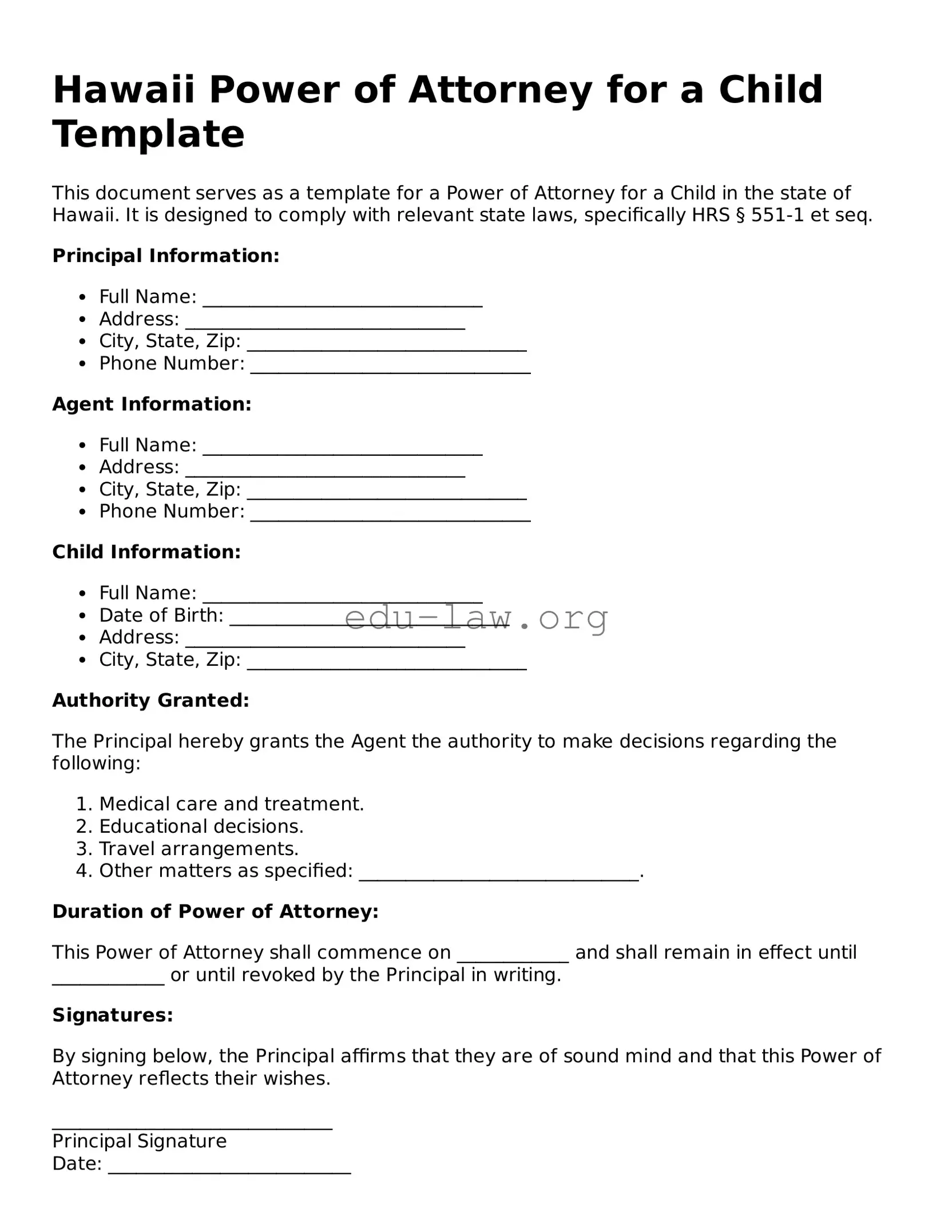
Hawaii Power of Attorney for a Child Template
This document serves as a template for a Power of Attorney for a Child in the state of Hawaii. It is designed to comply with relevant state laws, specifically HRS § 551-1 et seq.
Principal Information:
Agent Information:
Child Information:
Authority Granted:
The Principal hereby grants the Agent the authority to make decisions regarding the following:
Duration of Power of Attorney:
This Power of Attorney shall commence on ____________ and shall remain in effect until ____________ or until revoked by the Principal in writing.
Signatures:
By signing below, the Principal affirms that they are of sound mind and that this Power of Attorney reflects their wishes.
______________________________
Principal Signature
Date: __________________________
______________________________
Agent Signature
Date: __________________________
Witness Information:
This document should be signed in the presence of a notary public to ensure its validity.
| Fact Name | Description |
|---|---|
| Purpose | The Hawaii Power of Attorney for a Child form allows a parent or legal guardian to designate another adult to make decisions on behalf of their child. |
| Governing Law | This form is governed by Hawaii Revised Statutes § 551E-1 through § 551E-5. |
| Duration | The authority granted through this form can be limited to a specific period or can remain in effect until revoked. |
| Eligibility | Any adult can be designated as an agent, provided they are willing to act in the best interest of the child. |
| Revocation | A parent or guardian can revoke the Power of Attorney at any time, as long as they provide notice to the agent. |
| Limitations | The form does not grant the agent the authority to make decisions regarding the child’s education or medical care unless specified. |
| Notarization | The form must be signed in the presence of a notary public to be legally binding. |
| Usage | This Power of Attorney is often used for travel, temporary guardianship, or when a parent is unavailable. |
Filling out the Hawaii Power of Attorney for a Child form is a straightforward process. This document allows a parent or legal guardian to designate another person to make decisions on behalf of a child. After completing the form, ensure that it is signed and dated appropriately to make it valid.
What is a Power of Attorney for a Child in Hawaii?
A Power of Attorney for a Child in Hawaii is a legal document that allows a parent or legal guardian to designate another individual to make decisions on behalf of their child. This can include matters related to health care, education, and general welfare. It is particularly useful when parents are unavailable, such as during travel or other commitments.
Who can serve as an agent under this Power of Attorney?
The agent can be any responsible adult, such as a relative, family friend, or neighbor. It is essential to choose someone trustworthy and capable of making decisions in the best interest of the child. The agent must be at least 18 years old and should be willing to take on this responsibility.
How long is the Power of Attorney for a Child valid?
The Power of Attorney for a Child remains valid until the specified expiration date mentioned in the document, or until the parent or guardian revokes it. If no expiration date is provided, it typically lasts until the child reaches the age of majority, which is 18 years old in Hawaii.
Do I need to have the Power of Attorney notarized?
Yes, the Power of Attorney for a Child must be notarized to be legally binding in Hawaii. This step ensures that the document is valid and that the signatures are authentic. Notarization provides an additional layer of protection for both the child and the agent.
Can I revoke the Power of Attorney for a Child once it is established?
Yes, a parent or legal guardian can revoke the Power of Attorney at any time. To do this, a written notice of revocation should be provided to the agent and any relevant parties. This ensures that everyone is aware of the change and that the agent no longer has authority over the child's decisions.
What if the child requires medical care while the Power of Attorney is in effect?
If the child requires medical care while the Power of Attorney is active, the agent has the authority to make health care decisions on behalf of the child. However, it is crucial that the agent is informed about the child's medical history and any preferences the parents may have regarding treatment options.
Not Understanding the Purpose: Many people fill out the Power of Attorney for a Child form without fully grasping its significance. This document allows someone to make decisions on behalf of a child, which is a serious responsibility. It’s crucial to understand when and why this form is needed.
Choosing the Wrong Agent: Selecting the right person to act as the agent is vital. Some individuals choose a friend or relative without considering their ability to handle the responsibilities. It’s important to choose someone trustworthy and capable.
Leaving Out Important Details: Omitting essential information can lead to confusion. Ensure that all sections of the form are filled out completely, including the child’s full name, date of birth, and the agent’s contact information.
Not Specifying the Duration: Failing to indicate how long the Power of Attorney will be in effect can create issues. Be clear about whether it’s temporary or permanent, and specify any relevant dates.
Ignoring Witness and Notary Requirements: Some people overlook the need for witnesses or notarization. In Hawaii, certain signatures may need to be notarized to ensure the document is legally binding. Always check the requirements before submitting.
Failing to Keep Copies: After completing the form, it’s easy to forget about copies. Always make several copies of the signed document. Keep one for your records and provide others to the agent and any relevant parties.
When preparing a Power of Attorney for a Child in Hawaii, several additional forms and documents may be necessary to ensure that all legal requirements are met and that the child's best interests are prioritized. Below is a list of commonly used documents that often accompany this form.
These documents work together to provide a comprehensive legal framework for the care and protection of a child when parents are unable to fulfill their roles. Ensuring that all necessary forms are completed and properly executed can help prevent misunderstandings and facilitate smooth transitions in caregiving arrangements.
The Hawaii Power of Attorney for a Child form is similar to a General Power of Attorney. Both documents allow an individual to designate someone else to act on their behalf. In the case of a General Power of Attorney, the authority granted can cover a wide range of matters, including financial and legal decisions. However, the Power of Attorney for a Child specifically focuses on decisions related to the care and welfare of a minor, making it more specialized for parental rights and responsibilities.
Another document that resembles the Power of Attorney for a Child is the Medical Power of Attorney. This form allows an individual to appoint someone to make medical decisions on their behalf if they become unable to do so. While the Power of Attorney for a Child can include medical decisions, the Medical Power of Attorney is more focused on health care matters, ensuring that a designated person can make critical medical choices for the child in emergencies.
A Guardianship Agreement is also similar, as it involves the care of a minor. This legal document establishes a guardian for a child, giving that person the authority to make decisions about the child’s upbringing. Unlike a Power of Attorney, which can be temporary and easily revoked, a Guardianship Agreement often requires court approval and may be more permanent in nature.
The Child Custody Agreement shares similarities as well. This document outlines the arrangements for a child’s living situation, including where the child will reside and how decisions will be made regarding their upbringing. While the Power of Attorney for a Child allows for temporary delegation of authority, a Child Custody Agreement is usually established during divorce or separation proceedings and is intended to be more long-term.
The Temporary Guardianship Form is another related document. This form allows parents to appoint someone to care for their child for a limited time, often when they are unable to do so themselves. Like the Power of Attorney for a Child, it provides a way for parents to ensure their child is cared for by a trusted individual, but it is typically used for shorter durations.
A Child Travel Consent Form is also relevant. This document grants permission for a child to travel with someone other than their parents. It is similar to the Power of Attorney for a Child in that it allows for the delegation of authority regarding the child’s whereabouts, but it is specifically focused on travel permissions rather than broader parental rights.
The Adoption Consent Form shares some similarities as well. This document is used when a parent agrees to the adoption of their child by another individual or couple. While the Power of Attorney for a Child allows for temporary delegation of authority, the Adoption Consent Form permanently transfers parental rights, making it a more significant legal step.
The Child Support Agreement is another related document. This agreement outlines the financial responsibilities of parents towards their child. While it does not grant authority over a child's care, it is often part of the broader context of child welfare, similar to the considerations made in a Power of Attorney for a Child.
Lastly, the Special Needs Trust can be compared to the Power of Attorney for a Child. This trust is designed to manage assets for a child with special needs, ensuring they receive the care they require without jeopardizing government benefits. While the Power of Attorney for a Child allows for day-to-day decision-making, a Special Needs Trust focuses on long-term financial planning and support for the child’s unique requirements.
When filling out the Hawaii Power of Attorney for a Child form, it's important to follow specific guidelines to ensure everything is completed correctly. Here are some essential dos and don'ts:
Understanding the Power of Attorney for a Child in Hawaii is crucial for parents and guardians. However, several misconceptions can lead to confusion. Here are six common misunderstandings:
Many believe that this form is only necessary during emergencies. In reality, it can be useful for any situation where a parent or guardian needs someone else to make decisions for their child.
Some think that notarization is mandatory for the Power of Attorney to be valid. While notarization can add an extra layer of authenticity, it is not strictly required in Hawaii.
There is a misconception that once this document is signed, it remains in effect forever. In fact, it has a specific duration and can be revoked at any time by the parent or guardian.
Many assume that the Power of Attorney for a Child is limited to medical decisions. However, it can also cover educational and financial decisions, depending on how it is drafted.
Some people think that only one individual can be designated as an agent. In truth, multiple agents can be appointed, and they can act jointly or separately, as specified in the document.
There is a common belief that this Power of Attorney is equivalent to legal guardianship. However, guardianship involves a court process and grants more extensive rights than a Power of Attorney, which is a more limited arrangement.
Clarifying these misconceptions can help ensure that parents and guardians make informed decisions regarding their child's care and representation.
When filling out and using the Hawaii Power of Attorney for a Child form, it is essential to understand several key aspects. This document allows a parent or legal guardian to designate another individual to make decisions on behalf of their child. Here are some important takeaways:
By following these guidelines, you can ensure that the Power of Attorney for a Child form is filled out correctly and used effectively when needed.