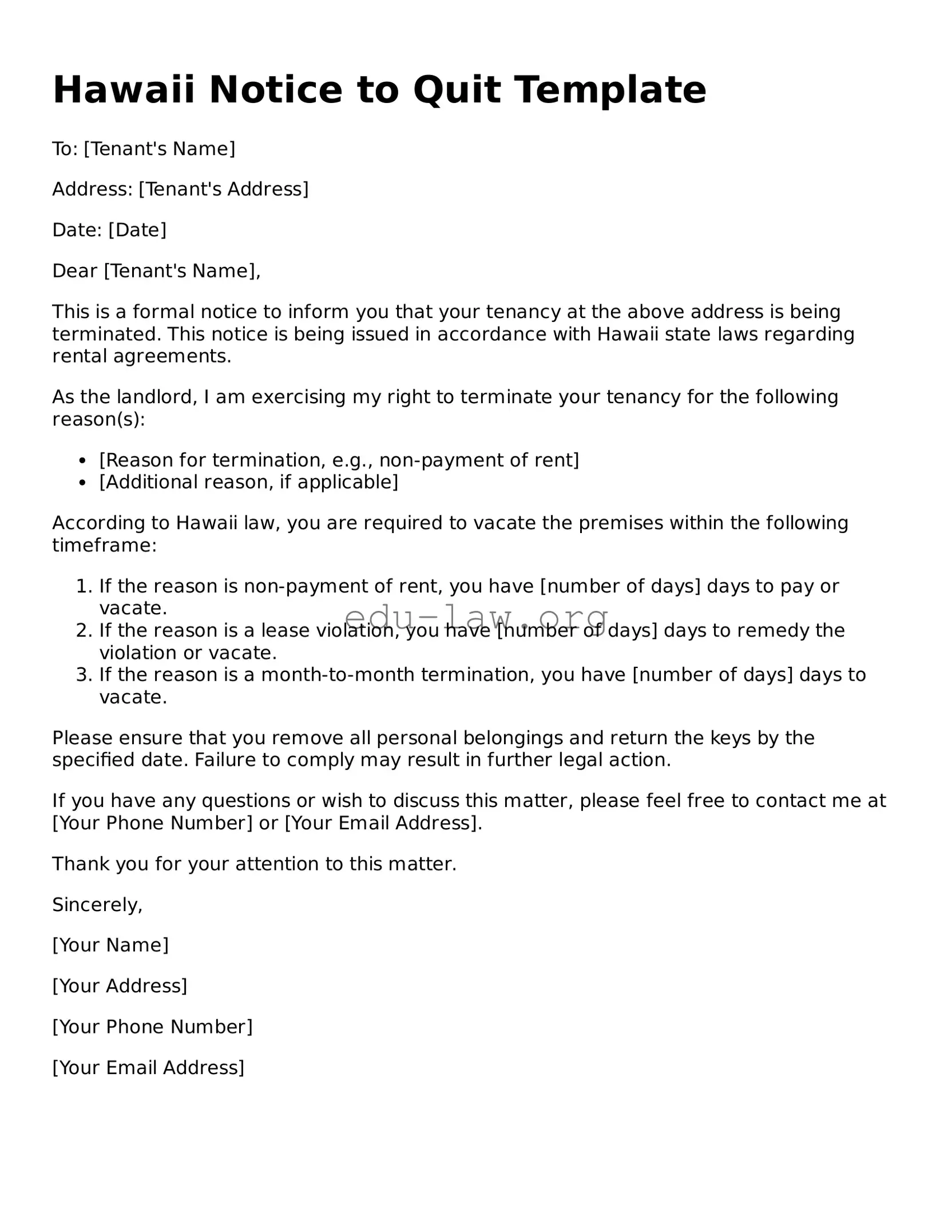
The Hawaii Notice to Quit form is a crucial document in the landlord-tenant relationship, particularly when a landlord seeks to terminate a rental agreement. This form serves as a formal notification to tenants, indicating that they must vacate the rental property within a specified timeframe. Typically, the notice outlines the reasons for eviction, which may include non-payment of rent, lease violations, or other breaches of the rental agreement. It is essential for landlords to adhere to state laws regarding notice periods, as they can vary depending on the circumstances. For instance, a tenant may be given a shorter notice period for non-payment of rent compared to other lease violations. Understanding the requirements of this form not only helps landlords protect their rights but also ensures that tenants are aware of their obligations. Properly executing a Notice to Quit is a vital step in the eviction process, and failure to do so can lead to complications in court proceedings. Familiarity with this form is beneficial for both parties involved, as it lays the groundwork for a fair and legal resolution to disputes.
Hawaii Notice to Quit Template
To: [Tenant's Name]
Address: [Tenant's Address]
Date: [Date]
Dear [Tenant's Name],
This is a formal notice to inform you that your tenancy at the above address is being terminated. This notice is being issued in accordance with Hawaii state laws regarding rental agreements.
As the landlord, I am exercising my right to terminate your tenancy for the following reason(s):
According to Hawaii law, you are required to vacate the premises within the following timeframe:
Please ensure that you remove all personal belongings and return the keys by the specified date. Failure to comply may result in further legal action.
If you have any questions or wish to discuss this matter, please feel free to contact me at [Your Phone Number] or [Your Email Address].
Thank you for your attention to this matter.
Sincerely,
[Your Name]
[Your Address]
[Your Phone Number]
[Your Email Address]
| Fact Name | Description |
|---|---|
| Purpose | The Hawaii Notice to Quit form is used by landlords to inform tenants of the intent to terminate a rental agreement. |
| Governing Law | This form is governed by Hawaii Revised Statutes, Chapter 521 (Residential Landlord-Tenant Code). |
| Delivery Methods | The notice can be delivered in person, by mail, or through electronic means, depending on the lease agreement. |
| Notice Period | Typically, a 5-day notice is required for non-payment of rent, while a 10-day notice applies for other lease violations. |
| Tenant Rights | Tenants have the right to respond to the notice and may contest the eviction in court. |
| Form Availability | The form can be found online or obtained from local housing offices and legal aid organizations. |
| Signature Requirement | The landlord must sign the notice to make it valid. |
| Contents of the Form | The form should include the date, tenant's name, address, and specific reasons for termination. |
| Legal Consequences | Failure to comply with the notice can lead to legal eviction proceedings. |
Once you have the Hawaii Notice to Quit form ready, you'll need to fill it out accurately to ensure that all necessary information is provided. This form is an important step in the process of terminating a rental agreement. Below are the steps to complete the form effectively.
After filling out the form, it is essential to serve it to the tenant properly, following the legal requirements in Hawaii. This ensures that the tenant is officially notified and understands the need to vacate the property.
What is a Hawaii Notice to Quit form?
The Hawaii Notice to Quit form is a legal document used by landlords to notify tenants that they must vacate the rental property. This notice is typically given when a tenant has violated the terms of their lease agreement or has not paid rent. The form outlines the reasons for the eviction and provides a deadline for the tenant to leave the premises.
When should a landlord use the Notice to Quit?
A landlord should use the Notice to Quit when a tenant fails to comply with the lease terms. Common reasons include non-payment of rent, lease violations, or when the lease is set to expire. It's important for landlords to follow the proper legal procedures to ensure that the eviction process is valid.
How much notice must be given to the tenant?
The amount of notice required can vary based on the reason for eviction. For non-payment of rent, a landlord typically must provide a 15-day notice. For lease violations, the notice period may be shorter, often around 5 days. Always check local laws for specific requirements.
What happens if the tenant does not leave by the deadline?
If the tenant does not vacate the property by the deadline stated in the Notice to Quit, the landlord may proceed with legal action to evict the tenant. This usually involves filing an eviction lawsuit in the local court. The court will then schedule a hearing to determine whether the eviction is justified.
Can a tenant contest a Notice to Quit?
Yes, a tenant can contest a Notice to Quit. If they believe the notice is unjust or that they have not violated any lease terms, they can respond to the notice and may choose to fight the eviction in court. It's advisable for tenants to seek legal advice if they find themselves in this situation.
Is the Notice to Quit form available online?
Yes, the Hawaii Notice to Quit form can often be found online through various legal aid websites or state government resources. It's crucial to ensure that the form is up-to-date and complies with current laws. Using the correct version helps prevent potential legal issues down the line.
Failing to provide accurate tenant information. It is crucial to include the full names of all tenants involved in the lease agreement. Omitting or misspelling names can lead to confusion and delays.
Not specifying the reason for the notice. The form requires a clear explanation of why the notice is being issued. Whether it’s for non-payment of rent or lease violations, clarity is essential.
Missing the date of the notice. The date is important as it establishes the timeline for the tenant’s response. Without it, the notice may be considered invalid.
Providing insufficient details about the rental property. It is important to include the full address of the property in question. This helps ensure that there is no ambiguity regarding which property the notice pertains to.
Not including the correct notice period. Different situations require different notice periods. Familiarity with these requirements is essential to avoid legal complications.
Using vague language. Specificity is key in legal documents. Avoid phrases that could be interpreted in multiple ways; instead, use clear and direct language.
Neglecting to sign the notice. A signature is necessary to validate the document. Without it, the notice may not be taken seriously by the tenant.
Not retaining a copy of the notice. Keeping a copy for your records is important. This serves as proof that the notice was issued and can be useful in future proceedings if necessary.
When dealing with rental agreements and potential evictions in Hawaii, the Notice to Quit form is just one of several important documents. Understanding these related forms can help ensure that both landlords and tenants navigate the process smoothly and in compliance with the law.
Each of these documents plays a crucial role in the rental and eviction process in Hawaii. Familiarity with them can help all parties involved understand their rights and responsibilities, leading to a more informed and effective resolution of disputes.
The Hawaii Notice to Quit form shares similarities with the Eviction Notice, which is a document used to inform a tenant that they must vacate the rental property. Like the Notice to Quit, an Eviction Notice outlines the reasons for termination of the tenancy and specifies a deadline by which the tenant must leave. Both documents serve as formal communication from the landlord to the tenant, emphasizing the need for compliance with lease terms. While the Eviction Notice may follow a specific timeline and legal process, its core purpose remains the same: to prompt the tenant to vacate the premises.
Another document that resembles the Hawaii Notice to Quit is the Lease Termination Letter. This letter is often used by landlords or tenants to officially end a rental agreement. Similar to the Notice to Quit, the Lease Termination Letter provides notice regarding the end of tenancy and may include reasons for termination. However, it is typically used in situations where both parties mutually agree to terminate the lease, whereas the Notice to Quit may indicate a more contentious situation. Both documents are essential for ensuring that all parties are aware of their rights and responsibilities regarding the rental agreement.
The Three-Day Notice to Pay Rent or Quit is another document that aligns closely with the Hawaii Notice to Quit. This notice is issued when a tenant fails to pay rent on time, giving them a short window to either pay the overdue rent or vacate the property. Like the Notice to Quit, it serves as a formal warning and outlines the consequences of not complying. Both documents highlight the importance of adhering to the terms of the lease, although the Three-Day Notice is specifically focused on rent payment issues, while the Notice to Quit can address a broader range of lease violations.
Finally, the Notice of Default is similar to the Hawaii Notice to Quit in that it alerts a tenant to a breach of the lease agreement. This document is typically used in situations involving mortgage defaults but can also apply to rental agreements. The Notice of Default informs the tenant of the specific issues that need to be resolved to avoid further action. Both the Notice of Default and the Notice to Quit serve as critical notifications that prompt the tenant to take action, whether it be remedying a situation or preparing to leave the property.
When filling out the Hawaii Notice to Quit form, it is important to follow certain guidelines to ensure the process goes smoothly. Here are five things to do and five things to avoid:
Things You Should Do:
Things You Shouldn't Do:
When it comes to the Hawaii Notice to Quit form, several misconceptions can lead to confusion among landlords and tenants alike. Understanding the realities behind these misunderstandings is crucial for navigating the rental landscape effectively. Here are six common misconceptions:
Clearing up these misconceptions can help both landlords and tenants approach the rental process with greater clarity and confidence.
When dealing with the Hawaii Notice to Quit form, it is essential to understand its purpose and the proper procedures involved. Below are key takeaways to consider: