The Hawaii Notary Acknowledgment form serves a crucial role in the legal landscape of the state, ensuring that documents are properly executed and authenticated. This form is used when a person, known as the signer, needs to confirm their identity and the voluntary nature of their signature before a notary public. It typically includes essential elements such as the name of the signer, the date of the acknowledgment, and the notary's official seal. Additionally, the form provides space for the notary to record their signature and commission details. By requiring this acknowledgment, Hawaii law helps to prevent fraud and ensures that documents are recognized as valid and enforceable. Understanding the nuances of this form is vital for anyone involved in legal transactions, as it can impact the validity of contracts, property deeds, and various other legal documents.
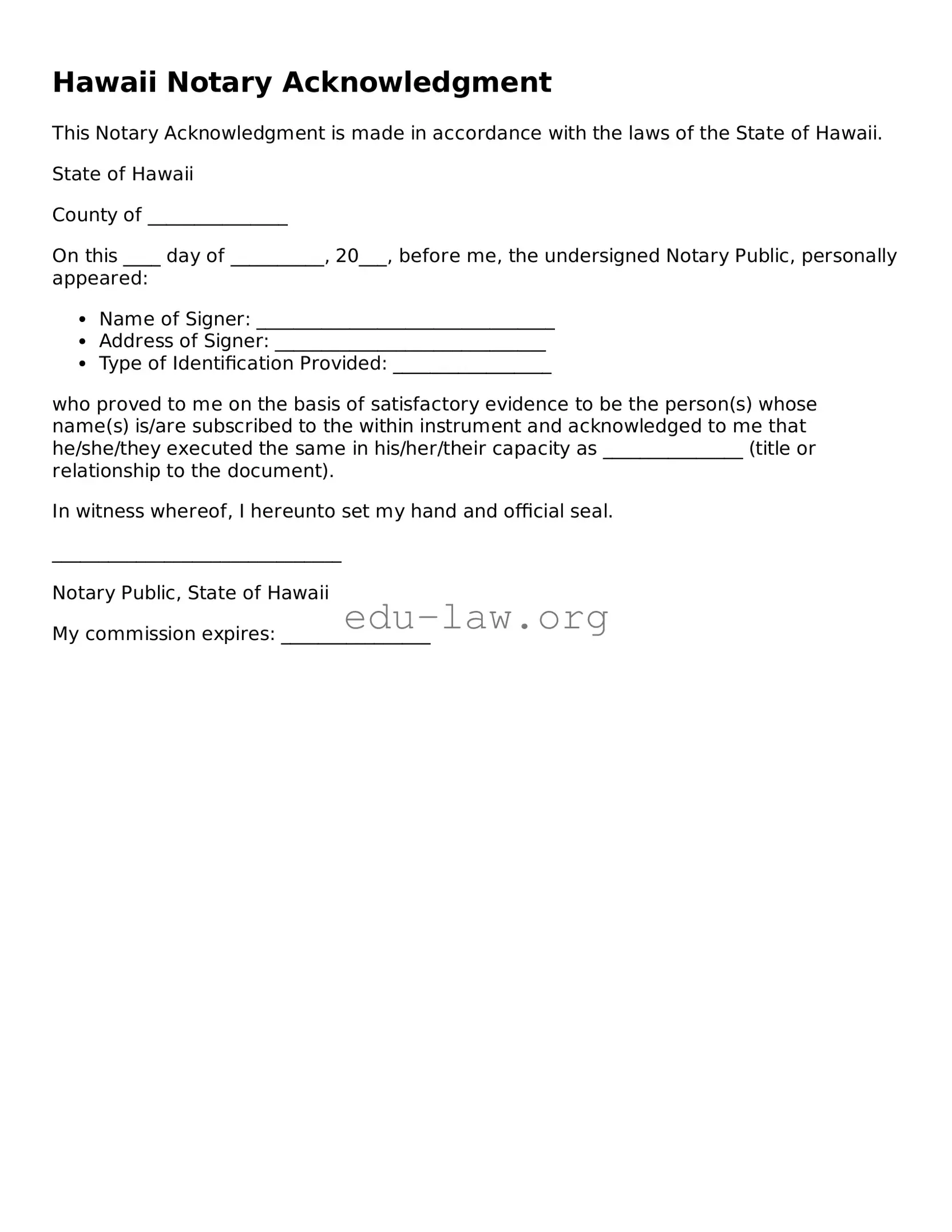
Hawaii Notary Acknowledgment
This Notary Acknowledgment is made in accordance with the laws of the State of Hawaii.
State of Hawaii
County of _______________
On this ____ day of __________, 20___, before me, the undersigned Notary Public, personally appeared:
who proved to me on the basis of satisfactory evidence to be the person(s) whose name(s) is/are subscribed to the within instrument and acknowledged to me that he/she/they executed the same in his/her/their capacity as _______________ (title or relationship to the document).
In witness whereof, I hereunto set my hand and official seal.
_______________________________
Notary Public, State of Hawaii
My commission expires: ________________
| Fact Name | Description |
|---|---|
| Definition | The Hawaii Notary Acknowledgment form is a document used to verify the identity of a signer and their willingness to sign a document. |
| Governing Law | The use of the Notary Acknowledgment form in Hawaii is governed by Hawaii Revised Statutes (HRS) § 456-1 et seq. |
| Purpose | This form serves to provide legal assurance that the signer is who they claim to be and that they are signing voluntarily. |
| Signature Requirement | The signer must physically appear before the notary public to complete the acknowledgment process. |
| Notary's Role | The notary public must witness the signing and then complete the acknowledgment by filling out the form. |
| Format | The form typically includes spaces for the notary's signature, seal, and details about the document being acknowledged. |
| Validity | Once completed, the acknowledgment is valid and can be used in various legal contexts, such as real estate transactions. |
| Expiration | The acknowledgment does not expire but must be executed in accordance with current laws to be valid. |
After completing the Hawaii Notary Acknowledgment form, the next step involves submitting it to the appropriate parties or offices as required. Ensure that all sections are filled out accurately to avoid delays.
What is a Hawaii Notary Acknowledgement form?
The Hawaii Notary Acknowledgement form is a legal document used to verify the identity of a signer. It confirms that the signer appeared before a notary public and acknowledged that they signed the document voluntarily. This form is often required for various legal documents, including deeds, contracts, and powers of attorney.
Who can act as a notary public in Hawaii?
In Hawaii, a notary public must be a resident of the state, at least 18 years old, and have no felony convictions. They must also complete the necessary training and obtain a notary commission from the state. Once commissioned, a notary can perform notarial acts, including acknowledgments, oaths, and affirmations.
How do I complete a Notary Acknowledgement form?
To complete a Notary Acknowledgement form, the signer must appear in person before the notary. The notary will verify the signer's identity, typically by checking a government-issued ID. After confirming the identity, the notary will complete the form by filling in the details, including the date, the signer's name, and the notary's information. The signer must then sign the document in the presence of the notary.
Is a Notary Acknowledgement form required for all documents?
No, a Notary Acknowledgement form is not required for all documents. However, many legal documents, especially those that will be filed with a court or government agency, may require notarization. It is essential to check the specific requirements for your document to determine if a notary acknowledgment is necessary.
What should I do if my document is rejected due to a notary issue?
If your document is rejected because of a notary issue, review the reasons for the rejection. Common issues include missing signatures, incorrect information, or failure to follow proper procedures. You may need to obtain a new acknowledgment from a notary public to correct the issue. Ensure that all required fields are completed accurately and that the notary's seal is affixed properly.
Can a notary public charge a fee for their services in Hawaii?
Yes, notaries in Hawaii are allowed to charge a fee for their services. The maximum fee for a notarial act is set by state law. It is advisable to inquire about the fee beforehand to avoid any surprises. Many notaries also accept payment in the form of cash or checks.
How long is a Notary Acknowledgement form valid in Hawaii?
A Notary Acknowledgement form does not have an expiration date once it is completed and signed. However, the underlying document's validity may depend on its specific terms or the laws governing that type of document. Always check the relevant laws to ensure compliance.
Where can I find a notary public in Hawaii?
Notaries can be found in various locations throughout Hawaii, including banks, law offices, and shipping centers. Additionally, many notaries offer mobile services and can travel to your location. You can also search online directories or contact local government offices for a list of notaries in your area.
Incomplete Information: One of the most common mistakes is leaving out essential details. Ensure that all required fields are filled in, including the name of the signer, the date, and the notary's information.
Incorrect Signer Identification: It’s crucial to confirm that the person signing the document is correctly identified. Using a different name or failing to match the signature with the identification can lead to issues.
Not Using the Correct Form: Different documents may require specific types of acknowledgments. Using the wrong form can invalidate the notarization. Always check that you are using the Hawaii Notary Acknowledgement form for the intended purpose.
Failing to Sign in the Presence of the Notary: The signer must physically sign the document in front of the notary. If this step is skipped, the acknowledgment is not valid.
Not Including the Notary Seal: A notary’s seal is a critical component of the acknowledgment. Omitting it can render the document ineffective. Ensure that the seal is clear and legible.
In addition to the Hawaii Notary Acknowledgement form, several other documents often accompany it in various legal and administrative processes. Each of these documents serves a specific purpose and may be required depending on the context in which the notary acknowledgment is being used.
These documents, when used in conjunction with the Hawaii Notary Acknowledgement form, help to ensure that legal transactions are conducted smoothly and securely. Understanding their purposes can aid individuals in navigating legal processes more effectively.
The Hawaii Notary Acknowledgment form shares similarities with the Affidavit. Both documents serve as formal declarations made under oath. An affidavit is a written statement confirmed by the oath of the party making it, often used in legal proceedings. Like the notary acknowledgment, it requires a signature and the presence of a notary public to validate the identity of the signer and ensure the authenticity of the document. This process helps to establish trust and credibility in the information provided.
Another document akin to the Hawaii Notary Acknowledgment is the Power of Attorney (POA). A POA allows an individual to designate another person to act on their behalf in legal or financial matters. Similar to the notary acknowledgment, the signing of a POA typically requires notarization to confirm the identity of the principal and ensure that the document is executed voluntarily. This notary presence helps prevent fraud and protects the interests of all parties involved.
The Statutory Declaration is another document that resembles the Hawaii Notary Acknowledgment. This declaration is a legal document made to affirm something to be true, similar to an affidavit. While both require notarization, a statutory declaration is often used for purposes outside of court, such as confirming identity or residency. The notary's role in both documents is to verify the identity of the signer and to witness the signing process, adding a layer of authenticity.
Next, consider the Deed. A deed is a legal document that transfers ownership of property from one party to another. Like the Hawaii Notary Acknowledgment, a deed must be signed in front of a notary public to be legally binding. The notary verifies the identity of the signers and ensures that they are signing willingly, which helps to prevent disputes over property ownership in the future.
The Bill of Sale is also similar to the Hawaii Notary Acknowledgment. This document serves as proof of the transfer of ownership of personal property. While not all bills of sale require notarization, having a notary public witness the signing adds an extra layer of protection. The notary's acknowledgment of the identities of the parties involved helps to validate the transaction and can be crucial if disputes arise later.
Another related document is the Certification of Trust. This document outlines the existence of a trust and the powers of the trustee. Notarization is often required to ensure that the certification is executed properly and that the identities of the parties are verified. This process is similar to the notary acknowledgment, as both aim to provide assurance of authenticity and to protect the interests of all parties involved.
Lastly, the Consent Form can be compared to the Hawaii Notary Acknowledgment. Consent forms are often used in medical and legal contexts to obtain permission for specific actions or decisions. Notarization of a consent form can add credibility, confirming that the individual granting consent is doing so voluntarily and understands the implications. This parallels the notary acknowledgment, which ensures that the signer is informed and acting of their own free will.
When filling out the Hawaii Notary Acknowledgement form, it is important to follow specific guidelines to ensure accuracy and compliance. Here are four things you should and shouldn't do:
Many people have misunderstandings about the Hawaii Notary Acknowledgement form. Here are seven common misconceptions, along with clarifications to help you understand this important document.
This is not true. Notaries can only acknowledge signatures and administer oaths. They do not certify documents or verify the content of what is being signed.
While both involve a notary, an acknowledgment specifically confirms that a person signed a document willingly. Notarization can include additional services, such as witnessing signatures.
This is incorrect. Not all documents need to be acknowledged. It typically depends on the type of document and its intended use.
Notaries must have a valid reason to refuse. This may include concerns about the signer’s identity or mental capacity.
This is a misconception. An acknowledgment does not guarantee the validity of the document or its contents. Legal challenges can still occur.
In fact, Hawaii has set limits on what notaries can charge for their services. It's important to check the current fee schedule.
This is false. While common in real estate, acknowledgments can be required for various legal documents, including contracts and powers of attorney.
Understanding these misconceptions can help you navigate the process of using a Notary Acknowledgement in Hawaii more effectively. If you have further questions, seeking professional advice can provide clarity.
When filling out and using the Hawaii Notary Acknowledgement form, there are several important points to consider. Understanding these can help ensure that the process is smooth and legally sound.
By keeping these takeaways in mind, individuals can navigate the notary process in Hawaii more effectively.