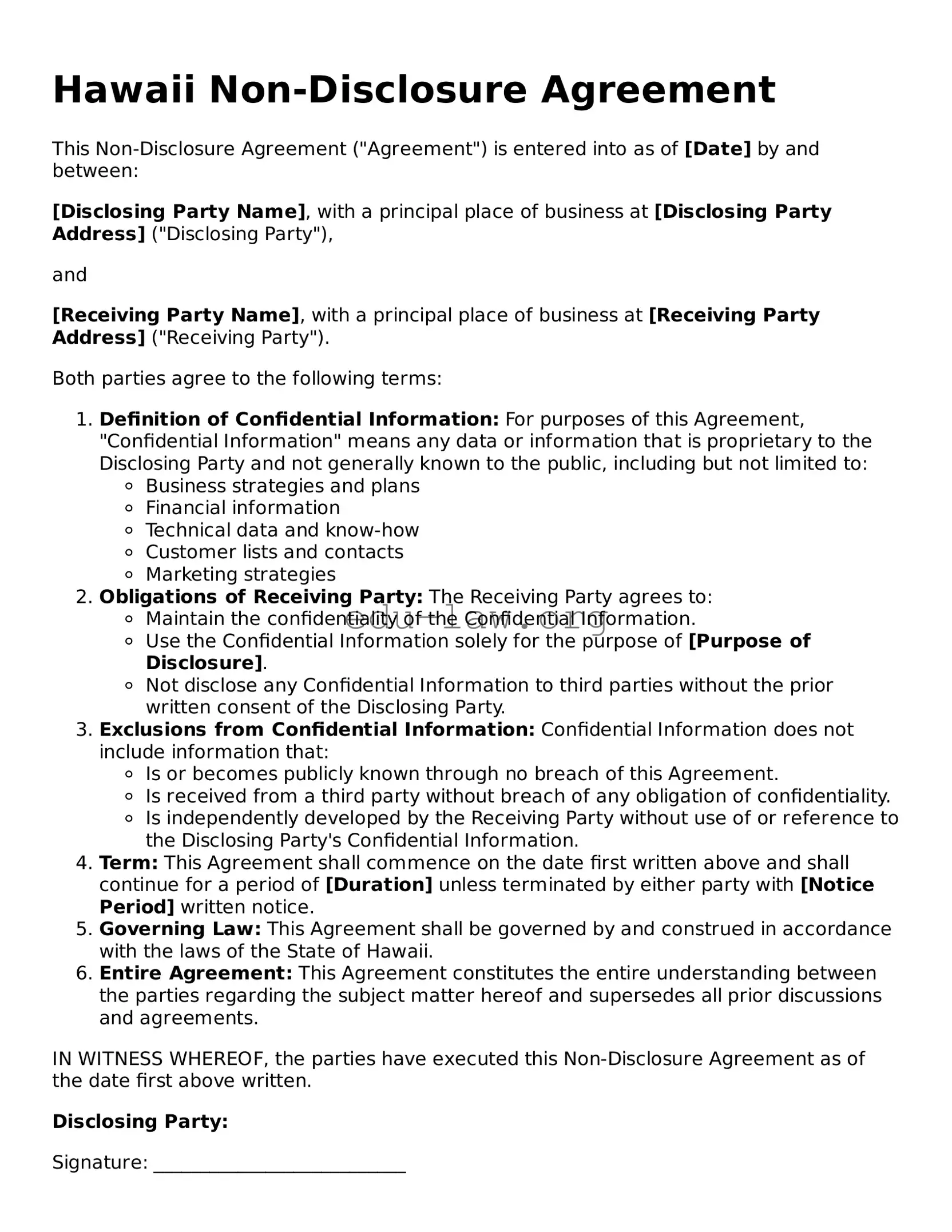
When engaging in business or personal relationships in Hawaii, protecting sensitive information is crucial. The Hawaii Non-disclosure Agreement (NDA) serves as a vital tool to safeguard confidential data from unauthorized disclosure. This legally binding contract outlines the expectations and responsibilities of the parties involved, ensuring that any proprietary information shared remains secure. Key aspects of the NDA include the definition of confidential information, the duration of confidentiality obligations, and the consequences of breaches. Furthermore, it specifies the permitted uses of the information and the obligations of both parties to maintain secrecy. By understanding these components, individuals and businesses can effectively navigate their relationships while minimizing risks associated with information leaks.
Hawaii Non-Disclosure Agreement
This Non-Disclosure Agreement ("Agreement") is entered into as of [Date] by and between:
[Disclosing Party Name], with a principal place of business at [Disclosing Party Address] ("Disclosing Party"),
and
[Receiving Party Name], with a principal place of business at [Receiving Party Address] ("Receiving Party").
Both parties agree to the following terms:
IN WITNESS WHEREOF, the parties have executed this Non-Disclosure Agreement as of the date first above written.
Disclosing Party:
Signature: ___________________________
Name: [Name]
Title: [Title]
Receiving Party:
Signature: ___________________________
Name: [Name]
Title: [Title]
| Fact Name | Details |
|---|---|
| Purpose | The Hawaii Non-disclosure Agreement (NDA) is designed to protect confidential information shared between parties. |
| Governing Law | The NDA is governed by the laws of the State of Hawaii, ensuring compliance with local regulations. |
| Duration | Typically, the duration of confidentiality obligations in Hawaii NDAs can range from one to five years, depending on the agreement. |
| Parties Involved | The NDA can be executed between individuals, businesses, or a combination of both, making it versatile for various situations. |
| Enforceability | Hawaii courts generally uphold NDAs as long as they are reasonable in scope and duration, protecting legitimate business interests. |
Filling out the Hawaii Non-disclosure Agreement form is an important step in protecting sensitive information. Ensure that you have all necessary details at hand before you start. Follow these steps carefully to complete the form accurately.
Once you have completed the form, review it carefully to ensure all information is accurate and complete. Proper execution of this agreement will help safeguard your confidential information.
What is a Hawaii Non-disclosure Agreement (NDA)?
A Hawaii Non-disclosure Agreement is a legal contract that protects confidential information shared between parties. It ensures that the information remains private and is not disclosed to unauthorized individuals or entities. This agreement is often used in business transactions, partnerships, or employment situations where sensitive information is exchanged.
Who typically uses a Non-disclosure Agreement in Hawaii?
Businesses, entrepreneurs, and individuals who are sharing proprietary information often use NDAs. This includes companies looking to protect trade secrets, intellectual property, or any sensitive data that could give competitors an advantage if disclosed.
What types of information are covered by an NDA?
Confidential information can include a wide range of data such as business plans, financial records, customer lists, marketing strategies, and technical processes. The NDA should clearly define what constitutes confidential information to avoid any ambiguity.
How long does the confidentiality obligation last?
The duration of confidentiality obligations can vary. Some NDAs specify a set period, such as two or five years, while others may require confidentiality to be maintained indefinitely. It is crucial to review the terms outlined in the agreement to understand the specific duration applicable.
Are there any exceptions to the confidentiality obligations?
Yes, most NDAs include exceptions. Common exceptions may allow disclosure if the information becomes public knowledge, is received from a third party without breach of confidentiality, or is required by law. Understanding these exceptions is important for both parties involved.
Can an NDA be enforced in Hawaii?
Yes, NDAs can be enforced in Hawaii as long as they are properly drafted and meet legal requirements. If a party violates the terms of the agreement, the other party may pursue legal action to seek remedies, which could include damages or injunctions.
Do I need a lawyer to create a Non-disclosure Agreement?
While it is not legally required to have a lawyer draft an NDA, consulting with a legal professional is advisable. A lawyer can ensure that the agreement is comprehensive, complies with Hawaii laws, and adequately protects your interests.
What happens if someone breaches the NDA?
If a breach occurs, the injured party may seek legal remedies. This could involve filing a lawsuit for damages caused by the breach. The NDA may also outline specific consequences for breaches, which could include financial penalties or the obligation to return confidential information.
Can I modify an existing NDA?
Yes, existing NDAs can be modified, but both parties must agree to the changes. It is essential to document any modifications in writing and have both parties sign the amended agreement to ensure enforceability.
Where can I obtain a Hawaii Non-disclosure Agreement form?
Hawaii Non-disclosure Agreement forms can be found online through various legal websites, or you may consult with an attorney to draft a customized agreement. Ensure that any form you use complies with Hawaii state laws and meets your specific needs.
Failing to include all parties involved. It is important to list everyone who will be bound by the agreement. Missing a party can lead to confusion later.
Not defining what constitutes confidential information. Be specific about what information is protected. Vague descriptions can create misunderstandings.
Overlooking the duration of the agreement. Specify how long the confidentiality obligation lasts. Leaving this blank may lead to disputes in the future.
Neglecting to sign and date the document. All parties must sign and date the agreement for it to be valid. An unsigned document is not enforceable.
Using outdated or incorrect forms. Ensure that you are using the most current version of the Non-disclosure Agreement form. Outdated forms may not comply with current laws.
Failing to consult legal advice when needed. If there are uncertainties, it is wise to seek help. A legal professional can provide clarity and ensure the agreement is properly completed.
When entering into a Non-disclosure Agreement (NDA) in Hawaii, several other forms and documents may be relevant to ensure that all parties are protected and informed. Below is a list of commonly used documents that complement the NDA. Each serves a specific purpose in the realm of confidentiality and business dealings.
Using these documents in conjunction with a Non-disclosure Agreement can help create a comprehensive framework for protecting sensitive information. Each document plays a vital role in ensuring that all parties understand their rights and responsibilities regarding confidentiality.
A Non-Disclosure Agreement (NDA) is often compared to a Confidentiality Agreement. Both documents serve the same primary purpose: to protect sensitive information from being disclosed to unauthorized parties. A Confidentiality Agreement may be broader in scope, encompassing not only trade secrets but also other private information shared during business dealings. Like an NDA, it outlines the obligations of the parties involved regarding the handling of confidential information.
Another similar document is the Proprietary Information Agreement (PIA). This agreement specifically focuses on protecting proprietary information, which includes unique processes, formulas, or methods that give a business a competitive edge. Both PIAs and NDAs require parties to maintain confidentiality, but a PIA is often more tailored to specific types of sensitive information, making it a valuable tool for businesses in highly competitive industries.
A Mutual Non-Disclosure Agreement is also akin to a standard NDA. This type of agreement is used when both parties intend to share confidential information with each other. Unlike a one-sided NDA, a Mutual NDA obligates both parties to protect the information they receive. This balance is essential in partnerships where both entities hold valuable insights and trade secrets.
In some cases, a Non-Circumvention Agreement is relevant. This document is designed to prevent one party from bypassing the other to engage directly with a third party. While it may not focus solely on confidentiality, it often includes clauses that protect sensitive information shared during negotiations. Thus, it serves a dual purpose of safeguarding trade secrets while also preserving business relationships.
A Non-Compete Agreement can also share similarities with an NDA. While primarily focused on restricting an individual's ability to compete with a former employer or business partner, it often includes clauses that protect confidential information. Both documents aim to prevent the misuse of sensitive information, although the primary focus of a Non-Compete is on competition rather than confidentiality.
Additionally, a Service Agreement may contain confidentiality clauses that resemble those found in an NDA. When a service provider is engaged, they often gain access to sensitive information. A Service Agreement may outline the obligations of the service provider to keep that information confidential, thus serving a similar function to an NDA while also detailing the services to be provided.
A Licensing Agreement also shares characteristics with an NDA. In a licensing arrangement, one party may disclose proprietary information to another for the purpose of using or selling a product or service. The confidentiality provisions within a Licensing Agreement ensure that the proprietary information remains protected, similar to the protections offered by an NDA.
Lastly, a Partnership Agreement can include confidentiality clauses that are similar to those in an NDA. When two or more parties enter into a partnership, they often share sensitive business information. The confidentiality provisions within a Partnership Agreement help ensure that this information is not disclosed to outside parties, thereby protecting the interests of all partners involved.
When filling out the Hawaii Non-disclosure Agreement form, it's important to keep a few key points in mind. Here’s a list of things you should and shouldn’t do:
Following these guidelines can help ensure that the process goes smoothly and that you understand your commitments under the agreement.
Understanding the Hawaii Non-disclosure Agreement (NDA) is crucial for anyone involved in business or sensitive information sharing. However, several misconceptions often cloud the clarity of this important document. Below is a list of common misunderstandings about the Hawaii NDA.
By addressing these misconceptions, individuals and businesses can approach NDAs with a clearer understanding, ensuring they are used effectively to protect valuable information.
When filling out and using the Hawaii Non-disclosure Agreement form, consider the following key takeaways:
Taking these steps can help ensure that the agreement is effective and serves its intended purpose.