In the beautiful state of Hawaii, businesses often rely on non-compete agreements to protect their interests and maintain a competitive edge. These agreements, which are designed to restrict an employee's ability to work for competing companies after leaving their current job, can be crucial for safeguarding sensitive information and trade secrets. The Hawaii Non-compete Agreement form outlines the specific terms and conditions that both parties must agree to, ensuring clarity and mutual understanding. Key aspects of this form include the duration of the restriction, the geographical area it covers, and the specific activities that are prohibited. By clearly defining these elements, the agreement aims to strike a balance between protecting the employer's interests and allowing employees the freedom to pursue their careers. Understanding the nuances of this form is essential for both employers and employees, as it can have significant implications for future employment opportunities and business operations in Hawaii.
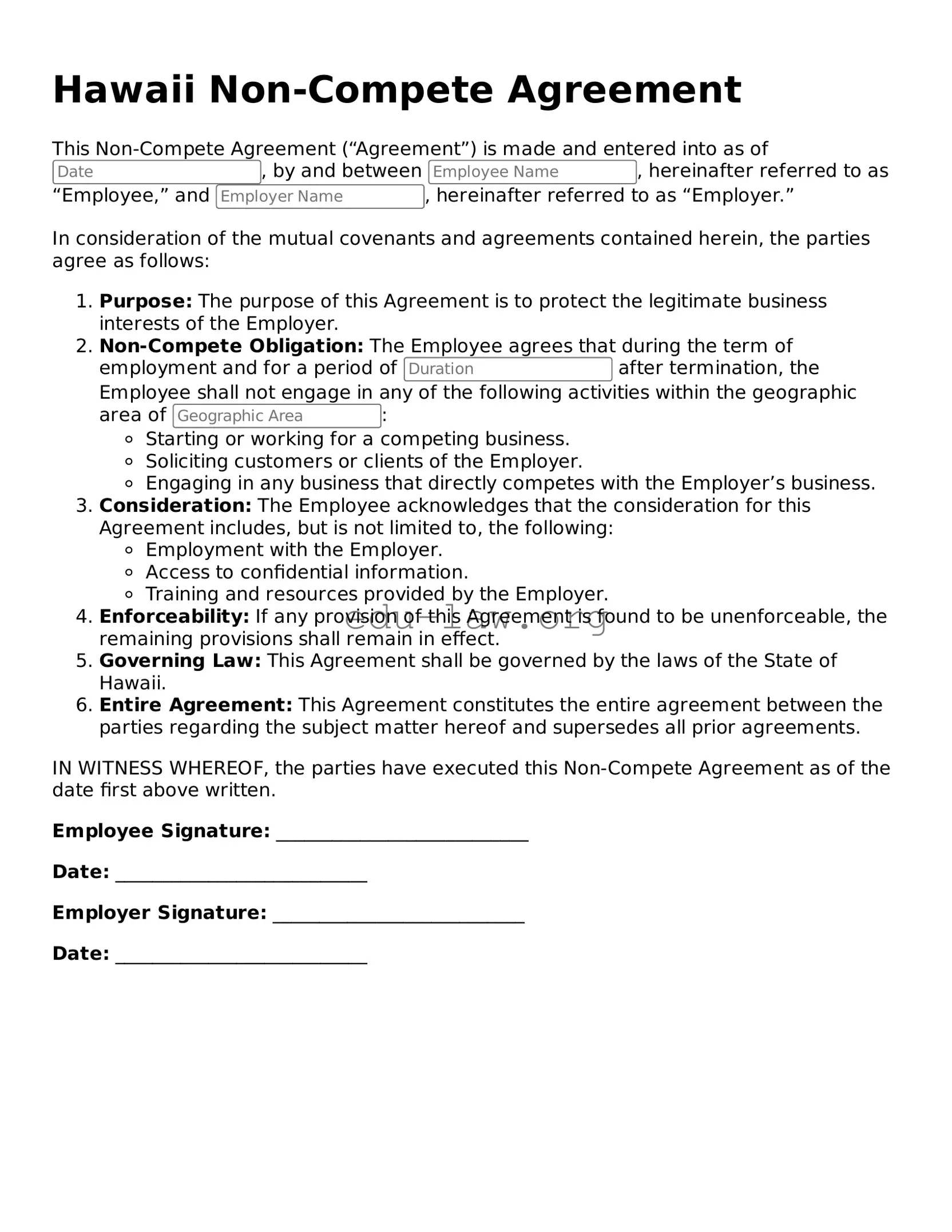
Hawaii Non-Compete Agreement
This Non-Compete Agreement (“Agreement”) is made and entered into as of , by and between , hereinafter referred to as “Employee,” and , hereinafter referred to as “Employer.”
In consideration of the mutual covenants and agreements contained herein, the parties agree as follows:
IN WITNESS WHEREOF, the parties have executed this Non-Compete Agreement as of the date first above written.
Employee Signature: ___________________________
Date: ___________________________
Employer Signature: ___________________________
Date: ___________________________
| Fact Name | Details |
|---|---|
| Governing Law | The Hawaii Non-compete Agreement is governed by Hawaii Revised Statutes (HRS) §480-4. |
| Enforceability | Non-compete agreements in Hawaii are enforceable only if they meet specific criteria. |
| Reasonable Duration | The duration of the non-compete must be reasonable, typically not exceeding two years. |
| Geographic Scope | The geographic area covered by the agreement must be reasonable and not overly broad. |
| Legitimate Business Interest | The agreement must protect a legitimate business interest, such as trade secrets or customer relationships. |
| Employee Consideration | For the agreement to be valid, the employee must receive some form of consideration, such as employment or a promotion. |
| Public Policy | Hawaii courts may refuse to enforce a non-compete if it violates public policy or restricts an individual's right to work. |
| Written Agreement | A non-compete agreement must be in writing to be enforceable in Hawaii. |
| Judicial Scrutiny | Courts in Hawaii will closely scrutinize non-compete agreements to ensure they are fair and reasonable. |
| Modification | Parties may modify the terms of a non-compete agreement, but any changes should be documented in writing. |
Completing the Hawaii Non-compete Agreement form requires careful attention to detail. After filling out the form, you will need to review it for accuracy and ensure that both parties sign it. This will help enforce the terms outlined in the agreement.
What is a Hawaii Non-compete Agreement?
A Hawaii Non-compete Agreement is a legal document that restricts an employee from working for a competitor or starting a competing business for a specific period after leaving their current employer. This agreement aims to protect the employer's business interests and confidential information.
Are Non-compete Agreements enforceable in Hawaii?
Yes, Non-compete Agreements can be enforceable in Hawaii, but they must meet certain criteria. The agreement must be reasonable in terms of duration, geographic scope, and the nature of the restricted activities. If a court finds the terms too broad or unfair, it may not enforce the agreement.
How long can a Non-compete Agreement last in Hawaii?
The duration of a Non-compete Agreement in Hawaii should be reasonable. Typically, agreements lasting six months to two years are more likely to be upheld. However, the specific circumstances of the employment and industry can influence what is considered reasonable.
What should be included in a Hawaii Non-compete Agreement?
A Hawaii Non-compete Agreement should clearly outline the following: the parties involved, the specific activities that are restricted, the duration of the restriction, and the geographic area covered. Additionally, it should state the consequences of violating the agreement.
Can I negotiate the terms of a Non-compete Agreement?
Yes, you can negotiate the terms of a Non-compete Agreement. It's important to discuss any concerns or desired changes with your employer before signing. Negotiating can lead to a more balanced agreement that protects both parties' interests.
What happens if I violate a Non-compete Agreement?
If you violate a Non-compete Agreement, your former employer may take legal action against you. This could include seeking an injunction to prevent you from working for a competitor or pursuing damages for any losses incurred due to the violation.
Can a Non-compete Agreement be enforced after I leave my job?
Yes, a Non-compete Agreement can be enforced after you leave your job, as long as the terms are reasonable and legally binding. The employer has the right to enforce the agreement within the specified time frame and geographic area.
What should I do if I am asked to sign a Non-compete Agreement?
If you are asked to sign a Non-compete Agreement, take the time to read it carefully. Consider seeking legal advice to understand the implications fully. It's important to know your rights and how the agreement may affect your future employment opportunities.
Failing to clearly define the scope of the agreement. It's important to specify what activities are restricted to avoid confusion.
Not including a reasonable time frame for the non-compete clause. A vague or overly long duration can lead to enforceability issues.
Omitting the geographic area where the non-compete applies. Clearly outlining the locations helps prevent misunderstandings.
Using ambiguous language can create problems. Clarity is crucial in ensuring that all parties understand the terms.
Not considering state laws that may affect the agreement. Each state has different rules regarding non-compete agreements.
Failing to discuss the agreement with a legal professional. Consulting an expert can help ensure the document is enforceable and fair.
Neglecting to include a termination clause. This clause can outline the conditions under which the agreement may end.
Not providing adequate consideration for the agreement. Both parties should receive something of value in exchange for their commitments.
Forgetting to keep a copy of the signed agreement. Both parties should retain a copy for their records to avoid future disputes.
When preparing a Hawaii Non-compete Agreement, several other forms and documents may be useful to ensure comprehensive coverage of the agreement's terms and the relationship between the parties. Below is a list of commonly associated documents.
Utilizing these documents alongside the Hawaii Non-compete Agreement can help clarify expectations and protect the interests of all parties involved. Each document plays a critical role in establishing a clear and enforceable agreement.
A Non-Disclosure Agreement (NDA) shares similarities with a Non-compete Agreement in that both are designed to protect sensitive information. An NDA focuses on preventing the sharing of proprietary information, trade secrets, or confidential data. This ensures that employees or partners do not disclose critical business information to competitors or the public. While a Non-compete Agreement restricts where and how an employee can work after leaving a company, an NDA restricts what they can share, creating a secure environment for businesses to operate without fear of information leaks.
An Employment Agreement often includes provisions similar to those found in a Non-compete Agreement. This document outlines the terms of employment, including job responsibilities, salary, and benefits. It may also contain clauses that restrict an employee's ability to work for competitors after their employment ends. This dual purpose helps to clarify expectations while also protecting the company's interests in a competitive market.
A Partnership Agreement may also incorporate elements similar to a Non-compete Agreement. In partnerships, the parties involved often share sensitive business strategies and client information. To protect these interests, a Partnership Agreement may contain clauses that prevent partners from engaging in competing businesses or soliciting clients from the partnership for a certain duration after leaving. This helps maintain the integrity and competitive edge of the partnership.
A License Agreement can also bear resemblance to a Non-compete Agreement, particularly when it involves licensing proprietary technology or products. Such agreements often include clauses that restrict the licensee from using the licensed material to compete directly with the licensor. This protects the licensor's intellectual property while allowing the licensee to benefit from the arrangement without jeopardizing the licensor’s market position.
When filling out the Hawaii Non-compete Agreement form, it is important to follow specific guidelines to ensure accuracy and compliance. Below is a list of things you should and shouldn't do:
Many people have misconceptions about the Hawaii Non-compete Agreement form. Understanding these misconceptions can help individuals navigate their employment agreements more effectively. Here are five common misunderstandings:
Non-compete agreements are enforceable in all situations. While Hawaii allows non-compete agreements, they are not automatically enforceable. Courts will evaluate the reasonableness of the agreement based on factors like duration, geographic scope, and the nature of the business.
All employees must sign a non-compete agreement. Not every employee is required to sign a non-compete agreement. These agreements are typically reserved for key employees, such as executives or those with access to sensitive information.
Non-compete agreements are the same as non-disclosure agreements. Although both types of agreements aim to protect business interests, they serve different purposes. A non-disclosure agreement focuses on keeping confidential information private, while a non-compete agreement restricts an employee's ability to work in similar industries after leaving the company.
Signing a non-compete means you can never work in your field again. This is not true. A well-drafted non-compete agreement may only restrict employment for a specific period and within a defined geographic area. After that time, individuals are generally free to pursue opportunities in their field.
Employers can enforce non-compete agreements without limitations. In Hawaii, there are legal limitations on how non-compete agreements can be enforced. Courts will often consider whether the agreement protects legitimate business interests and whether it imposes an undue hardship on the employee.
Being aware of these misconceptions can empower individuals to make informed decisions regarding their employment agreements in Hawaii.
When considering a Non-compete Agreement in Hawaii, it’s essential to understand its implications and requirements. Here are some key takeaways to keep in mind:
By keeping these points in mind, you can navigate the process of filling out and using a Non-compete Agreement in Hawaii more effectively.