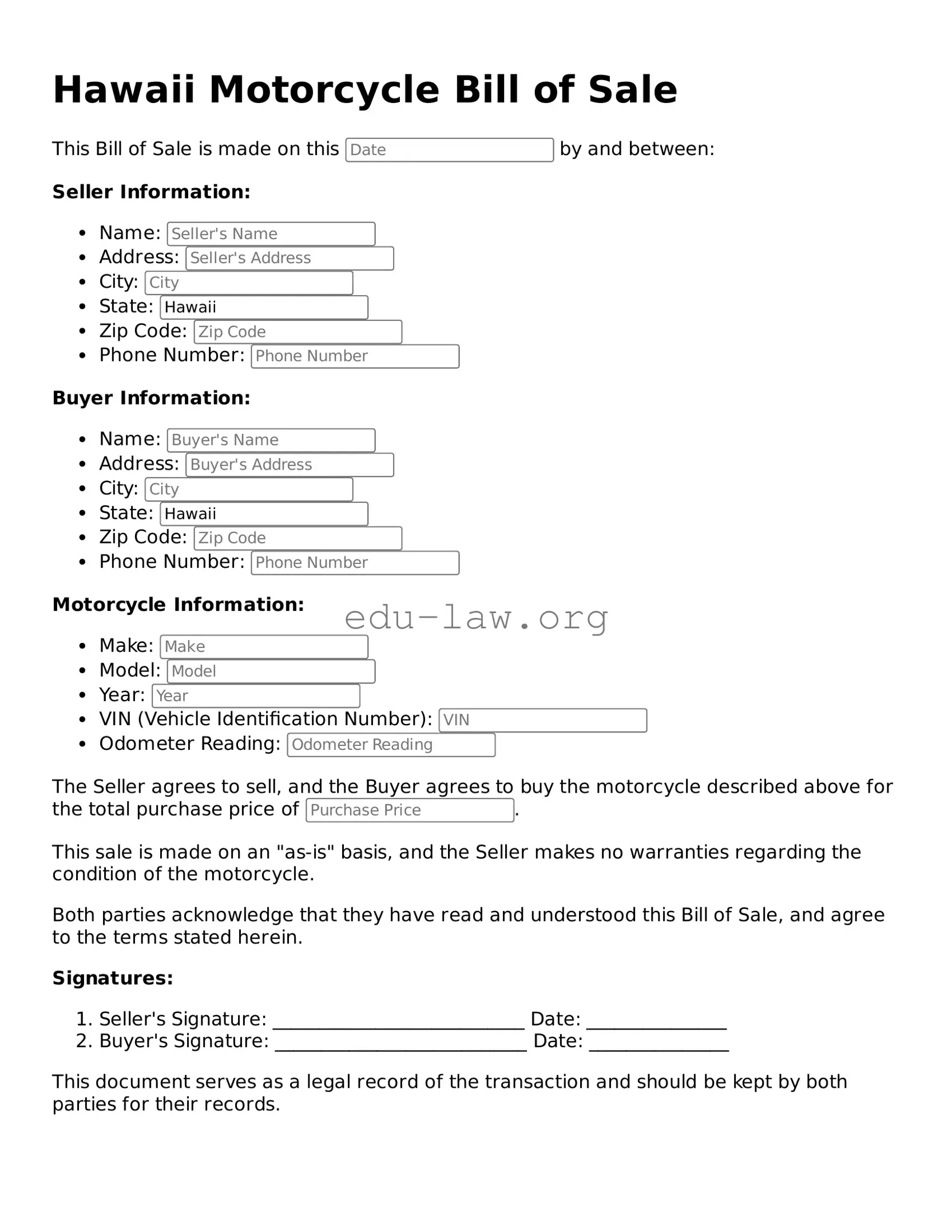
When purchasing or selling a motorcycle in Hawaii, a Motorcycle Bill of Sale form serves as an essential document that formalizes the transaction between the buyer and the seller. This form outlines key details such as the names and addresses of both parties, the motorcycle's make, model, year, and Vehicle Identification Number (VIN). Additionally, it includes the sale price and the date of the transaction, ensuring that both parties have a clear record of the agreement. The form may also contain information regarding the condition of the motorcycle at the time of sale, which can protect both parties in case of future disputes. By documenting the transfer of ownership, the Motorcycle Bill of Sale provides legal protection and facilitates the registration process with the state. Understanding the components of this form is crucial for anyone involved in a motorcycle sale in Hawaii, as it helps to ensure a smooth and transparent transaction.
Hawaii Motorcycle Bill of Sale
This Bill of Sale is made on this by and between:
Seller Information:
Buyer Information:
Motorcycle Information:
The Seller agrees to sell, and the Buyer agrees to buy the motorcycle described above for the total purchase price of .
This sale is made on an "as-is" basis, and the Seller makes no warranties regarding the condition of the motorcycle.
Both parties acknowledge that they have read and understood this Bill of Sale, and agree to the terms stated herein.
Signatures:
This document serves as a legal record of the transaction and should be kept by both parties for their records.
| Fact Name | Details |
|---|---|
| Purpose | The Hawaii Motorcycle Bill of Sale form is used to document the sale of a motorcycle between a buyer and a seller. |
| Governing Law | This form is governed by Hawaii Revised Statutes, specifically Section 286-2 and Section 286-51. |
| Information Required | The form requires details such as the motorcycle's make, model, year, VIN, and the names and addresses of both the buyer and seller. |
| Signatures | Both the buyer and seller must sign the form to validate the transaction and transfer ownership. |
| Notarization | While notarization is not mandatory, it is recommended for added security and to verify identities. |
| Record Keeping | Both parties should keep a copy of the completed Bill of Sale for their records, especially for registration purposes. |
Completing the Hawaii Motorcycle Bill of Sale form is an important step in the process of transferring ownership of a motorcycle. This document serves as a record of the sale and provides essential information about the buyer, seller, and the motorcycle itself. Following the steps below will ensure that all necessary details are accurately captured.
Once the form is completed, it is advisable for both parties to keep a copy for their records. This ensures that both the buyer and seller have proof of the transaction, which may be necessary for future reference or legal purposes.
What is a Hawaii Motorcycle Bill of Sale?
A Hawaii Motorcycle Bill of Sale is a legal document that records the sale of a motorcycle between a buyer and a seller. It serves as proof of the transaction and includes essential details about the motorcycle, the parties involved, and the sale terms. This document is crucial for both parties to establish ownership and protect their rights.
Is a Bill of Sale required in Hawaii for motorcycle sales?
While a Bill of Sale is not legally required in Hawaii, it is highly recommended. Having this document can help prevent disputes over ownership and provide clear evidence of the sale. It can also be useful when registering the motorcycle with the state or when dealing with insurance companies.
What information should be included in the Bill of Sale?
A comprehensive Bill of Sale should include the following information: the names and addresses of both the buyer and the seller, the motorcycle's make, model, year, and Vehicle Identification Number (VIN), the sale price, and the date of the transaction. Additionally, both parties should sign the document to make it legally binding.
Can I create my own Bill of Sale?
Yes, you can create your own Bill of Sale. However, it’s important to ensure that it includes all the necessary information and complies with state regulations. Many templates are available online, but customizing it to fit your specific transaction is advisable to avoid any potential issues.
Do I need to have the Bill of Sale notarized?
In Hawaii, notarization is not required for a motorcycle Bill of Sale. However, having it notarized can add an extra layer of authenticity and may help if any disputes arise in the future. It can also be beneficial when registering the motorcycle with the Department of Motor Vehicles.
What should I do with the Bill of Sale after the transaction?
After the transaction, both the buyer and the seller should keep a copy of the Bill of Sale for their records. The buyer will need it when registering the motorcycle, while the seller may want to retain it as proof of the sale in case of any future claims regarding ownership or liability.
How does a Bill of Sale affect the registration process?
The Bill of Sale is an important document when registering a motorcycle in Hawaii. It provides proof of ownership and the sale price, which may be necessary for calculating taxes. When registering, the buyer will typically need to present the Bill of Sale along with other required documents to the local DMV office.
What if the motorcycle has a lien on it?
If there is a lien on the motorcycle, it is crucial to address this before completing the sale. The seller should ensure that the lien is paid off and released before transferring ownership. The Bill of Sale should also reflect any agreements made regarding the lien, ensuring both parties are clear on the terms of the sale.
Can I use a Bill of Sale for a motorcycle trade?
Yes, a Bill of Sale can be used for motorcycle trades. In this case, the document should outline the details of both motorcycles involved in the trade, including their respective values. It’s important to clearly state the terms of the trade to avoid any misunderstandings between the parties.
Where can I find a template for a Hawaii Motorcycle Bill of Sale?
Templates for a Hawaii Motorcycle Bill of Sale can be found online through various legal websites, state government resources, and even local DMV offices. Ensure that any template you choose complies with Hawaii’s regulations and includes all necessary information for your specific transaction.
Failing to include the correct date of the transaction. It is essential to document when the sale occurs to establish ownership transfer.
Not providing the VIN (Vehicle Identification Number). This unique identifier is crucial for identifying the motorcycle and ensuring it is not stolen.
Leaving out the seller's and buyer's information. Full names, addresses, and contact details must be included to validate the transaction.
Neglecting to indicate the purchase price. This amount should reflect the agreed-upon price for the motorcycle.
Not signing the form. Both parties must sign the Bill of Sale to confirm their agreement and finalize the sale.
Using incorrect or incomplete descriptions of the motorcycle. Details such as make, model, year, and color should be clearly stated.
Forgetting to check for liens on the motorcycle. Ensuring that there are no outstanding debts is important for a clear title transfer.
Failing to provide witness signatures if required. Some transactions may necessitate a witness to validate the sale.
Not keeping a copy of the Bill of Sale for personal records. Both parties should retain a copy for future reference.
Overlooking local laws and requirements regarding motorcycle sales. It’s important to be aware of specific regulations in Hawaii that may affect the transaction.
When buying or selling a motorcycle in Hawaii, the Motorcycle Bill of Sale is an essential document. However, several other forms and documents can accompany it to ensure a smooth transaction. Here’s a list of those important documents.
Having these documents ready can simplify the buying or selling process. Each form plays a vital role in ensuring that all legal requirements are met, protecting both parties involved in the transaction.
The Motorcycle Bill of Sale form in Hawaii shares similarities with the Vehicle Bill of Sale. Both documents serve as proof of ownership transfer for motor vehicles. When selling or buying a motorcycle or any other vehicle, these forms provide essential details, such as the buyer's and seller's information, the vehicle's identification number (VIN), and the sale price. This helps protect both parties in the transaction and ensures that the transfer of ownership is legally recognized.
Another document akin to the Motorcycle Bill of Sale is the Boat Bill of Sale. Just like motorcycles, boats require a bill of sale to confirm ownership transfer. This document includes similar elements, such as the boat's hull identification number (HIN), the seller's and buyer's information, and the sale price. Having this document is crucial for registering the boat and avoiding potential disputes over ownership in the future.
The ATV Bill of Sale is also comparable to the Motorcycle Bill of Sale. All-terrain vehicles, like motorcycles, need a formal document to establish ownership transfer. The ATV Bill of Sale includes key details like the vehicle's make, model, and VIN, along with the buyer's and seller's information. This document not only protects the interests of both parties but also assists in registration and title transfer processes.
A Snowmobile Bill of Sale shares similarities with the Motorcycle Bill of Sale, particularly in its role in facilitating ownership transfers. This document outlines the specifics of the snowmobile, including its identification number and sale price. Just as with motorcycles, having a snowmobile bill of sale is essential for legal registration and to avoid disputes regarding ownership.
The Trailer Bill of Sale is another document that mirrors the Motorcycle Bill of Sale. Trailers, like motorcycles, require a bill of sale to confirm the transfer of ownership. This document captures vital information, including the trailer's VIN, the names of both the buyer and seller, and the sale amount. It serves as a legal record that both parties can refer to in case of future ownership questions.
The Mobile Home Bill of Sale is also similar, as it facilitates the transfer of ownership for mobile homes. This document typically includes details such as the mobile home’s serial number, the buyer's and seller's names, and the sale price. Just as with motorcycles, this bill of sale is crucial for ensuring that the transaction is legally binding and that ownership is properly recorded.
In addition, the Firearm Bill of Sale has commonalities with the Motorcycle Bill of Sale. Both documents are used to confirm the transfer of ownership for regulated items. The Firearm Bill of Sale includes information about the firearm, such as the make, model, and serial number, along with the buyer's and seller's details. It serves as a legal record that protects both parties in the transaction.
The Gun Safe Bill of Sale is another document that functions similarly. While it may not seem directly related to motorcycles, it serves to document the sale of a specific item that may be used for storing firearms, paralleling the ownership transfer process. This document includes details about the safe, such as its brand and model, along with the buyer's and seller's information, ensuring that the transaction is legally recognized.
The Equipment Bill of Sale can also be compared to the Motorcycle Bill of Sale. This document is used for the sale of various types of equipment, from farm machinery to construction tools. It includes essential details such as the equipment's description, serial number, and sale price, ensuring that both parties are protected and that the ownership transfer is documented.
Lastly, the Personal Property Bill of Sale is similar in that it can be used for a wide range of items, including motorcycles. This document outlines the specifics of the personal property being sold, including a description, sale price, and the buyer's and seller's information. It serves as a legal record of the transaction, protecting both parties and providing proof of ownership transfer.
When filling out the Hawaii Motorcycle Bill of Sale form, attention to detail is crucial. Here are some important dos and don'ts to consider:
Misconceptions about the Hawaii Motorcycle Bill of Sale form can lead to confusion among buyers and sellers. Understanding these misconceptions is crucial for a smooth transaction. Here are four common misunderstandings:
Filling out and using the Hawaii Motorcycle Bill of Sale form is an important step in transferring ownership of a motorcycle. Here are some key takeaways to keep in mind:
By following these guidelines, you can ensure a smooth and legally sound transaction when buying or selling a motorcycle in Hawaii.