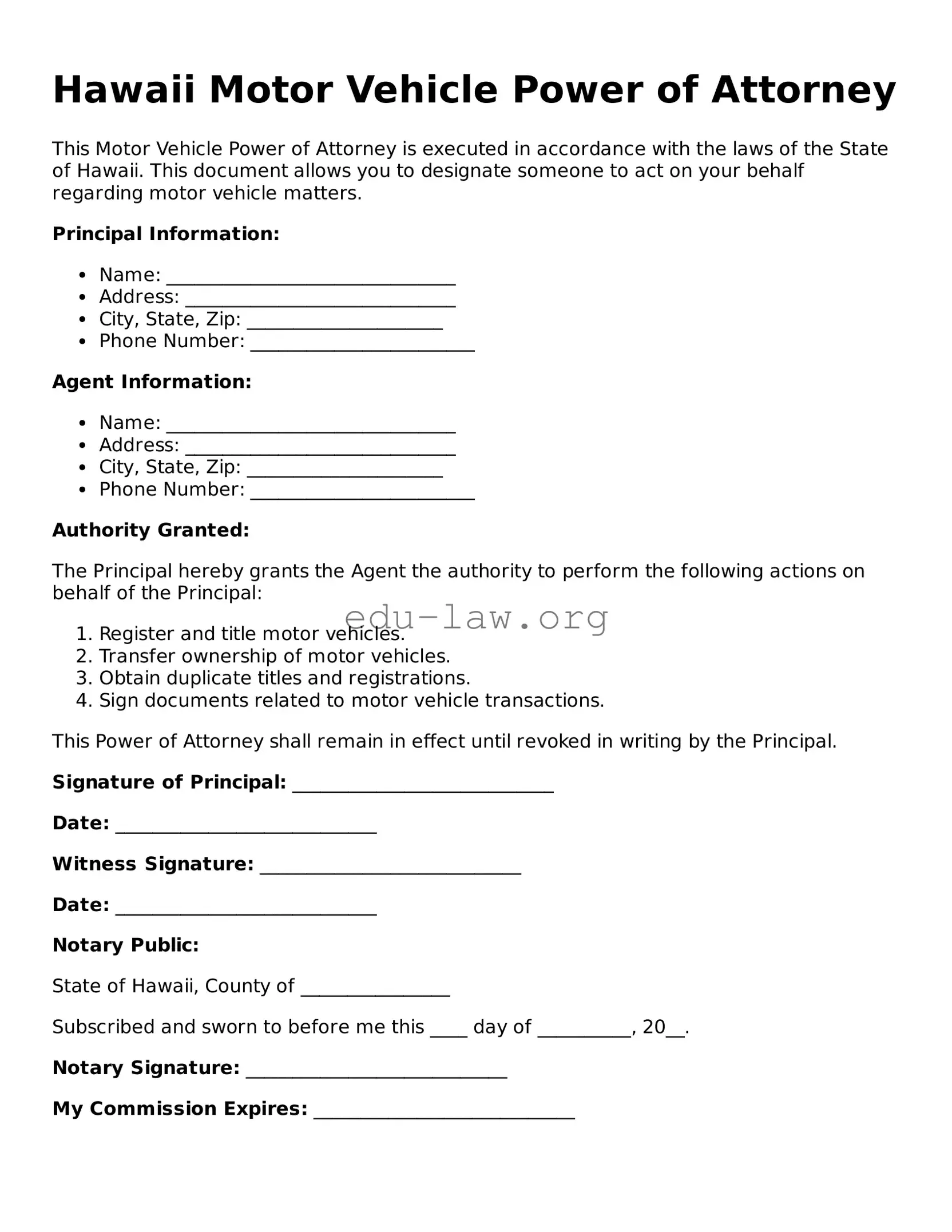
The Hawaii Motor Vehicle Power of Attorney form serves as a vital tool for individuals looking to delegate authority over their vehicle-related matters to another person. This form allows a designated agent to handle a variety of tasks, such as registering a vehicle, transferring ownership, or obtaining a duplicate title. By utilizing this form, vehicle owners can ensure that their interests are represented, even when they are unable to manage these responsibilities personally. The process of completing the form is straightforward, but it requires careful attention to detail to avoid any potential issues. The agent must be someone the vehicle owner trusts, as this person will have the power to make significant decisions regarding the vehicle. Understanding the implications of this authority is crucial for both parties involved. With the right precautions, the Hawaii Motor Vehicle Power of Attorney can streamline vehicle transactions and provide peace of mind for vehicle owners.
Hawaii Motor Vehicle Power of Attorney
This Motor Vehicle Power of Attorney is executed in accordance with the laws of the State of Hawaii. This document allows you to designate someone to act on your behalf regarding motor vehicle matters.
Principal Information:
Agent Information:
Authority Granted:
The Principal hereby grants the Agent the authority to perform the following actions on behalf of the Principal:
This Power of Attorney shall remain in effect until revoked in writing by the Principal.
Signature of Principal: ____________________________
Date: ____________________________
Witness Signature: ____________________________
Date: ____________________________
Notary Public:
State of Hawaii, County of ________________
Subscribed and sworn to before me this ____ day of __________, 20__.
Notary Signature: ____________________________
My Commission Expires: ____________________________
| Fact Name | Description |
|---|---|
| Purpose | The Hawaii Motor Vehicle Power of Attorney form allows an individual to authorize another person to handle motor vehicle transactions on their behalf. |
| Governing Law | This form is governed by the Hawaii Revised Statutes, specifically Chapter 507. |
| Required Signatures | Both the principal (the person granting authority) and the agent (the person receiving authority) must sign the form. |
| Notarization | While notarization is not always required, it is recommended to enhance the form's validity. |
| Revocation | The principal can revoke the power of attorney at any time, provided they do so in writing. |
| Use Cases | This form is commonly used for tasks like transferring vehicle titles, registering vehicles, and obtaining license plates. |
After obtaining the Hawaii Motor Vehicle Power of Attorney form, follow these steps to complete it accurately. Ensure that all required information is provided to avoid any delays in processing.
What is the Hawaii Motor Vehicle Power of Attorney form?
The Hawaii Motor Vehicle Power of Attorney form is a legal document that allows one person to authorize another individual to act on their behalf in matters related to motor vehicles. This can include tasks such as transferring ownership, registering vehicles, or obtaining titles. It is particularly useful when the vehicle owner cannot be present to complete these actions themselves, whether due to time constraints, distance, or other obligations.
Who can be designated as an agent in this form?
Any competent adult can be designated as an agent in the Hawaii Motor Vehicle Power of Attorney form. This means that the person you choose should be trustworthy and capable of handling the responsibilities you are assigning to them. Often, individuals select family members, friends, or professionals, such as attorneys or auto dealers, to serve in this role. It’s essential to choose someone who understands the tasks involved and can act in your best interest.
How do I complete the form?
Completing the Hawaii Motor Vehicle Power of Attorney form requires careful attention to detail. First, you will need to provide your information as the principal, including your name and address. Next, you will identify your agent by including their name and contact details. After that, specify the powers you are granting, whether it’s for a specific transaction or broader authority. Finally, both you and your agent must sign and date the form. It’s advisable to have the document notarized to enhance its validity and to ensure that it is recognized by the relevant authorities.
Is the form valid in other states?
The Hawaii Motor Vehicle Power of Attorney form is specifically designed for use within Hawaii. While other states may recognize the authority granted in this form, it is crucial to check the laws of the state where you intend to use it. Some states have their own requirements or forms for a power of attorney related to motor vehicles. If you plan to operate in multiple states, consider consulting with a legal professional to ensure compliance with all applicable laws.
What happens if I need to revoke the power of attorney?
If you decide to revoke the power of attorney, you must do so formally. This typically involves completing a revocation form and notifying your agent of the change. You should also inform any institutions or agencies that were relying on the original power of attorney. It’s important to take these steps to prevent any unauthorized actions by your former agent. Keep in mind that revoking a power of attorney does not affect any actions taken by the agent while the authority was still in effect.
Failing to provide complete information. It's essential to fill out all required fields accurately. Incomplete information can lead to delays or rejection of the form.
Not signing the form. A signature is necessary to validate the Power of Attorney. Without it, the document is not legally binding.
Using outdated forms. Always ensure that you are using the most current version of the Hawaii Motor Vehicle Power of Attorney form. Using an old version may result in complications.
Neglecting to specify the scope of authority. Clearly outline what powers are being granted. Ambiguity can lead to misunderstandings and disputes.
Not including the date. The date of signing is crucial for establishing the timeline of authority. Omitting it can create confusion about when the powers take effect.
Forgetting to have the form notarized. In some cases, notarization may be required to ensure the document is recognized legally. Check local requirements to avoid issues.
Not providing identification. Including copies of identification for both the principal and the agent can help verify identities and prevent fraud.
Ignoring state-specific instructions. Each state may have unique requirements for the Power of Attorney. Familiarize yourself with Hawaii's specific regulations to ensure compliance.
When dealing with the Hawaii Motor Vehicle Power of Attorney form, there are several other forms and documents that may be necessary to ensure a smooth transaction. These documents can help clarify authority, confirm ownership, or facilitate the transfer of vehicle-related responsibilities. Below is a list of some commonly used forms that often accompany the Power of Attorney.
Each of these documents plays a vital role in the process of managing vehicle ownership and transactions in Hawaii. Having them prepared and ready can help streamline the process, ensuring that all legal requirements are met efficiently.
The Durable Power of Attorney is a legal document that allows an individual to appoint someone to manage their financial and legal affairs, even if they become incapacitated. Similar to the Hawaii Motor Vehicle Power of Attorney, it grants authority to another person to act on behalf of the principal. This document remains effective until the principal revokes it, providing a continuous power that can cover various transactions, including vehicle-related matters.
The General Power of Attorney is another document that shares similarities with the Hawaii Motor Vehicle Power of Attorney. It allows an individual to designate someone to handle a wide range of affairs, including real estate, banking, and personal matters. While the Hawaii Motor Vehicle Power of Attorney is specific to vehicle transactions, the General Power of Attorney offers broader authority, allowing the agent to manage multiple aspects of the principal's life.
A Limited Power of Attorney is designed for specific tasks or a set period. This document is similar to the Hawaii Motor Vehicle Power of Attorney in that it grants authority to someone to perform certain actions on behalf of the principal. For example, it may be used to allow someone to sell a vehicle or sign documents related to vehicle registration, but not for other financial matters.
The Healthcare Power of Attorney focuses on medical decisions rather than vehicle transactions. However, both documents empower another person to act on behalf of the principal. While the Healthcare Power of Attorney is specific to health-related decisions, the Hawaii Motor Vehicle Power of Attorney is tailored for vehicle-related matters, illustrating the concept of delegation of authority in different contexts.
The Revocation of Power of Attorney document is essential for terminating any previously granted power. It serves as a formal notice that a principal no longer wishes to allow their agent to act on their behalf. This document is relevant to the Hawaii Motor Vehicle Power of Attorney, as it can be used to revoke the authority given to someone for handling vehicle transactions, ensuring clarity and control over one's affairs.
The Consent to Release Information form is often used in situations where an individual allows another person to access their personal information. This document is similar to the Hawaii Motor Vehicle Power of Attorney in that it provides a mechanism for one person to authorize another to act on their behalf. Both documents facilitate communication and action between parties while ensuring that the principal's wishes are respected.
The Vehicle Bill of Sale is a document that records the sale of a vehicle. While it does not grant authority like the Hawaii Motor Vehicle Power of Attorney, it is related in that both documents are used in vehicle transactions. The Bill of Sale serves as proof of ownership transfer, while the Power of Attorney allows someone to sign documents related to that sale on behalf of the owner.
The Vehicle Registration Application is another document associated with vehicle ownership. Similar to the Hawaii Motor Vehicle Power of Attorney, this application is necessary for legally registering a vehicle. Both documents involve the transfer or acknowledgment of vehicle ownership, although the Power of Attorney specifically allows someone to act on behalf of the owner during the registration process.
The Affidavit of Heirship is a document used to establish the heirs of a deceased individual. While it serves a different purpose, it can be relevant in vehicle ownership situations, especially when determining who has the right to inherit a vehicle. The Hawaii Motor Vehicle Power of Attorney can be used by heirs to manage the vehicle transactions of the deceased, demonstrating the interconnectedness of these legal documents.
Lastly, the Release of Liability form is used to protect a seller from future claims after selling a vehicle. While it does not grant authority, it is related to the process of transferring vehicle ownership. The Hawaii Motor Vehicle Power of Attorney can facilitate the signing of this form, allowing someone to act on behalf of the seller, ensuring that all legal requirements are met during the transaction.
Filling out the Hawaii Motor Vehicle Power of Attorney form can seem daunting, but it’s a straightforward process if you keep a few key points in mind. Here’s a helpful list of things you should and shouldn’t do when completing this important document.
By following these guidelines, you can ensure that your Motor Vehicle Power of Attorney form is filled out correctly and efficiently. Taking the time to do it right can save you from potential headaches down the road.
Understanding the Hawaii Motor Vehicle Power of Attorney form is crucial for vehicle owners in the state. However, several misconceptions can lead to confusion. Here are six common misconceptions:
This is not true. While many people associate the form with selling a vehicle, it can also be used for other purposes, such as registering a vehicle, transferring ownership, or handling any related transactions.
This misconception is incorrect. Vehicle owners can prepare the form themselves or seek assistance from a legal document preparer. Legal representation is not a requirement for completing the form.
While notarization can add an extra layer of authenticity, it is not always necessary. The form can be valid without a notary, depending on the specific requirements of the transaction.
The validity of the form does not have a strict time limit. It remains effective until the task it was created for is completed or until the principal revokes it.
This is a misconception. The form allows the principal to specify which powers are granted to the agent. Not all powers are automatically included; the principal can tailor the powers to fit their needs.
This is misleading. The form is specifically designed for motor vehicles, which include cars, trucks, and motorcycles. Other types of vehicles, like boats or aircraft, require different forms.
By addressing these misconceptions, vehicle owners can better understand the Hawaii Motor Vehicle Power of Attorney form and utilize it effectively for their needs.
When filling out and using the Hawaii Motor Vehicle Power of Attorney form, keep these key takeaways in mind: