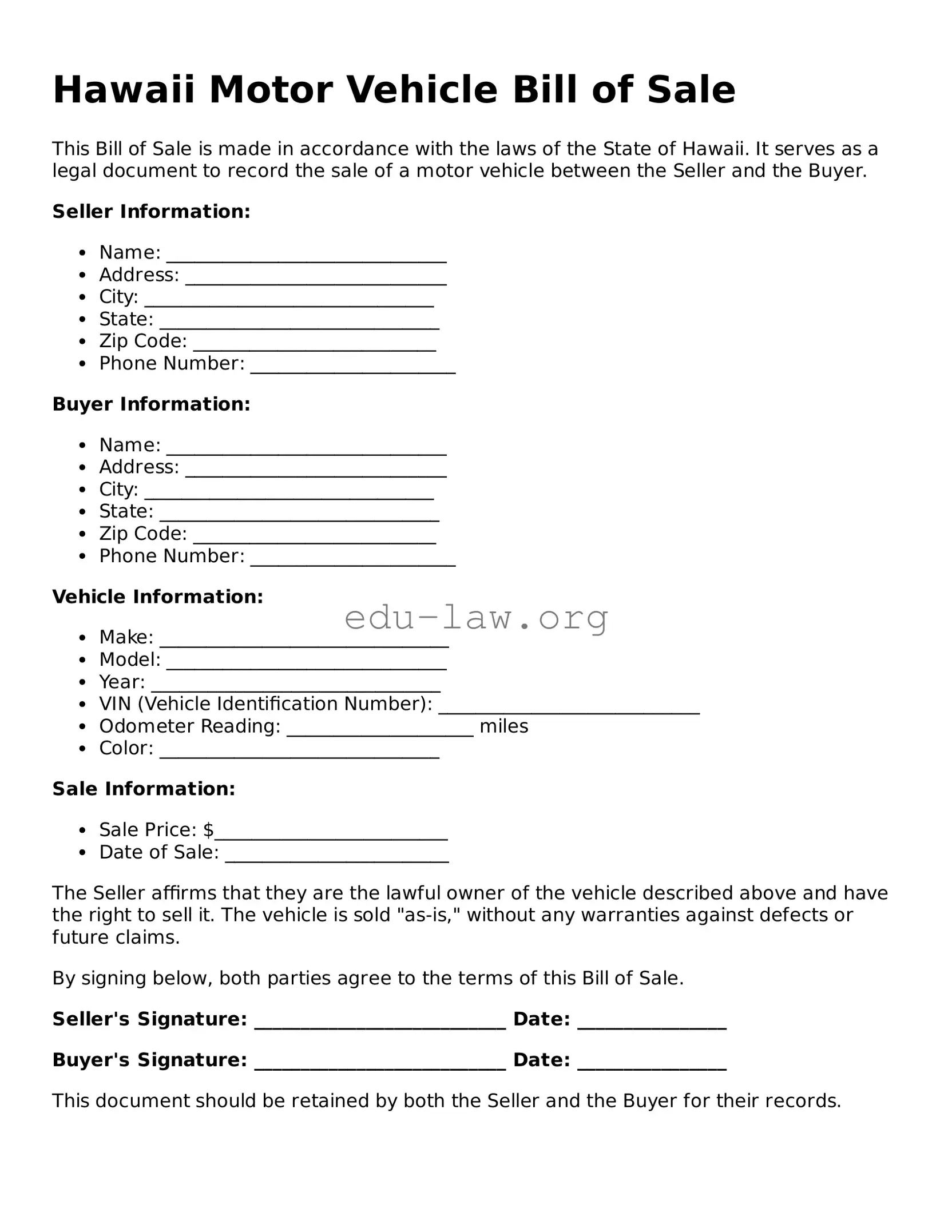
The Hawaii Motor Vehicle Bill of Sale form serves as a crucial document in the process of transferring ownership of a vehicle. This form captures essential details about the transaction, including the buyer's and seller's names and addresses, the vehicle's make, model, year, and vehicle identification number (VIN). It also outlines the sale price and any terms agreed upon by both parties. Completing this form is vital for ensuring that the transaction is legally recognized and can help prevent disputes in the future. Additionally, it provides a record that may be needed for registration purposes with the state’s Department of Motor Vehicles. By using this form, both the buyer and seller can protect their interests and facilitate a smooth transfer of ownership.
Hawaii Motor Vehicle Bill of Sale
This Bill of Sale is made in accordance with the laws of the State of Hawaii. It serves as a legal document to record the sale of a motor vehicle between the Seller and the Buyer.
Seller Information:
Buyer Information:
Vehicle Information:
Sale Information:
The Seller affirms that they are the lawful owner of the vehicle described above and have the right to sell it. The vehicle is sold "as-is," without any warranties against defects or future claims.
By signing below, both parties agree to the terms of this Bill of Sale.
Seller's Signature: ___________________________ Date: ________________
Buyer's Signature: ___________________________ Date: ________________
This document should be retained by both the Seller and the Buyer for their records.
| Fact Name | Description |
|---|---|
| Purpose | The Hawaii Motor Vehicle Bill of Sale form is used to document the sale of a motor vehicle between a buyer and a seller. |
| Governing Law | This form is governed by Hawaii Revised Statutes, Chapter 286, which outlines vehicle registration and titling requirements. |
| Required Information | The form must include details such as the vehicle's make, model, year, VIN, and the sale price. |
| Signatures | Both the buyer and seller must sign the form to validate the transaction. |
| Notarization | Although notarization is not required, it is recommended for added protection and authenticity. |
| Use for Registration | This Bill of Sale can be used to apply for a new title and registration with the Hawaii Department of Transportation. |
Once you have the Hawaii Motor Vehicle Bill of Sale form in hand, it is essential to complete it accurately to ensure a smooth transfer of ownership. After filling out the form, both the seller and buyer will need to sign it. This document may be required for vehicle registration and titling, so it is important to keep a copy for your records.
What is a Hawaii Motor Vehicle Bill of Sale form?
The Hawaii Motor Vehicle Bill of Sale form is a legal document that records the sale of a vehicle between a buyer and a seller. It serves as proof of the transaction and includes essential details such as the vehicle's make, model, year, VIN (Vehicle Identification Number), and the sale price. This form is crucial for both parties to ensure a smooth transfer of ownership and to provide documentation for future reference.
Do I need a Bill of Sale to sell my vehicle in Hawaii?
While it is not legally required to have a Bill of Sale to sell a vehicle in Hawaii, it is highly recommended. This document protects both the buyer and the seller by providing a clear record of the transaction. In case of disputes or questions about the sale in the future, having a Bill of Sale can be invaluable. Additionally, some buyers may request it for their records or to register the vehicle.
How do I complete the Bill of Sale form?
To complete the Hawaii Motor Vehicle Bill of Sale form, both the buyer and seller should fill out the required information accurately. This includes the names and addresses of both parties, the vehicle details (make, model, year, VIN), the sale price, and the date of the transaction. Both parties should sign the form to validate the sale. It’s advisable to keep a copy for your records after the transaction is finalized.
Where do I submit the Bill of Sale after completing it?
Once the Bill of Sale is completed and signed, it should be kept with the vehicle's title. The buyer will typically need to present this document when registering the vehicle with the Hawaii Department of Transportation. The Bill of Sale may also be required for tax purposes or if the buyer needs to obtain a new title. Always check with local authorities for any specific submission requirements.
Incorrect Vehicle Information: One common mistake is failing to provide accurate details about the vehicle. This includes the make, model, year, and Vehicle Identification Number (VIN). Double-checking this information is crucial, as errors can lead to issues with registration or ownership transfer.
Missing Signatures: Both the seller and buyer must sign the form. Omitting one or both signatures is a frequent oversight. Without these signatures, the bill of sale may not be considered valid, which can complicate the transfer process.
Improper Date Entry: Entering the wrong date can create confusion regarding the sale's timeline. It's essential to write the correct date when the transaction takes place. This helps in establishing a clear record of the sale.
Failure to Include Payment Details: Not specifying the sale price or payment method can lead to misunderstandings. Clearly stating the amount paid and how the payment was made ensures both parties are on the same page and can prevent disputes later.
The Hawaii Motor Vehicle Bill of Sale form is an essential document for anyone buying or selling a vehicle in the state. However, several other forms and documents may accompany this transaction to ensure a smooth and legally compliant process. Below is a list of these documents, each serving a specific purpose in the vehicle transfer process.
Having these documents prepared and organized can significantly streamline the process of buying or selling a vehicle in Hawaii. Ensuring all paperwork is in order helps protect both parties and facilitates a successful transaction.
The Hawaii Motor Vehicle Bill of Sale form is similar to the general Bill of Sale, which is used for various types of personal property transactions. Just like the motor vehicle version, a general Bill of Sale serves as proof of purchase and ownership transfer between a seller and a buyer. It typically includes details such as the names of both parties, a description of the item being sold, and the sale price. This document is crucial for record-keeping and can protect both parties in case of disputes.
Another document that shares similarities is the Vehicle Title. While the Bill of Sale records the transaction, the Vehicle Title serves as an official document that proves ownership of the vehicle. It includes essential information such as the vehicle identification number (VIN), make, model, and year of the vehicle. When a vehicle is sold, the title must be signed over to the new owner, often in conjunction with the Bill of Sale, ensuring a complete transfer of ownership.
The Purchase Agreement is also akin to the Motor Vehicle Bill of Sale. This document outlines the terms of the sale, including price, payment methods, and any conditions that must be met before the transaction is finalized. While a Bill of Sale is often simpler and focuses on the transfer of ownership, a Purchase Agreement can be more detailed, making it ideal for high-value transactions or when specific terms are negotiated.
In the realm of real estate, the Real Estate Purchase Agreement shares some characteristics with the Motor Vehicle Bill of Sale. Both documents facilitate the transfer of ownership, although the real estate version is typically more complex. It includes contingencies, disclosures, and various legal stipulations that protect both the buyer and seller throughout the property transaction process.
The Uniform Commercial Code (UCC) Financing Statement is another related document. While not a direct equivalent, it is used in transactions involving secured interests in personal property, including vehicles. When a vehicle is financed, the lender files a UCC Financing Statement to establish their legal claim to the vehicle until the loan is paid off. This document ensures that the lender's interest is protected, similar to how a Bill of Sale protects the buyer's ownership rights.
The Affidavit of Ownership is similar to the Bill of Sale in that it serves as a declaration of ownership. This document may be used when the original title is lost or when a vehicle is inherited. It provides a sworn statement from the owner affirming their ownership and can be used to obtain a replacement title, much like how a Bill of Sale can establish ownership during a sale.
The Release of Liability form is another document that parallels the Motor Vehicle Bill of Sale. When a vehicle is sold, the seller typically submits this form to the Department of Motor Vehicles (DMV) to notify them that they are no longer responsible for the vehicle. This document protects the seller from future liabilities related to the vehicle, much like how the Bill of Sale protects the buyer's rights to the vehicle.
The Odometer Disclosure Statement is also relevant when selling a vehicle. This document must be completed to disclose the vehicle's mileage at the time of sale. It helps prevent fraud and ensures that buyers are informed about the vehicle's condition. While the Bill of Sale records the sale, the Odometer Disclosure Statement provides crucial information that can affect the vehicle's value and the buyer's decision.
The Warranty Deed is similar in function to the Bill of Sale, albeit in real estate transactions. It conveys ownership of a property from one party to another, ensuring that the buyer receives a clear title. Both documents serve as proof of ownership transfer, but the Warranty Deed includes guarantees about the title's validity, offering additional protection to the buyer.
Lastly, the Certificate of Title Application is akin to the Motor Vehicle Bill of Sale in that it is often submitted alongside it when registering a vehicle. This application requests the issuance of a new title in the buyer's name after the sale is complete. It ensures that the new owner is officially recognized, just as the Bill of Sale documents the transaction itself.
When filling out the Hawaii Motor Vehicle Bill of Sale form, it's important to follow specific guidelines to ensure accuracy and compliance. Here’s a straightforward list of dos and don’ts:
Understanding the Hawaii Motor Vehicle Bill of Sale form is essential for anyone buying or selling a vehicle in the state. However, several misconceptions can lead to confusion. Here are eight common misconceptions:
Clarifying these misconceptions can help ensure a smoother transaction process for both buyers and sellers in Hawaii.
Here are some key takeaways about filling out and using the Hawaii Motor Vehicle Bill of Sale form: