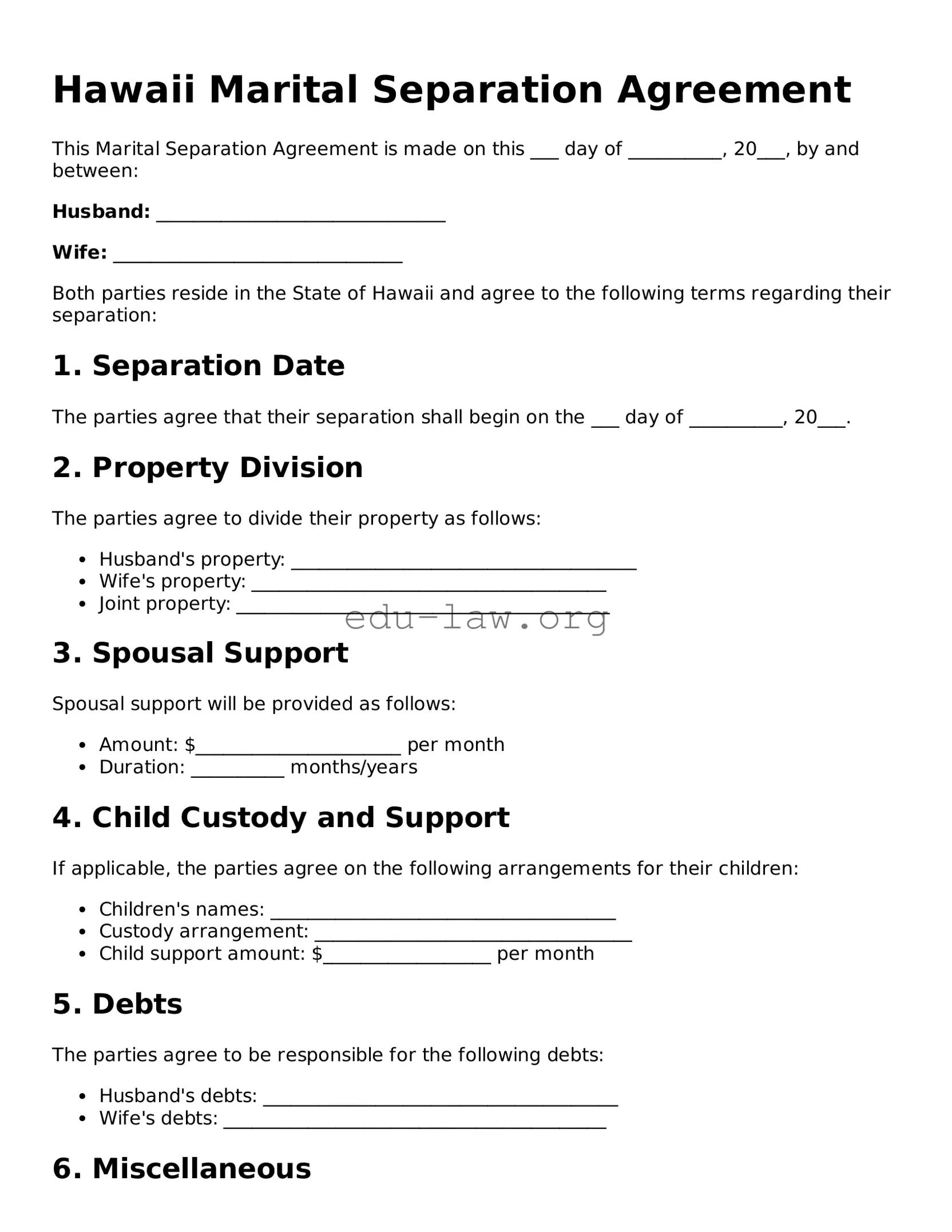
When couples in Hawaii decide to separate but not divorce, a Marital Separation Agreement becomes an essential tool. This document outlines the rights and responsibilities of each spouse during the separation period. It typically addresses key areas such as the division of property, child custody arrangements, and financial obligations, ensuring that both parties have a clear understanding of their roles. By putting these terms in writing, the agreement helps to prevent misunderstandings and disputes down the line. Additionally, it can serve as a foundation for future divorce proceedings, should the couple choose to take that step later. Understanding the components of this agreement is crucial for anyone navigating the complexities of marital separation in Hawaii.
Hawaii Marital Separation Agreement
This Marital Separation Agreement is made on this ___ day of __________, 20___, by and between:
Husband: _______________________________
Wife: _______________________________
Both parties reside in the State of Hawaii and agree to the following terms regarding their separation:
1. Separation Date
The parties agree that their separation shall begin on the ___ day of __________, 20___.
2. Property Division
The parties agree to divide their property as follows:
3. Spousal Support
Spousal support will be provided as follows:
4. Child Custody and Support
If applicable, the parties agree on the following arrangements for their children:
5. Debts
The parties agree to be responsible for the following debts:
6. Miscellaneous
This agreement represents the entire understanding between the parties. Any changes must be made in writing and signed by both parties.
7. Signatures
By signing below, both parties acknowledge that they have read and understood this agreement and agree to abide by its terms.
Husband's Signature: _______________________________ Date: ___________
Wife's Signature: _______________________________ Date: ___________
This agreement shall be governed by the laws of the State of Hawaii.
| Fact Name | Details |
|---|---|
| Purpose | The Hawaii Marital Separation Agreement outlines the terms of separation between spouses. |
| Governing Law | Hawaii Revised Statutes, Chapter 580. |
| Voluntary Agreement | Both parties must voluntarily agree to the terms outlined in the document. |
| Child Custody | The agreement can include provisions for child custody and support. |
| Property Division | It addresses how marital property and debts will be divided. |
| Legal Status | This agreement does not end the marriage; it only separates the couple. |
| Modification | Terms can be modified later if both parties agree to the changes. |
After obtaining the Hawaii Marital Separation Agreement form, you will need to fill it out accurately to ensure that your intentions and agreements are clearly documented. This is an important step in the separation process, as it lays the groundwork for future arrangements regarding assets, debts, and responsibilities.
Once the form is filled out and signed, it is advisable to consult with a legal professional to ensure that all aspects of your agreement comply with Hawaii laws. This will help in avoiding potential disputes in the future.
What is a Hawaii Marital Separation Agreement?
A Hawaii Marital Separation Agreement is a legal document that outlines the terms of a couple's separation. It addresses issues such as property division, child custody, and support obligations. This agreement is crucial for couples who wish to live apart but are not ready to divorce.
Why should I use a Marital Separation Agreement?
This agreement helps clarify each spouse's rights and responsibilities during the separation period. It can prevent misunderstandings and disputes over finances, child care, and other important matters. Having a clear, written agreement can also simplify the divorce process if the couple decides to proceed with one later.
Is a Marital Separation Agreement legally binding in Hawaii?
Yes, once signed by both parties, the Marital Separation Agreement is legally binding in Hawaii. However, it must be fair and reasonable to be enforceable in court. It is advisable to consult with a legal professional to ensure the agreement meets all legal requirements.
What should be included in the Marital Separation Agreement?
The agreement should cover several key areas, including the division of assets and debts, child custody arrangements, visitation schedules, child support, and spousal support if applicable. It may also address health insurance and tax-related issues.
Can I modify the Marital Separation Agreement later?
Yes, modifications can be made to the agreement if both parties consent. It is essential to document any changes in writing and have both parties sign the revised agreement. This ensures that the modifications are legally recognized.
Do I need a lawyer to create a Marital Separation Agreement?
While it is not legally required to have a lawyer, it is highly recommended. A legal professional can help ensure that the agreement is fair, complies with Hawaii laws, and addresses all necessary issues. This can prevent potential legal complications in the future.
How do I file the Marital Separation Agreement in Hawaii?
The Marital Separation Agreement does not need to be filed with the court unless it is part of a divorce proceeding. If you do proceed with a divorce, you may need to submit the agreement as part of your divorce paperwork. Always check with the local court for specific filing requirements.
What happens if one spouse does not follow the terms of the agreement?
If one spouse fails to comply with the terms of the agreement, the other spouse may seek legal remedies. This could include filing a motion in court to enforce the agreement. The court can order compliance or impose penalties for violations.
Can a Marital Separation Agreement help with child custody issues?
Yes, the agreement can outline child custody arrangements and visitation schedules. By specifying these details, both parents can have a clear understanding of their responsibilities and rights regarding their children. This can help reduce conflict and ensure that the children's best interests are prioritized.
Is a Marital Separation Agreement the same as a divorce?
No, a Marital Separation Agreement is not the same as a divorce. It is a temporary arrangement that allows couples to live separately while still legally married. A divorce, on the other hand, is the legal dissolution of the marriage. Couples may use a separation agreement as a step toward divorce or as a way to live apart without terminating their marriage.
Incomplete Information: One common mistake is failing to provide all necessary details. Each section of the form must be filled out completely. Omitting information can lead to delays or complications in the separation process.
Not Reviewing State Requirements: Each state has specific requirements for marital separation agreements. Individuals often overlook Hawaii's unique regulations. It is crucial to ensure that the agreement complies with state laws to avoid potential issues later.
Ignoring Financial Disclosures: Transparency regarding financial matters is essential. Some individuals may neglect to disclose all assets and debts. This oversight can result in disputes or an unfair division of property in the future.
Failing to Seek Legal Advice: While it is possible to complete the form without an attorney, many people underestimate the value of legal guidance. Consulting with a legal professional can provide clarity and help avoid pitfalls that could arise from misunderstandings or misinterpretations of the agreement.
When navigating a marital separation in Hawaii, several documents may accompany the Marital Separation Agreement to ensure all aspects of the separation are addressed. Each document serves a specific purpose and helps clarify the rights and responsibilities of both parties. Below is a list of commonly used forms and documents in conjunction with the Marital Separation Agreement.
Each of these documents plays a vital role in ensuring a smooth transition during a marital separation. Understanding their purpose can help individuals navigate this challenging time with greater confidence and clarity.
The Hawaii Marital Separation Agreement is similar to a Divorce Settlement Agreement. Both documents outline the terms of a couple's separation, including division of assets, child custody arrangements, and spousal support. While the Marital Separation Agreement is used when couples choose to live apart without officially ending their marriage, the Divorce Settlement Agreement finalizes the dissolution of the marriage. Both documents aim to provide clarity and structure to the couple's new living arrangements, ensuring that both parties understand their rights and obligations.
Another similar document is the Legal Separation Agreement. This agreement serves a similar purpose to the Marital Separation Agreement but is often filed with the court. It allows couples to live separately while remaining legally married, which can be beneficial for various reasons, including health insurance coverage and tax considerations. Like the Marital Separation Agreement, it addresses issues such as property division, child custody, and support, providing a framework for the couple during their separation.
The Cohabitation Agreement is also comparable, particularly for couples who choose to live together without marrying. This document outlines the rights and responsibilities of each partner, covering aspects like property ownership, financial contributions, and what happens if the relationship ends. While it is not specifically for separated couples, it shares the goal of clarifying expectations and protecting both parties' interests.
A Property Settlement Agreement is another relevant document. This agreement is often used in divorce proceedings to detail how a couple's assets and debts will be divided. While it is typically associated with divorce, it can also be part of a Marital Separation Agreement if the couple decides to address property division during their separation. Both documents aim to prevent future disputes by clearly outlining each party's rights to property and financial responsibilities.
The Child Custody Agreement is crucial for parents going through separation or divorce. This document specifies the custody arrangement for children, including physical and legal custody, visitation rights, and decision-making responsibilities. Like the Marital Separation Agreement, it focuses on the best interests of the children involved and seeks to provide a stable environment for them during the transition.
The Parenting Plan is similar to the Child Custody Agreement but goes into greater detail about the day-to-day responsibilities of each parent. It outlines schedules for visitation, holidays, and communication methods. This document ensures that both parents are on the same page regarding their children's upbringing, which is essential during a separation or divorce.
A Non-Marital Separation Agreement can also be compared to the Hawaii Marital Separation Agreement. This document is used by couples who are not legally married but wish to separate their financial and personal lives. It covers similar topics, such as asset division and support obligations, ensuring that both parties understand their rights and responsibilities, even without a legal marriage.
Lastly, a Prenuptial Agreement can be seen as related to the Marital Separation Agreement in terms of asset protection and financial planning. While a Prenuptial Agreement is created before marriage to outline how assets will be divided in the event of divorce or separation, it shares the goal of protecting individual interests. Both documents serve to clarify expectations and reduce conflict, making them essential tools for couples navigating complex relationship dynamics.
When filling out the Hawaii Marital Separation Agreement form, it is important to approach the process carefully. Below are some guidelines to consider, including things you should do and things you should avoid.
Things You Should Do:
Things You Shouldn't Do:
When it comes to the Hawaii Marital Separation Agreement form, several misconceptions can lead to confusion. Here are four common misunderstandings:
A marital separation agreement is not a divorce. It outlines the terms of separation but does not legally end the marriage. Couples remain married until they file for divorce and complete that process.
Many believe that a separation agreement has no legal weight. In Hawaii, however, once both parties sign the agreement, it can be enforced in court, making it a legally binding document.
Some think that separation agreements are only necessary for couples with children. In reality, any couple can benefit from a separation agreement, regardless of whether they have kids, as it helps clarify financial and property arrangements.
There is a belief that once a marital separation agreement is signed, it cannot be changed. In fact, both parties can agree to modify the terms later, provided they document the changes properly.
When considering a Marital Separation Agreement in Hawaii, there are several important aspects to keep in mind. This document serves as a crucial tool for couples who have decided to live apart but wish to outline their responsibilities and rights during this period.
Filling out and utilizing the Hawaii Marital Separation Agreement form is a significant step in navigating a separation. By understanding these key takeaways, individuals can approach the process with greater confidence and clarity.