In Hawaii, the Living Will form plays a crucial role in healthcare planning, allowing individuals to express their wishes regarding medical treatment in case they become unable to communicate those wishes themselves. This legal document provides guidance to healthcare providers and family members about the types of medical interventions one desires or wishes to avoid, particularly in end-of-life situations. It covers important decisions such as the use of life-sustaining treatments, resuscitation efforts, and palliative care options. By completing a Living Will, individuals can ensure that their preferences are respected, relieving loved ones from the burden of making difficult decisions during emotionally challenging times. Understanding the requirements and implications of this form is essential for anyone looking to take control of their healthcare decisions and to communicate their values clearly to those who may be involved in their care.
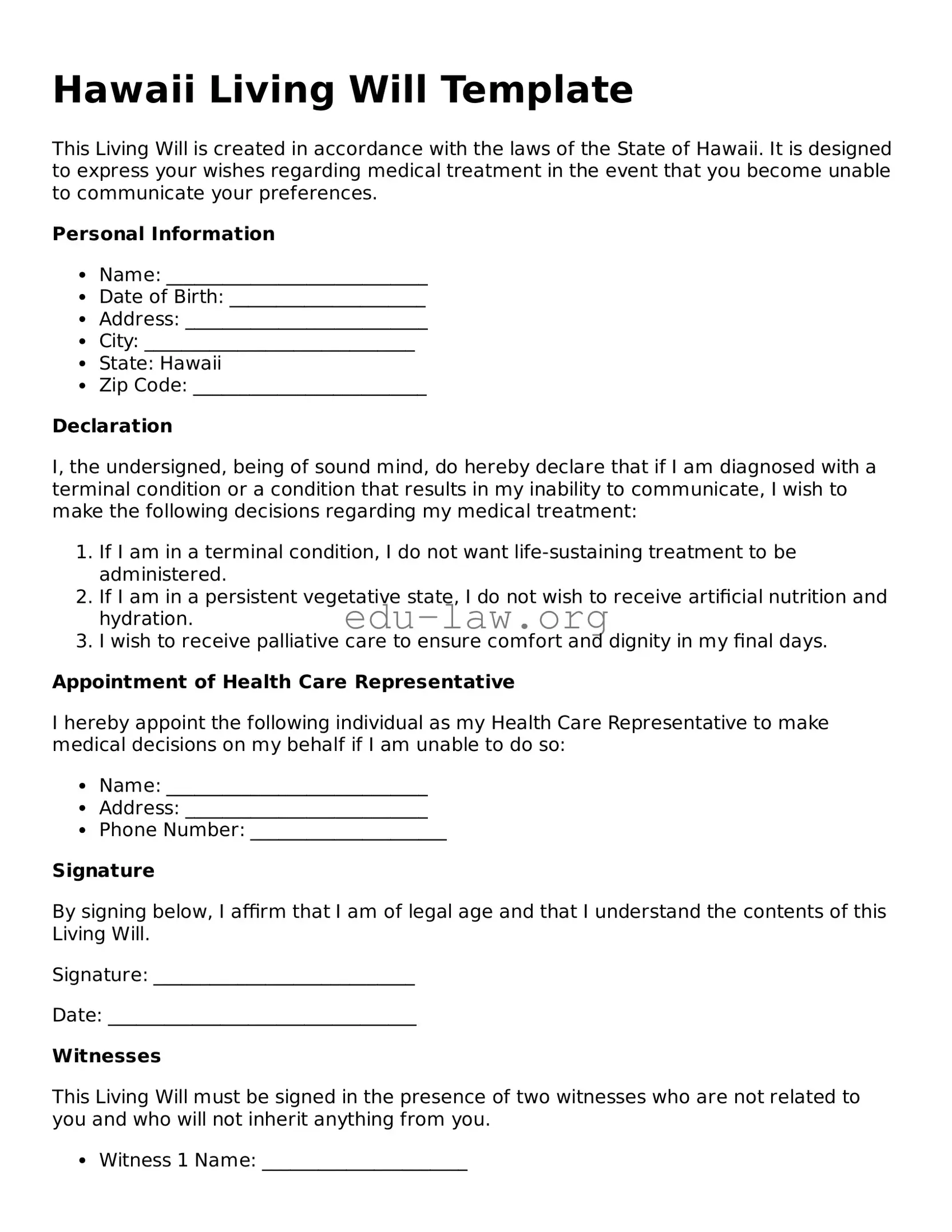
Hawaii Living Will Template
This Living Will is created in accordance with the laws of the State of Hawaii. It is designed to express your wishes regarding medical treatment in the event that you become unable to communicate your preferences.
Personal Information
Declaration
I, the undersigned, being of sound mind, do hereby declare that if I am diagnosed with a terminal condition or a condition that results in my inability to communicate, I wish to make the following decisions regarding my medical treatment:
Appointment of Health Care Representative
I hereby appoint the following individual as my Health Care Representative to make medical decisions on my behalf if I am unable to do so:
Signature
By signing below, I affirm that I am of legal age and that I understand the contents of this Living Will.
Signature: ____________________________
Date: _________________________________
Witnesses
This Living Will must be signed in the presence of two witnesses who are not related to you and who will not inherit anything from you.
This document reflects my wishes and is intended to guide my Health Care Representative and medical professionals in making decisions that align with my values and preferences.
| Fact Name | Description |
|---|---|
| Definition | A Hawaii Living Will is a legal document that allows individuals to outline their preferences for medical treatment in the event they become unable to communicate their wishes. |
| Governing Laws | The Hawaii Living Will is governed by Hawaii Revised Statutes, Chapter 327E. |
| Eligibility | Any adult resident of Hawaii can create a Living Will, provided they are of sound mind. |
| Witness Requirements | The document must be signed in the presence of two witnesses who are at least 18 years old and who are not related to the individual or beneficiaries. |
| Revocation | A Living Will can be revoked at any time by the individual, either verbally or in writing. |
| Advance Health Care Directive | The Living Will is part of a broader category known as Advance Health Care Directives, which may also include a durable power of attorney for health care. |
| Legal Effect | Healthcare providers are required to honor the wishes expressed in a Living Will as long as it complies with state laws. |
Filling out the Hawaii Living Will form is an important step in making your healthcare preferences known. This document allows you to express your wishes regarding medical treatment in the event that you are unable to communicate them yourself. Once you have completed the form, it is advisable to share it with your healthcare providers and family members to ensure everyone is aware of your decisions.
What is a Hawaii Living Will?
A Hawaii Living Will is a legal document that outlines your wishes regarding medical treatment in the event that you become unable to communicate your preferences. It specifies the types of medical interventions you do or do not want, particularly in end-of-life situations.
Who should create a Living Will?
Anyone over the age of 18 who wants to ensure their medical treatment preferences are respected should consider creating a Living Will. It is especially important for individuals with serious health conditions or those who want to make their wishes clear to family and healthcare providers.
How do I create a Living Will in Hawaii?
To create a Living Will in Hawaii, you can use a template or form that complies with state laws. You will need to fill out the document, sign it in the presence of two witnesses, and ensure that it is dated. It’s advisable to discuss your wishes with your healthcare provider and family members.
Do I need a lawyer to create a Living Will?
No, you do not need a lawyer to create a Living Will in Hawaii. However, consulting with a legal professional can provide guidance and ensure that your document meets all legal requirements and accurately reflects your wishes.
Can I change or revoke my Living Will?
Yes, you can change or revoke your Living Will at any time as long as you are mentally competent. To do this, simply create a new Living Will or write a statement indicating that you are revoking the previous one. Inform your healthcare providers and family members about the changes.
What happens if I do not have a Living Will?
If you do not have a Living Will, your healthcare providers will follow standard medical protocols and may rely on family members to make decisions on your behalf. This can lead to confusion and disagreements among family members about your wishes.
Is my Living Will valid in other states?
A Hawaii Living Will is generally recognized in other states, but laws can vary. It’s best to check the specific requirements of the state where you may be residing or receiving medical treatment to ensure your wishes are honored.
Where should I keep my Living Will?
Store your Living Will in a safe but accessible location. Inform your family members, healthcare providers, and anyone else involved in your care about where to find it. Consider giving copies to your healthcare proxy and trusted individuals to ensure your wishes are known.
Not understanding the purpose of the Living Will: Many individuals fill out the form without fully grasping its significance. A Living Will expresses a person's wishes regarding medical treatment in case they become unable to communicate their preferences.
Failing to discuss wishes with loved ones: It is crucial to have conversations with family members about healthcare preferences. Without this dialogue, loved ones may struggle to make decisions that align with the individual's desires.
Not being specific enough: General statements about wanting "everything done" or "no extraordinary measures" can lead to confusion. Clear and detailed instructions are essential for ensuring that medical personnel understand the person's wishes.
Overlooking the need for witnesses: In Hawaii, a Living Will must be signed in the presence of two witnesses. Failing to include witnesses can render the document invalid.
Not updating the document: Life circumstances and preferences can change. Regularly reviewing and updating the Living Will ensures that it accurately reflects current wishes.
Neglecting to designate a healthcare proxy: While a Living Will outlines medical preferences, designating a healthcare proxy can provide additional support. This individual can make decisions on behalf of the person if they cannot do so themselves.
Assuming the form is legally binding without proper execution: Simply filling out the form does not guarantee its legal standing. It must be signed and witnessed according to state requirements.
Using outdated forms: Laws and regulations can change. Utilizing an outdated version of the Living Will form may lead to complications or invalidation of the document.
Ignoring state-specific requirements: Each state has its own rules regarding Living Wills. Failing to comply with Hawaii's specific requirements can jeopardize the validity of the document.
Not storing the document in an accessible place: After completing the Living Will, it is vital to keep it in a location where family members or healthcare providers can easily access it. Hiding the document away defeats its purpose.
A Hawaii Living Will is a crucial document that outlines an individual's preferences regarding medical treatment in the event of incapacitation. However, it is often used in conjunction with several other important forms and documents that can provide a more comprehensive approach to healthcare and end-of-life decisions. Below is a list of these related documents.
These documents work together to create a clear and actionable plan for healthcare and end-of-life decisions. Having them in place can provide peace of mind for both individuals and their families, ensuring that personal wishes are respected and followed. It is advisable for individuals to consider these forms as part of a comprehensive approach to planning for their future healthcare needs.
The Hawaii Living Will form is similar to a Health Care Proxy. A Health Care Proxy allows individuals to appoint someone they trust to make medical decisions on their behalf if they become unable to do so. Like a Living Will, this document focuses on end-of-life care, ensuring that the appointed agent understands the individual's wishes regarding treatment options and interventions. Both documents emphasize the importance of clear communication about personal health care preferences, especially in critical situations.
Another document akin to the Hawaii Living Will is the Durable Power of Attorney for Health Care. This document grants authority to a designated person to make health care decisions for someone else. While a Living Will specifies the types of medical treatment an individual does or does not want, the Durable Power of Attorney allows the appointed agent to interpret those wishes and make decisions in real-time, providing flexibility in unforeseen circumstances.
The Advance Directive is also comparable to the Hawaii Living Will. An Advance Directive encompasses both a Living Will and a Health Care Proxy, serving as a comprehensive guide for medical decision-making. It outlines an individual's preferences for medical treatment and designates an agent to make decisions if necessary. This all-in-one approach simplifies the process for healthcare providers and loved ones during critical moments.
The Do Not Resuscitate (DNR) order shares similarities with the Living Will as well. A DNR order specifically instructs medical personnel not to perform cardiopulmonary resuscitation (CPR) in the event of cardiac arrest. While a Living Will covers a broader range of medical treatments, a DNR focuses solely on resuscitation efforts, making it a vital part of end-of-life planning for individuals who wish to avoid aggressive interventions.
The Physician Orders for Life-Sustaining Treatment (POLST) form is another document that aligns with the Hawaii Living Will. POLST is designed for individuals with serious health conditions and translates their treatment preferences into actionable medical orders. This form ensures that healthcare providers understand and respect the individual's wishes, similar to how a Living Will articulates preferences regarding life-sustaining treatments.
The Mental Health Advance Directive is similar in concept but focuses specifically on mental health care. This document allows individuals to outline their preferences for treatment in mental health crises. Like a Living Will, it serves to communicate personal values and wishes to healthcare providers, ensuring that the individual’s preferences are respected during challenging times.
The Organ Donation Authorization form also bears resemblance to the Hawaii Living Will. This document allows individuals to express their wishes regarding organ donation after death. While a Living Will addresses medical treatment preferences, the Organ Donation Authorization provides clarity on the individual's intentions concerning organ donation, thereby facilitating the decision-making process for family members and healthcare providers.
Lastly, the Estate Planning documents, such as a Last Will and Testament, share a connection with the Living Will. Although they primarily focus on the distribution of assets after death, they can include health care preferences and directives related to end-of-life decisions. Both types of documents emphasize the importance of planning for the future and ensuring that personal wishes are honored, whether in health care or estate matters.
When filling out the Hawaii Living Will form, it's important to approach the process with care. Here are some key do's and don'ts to keep in mind:
Many individuals hold misconceptions about the Hawaii Living Will form. Understanding these misconceptions can help clarify the purpose and function of this important document. Here are four common misunderstandings:
This is incorrect. A Living Will outlines a person's wishes regarding medical treatment in the event they become incapacitated, while a Last Will and Testament deals with the distribution of assets after death.
While many associate Living Wills with terminal conditions, they can also address situations where a person is in a persistent vegetative state or unable to communicate their wishes.
This is a misconception. Individuals can update or revoke their Living Will at any time, as long as they are mentally competent to do so.
This is not true. While Hawaii recognizes Living Wills, the legal requirements and enforceability may vary in other states. It's important to understand local laws.
Filling out a Living Will in Hawaii is an important step in ensuring that your healthcare preferences are honored. Here are some key takeaways to keep in mind:
By understanding these key points, you can ensure that your healthcare wishes are respected and that your loved ones are informed about your preferences.